Buyer Fit Snapshot
| Best fit | Custom Die Cut Stickers Bulk projects where brand print, material claims, artwork control, MOQ, and repeat-order consistency need to be specified before quoting. |
|---|---|
| Quote inputs | Share finished size, material target, print colors, finish, packing count, annual reorder estimate, ship-to region, and any compliance wording. |
| Proofing check | Approve dieline scale, logo placement, barcode or warning zones, color tolerance, closure strength, and carton packing before bulk production. |
| Main risk | Vague material claims, crowded artwork, missing packing details, or unclear freight terms can make a low unit price expensive after revisions. |
Fast answer: Custom Die Cut Stickers Bulk: Pricing, Specs, and Proofs should be specified like a repeatable production item. The safest quote records material, print method, finish, artwork proof, packing count, and reorder notes in one written spec.
Production checks before approval
Compare the actual filled-product size with the drawing, then confirm tolerance on folds, seals, hang holes, label areas, and retail display edges. Reserve space for logos, QR codes, warning copy, and material claims before decorative graphics fill the panel.
Quote comparison points
Review material grade, print process, finish, sampling route, tooling charges, carton quantity, and freight assumptions side by side. A quote is only useful when the supplier can repeat the same color, closure quality, and packing count on the next order.
Custom Die Cut stickers bulk orders usually make more sense than buyers expect once a brand is shipping in volume and every reprint starts looking like a line item with teeth. The savings are not just about the per-unit number. A larger run can also cut down on proof cycles, reduce batch variation, and keep the packaging story steady from the first carton to the last. That is a real operational benefit, not marketing fluff.
In packaging, stickers rarely live by themselves. They sit on mailers, cartons, retail bags, insert cards, and shipping kits, and they have to look right beside the rest of the printed material. The adhesive has to hold on the actual surface, not the sample on your desk. The finish has to work with the brand system instead of fighting it. That is why Custom Die Cut stickers bulk deserves the same level of thought as boxes, labels, and inserts.
There is also a simple math problem underneath the whole thing. The setup work is similar whether you order a few hundred pieces or several thousand. The proof still needs review. The contour still needs checking. The stock still needs to be printed and trimmed. Once those fixed steps are spread across a larger quantity, the economics shift in a pretty predictable way. If the artwork is stable and the sticker shape will be reused for launches, subscription boxes, or seasonal packaging, bulk orders can be the smarter move by a wide margin.
Over the years, I have seen plenty of teams start with a small run because it feels safe, then reorder again and again after the first campaign proves the design works. That approach is fine, but it often costs more time than people think. If the sticker is going to become part of the brand's regular packaging rhythm, it is worth planning it that way from the start. The sections below break down the details that matter most: shape, material, finish, specs, pricing, proofing, and how Custom Die Cut stickers bulk fits into a real production schedule without turning into a headache.
Custom die cut stickers bulk: why larger orders change the math
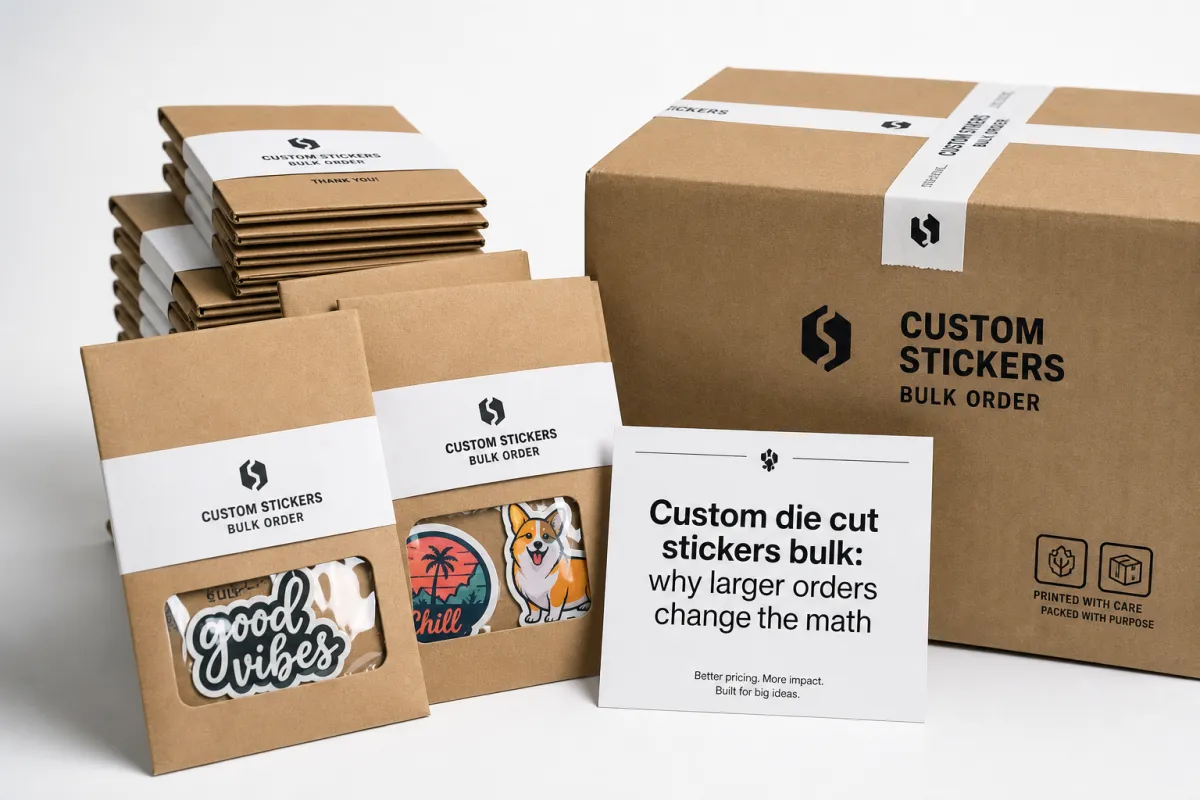
Die Cut Stickers are trimmed to the outline of the artwork instead of being left as a plain rectangle or circle. That contour becomes part of the design, which is one reason brands use them for packaging that needs a more finished, more intentional look. A shape that follows the logo can make the piece feel custom in a way that a standard label never quite does. A square label has its place, sure, but a die cut piece often carries more personality.
The cost structure shifts once the order gets large enough. Setup costs do not scale linearly with quantity, so the bigger run absorbs more of the prepress, proofing, die creation, and finishing effort. A 500-piece order can be perfectly reasonable, but a larger order often becomes easier to manage if the artwork is locked and the sticker shape will be reused across several packaging workflows. That is the quiet advantage of custom die cut stickers bulk: the per-piece price falls, and the operational friction often falls with it.
That matters most for brands that use the same sticker in more than one place. A subscription box team may apply the same mark to inner inserts and shipping cartons. A retail brand may use one shape for sample kits, display cartons, and seasonal mailers. A DTC brand may carry the same sticker across launch campaigns and refill orders. In each case, bulk planning keeps the visual language steady and reduces reorder drama. Nobody wants to scramble for a match three weeks before launch.
Consistency is another reason larger runs make sense. If the sticker appears on every shipment, even a small shift in color, finish, or cut placement becomes obvious fast. Bulk planning helps protect that consistency because the same proof, the same stock, and the same adhesive can carry through a larger inventory window. I have seen packaging teams save themselves a lot of cleanup just by approving the right construction once and sticking with it.
If the sticker is going on a mailer, carton, or poly bag, test the adhesive on the actual surface before you approve the order. That one step can save a lot of backtracking later.
For packaging teams that also buy Custom Labels & Tags, the sticker decision often turns into a broader packaging system decision. The same logo might stay in place, but the use case can move from inventory marking to branded presentation. The construction should match that job instead of asking one material to do everything.
When buyers compare custom die cut stickers bulk with smaller runs or generic formats, the savings are not always only in print cost. They can also show up in fewer art revisions, fewer emergency reorders, and fewer moments where a campaign stalls because the packaging team is waiting on a repeat production slot. That kind of stability is worth real money.
Product details: shapes, materials, and finishes
No sticker should be built the same way by default. The right setup depends on the surface, the environment, and the visual goal. For custom die cut stickers bulk, shape is usually the first decision because the contour drives the rest of the production plan. A simple logo outline is straightforward. A delicate script mark or a sticker with a lot of internal cutouts needs more careful handling, a cleaner proof review, and a little more room for tolerance.
Most buyers start with one of four common constructions:
- White vinyl for durable, versatile use on mailers, cartons, and everyday branded packaging.
- Paper stock for indoor use, short promotions, and lighter-duty applications.
- Clear film for a floating look where the package surface should show through.
- Weather-resistant or laminated options for heavier handling, moisture exposure, or longer life.
Finish matters almost as much as material. Matte gives a softer, less reflective look that reads as calm and controlled. Gloss pushes color harder and gives a surface that wipes clean more easily, which suits a lot of retail packaging. Specialty laminates are worth the extra spend when durability matters more than the lowest quote, especially on cartons and mailers that get handled a lot. For custom die cut stickers bulk, choosing the finish early keeps expectations aligned with the final result.
Adhesive choice deserves real attention. Permanent adhesive is usually the right fit for long-term placement on packaging and for most shipping applications. Removable adhesive works better for temporary promotions, event materials, or surfaces where you do not want residue or an aggressive hold. The surface itself matters too. A coated carton behaves differently than kraft paper. A smooth poly mailer behaves differently than a textured recycled mailer. Good custom die cut stickers bulk planning takes those differences seriously instead of hoping they sort themselves out.
Artwork complexity shapes the result as well. Thin strokes, tiny cut points, and intricate internal details can look beautiful on screen and still be a pain to cut cleanly at press speed. Production needs breathing room. If the logo has tight counters or sharp points, the contour may need a slight adjustment so the cut stays dependable and the sticker peels cleanly. That is one of those unglamorous details that separates a pretty mockup from a production-ready order.
I have had more than one project where the digital artwork looked polished, but the physical piece would have been trouble if we had sent it straight to press. That is normal, honestly. Screen design and print production do not always speak the same language. The job is to translate the design so it holds up in the real world, not just in the mockup.
For broader packaging context, the Institute of Packaging Professionals is a useful source for material and design thinking, and the ISTA framework is worth reviewing if the sticker will travel inside a shipping system that faces vibration, abrasion, or temperature swings. Those standards are not about making a sticker fancy. They are about making the whole package behave predictably.
If your brand needs a coordinated look across labels, inserts, and cartons, it usually makes more sense to think about the full system instead of one piece in isolation. That is where custom die cut stickers bulk can support the broader package branding strategy rather than sitting off to the side as a decorative extra.
Specifications that affect print quality and performance
Strong results start with clean specs. A buyer does not need to micromanage every setting, but the core production details should be clear before proof approval. For custom die cut stickers bulk, the important items are finished size, bleed, safe area, resolution, color mode, and whether the file includes a separate contour line for the cut.
Bleed matters especially on shaped stickers. A contour cut is never perfectly invisible, and a small bleed gives the printer room to trim without leaving a white edge around the art. A standard bleed of 0.125 inch is common in print workflows, though the exact requirement depends on the shape and the equipment involved. The tighter the contour, the more carefully that bleed has to be managed.
Safe area matters just as much. Type, fine lines, and important logos should sit inside the cut line with enough margin to avoid looking cramped. A safe margin of roughly 0.125 inch to 0.1875 inch is often sensible for simple shapes, but intricate outlines may need more breathing room. That is one reason custom die cut stickers bulk orders should never be approved from a tiny email thumbnail alone. A file can look fine on screen and still feel crowded once it is trimmed and applied.
Artwork format is another common issue. Vector files are the best choice for cut paths, clean lines, and smooth curves. AI, EPS, and vector PDF files usually produce the most reliable results because the cutter can follow the geometry precisely. High-resolution raster artwork can work for simple graphics, but the contour itself should still be vector-based. If the logo needs to look crisp on branded packaging, the file should be built to support that outcome from the start.
Color mode and resolution matter too. CMYK is the normal print mode for production, and 300 dpi is a good minimum for raster art at final size. If a design includes subtle gradients or deep blacks, the proof should be checked carefully because shaped cuts can make color shifts more noticeable at the edge. That is one reason experienced buyers of custom die cut stickers bulk ask for a digital proof before anything moves forward.
Usage-based specs can change the construction entirely. A sticker for indoor mailers may not need laminate. A sticker on a reusable shipping bag may need better abrasion resistance. A sticker on a hand-applied carton does not face the same stresses as one that runs through a machine-applied workflow. If the application is more demanding, the sticker spec should reflect that reality instead of relying on a generic setup.
Here is the simplest way to think about it: if the sticker is part of a low-touch brand insert, material and finish can lean toward appearance. If the sticker is part of a packaging surface that will be handled, stacked, or shipped, durability starts to matter more. custom die cut stickers bulk should be chosen for the real use case, not just for the rendering on the screen.
Pricing and MOQ for custom die cut stickers bulk
Bulk pricing usually follows a predictable pattern: the unit price drops as quantity rises. That sounds straightforward, but the quote is still shaped by the rest of the spec. Size, material, finish, cut complexity, print coverage, proofing needs, and any special packaging or kitting can all influence the final number. For custom die cut stickers bulk, the best quote is not just the cheapest one. It is the one that fits the actual application and keeps production predictable.
Minimum order quantities exist because setup work is real. The press still needs a file. The cutter still needs a contour. The finishing step still takes time whether the order is small or large. That is why larger quantities often represent the stronger value. A buyer ordering one campaign's worth of stickers may accept a higher unit cost. A buyer supporting monthly shipments, retail restocks, or seasonal packaging runs usually wants lower per-piece pricing and a cleaner reorder path.
For reference, here is a practical way many packaging buyers compare the main options for custom die cut stickers bulk:
| Material / Finish | Typical Use | Approximate Bulk Price Range | Notes |
|---|---|---|---|
| Paper stock, matte | Indoor mailers, short campaigns, light-duty branding | $0.06-$0.12 per unit | Lower cost, but less durable in moisture or heavy handling |
| White vinyl, matte | General branded packaging, cartons, inserts | $0.09-$0.18 per unit | Balanced choice for appearance and day-to-day use |
| White vinyl, gloss | Retail packaging, bright artwork, stronger color pop | $0.10-$0.20 per unit | More reflective finish, easy to wipe clean |
| Clear film | Transparent surfaces, modern package branding | $0.12-$0.24 per unit | Best when the package surface should show through |
| Laminated or weather-resistant | Higher handling, moisture exposure, longer life | $0.14-$0.28 per unit | Usually worth it when durability matters more than the lowest price |
Those ranges are not fixed promises, and they should not be treated that way. A 2-inch sticker with light coverage behaves very differently from a 4-inch contour-cut badge with dense artwork and a specialty laminate. Still, the table gives buyers a sensible frame for comparing custom die cut stickers bulk quotes without getting lost in vague language or sales talk.
Ask for the pricing breakpoints before you approve the order. A good quote should show what happens at 250, 500, 1,000, 2,500, and 5,000 pieces, or at whatever quantities fit the job. The quote should also show whether proof fees apply, whether shipping is separate, and whether rush handling changes the schedule. Those details matter more than a tiny difference in unit cost if the order has to land on a launch date.
There is another practical angle here: cost per use. If the sticker supports multiple campaigns, reorder simplicity can outweigh a slightly lower price from a one-off supplier. A reliable custom die cut stickers bulk program can save time, reduce spoilage, and keep branded packaging consistent across the entire shelf life of the design. That is the kind of savings that shows up quietly, then all at once.
For brands buying alongside Custom Packaging Products or planning annual volume with Wholesale Programs, the economics become even clearer. Once the sticker is part of a larger packaging system, the value shows up in fewer separate orders, fewer approval loops, and less risk of color drift between batches.
Process and timeline: from proof to production
A dependable production process should feel orderly, not mysterious. For custom die cut stickers bulk, the usual path is straightforward: submit artwork, confirm specs, receive a digital proof, approve the proof, move into production, and then pack and ship the completed order. Each step exists for a reason, and the proof stage is where the most expensive errors are usually caught.
Proofing deserves more attention than many buyers give it. It is the moment to check spelling, color intent, cut shape, adhesive assumptions, and size relationship against the actual packaging surface. A logo that looks right on a white screen can feel too small on a large corrugated shipper. A rich black that looks sharp in design software may print differently on paper stock than it does on vinyl. Projects using custom die cut stickers bulk stay smooth or get delayed right here. There is no elegant way around that.
The best proof review is practical, not emotional. Check the dieline, the bleed, the safe area, and the target surface before you approve anything.
Timeline depends on quantity and complexity. A straightforward repeat order with no artwork changes can move quickly. A highly detailed contour, a clear film build, or a special finishing requirement can add time. If a buyer has a product launch, seasonal drop, or event date tied to the order, the internal approval schedule should be built first, and the production timeline should fit around that, not the other way around.
As a rough planning guide, simple bulk sticker production often lands in the 12-15 business day range after proof approval, though faster or slower timing can happen based on artwork readiness, quantity, and finish selection. For custom die cut stickers bulk, the key variable is rarely the press itself; it is usually how quickly the proof is reviewed and signed off. That part is often the bottleneck.
Clear communication matters too. Buyers should expect plain language around file issues, cut-line concerns, or color adjustments. A production partner should not hide behind jargon. If a contour needs revision because the internal cut is too tight, that should be explained clearly. If the order needs a different adhesive for a coated carton, that should be said before the job enters the press queue.
That becomes even more important for teams managing several packaging SKUs at once. A sticker for a monthly box may share a schedule with inserts, sleeves, and shipper labels. In that kind of workflow, custom die cut stickers bulk are easiest to manage when each milestone is visible and each approval is documented. Predictability is the real advantage, and it is one of the few things that actually gets easier when the process is well managed.
Why choose Custom Logo Things for bulk sticker orders
Custom Logo Things is set up to think about stickers the way packaging teams do: as part of a larger production system, not as an isolated novelty item. That matters because the sticker has to work inside the actual workflow of product packaging, retail packaging, and branded packaging, where size, adhesion, finish, and reordering all affect the final result. For custom die cut stickers bulk, that practical lens is more useful than flashy promises.
Good support starts with artwork readiness. If a file has a contour issue, a weak bleed, or a type element sitting too close to the edge, it is better to catch it before production. That avoids reprints and keeps the approval process clean. The goal is to give buyers an order they can trust, not a stack of surprises they have to sort out after the fact. Nobody wants that kind of surprise, and frankly, it is usually avoidable.
The other benefit is consistency. Brands that place stickers on shipments month after month care about repeatability. They do not want one batch that leans warm and another that leans cool. They do not want one cut line that feels tight and another that feels loose. They want the same approved look to show up across every run. custom die cut stickers bulk are strongest when the supplier treats that consistency as a requirement, not a bonus.
That is why a packaging-focused supplier is often a better fit than a general print source for many buyers. A team that understands package branding can help decide whether the sticker should be matte or gloss, paper or vinyl, removable or permanent, simple contour or highly detailed cut. It can also point the buyer toward related items like Custom Labels & Tags or larger packaging sets when the sticker is only one part of the job.
There is a quiet advantage in keeping the process straightforward. Buyers do not want to spend half a day translating packaging goals into print terms. They want the order to move from quote to proof to production without unnecessary back-and-forth. A good bulk sticker partner shortens that path while still protecting the technical details that keep the order accurate.
For teams building out a broader line of Custom Packaging Products, this kind of support can help align stickers with mailers, cartons, inserts, and seasonal materials. That alignment is what makes the whole package look intentional instead of assembled piece by piece. And for buyers working through Wholesale Programs, repeatability and clear volume planning are usually worth more than a small price swing.
Honestly, the most useful supplier is the one that tells you the truth about fit. If the material is wrong for the surface, the adhesive will tell on you. If the art is too tight for the contour, the cutter will tell on you. If the finish does not match the packaging design, the shelf will tell on you. That is why custom die cut stickers bulk should be sold on technical fit first and price second.
Next steps for ordering custom die cut stickers bulk
If you are ready to place an order, the fastest path is to keep the decision set simple. Start with the artwork, then choose the intended surface, then decide on size and finish, and finally estimate the quantity based on the campaign or inventory window. Those four choices cover most of the important variables for custom die cut stickers bulk.
A useful pre-quote checklist looks like this:
- Confirm the final artwork file and make sure the contour line is clear.
- Identify the target surface, such as paper mailers, coated cartons, poly bags, or retail packaging.
- Choose the finish, with matte, gloss, or clear film based on the look and durability needed.
- Estimate the quantity needed for the full rollout, not just the first week.
- Set the delivery target so the proof and production schedule can match it.
That list sounds simple because it should be. The more complicated an order becomes, the more likely it is to stall in approvals or get quoted on the wrong assumptions. With custom die cut stickers bulk, clarity at the start saves time later.
Review the proof carefully before approval. Look at the cut shape first, then spelling, then color intent, then quantity. If there is any doubt about the surface or the adhesive, raise it before production starts. That is the fastest way to avoid delays and the most practical way to protect your packaging budget.
For brands that buy repeatedly, the smartest move is to save the approved spec sheet and keep the original proof on hand. That makes the next reorder faster and makes color consistency easier to preserve. Repeat orders are almost always smoother when the original construction is documented and the supplier can match it without guessing.
Once the pieces are in place, custom die cut stickers bulk stop being a procurement headache and start becoming a dependable packaging tool. The practical takeaway is simple: lock the artwork, confirm the surface, Choose the Right stock and finish, and keep the approved spec on file so the next run stays consistent without extra back-and-forth.
What is the minimum order for custom die cut stickers bulk?
Minimums depend on material, size, and cut complexity because setup work is similar whether the run is small or large. Bulk orders usually make the most sense when the stickers will be used across repeated shipments, retail packs, or event giveaways.
Are custom die cut stickers bulk orders suitable for packaging surfaces?
Yes, as long as the adhesive and material are matched to the surface, such as paper mailers, coated cartons, or flexible packaging. A good proof review should confirm size, finish, and cut shape before production starts.
How long does production usually take for custom die cut stickers bulk?
Turnaround depends on quantity, artwork readiness, and finishing requirements, but proof approval is usually the step that controls timing. Simple repeat orders often move faster than complex shapes or specialty materials.
What file format is best for a bulk die cut sticker order?
Vector artwork is preferred for sharp edges and accurate cut lines, while high-resolution raster files can work when the design is simple. The file should include clear bleed and a separate contour line if the cut follows a custom outline.
Can I reorder the same custom die cut stickers bulk run later?
Yes, repeat custom die cut stickers bulk runs are easier to reproduce when the original dieline, stock, finish, and proof are archived, and that usually keeps color and trim consistent from batch to batch.

