Buyer Fit Snapshot
| Best fit | Printed Adhesive Labels Wholesale projects where brand print, material claims, artwork control, MOQ, and repeat-order consistency need to be specified before quoting. |
|---|---|
| Quote inputs | Share finished size, material target, print colors, finish, packing count, annual reorder estimate, ship-to region, and any compliance wording. |
| Proofing check | Approve dieline scale, logo placement, barcode or warning zones, color tolerance, closure strength, and carton packing before bulk production. |
| Main risk | Vague material claims, crowded artwork, missing packing details, or unclear freight terms can make a low unit price expensive after revisions. |
Fast answer: Printed Adhesive Labels Wholesale: Specs, Pricing, Process should be specified like a repeatable production item. The safest quote records material, print method, finish, artwork proof, packing count, and reorder notes in one written spec.
Production checks before approval
Compare the actual filled-product size with the drawing, then confirm tolerance on folds, seals, hang holes, label areas, and retail display edges. Reserve space for logos, QR codes, warning copy, and material claims before decorative graphics fill the panel.
Quote comparison points
Review material grade, print process, finish, sampling route, tooling charges, carton quantity, and freight assumptions side by side. A quote is only useful when the supplier can repeat the same color, closure quality, and packing count on the next order.
One label size change can make an entire product line feel slightly off. The artwork may be crisp, the copy may be tuned, and the packaging still reads wrong if the label is 3 mm too short or the finish fights the container instead of sitting with it. I have seen a strong design lose shelf presence for that exact reason. That is why brands compare printed adhesive labels wholesale options so carefully before placing a bulk order.
From a packaging buyer’s point of view, printed adhesive labels wholesale is not about collecting samples for a nice-looking board and calling it progress. It is about keeping jars, cartons, bottles, mailers, and promotional packs consistent without paying retail pricing every time a reorder lands on your desk. The practical payoff is straightforward: lower unit cost, steadier color, fewer last-minute fixes, and less time spent trying to make mismatched packaging look deliberate. Usually, it does not look deliberate. It looks rushed.
For a launch, a replenishment cycle, or a multi-SKU line, the task is simple to describe and annoyingly detailed to execute: find printed adhesive labels wholesale that stick, print cleanly, arrive on time, and do not force a second round of corrections. The sections below break down the Specs, Pricing, and Process that actually matter once production starts moving.
Printed Adhesive Labels Wholesale: The Fastest Way to Standardize Packaging
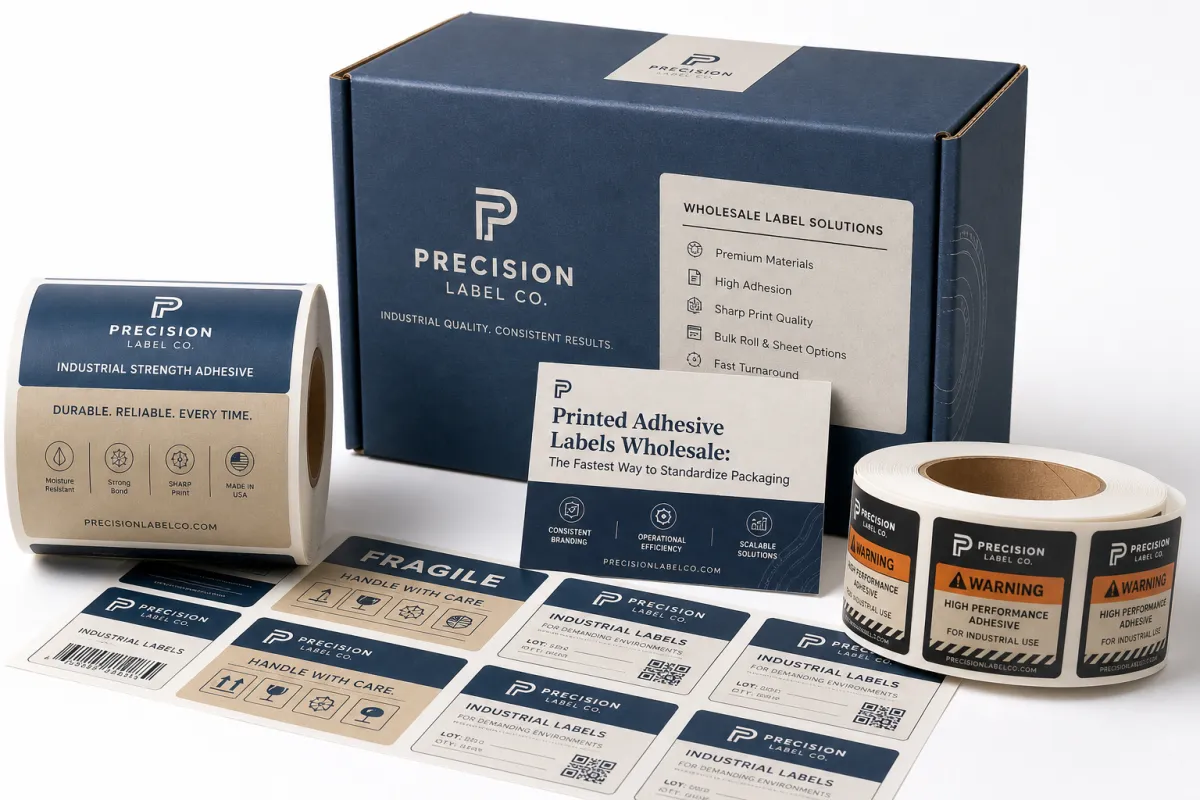
Printed adhesive labels wholesale gives a brand one baseline across every pack format it ships. That sounds ordinary until the first time a jar label, a bottle wrap, and a mailer seal all drift apart because they were sourced separately. Different paper thicknesses, different gloss levels, different inks. The line starts to look assembled from leftovers, even when each individual piece was approved in isolation.
Wholesale ordering helps prevent that drift because the same press setup, the same substrate, and the same color target can be reused across a run or repeated on later orders. For brands that need printed adhesive labels wholesale for beauty, food, beverage, supplements, or general retail packaging, that kind of consistency saves time in design and prevents headaches in production. It also lowers the risk that one SKU looks richer than another for no clear reason.
The useful part is not glamorous. It is the ordinary, steady stuff buyers care about: predictable pricing, fewer reorder surprises, and enough control to match a black brand mark from one batch to the next. Printed adhesive labels wholesale also gives you room to decide what matters most for the product. Maybe moisture resistance matters because the bottles sit in a chilled display. Maybe a removable adhesive fits a seasonal promotion. Maybe a matte paper label is all you need for corrugated mailers. Wholesale makes those tradeoffs easier to plan because you are comparing real specs instead of guessing from product photos.
There is a sales angle here, though it helps to keep it grounded. Buyers do not want a grand story about labels. They want something that sticks straight, prints sharp, and lands while the inventory window is still open. If the labels arrive late, the launch slips. If the color is off, the shelf display looks cheap. If the adhesive fails in a cold room, the whole order turns into expensive scrap.
That is why printed adhesive labels wholesale deserves a spec-first conversation. Before anyone starts talking about foil or decorative finishes, the use case needs to be clear: surface type, temperature, moisture exposure, application method, and pack shape. Once those are settled, the rest gets easier. Not easy. Easier.
Label Materials, Finishes, and Adhesives That Change the Result
Material choice affects more than appearance. It affects whether printed adhesive labels wholesale survives the trip from packing table to warehouse to customer hands. Paper still makes sense for dry goods, mailers, and short-use retail items. It prints cleanly, feels familiar, and keeps cost under control. BOPP and PP films handle moisture better, which is why they show up on bottles, bath products, and chilled items. Clear film works when the design needs a no-label look, but it only succeeds if the artwork has enough contrast to carry the information. Vinyl is tougher and more forgiving on curved or heavily handled surfaces. Textured stocks add a premium feel, though they are not the first choice for wet environments.
Finish changes the perception right away. Matte feels restrained and reads well under bright store lighting. Gloss makes color pop harder and can help saturated artwork look richer. Soft-touch adds a muted, tactile feel that some cosmetic and premium food brands like, but it does not rescue a weak layout. It only makes a bad layout feel more expensive, which is not the same thing. Metallic foil accents can help with shelf impact, but they need careful placement because small text on foil can lose legibility quickly. Printed adhesive labels wholesale should always start with readability, then move to finish.
Adhesive selection is where many orders go wrong. A standard permanent adhesive works for most cartons and dry retail packs. Removable adhesive suits promotions, temporary seals, and some container return programs. Freezer-safe adhesive is not the same as a standard cold-storage option, and oil-resistant adhesive matters for bath oils, lotions, and containers that are handled with product residue on the outside. High-tack adhesive helps on rough corrugated surfaces or lower-energy plastics where ordinary adhesives lift at the corners. If the container is curved, chilled, dusty, or slightly oily, do not assume a basic adhesive will behave. It will not.
For packaging buyers comparing printed adhesive labels wholesale across categories, the short version is simple: beauty products often need film stock and a clean finish, food labels often need moisture tolerance and barcode clarity, beverage labels often need stronger adhesion and condensation resistance, and supplement labels usually need dense information layout with good small-type readability. The face stock, finish, and adhesive need to work together. One good component does not save the others.
For brands sourcing from FSC-certified paper mills, it helps to check the chain-of-custody options available from FSC. For shipping durability and pack abuse, transit testing standards from ISTA are useful when labels are part of a larger packed system and need to survive real handling, not a polite desk test.
Printed adhesive labels wholesale only looks simple if you ignore the surface the label has to survive on. The adhesive does not care about your brand deck. It cares about temperature, dust, oil, and pressure.
Specifications That Matter: Size, Shape, Roll Format, and Print Quality
Before a quote makes sense, the buyer needs the working specs. Printed adhesive labels wholesale cannot be priced intelligently if the order only says “about 3 inches wide” and “something glossy.” That is how people end up with mismatched proofs and late revisions. The basic checklist is straightforward: exact dimensions, bleed, corner radius, die-cut shape, quantity, material, adhesive type, finish, roll or sheet format, and whether the labels will be applied by hand or by machine.
Size affects three things at once. First, it changes legibility. A label that is too small forces copy to shrink and barcodes to compete with branding. Second, it changes material efficiency. Some dimensions nest well on press sheets or web rolls, which lowers waste. Third, it changes application speed. On a manual packing line, a wider label may slow workers down if it is awkward to peel. On an automated line, roll direction and unwind position matter just as much as the art itself. Printed adhesive labels wholesale is full of these small decisions, and none of them disappear once production starts.
Artwork files deserve the same respect. A clean file reduces proofing time and avoids the familiar “why is the logo soft?” conversation. Use vector artwork where possible, keep raster images at 300 dpi or higher at final size, and build in a safe area so text does not sit too close to the trim. CMYK is the normal print path for most jobs, but spot colors or white ink may be needed for transparent stock. Barcode content should be checked carefully, because tiny type and poor quiet zones cause avoidable scanning failures. That is not a design issue. It is a production problem that starts with weak setup.
Roll format matters more than many first-time buyers expect. A standard roll label order may need a specific core size, often 1 inch or 3 inches, depending on dispenser compatibility. The unwind direction must match how the label is applied, and label count per roll affects changeover time on the line. If you are ordering printed adhesive labels wholesale for a semi-automatic applicator, ask for machine specs before you approve the die line. Fixing roll direction after production is a reliable way to burn time you do not have.
For manual packers, sheeted labels can be easier to manage in smaller quantities. For faster throughput, rolls are usually the better call. Die-cut shapes cost more than simple rectangles because they require a custom tool, but the visibility gain can be worth it if the packaging lives in a crowded retail space. Printed adhesive labels wholesale should balance all of that: legibility, price efficiency, and operational fit.
Buyers do not need a label that “does everything.” They need the right label for the surface, the run size, and the packing method. Anything else is just expensive optimism.
Printed Adhesive Labels Wholesale Pricing, MOQ, and Unit Cost
Pricing for printed adhesive labels wholesale is driven by a few familiar levers. Material choice matters first. Finish matters next. Then size, shape, print coverage, number of colors, special inks, label count per roll, and total quantity. If a quote feels scattered, it usually means one of those variables changed and nobody wrote it down clearly. That is not flexible pricing. That is a quoting problem.
MOQ mostly follows setup logic. The press needs setup, the cutter needs setup, the proof has to be checked, and the run has to be packed. When those costs are spread across a small quantity, unit price climbs. With printed adhesive labels wholesale, lower volumes can still make sense if you need testing, seasonal SKUs, or a short launch window. Buyers should still understand the math. A 1,000-piece order often costs far more per label than 10,000 pieces, even when the artwork stays the same.
Here is a practical pricing range for common wholesale label orders. These are typical ballpark figures for standard digital or flexo-style production, and they shift with coverage, substrate, and finish. If someone quotes far outside these bands, ask why before you celebrate or panic.
| Option | Typical Use | Approx. Unit Cost at 5,000 | Notes |
|---|---|---|---|
| Matte paper, simple rectangle | Dry goods, mailers, lightweight retail packs | $0.05-$0.10 | Lowest-cost path for straightforward printed adhesive labels wholesale orders |
| Gloss BOPP, die-cut shape | Bottles, jars, packaged food, general retail | $0.08-$0.16 | Better moisture resistance and stronger shelf presence |
| Clear film with white ink | Premium cosmetic or beverage packs | $0.10-$0.20 | White ink adds cost, but clear labels can elevate the design if the artwork is built correctly |
| Vinyl or high-tack stock | Curved, rough, or harder-to-stick surfaces | $0.12-$0.24 | Useful when adhesion matters more than paper feel |
| Textured stock with foil accent | Premium product lines and gift packaging | $0.15-$0.35 | Looks good when used with restraint; gets expensive quickly if coverage is heavy |
Volume breaks are where buyers can save real money. A rough pattern for printed adhesive labels wholesale might look like this: 1,000 pieces at $0.22-$0.48 each, 5,000 pieces at $0.08-$0.22, 10,000 pieces at $0.05-$0.14, and 50,000 pieces at $0.03-$0.08. That does not mean every quote follows that exact curve, but it gives you a useful sense of how setup cost gets diluted. The label size, die shape, and finish still matter. Of course they do.
MOQ expectations vary. Simple sheet labels may start at a few hundred pieces. Roll labels with standard stock often start around 500 to 1,000 pieces. Custom die-cut printed adhesive labels wholesale with specialty finishes may need 1,000 to 2,500 pieces or more, depending on production method and material availability. If you need multiple SKUs, each one may carry its own setup or minimum. That is normal. It is also why buyers should quote the full program instead of one hero SKU and guessing at the rest.
Watch the hidden costs. Rush fees can add up quickly. New dies cost money. Color changes across SKUs can increase setup time. Proof revisions can slow the job and sometimes add cost if artwork shifts after approval. Shipping matters too, especially for heavy roll orders. A cheap label quote that doubles in freight is not cheap. It is just bad math dressed up as a deal.
A solid quote checklist for printed adhesive labels wholesale should include: exact dimensions, material, finish, adhesive type, quantity, roll or sheet format, core size, unwind direction, proof expectations, shipping method, and whether artwork changes are allowed after approval. Compare every vendor on the same basis. If the specs differ, the price comparison is fake.
Printed Adhesive Labels Wholesale Process, Timeline, and Lead Time
The process for printed adhesive labels wholesale usually starts with a spec review, and that step saves the most trouble later. A good supplier will ask questions that seem tedious but are actually useful: what surface is the label going on, will it face moisture or refrigeration, what format is the artwork in, and do you need rolls or sheets. If those questions are skipped, the proof becomes the first place problems show up. That is the expensive place to find them.
The normal workflow looks like this: inquiry, quote, artwork check, proof, approval, production, finishing, and shipment. Each step has a failure point. Missing dielines cause layout errors. Low-resolution files make logos soft. Barcode issues show up late if nobody checked the quiet zones. Color corrections take time. And the biggest delay of all is usually waiting on proof approval from someone who is busy and not thinking about labels every minute of the day.
Turnaround depends on complexity. Simple repeat printed adhesive labels wholesale orders can move in 7 to 12 business days after proof approval if the spec is settled and materials are in stock. Custom die-cut jobs, specialty finishes, foil accents, or multi-SKU programs often need 12 to 18 business days, sometimes more if the artwork is still changing. Rush orders may be possible, but rush and revision do not belong together. Pick one.
If you need labels for a seasonal launch or a replenishment cycle, build backwards from the application date, not the order date. You need time for proofing, shipping, receiving, and actual packing. Printed adhesive labels wholesale often looks “fast” until someone remembers that boxes have to be built, filled, and staged before the labels go on.
There are a few ways to shorten lead time without making the job sloppy. Send final artwork early. Confirm material and adhesive before the quote is issued. Keep revisions tight and limited to real fixes. Approve proofs quickly. If you have multiple SKUs, group them so the supplier can plan the press schedule efficiently. And if a sample test is needed for a curved bottle, refrigerated jar, or rough carton, do that before the full run. It is cheaper to test 100 labels than to explain a failure on 10,000.
For shipping-heavy programs, it helps to think beyond the label itself. If the packaging must survive distribution, handling standards like ISTA are worth referencing early. A label that survives a gentle handoff is not necessarily a label that survives a warehouse and parcel network. That is why printed adhesive labels wholesale should be reviewed in the context of the full pack-out, not in isolation.
Simple rule: if the surface is tricky, if the artwork has tiny type, or if there are multiple SKUs, give yourself more lead time than you think you need. It is usually not the printer that causes the delay. It is the version that arrived “final” after three more rounds of edits. That part is almost never a surprise to anyone who has been through a few launches.
Why Choose Us for Printed Adhesive Labels Wholesale
Brands come back for printed adhesive labels wholesale when the quote is clear, the spec guidance is honest, and the labels show up ready to use. That sounds basic because it is basic. Yet a surprising number of suppliers make quoting confusing on purpose or by accident, which is usually worse. You should know what the order costs, what it needs, and what it will look like before production starts.
At Custom Logo Things, the value is practical. We help buyers Choose the Right mix of material, finish, adhesive, and format so the order fits the product instead of forcing the product to adapt to the label. If you need Custom Labels & Tags for product packaging, secondary branding, or matching tag sets, we can keep the look aligned across the line. If your buying pattern is recurring, our Wholesale Programs are built for repeat orders and tighter planning.
That matters because printed adhesive labels wholesale is rarely a one-and-done purchase. Most buyers reorder. They expand into a second SKU. They test a new size. They move from one bottle shape to another. The best supplier is the one who remembers the spec history, keeps the print consistent, and does not force you to explain the whole brand story every time you need a quote. Nobody has time for that.
Communication matters just as much as print quality. When artwork needs a correction, you want a straight answer. When the adhesive choice is not right for condensation, you want to hear it before the press runs. When the lead time changes because of a special finish or a custom tool, you want to know early enough to adjust the launch plan. Printed adhesive labels wholesale should reduce uncertainty, not create a scavenger hunt.
We also keep the buying conversation grounded in cost and performance. A higher-end finish only makes sense if it improves shelf presence or the handling experience enough to justify the spend. A premium label on a low-margin product can be a bad trade. A plain label on a premium item can be equally wrong. The job is to find the balance that fits the SKU, not to pile on features because they sound impressive.
Here is the part most buyers appreciate after the fact: better guidance up front usually means fewer surprises later. Fewer surprises means fewer revisions, fewer reworks, and fewer late-night messages about labels that peel at the edge or arrive in the wrong format. Printed adhesive labels wholesale should feel controlled. Not dramatic. Controlled.
What to Do Before You Order
Start with the basics and write them down. Size, shape, quantity, substrate, adhesive type, finish, and whether the labels need to come on rolls or sheets. That is the minimum. If you already know the dispenser core size, unwind direction, or application method, add that too. Printed adhesive labels wholesale gets easier when the quote starts from complete information instead of guesswork.
Gather the files that keep the timeline moving. Final artwork helps. A dieline helps even more. Barcode data should be clean and verified. If your brand has fixed color references, send those. If there is a previous label version that worked well, include it. Buyers who send the full spec sheet up front usually get faster quotes and fewer proof cycles. Buyers who send “we need something like this, sort of” usually get a longer thread. That is not a mystery.
Compare quotes on the same basis. Do not compare one supplier’s 1,000-piece roll quote to another supplier’s 5,000-piece sheet quote and pretend the numbers mean anything. Ask for pricing at several volume points if you think the order may grow. For printed adhesive labels wholesale, those breakpoints tell you where the best value sits and where setup costs stop hurting so much. If one quote looks better but the adhesive, finish, or lead time is weaker, you are not looking at a better deal. You are looking at a cheaper problem.
Think about use conditions before you approve the final proof. Will the label touch condensation? Will the product sit in a fridge? Is the container curved? Will workers apply the label by hand or with a machine? Does the surface pick up dust or oil? A few minutes spent answering those questions can save a full batch from curling, lifting, or scuffing. Printed adhesive labels wholesale is one of those purchases where the right question matters more than a prettier mockup.
A simple next-step plan usually works best:
- Lock the spec sheet.
- Send artwork and quantity targets.
- Review the proof with barcode and color checks.
- Confirm delivery timing against your packing schedule.
- Approve production only after the final details match.
If you need printed adhesive labels wholesale for a launch, a restock, or a multi-SKU program, the cleanest path is to send the full spec sheet first. That keeps the quote accurate, the proof accurate, and the production plan honest. Which is refreshingly rare.
What affects printed adhesive labels wholesale pricing the most?
Material choice and finish usually move the price more than the artwork itself. Higher quantities reduce unit cost because setup is spread across more labels. Complex shapes, special inks, and rush delivery add cost fast, so printed adhesive labels wholesale quotes should always be compared with the same specs.
What is a common MOQ for printed adhesive labels wholesale?
MOQ depends on size, stock, and whether the labels are cut sheets or rolls. Simple repeat jobs can start lower, while custom die-cut printed adhesive labels wholesale orders often need a higher minimum. Ask for pricing at several volumes so you can see the break points clearly instead of guessing.
How long does printed adhesive labels wholesale production usually take?
Simple orders move faster than custom shapes, specialty finishes, or multi-SKU projects. Artwork approval is the biggest variable; slow proofs slow everything. A realistic timeline for printed adhesive labels wholesale should include proofing, production, finishing, and shipping, not just the press time.
Can printed adhesive labels wholesale be made for curved or cold surfaces?
Yes, but the adhesive and face stock need to match the surface. Curved bottles, refrigerated items, and oily packaging often need stronger adhesive options. Test samples are worth it when printed adhesive labels wholesale must hold in tough conditions, because guessing is a very expensive hobby.
What files do I need for a printed adhesive labels wholesale quote?
Send final dimensions, quantity, material preference, and finish if you already know it. Include artwork files, dielines, and barcode data when available. The clearer the spec sheet, the faster the quote and proof process for printed adhesive labels wholesale, and the fewer surprises you will have later.
Practical takeaway: treat printed adhesive labels wholesale like a production decision, not a design afterthought. Lock the material, adhesive, size, and application method first, then test the proof on the actual container before approving the full run. That one habit catches most of the problems that turn a clean label order into an expensive reprint.


