Buyer Fit Snapshot
| Best fit | Printed Apparel Bags Bulk Order projects where brand print, material claims, artwork control, MOQ, and repeat-order consistency need to be specified before quoting. |
|---|---|
| Quote inputs | Share finished size, material target, print colors, finish, packing count, annual reorder estimate, ship-to region, and any compliance wording. |
| Proofing check | Approve dieline scale, logo placement, barcode or warning zones, color tolerance, closure strength, and carton packing before bulk production. |
| Main risk | Vague material claims, crowded artwork, missing packing details, or unclear freight terms can make a low unit price expensive after revisions. |
Fast answer: Printed Apparel Bags Bulk Order: Specs, Pricing, Timing should be specified like a repeatable production item. The safest quote records material, print method, finish, artwork proof, packing count, and reorder notes in one written spec.
Production checks before approval
Compare the actual filled-product size with the drawing, then confirm tolerance on folds, seals, hang holes, label areas, and retail display edges. Reserve space for logos, QR codes, warning copy, and material claims before decorative graphics fill the panel.
Quote comparison points
Review material grade, print process, finish, sampling route, tooling charges, carton quantity, and freight assumptions side by side. A quote is only useful when the supplier can repeat the same color, closure quality, and packing count on the next order.
A printed apparel bags bulk order needs to do more than carry folded clothes from point A to point B. It has to fit the garment cleanly, print the way the brand expects, and survive real handling in stores, stockrooms, and shipping lanes. That sounds basic. It is not. A bag that looks fine on a mockup and fails in a back room is just expensive optimism.
Bulk ordering solves a lot of headaches if the spec is set correctly. Unit cost usually drops as quantity rises, print stays consistent across the run, and the team stops scrambling for replacement bags every time sales spike or a launch date moves. That is the part buyers care about. Less friction, fewer emergencies, fewer awkward conversations about why the packaging ran out before the product did.
For Custom Logo Things, the real job is to match the bag style, material, and print method to how the apparel is actually packed and handed off. Not how it looks on a mood board. How it gets used by a cashier, a warehouse picker, or a customer who is already juggling three shopping bags and a receipt.
Why Printed Apparel Bags Bulk Order Pays Off Fast
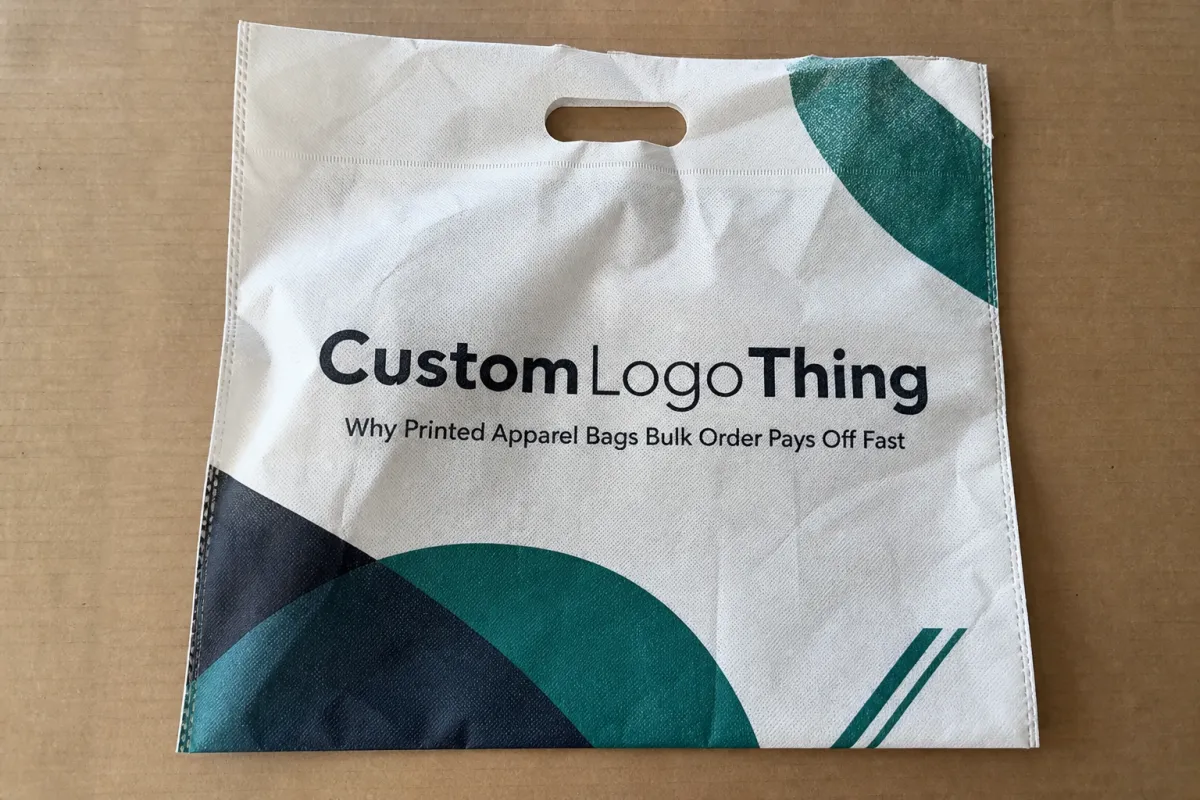
A strong apparel bag keeps working after the purchase. Customers reuse it, carry it around town, stash it in a closet, or notice the brand again when they pull it out later. That makes packaging part of the product experience, not a throwaway layer of plastic or paper.
The economics make sense once the order gets past sample stage. Setup costs hit hardest on small runs. A larger printed apparel bags bulk order spreads those costs across more units, which usually improves the landed cost per bag. It also gives the buyer room to build real inventory instead of placing last-minute rush orders that burn budget on freight.
Consistency matters just as much as cost. One store using a different size, one warehouse packing from a different supplier, or one buyer approving a slightly changed print spec can create a mess that is hard to spot until the bags are already in use. A single approved run gives the team one reference point, one print standard, and one replenishment plan.
The bag is not just holding apparel. It keeps folded items neat, prevents scuffing, supports bundled sets, and makes the handoff feel deliberate. That matters for giftable merchandise, premium basics, outerwear, and multi-piece outfits where presentation changes the perceived value.
“Cheap packaging is only cheap when it works. Once it creases the product, prints crooked, or shows up late, the savings disappear fast.”
The first decision should be about use case. A retail carry bag, a poly mailer, and a garment bag are not interchangeable just because they all have a logo on them. Material, closure style, print coverage, and finishing all change the outcome. Pick the wrong format and the product may arrive protected, but the presentation will feel off. Or worse, the bag will fail the first time someone grabs it by the handle.
Bulk ordering also makes forecasting less painful. Replenishment becomes easier to track. Safety stock becomes easier to set. And packaging can be tied to product launches instead of being ordered after inventory is already moving. That is the boring part of the job. It is also the part that saves real money.
Choosing the Right Printed Apparel Bag Style for Bulk Orders
The right bag style starts with where it will be used, not where the logo lands. A boutique checkout bag has different requirements than an e-commerce shipper. A premium sweater set does not need the same construction as a stack of basic tees. A printed apparel bag should fit inside the packaging system, not sit outside it as a decorative afterthought.
Paper shopping bags
Paper Shopping Bags are still one of the most common retail choices because they feel familiar and present well. They can be produced in different paper weights, handle styles, and finishes, which gives buyers some flexibility. Kraft paper brings a natural, understated look. Coated paper or heavier printed stock moves the bag toward a more polished retail presentation.
For folded apparel, accessories, and in-store purchases, paper bags are often a good fit. They stack reasonably well, display branding clearly, and work especially well when the product does not need moisture protection. They are not the answer for every channel, though. If the garment has to travel through rain, packing tape, or a rough parcel network, paper may not be the smartest choice.
Poly mailers and film-based bags
Poly mailers usually make more sense for outbound e-commerce, especially when moisture resistance, tear resistance, and shipping efficiency matter. They are light, easy to store in quantity, and less expensive to ship than heavier paper structures. For apparel that does not need a luxury retail feel but does need reliable transit protection, this is usually the practical choice.
There is a tradeoff. Poly mailers are functional, but they do not read as premium retail packaging. If the package is opening in a store, a studio, or a gift purchase, that utilitarian feel may be a problem. If the package is getting sorted on a conveyor belt and dropped into a parcel network, nobody is losing sleep over elegance.
Garment bags and specialty retail bags
Garment bags, sealed retail sleeves, and other specialty formats are built for protection and presentation at the same time. They work well for jackets, formalwear, higher-value clothing, and multi-piece sets. If the apparel has to stay smooth, dust-free, or neatly contained, this style often makes more sense than a standard shopping bag.
These formats can also support brand positioning. A structured garment bag sends a different message than a thin mailer. That matters for premium labels, occasionwear, and seasonal launches where the package needs to justify the price before the customer even opens it.
Tote-style carry bags
Tote-style bags matter when reusability is part of the plan. They can strengthen the in-store experience, especially for premium brands or promotions where the bag itself adds value. Reinforced handles, heavier material, and stronger print coverage push the bag toward durability. They also push cost and freight weight upward. Physics is rude that way.
These bags can be worth it for repeat use, events, or loyalty programs. They are not automatically better just because they are reusable. If the bag is oversized, flimsy, or badly printed, it becomes clutter with handles.
Surface finish affects perception faster than many buyers expect. Matte feels restrained and modern. Gloss reflects more light and gives the artwork extra punch. Soft-touch creates a velvety hand feel that suits premium positioning, although it usually costs more and can show scuffs differently. Kraft signals texture and practicality. Clear film keeps the contents visible while still offering protection.
Storage deserves attention too. Some bags fold flat and stack cleanly. Others need more careful handling because of handle shape, gussets, or sensitive finishes. In a warehouse, a bag that stores efficiently can save time every day. At retail, a bag that opens without fuss keeps the line moving.
If the bag has to work in both retail and fulfillment, one format may not cover everything. A paper shopping bag can look better on the sales floor, while a poly mailer can win on shipping efficiency. Many programs use both. Same artwork. Different jobs. That is usually smarter than pretending one bag can fix two different problems.
Specifications That Matter for Printed Apparel Bags
Lock the spec sheet before asking for quotes. A buyer who sends only a logo and an approximate size usually gets slower responses, more revisions, and a wider price spread. A buyer who sends finished dimensions, quantity tiers, material preference, and print expectations gets a cleaner proof process and fewer surprises later.
Finished size is the first spec to confirm. Too small, and the garment creases or catches at the edges. Too large, and the product floats inside the bag like it was packed by someone who gave up halfway through. The right size keeps the item secure without making the package look sloppy.
Structure comes next. For paper bags, that means paper weight, gusset depth, handle type, and whether reinforcement is needed around the top edge or handle attachment. For film-based bags, thickness, seal type, and closure method matter more. Those details decide how the bag carries, how it stacks, and how it behaves when the customer actually uses it.
Print specifications need the same level of detail. A one-color logo on kraft is a very different production job from a full-coverage, multi-color design that wraps around folds or sits close to a seam. Buyers should confirm color counts, imprint area, and placement early. If the artwork crosses a fold or lands too close to a handle, the proof should show that before production starts.
Good artwork files make a difference too. Vector files are easier to reproduce cleanly. Raster files can work, but only if the resolution holds up at the final print size. PMS color targets help when brand color has to stay consistent from one run to the next. If the brand already uses a color standard, send it. Guessing at color is how gray turns into a fight.
Ink and finish choices also affect durability. Coatings can change how the artwork looks under store lighting. Lamination can improve scuff resistance and add stiffness, but it may change the hand feel and can complicate recycling depending on the construction. That does not make it bad. It just means the buyer should choose the finish with both appearance and disposal in mind.
Packaging extras belong in the brief as well. Tissue paper, inserts, stickers, hang tags, barcode labels, and bundle counts all affect the dieline and the pack-out method. If the apparel is being kitted into sets, the bag should be designed around the full contents, not just the base garment. Otherwise the team ends up forcing a square product into a round box and calling it a process.
For buyers who want a broader view of packaging materials and operations, the Packaging Machinery Manufacturers Institute has useful reference material at packaging.org. For transit and distribution concerns, the testing and handling guidance at ista.org is a solid reference point when the bag is part of a larger fulfillment workflow.
| Bag Type | Best Use | Typical Strengths | Common Tradeoffs |
|---|---|---|---|
| Kraft paper shopping bag | Retail handoff, folded apparel, boutique presentation | Natural look, good print surface, easy to brand | Less moisture resistance than film, can crush if overloaded |
| Coated paper bag | Premium retail, gift presentation, stronger visual impact | Cleaner color reproduction, more polished finish | Usually higher cost than plain kraft |
| Poly mailer | E-commerce shipping, lightweight apparel, repeat fulfillment | Low weight, moisture resistance, efficient storage | Less retail feel, surface texture is more utilitarian |
| Garment bag | Formalwear, premium apparel, protected presentation | Dust protection, neat appearance, strong brand impression | Can be bulkier and more expensive per unit |
| Tote-style carry bag | Reusable retail packaging, promotions, higher perceived value | Durable feel, repeat use, strong brand visibility | Higher material and freight cost, more storage space |
One more detail deserves attention: check whether the artwork needs to align with a folded edge, seam, or handle zone. That changes both visibility and production setup. A good proof should show the design in context, not just floating in empty space like it wandered out of the room.
Printed Apparel Bags Bulk Order: Cost, MOQ, and Quote Factors
The biggest price drivers are usually obvious once the spec sheet is complete. Size, material, print complexity, handle construction, finish, and total quantity all matter. Two orders that both say “custom apparel bags” can land at very different price points because the production requirements are not the same.
MOQ, or minimum order quantity, changes with construction and print method. A straightforward paper bag may carry a lower threshold than a more customized structure with special finishes, detailed print coverage, or reinforced hardware. Buyers should expect different minimums for different formats instead of assuming one universal number will fit every program.
Tiered pricing is worth asking for. If 2,500 units only cost a little more per unit than 1,500, the larger run may deliver a better landed cost once setup is included. The real question is not just “What is the cheapest unit?” It is “What quantity gives the best balance of cost, storage, and replenishment coverage?”
For a clean comparison, the quote should separate at least four pieces: product cost, print setup, freight, and any special handling or finishing. That breakdown gives the buyer a fair way to compare offers. A low headline number can look great right up until shipping, setup, or rush charges show up underneath it.
Speed changes price too. If the order has to move faster than the standard schedule, or if it needs split shipments to multiple locations, the cost usually climbs. That does not make rush options bad. It just means the buyer should understand the tradeoff before approving the order. A slightly higher unit price can still be the smarter move if it prevents a stockout during launch.
Storage and receiving should also be part of the cost picture. A bulk run that arrives in one facility may be cheaper to manage than the same order split across three warehouses. If storage space is tight, a slightly smaller order may be better even if the unit price is a bit higher. Landed cost is not only about what is on the invoice. It is also about what the team has to do after the boxes arrive.
Here is a practical way to compare common order factors:
| Order Factor | Effect on Price | What to Ask |
|---|---|---|
| Higher quantity | Usually lowers per-unit cost | Ask for pricing at two or three volume tiers |
| More print colors | Raises setup and production complexity | Confirm whether spot colors or simplified artwork can reduce cost |
| Special finish | Can add material and processing cost | Compare matte, gloss, and soft-touch by landed cost |
| Custom size | May require special tooling or longer lead time | Ask whether standard dimensions fit the product without weakening presentation |
| Split shipment | Often increases freight and handling cost | Confirm whether staging inventory in one location is more efficient |
Buyers often obsess over unit price and ignore the cost of poor planning. A late order can force air freight. An undersized bag can trigger repacking. A mismatched print can require rework. That is how a cheap quote turns into an expensive mistake.
If sourcing responsibility matters to your team, the Forest Stewardship Council provides useful information about certified materials at fsc.org. That can help brands document paper sourcing preferences and answer supplier questionnaires without guessing.
Process and Timeline for Printed Apparel Bags Bulk Order
A clean production process usually follows the same path: brief, specification review, artwork check, proof approval, material confirmation, manufacturing, inspection, packing, and freight scheduling. Strong information at the start saves time later. Weak information creates email chains, extra revisions, and the sort of calendar drift that ruins launch planning.
The fastest timelines come from complete inputs. If the supplier receives finished dimensions, quantity options, print colors, artwork files, and the ship-to address up front, quoting and proofing move faster. If the order is still debating bag type or logo version, every revision adds time. That part never gets more elegant than it sounds.
Delays usually come from the same few places. Missing dielines. Unclear color expectations. A last-minute switch from matte to gloss. A handle change after proof approval. A buyer who is still changing quantities while the production slot is sitting open. All manageable. All easier to avoid.
Timeline planning should include proof time, production time, and transit time. A quote that sounds fast is not truly fast if the artwork still needs correction or the bags have to cross a long freight lane before they arrive. Even a repeat order needs enough room for approval and shipping.
A realistic schedule depends on order size, print complexity, and destination. A simple repeat run with no artwork changes usually moves faster than a first-time custom order with multiple colors and a specialty finish. Either way, leave room for proof review and freight variability instead of assuming the calendar will cooperate because the sales team asked nicely.
Milestone checks help. Ask when the digital proof will be issued, when the production slot is reserved, and when the finished bags are expected to leave the facility. That makes it easier to coordinate packaging with a product launch, store reset, or fulfillment wave.
It also helps to keep a record of approved specs and artwork versions. Future restocks can then use the same approved configuration instead of starting over every time. If your team needs a recurring buying path, the Wholesale Programs page can be a useful starting point, and the FAQ page covers common order questions before a quote is requested.
Why Custom Logo Things Fits Bulk Apparel Bag Programs
A packaging supplier should do more than drop a logo onto a blank bag. It should help turn a brand idea into a production-ready spec that works in the real world. That means print clarity, dimension control, finishing, and a clear picture of how the bag will be used once it reaches the store, warehouse, or fulfillment team.
Custom Logo Things is set up for buyers who need that practical support. In a bulk apparel bag program, the important work lives in the details: whether the material has enough body, whether the print will reproduce cleanly, whether the structure suits the garment inside, and whether replenishment can stay on a predictable cycle.
That matters most when the order includes multiple sizes or packaging formats. A retail line may need a small bag for accessories, a medium bag for basics, and a larger format for outerwear or bundled sets. Those variations should be planned together so artwork placement, sizing, and inventory usage stay consistent across the line.
Structured proofing matters too. A buyer should be able to see logo placement, panel orientation, and key artwork details before production starts. That reduces mistakes and gives the purchasing team a clear checkpoint for approving the order. In custom packaging, that checkpoint is not busywork. It is where expensive errors get stopped.
Manufacturing discipline matters just as much. Bulk packaging orders should not depend on one good sample and a hope that the rest will match. Material checks, print control, and final inspection all count because the buyer is not ordering one piece. The buyer is ordering hundreds or thousands of pieces that need to look the same from carton to carton.
From a buyer’s standpoint, the ideal supplier helps in three ways: it protects brand presentation, keeps rework low, and makes replenishment easier to manage. That is the value of an experienced packaging partner. The order becomes easier to repeat, easier to forecast, and easier to expand when the brand grows.
If a team already runs standard packaging across multiple channels, apparel bags should align with the rest of the print and fulfillment system. That can mean consistent color rules, repeated logo placement, and a shared spec library so reorders are less fragmented. Those habits save time on every future run.
How to Prepare Your Printed Apparel Bags Bulk Order
The smoothest orders start with a clear brief. Before requesting a quote, gather the bag type, finished dimensions, quantity range, print colors, artwork files, delivery address, and target in-hand date. If the order has special requirements, list them now instead of after the proof is already moving around the inbox.
Sending a sample of the folded garment or kit helps too. Packed dimensions often matter more than flat garment size, and a sample gives the supplier a better read on how much structure and depth the bag actually needs. A bag that works on paper can be too tight or too loose in real use if the pack-out was never checked.
Ask for pricing at multiple quantities. That shows the break points more clearly and helps you choose the most efficient order size for the budget you have. Sometimes the smarter move is ordering a bit more and locking in a lower unit cost. Other times the better choice is a tighter run that fits storage space and launch timing.
Proof review deserves real attention. Check spelling, logo placement, color expectation, panel orientation, handle positions, and any artwork that lands close to an edge or seam. This is the last low-cost chance to catch a mistake. Once production begins, changes get harder and more expensive. Corporate surprise is not a strategy.
Keep the brief direct and specific. Instead of saying “premium look,” describe the finish. Instead of saying “durable,” identify the paper weight or material thickness you want. Instead of saying “fast,” give the in-hand date. Those details make the quote more accurate and the production plan easier to follow.
If the order will repeat, store the final approved spec, artwork version, and delivery notes in one place. That way the next printed apparel bags bulk order does not start from zero. It starts from a known good setup that can be adjusted only where needed.
Practical takeaway: lock the use case, finished size, artwork file, and quantity tiers first. Then review the proof against the actual dieline and confirm the in-hand date against real transit time. That is the cleanest way to move a printed apparel bags bulk order into production without buying problems twice.
FAQ
What is the minimum for a printed apparel bags bulk order?
Minimums depend on the bag material, print method, and whether the order uses standard or custom dimensions. Higher quantities usually reduce unit cost, so it is worth asking for pricing at several tiers before choosing a final run size. If you need a tighter budget, Request a Quote that shows the MOQ, the next price break, and any setup costs.
Which bag material works best for printed apparel bags bulk order use?
Paper works well for retail presentation and reusable carryout, while poly or film-based options are better when moisture resistance and shipping durability matter. Premium apparel lines often use heavier stock or coated finishes to improve structure and shelf appeal. The right choice depends on whether the bag is meant for in-store handoff, e-commerce shipping, or both.
How do I get the most accurate quote for a bulk order?
Provide finished dimensions, quantity, material preference, print colors, and any special finishing details upfront. Include artwork files and a ship-to location so freight and production assumptions can be built into the quote. Ask for a landed-cost breakdown so you can compare options fairly.
How long does production usually take for printed apparel bags bulk order runs?
Timeline depends on proof approval, order complexity, and shipping distance, so it is best to plan from the date the final proof is approved. Simple, repeat orders generally move faster than first-time custom packaging with multiple print colors or special finishes. Build in time for revisions if artwork is still changing.
What should I send before requesting a bulk order quote?
Send the bag size, quantity range, artwork files, preferred material, and any required delivery date. If possible, include examples of your current packaging or a reference sample so the supplier can match the feel and structure you want. The clearer the brief, the faster the quote and proof process.

