Buyer Fit Snapshot
| Best fit | Printed box inserts for ecommerce projects where brand print, material claims, artwork control, MOQ, and repeat-order consistency need to be specified before quoting. |
|---|---|
| Quote inputs | Share finished size, material target, print colors, finish, packing count, annual reorder estimate, ship-to region, and any compliance wording. |
| Proofing check | Approve dieline scale, logo placement, barcode or warning zones, color tolerance, closure strength, and carton packing before bulk production. |
| Main risk | Vague material claims, crowded artwork, missing packing details, or unclear freight terms can make a low unit price expensive after revisions. |
Fast answer: Printed box inserts for ecommerce: design, cost, timing should be specified like a repeatable production item. The safest quote records material, print method, finish, artwork proof, packing count, and reorder notes in one written spec.
Production checks before approval
Compare the actual filled-product size with the drawing, then confirm tolerance on folds, seals, hang holes, label areas, and retail display edges. Reserve space for logos, QR codes, warning copy, and material claims before decorative graphics fill the panel.
Quote comparison points
Review material grade, print process, finish, sampling route, tooling charges, carton quantity, and freight assumptions side by side. A quote is only useful when the supplier can repeat the same color, closure quality, and packing count on the next order.
Two orders can leave the same warehouse in the same plain mailer and still create very different reactions when they arrive. One feels considered. The other feels like the product was dropped into the box and forgotten. That gap often comes down to printed box inserts for ecommerce: the insert keeps the item centered, carries the message, and turns the first few seconds of unboxing into something deliberate.
From a packaging buyer's perspective, the insert is carrying more weight than its thickness suggests. It controls movement, supports the product, delivers instructions, and can cut support tickets before they start. That is a lot of responsibility for a component that may be only a few millimeters thick.
For a DTC brand, printed box inserts for ecommerce sit in a useful middle band. They cost far less than a fully custom shipper, yet they can change the first impression almost as much as a premium outer carton. The strongest teams treat them as part of the packaging system, not as decoration attached at the end.
I have seen that difference firsthand in packaging audits. A cosmetic brand I reviewed had a sturdy outer box but an insert that allowed the bottle to tilt during transit. Damage rates were not catastrophic, but customer complaints kept pointing to the same issue: the product looked less premium because it arrived slightly off-center. The fix was not expensive. It was structural.
What Printed Box Inserts for Ecommerce Actually Do
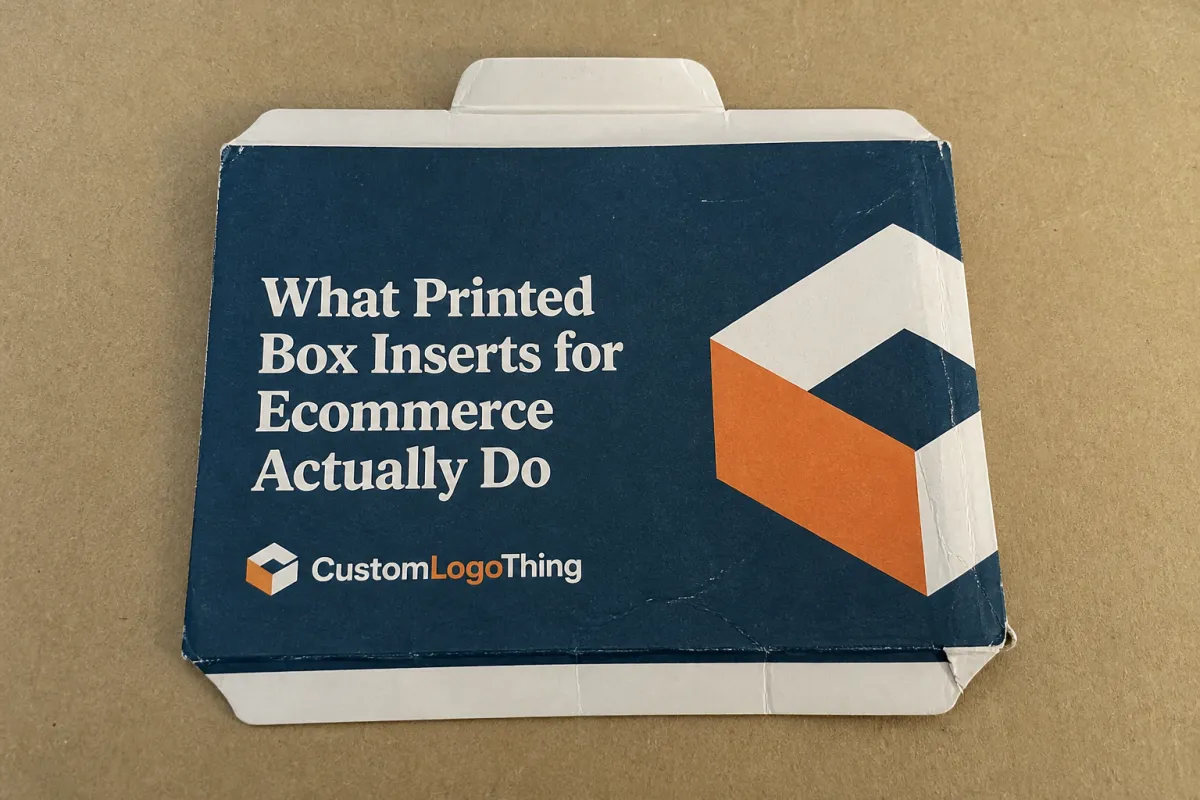
Good printed box inserts for ecommerce handle four jobs at once: they hold the product, communicate the offer, reduce damage, and shape the opening moment. That mix matters because ecommerce has no shelf, no sales associate, and no display lighting to carry the message. The package has to protect, persuade, and instruct in a single interaction.
The contrast is easy to see. Two parcels can ship with the same outer carton and the same SKU inside, yet the customer reaction changes completely depending on what sits between the item and the box walls. One insert feels intentional. The other feels like leftover packing material. That is why printed box inserts for ecommerce are often judged first by emotion, then by cost, then by line speed.
In daily use, the insert can do far more than cradle a product. It can explain how to use the item, point to a QR code for assembly or care instructions, invite a review, offer a reorder path, or cross-sell a matching item without adding another card. A strong insert is often the cheapest place to place useful information because the customer is already looking at it during unboxing.
Brands often miss one part of the equation: inserts influence support volume. If a fragile item shifts in transit, returns and complaints rise. If the insert clearly explains what is included, what is not, and how to start using the product, confusion drops. If the graphics are crisp and the copy is readable, the package feels more expensive than it really was. That is one reason printed box inserts for ecommerce can affect conversion and repeat purchase behavior long after the label is gone.
You can think of the insert as a bridge between logistics and branding. Logistics wants fast packing, consistent fit, and low damage rates. Marketing wants the customer to remember the brand, share the unboxing, and understand the product. The best printed box inserts for ecommerce serve both without forcing the warehouse to slow down.
Some common uses are straightforward:
- Product positioning so bottles, tools, jars, or devices stay centered.
- Message delivery such as thank-you notes, care instructions, or QR prompts.
- Cross-sell support by directing buyers to refills, accessories, or bundles.
- Damage reduction by limiting movement and protecting corners, caps, or screens.
The goal is not to make the insert busy. The goal is to make it useful. In strong packaging programs, printed box inserts for ecommerce earn their place because they solve a real packing problem and a real brand problem at the same time.
If the insert looks beautiful but does not fit the SKU, it is not a branding asset. It is a future problem dressed up as premium detail.
How Printed Box Inserts for Ecommerce Work in Fulfillment
Inside a warehouse, the best printed box inserts for ecommerce behave almost invisibly. The packer should be able to grab them, place them, close the carton, and move on without hesitation. Anything else risks slowing the line, especially during peak volume, when seconds matter and small errors multiply fast.
The sequence usually looks like this: the product is picked, placed into the insert or cavity, the insert is loaded into the shipper, any secondary protection is added, and the outer box is closed and labeled. That sounds simple until you watch a team pack a few hundred orders an hour. A good insert disappears into the routine. A bad one creates tiny interruptions that add up.
There is also a real difference between decorative inserts and structural inserts. Decorative inserts carry the brand visuals and the message. Structural inserts do the holding, spacing, and cushioning. Some brands only need one. Many need both. A fragile skincare bottle, for example, may sit in a die-cut cavity while a printed panel above it explains usage and ingredients. In that case, the insert is part carton, part communication surface.
Common construction styles include die-cut paperboard, corrugated inserts, folding trays, sleeves, and custom cavities matched to a specific SKU. Paperboard works well when the product is light and the printed surface matters. Corrugated board adds rigidity and crush resistance. Folding trays can speed assembly. Molded pulp can suit brands that want a more natural feel and solid shock absorption. The right choice depends on weight, shape, and how much movement the product can tolerate during transit.
Print placement matters as much as structure. A design can look excellent in a mockup and still fail in production if the logos sit on a fold line, the QR code lands where a glue tab covers it, or the artwork slows scanning and verification. That is why the strongest printed box inserts for ecommerce are designed with warehouse reality in mind. They are attractive, yes, but they are also hard to misplace, quick to fold, and consistent from one pack station to the next.
Decorative and structural roles
When those roles are separated cleanly, the packaging system works better. Decorative elements can focus on color, typography, and brand story. Structural elements can focus on friction points, cavity depth, tab strength, and compression. Brands often save money by simplifying both. Fewer parts. Fewer errors. Faster pack speed. Less scrap.
Why fulfillment teams care
Warehouse teams do not need an insert to be elaborate. They need it to be predictable. If the same printed box inserts for ecommerce can be stacked flat, folded in one motion, and placed with minimal thought, the line keeps moving. If the insert requires constant rework or hand alignment, even a small run becomes expensive in labor terms.
That is also why a pack-line test matters more than a polished presentation deck. In one fulfillment review, a folding tray that looked elegant on screen added nearly four seconds to each order because the tabs had to be coaxed into place. Four seconds sounds trivial until you multiply it across 15,000 units. Then it becomes overtime, fatigue, and a slower ship promise.
Design Factors That Shape Printed Box Inserts for Ecommerce
Fit comes first. Before color, before finish, before logo treatment, the insert has to match the product dimensions, weight, fragility, and movement tolerance. That is the real design brief behind printed box inserts for ecommerce. If the product can rattle, tip, crush, or scuff, the design has not solved the problem yet.
Material choice follows fit. Paperboard is common for lighter products because it prints crisply and folds cleanly. Corrugated board is better when the item needs more edge protection or when the shipper sees rougher handling. Molded pulp can support a more natural feel and good shock absorption, though the tactile finish is different and the tooling can be less flexible. Specialty substrates can add premium texture, but they should be justified by the brand and the use case, not chosen just because they look good in a sample kit.
Branding decisions should be specific. Do you want the insert to mirror the outer carton, or do you want a surprise inside? Both work. A coordinated palette can make the whole package feel polished. A contrasting interior can create a reveal moment that photographs well. Typography matters too. Small copy needs enough contrast and enough point size to be readable under warehouse lighting and in a low-light apartment hallway. If the customer cannot read the insert, the message is lost.
Sustainability expectations now sit inside nearly every brief. Buyers ask about recycled content, recyclability, and whether the paper comes from responsibly managed sources. If you want a recognized sourcing standard, look at the FSC program and make sure the claim matches the actual board specification. Do not decorate a package with a green message that the material cannot support. That is a fast way to lose trust.
There is also an operational side to sustainability. A lighter insert that trims freight weight by even a few grams may matter at scale. A design that ships flat can cut cubic storage cost. A single-material structure can make recycling easier for the customer. None of that is automatic. It depends on the exact construction, the print coverage, the adhesives, and the regional recycling stream. Honest claims beat vague ones every time.
For brands that want a more technical frame, transit testing can help. Many packaging teams reference ISTA testing protocols, along with ASTM methods such as D4169, to see how a structure behaves under vibration, drop, and compression conditions. That does not guarantee every shipment will arrive perfectly, but it gives the design a real stress test before a full rollout.
Operational constraints are where the art meets the floor. Fold lines need to sit where they do not distort print. Glue zones must stay clear of graphics. Thickness must work with the outer carton size. Inks should not crack at the crease. If the insert is too stiff, the packer may struggle to fold it consistently. If it is too light, it may not hold shape. The sweet spot usually appears after testing a prototype in the actual packaging workflow, not just after reviewing a PDF.
That is why printed box inserts for ecommerce should be judged as systems, not as artwork. A beautiful layout that fails under real packing conditions is not ready. A plain insert that packs quickly, protects the item, and still feels branded may be the smarter choice.
Printed Box Inserts for Ecommerce Process and Timeline
The timeline for printed box inserts for ecommerce starts before print ever happens. It starts with the brief. The best briefs include product dimensions, weight, photos, movement concerns, outer box size, quantity target, finish preferences, and the exact thing the insert must communicate. A vague brief usually leads to vague pricing, and vague pricing slows everything down.
A practical production flow often looks like this:
- Intake and specification review to confirm size, SKU, and use case.
- Dieline development so the flat artwork matches the folded structure.
- Prototype or sample to check fit, foldability, and print placement.
- Revision if the cavity is tight, loose, or awkward to assemble.
- Final approval once the artwork and dimensions are locked.
- Production print run followed by cutting, folding, or finishing.
- Packing and freight to the warehouse or fulfillment partner.
For simple paperboard jobs, production can often move in roughly 10 to 15 business days after proof approval, assuming artwork is ready and the material is available. More complex printed box inserts for ecommerce may take 15 to 25 business days once fit tests, custom tooling, or special finishing enter the picture. Molded pulp or unusual structures can stretch beyond that, especially if a tool has to be made first. These are practical ranges, not promises. A busy season, a paper shortage, or a major revision can change the schedule quickly.
Sampling is where many projects speed up or stall. If the first sample shows the product moving in transit, the design needs another pass. If the insert is difficult to fold, the pack line may need a redesign before the order goes live. If the print coverage is too heavy on a fold area, cracking can appear after creasing. It is far cheaper to catch those problems in sampling than after 20,000 units are already in the warehouse.
Special finishes add time. Embossing, foil, soft-touch coating, spot varnish, and complex die lines can all stretch the schedule. That does not mean they are a bad idea. It means they should be chosen for a reason. If the finish does not raise perceived value or improve durability, it may be decoration without payoff. Many of the strongest printed box inserts for ecommerce use very modest finishing and still feel premium because the structure is smart and the print is disciplined.
Rush orders are tempting, especially when a launch date is fixed. The fastest project is usually the one with the clearest brief. Every change after proof approval adds time and money. A fit issue can force rework. A late artwork change can require a new plate or a new print step. A poor handoff between marketing and operations can slow the whole program. In packaging, speed is rarely free.
Think of lead time as a tradeoff between certainty and flexibility. If you want the insert to be highly customized, expect more time for samples and approvals. If you want short-run speed, be ready for a higher unit price and fewer finish options. That is the honest math behind printed box inserts for ecommerce.
Printed Box Inserts for Ecommerce Cost, Pricing, and MOQ
Cost for printed box inserts for ecommerce depends on a few core levers: board type, print coverage, number of colors, finish complexity, order quantity, and structural design. The unit price tells only part of the story. The total project cost also includes setup, sampling, freight, storage, and the labor required to assemble the insert inside the pack line.
A lower per-piece quote can still cost more overall if it needs a special tool or if the structure wastes labor. A slightly higher unit price can be the cheaper option if it folds faster and reduces damage. That is why packaging teams should compare total landed cost, not just the number on the quote.
Here is a practical comparison of common options for printed box inserts for ecommerce:
| Insert Type | Typical Use | Approx. Unit Cost at Volume | Setup or Tooling | Notes |
|---|---|---|---|---|
| Paperboard die-cut insert | Lighter products, cosmetics, small accessories | $0.12-$0.28 | $250-$700 setup | Clean print surface, fast fold, good for branded messaging |
| Corrugated insert | Heavier goods, fragile items, items needing crush resistance | $0.20-$0.45 | $350-$900 setup | More strength, slightly bulkier, often better for transit protection |
| Molded pulp insert | Eco-forward kits, protection-focused unboxing | $0.30-$0.75 | $1,500-$5,000 tooling | Longer lead time, tactile feel, strong sustainability story when specified well |
| Folded tray or sleeve | Simple positioning, light to medium items | $0.10-$0.22 | $200-$500 setup | Fast assembly, fewer components, good for short runs and subscriptions |
These ranges help with planning, but they are not universal. Print coverage, board grade, carton size, and regional freight can move the price in either direction. A short-run digital job may cost more per unit but avoid tooling expense. A high-volume offset run can lower the unit price sharply once the line is stable.
MOQ is another point where brands get surprised. Some suppliers can quote small runs of 500 to 1,000 units for simpler paperboard inserts, especially if digital print is used. Custom corrugated or molded pulp projects often push much higher, sometimes 3,000 to 10,000 units depending on the vendor and the tooling. For startup brands testing product-market fit, that matters. You do not want to overbuy packaging before the SKU has proven demand. On the other hand, very small runs can make printed box inserts for ecommerce look expensive because the setup cost is spread over too few units.
To price accurately, suppliers need more than a logo file. They need:
- Exact product dimensions and weight.
- Outer carton size and any internal clearance limits.
- Artwork intent including print coverage and finish.
- Quantity target and expected repeat order cadence.
- Packing method so assembly labor can be estimated.
- Delivery location because freight can change the landed cost materially.
There is also a hidden cost that never appears on the quote: difficult assembly. If the insert takes 14 seconds to fold instead of 6, that difference becomes expensive across 20,000 orders. If the shape is fiddly, the team may need extra training or a revised packing SOP. A good packaging buyer will ask about labor even when the supplier does not mention it. That question often saves more money than pushing for another nickel off the unit price.
For many brands, the smartest budgeting approach is simple: pay once for a sample, once for setup, and then make sure the full run is boring in the best possible way. Predictable packing is what keeps printed box inserts for ecommerce profitable.
Common Mistakes With Printed Box Inserts for Ecommerce
The most common mistake is designing for looks first and fit second. A package can look beautiful in a mockup and still fail in a real shipment because the product moves too much, the cavity is too loose, or the insert leaves no room for tape, labels, or warehouse handling. Printed box inserts for ecommerce are not winning if the item arrives scuffed or the customer opens the box to find a rattling product.
Another error is underestimating fulfillment speed. A beautiful insert that takes too long to assemble may be fine for 200 orders, then painful at 2,000. If a packer has to force folds, check orientation twice, or trim a tab, the time cost is real. That is why even premium-looking printed box inserts for ecommerce should be reviewed in the actual warehouse workflow, not just on a designer's desk.
Vague specifications create a third problem. Missing product weight, missing tolerance ranges, unclear inner dimensions, or artwork that ignores glue zones can all derail a project. The supplier cannot guess the mechanical behavior of the SKU. Good spec sheets save time because they reduce back-and-forth, and they prevent a lot of avoidable sampling revisions.
Overfinishing is another trap. Foil, heavy lamination, intricate embossing, and multiple specialty effects can look impressive, but they do not automatically improve the customer experience. If the insert is hidden inside the box, a costly finish may never justify itself. In some categories, the right move is a cleaner print treatment and a stronger structure. Not everything needs gloss to feel premium.
There is also a post-purchase blind spot. Too many brands use the insert only as a holding device and ignore its communication value. That wastes an easy place to explain care steps, encourage reviews, support reorders, or guide a return if needed. Strong printed box inserts for ecommerce are useful after the sale as well as during the unboxing.
One packaging manager's rule of thumb is hard to argue with:
"If a nice-looking insert adds five extra seconds to every pack, the line will remind you about it long before the customer does."
That comment lands because it reflects reality. A small slowdown on paper can become a major cost in practice. For that reason, the best printed box inserts for ecommerce are tested for fit, speed, and durability before anyone signs off on the full run.
- Do not approve artwork before the dieline is final.
- Do not assume a sample that looks fine on a desk will behave the same in shipping.
- Do not choose a finish that adds cost without changing the customer experience.
- Do not ignore the way inserts affect returns, reviews, and support traffic.
When brands avoid those mistakes, the package starts working like a system instead of a decoration. That is where printed box inserts for ecommerce begin returning real value.
Expert Tips and Next Steps
Start with one high-volume SKU. That sounds almost too simple, but it prevents a lot of wasted effort. If the insert works for the product that ships most often, the pack line gets a real-world test case and the brand gets a reliable baseline. Once that insert is proven, it is easier to adapt it to adjacent SKUs. This is one of the cleanest ways to launch printed box inserts for ecommerce without overcommitting budget.
Ask for three things before approving anything: a flat sketch, an assembled prototype, and a sample that has been tested inside the real box with the real product. A file on a screen can hide problems. A physical sample reveals them fast. Is the cavity too tight? Does the print crack on the fold? Can the customer lift the product without tearing the insert? Those questions only get answered honestly in a hand test.
Testing at the warehouse helps more than testing in a conference room. The difference is larger than people expect. At a desk, a crew member can fold carefully and admire the print. On the line, the team is moving with a rhythm, and every extra motion matters. If the insert slows that rhythm, the design needs revision. That is not failure. That is the point of the test. Many printed box inserts for ecommerce improve after that kind of honest review.
Before launch, use a short checklist:
- Final dimensions confirmed against the product and outer carton.
- Print intent approved, including logo position and message hierarchy.
- Quantity target set with room for spoilage and reprints.
- Supplier timeline aligned with launch and replenishment needs.
- Freight plan mapped to the warehouse or 3PL.
- Quality-control rules defined for fit, color, and assembly consistency.
If you want a practical launch sequence, keep it short: audit the SKU, request quotes, sample the fit, pilot a small run, measure pack speed and damage rates, then scale the winner. That is the cleanest path for printed box inserts for ecommerce, especially if the brand wants both a stronger unboxing and tighter operational control.
One last point: do not expect the insert to solve every branding issue. It is one touchpoint. A strong one, yes, but still only one. The outer box, the shipping label, the product itself, and the post-purchase emails all matter. The insert earns its keep when it closes the gap between what the customer expects and what the package delivers.
The most practical takeaway is also the least glamorous: treat the insert as a production component first and a brand surface second. Lock the dieline, test it with the real product, run it through the real pack line, and only then finalize print and finish. That order protects both the customer experience and the margin.
What are printed box inserts for ecommerce used for?
They keep products centered, protected, and easier to unbox during shipping and delivery. They also carry branding, instructions, QR codes, and cross-sell messages without adding a separate card. For many brands, printed box inserts for ecommerce are the smallest part of the package with the biggest customer-facing impact.
How do I choose the right material for printed inserts for ecommerce?
Match the material to product weight, fragility, and the feel you want at opening. Paperboard works for lighter items, while corrugated or molded options suit heavier or more fragile products. If sustainability is part of the brief, check the actual board specification, recycled content, and sourcing claims before you approve the order.
What affects the price of printed box inserts for ecommerce the most?
Order quantity, material choice, print complexity, and structural design drive most of the cost. Extra finishing, small MOQs, and difficult assembly can raise both unit cost and total project cost. In practice, the cheapest-looking quote is not always the lowest-cost option once freight and labor are included.
How long does the process usually take for custom printed box inserts?
Simple designs can move quickly once artwork and dimensions are approved. Custom structures, sampling, and special finishes add time, so planning around lead time matters. A straightforward paperboard insert may move in roughly 10 to 15 business days after approval, while more complex printed box inserts for ecommerce can take longer if tooling or fit revisions are involved.
Can printed box inserts for ecommerce help with repeat sales?
Yes, they can direct customers to product education, reorder links, reviews, or complementary products. A useful insert turns the unboxing moment into a low-friction marketing touchpoint. That is why many brands now treat printed box inserts for ecommerce as part of post-purchase commerce, not just packaging.
For most launches, printed box inserts for ecommerce work best when they start as a fit problem, then become a branding layer. Audit the SKU, sample the cavity, test it in the actual pack line, and scale only after the insert proves it can protect the product and the margin.
Related packaging resources
Use these related guides to compare specs, costs, quality checks, and buyer decisions before making the final call.