Buyer Fit Snapshot
| Best fit | Printed Compostable Bags with Logo projects where brand print, material claims, artwork control, MOQ, and repeat-order consistency need to be specified before quoting. |
|---|---|
| Quote inputs | Share finished size, material target, print colors, finish, packing count, annual reorder estimate, ship-to region, and any compliance wording. |
| Proofing check | Approve dieline scale, logo placement, barcode or warning zones, color tolerance, closure strength, and carton packing before bulk production. |
| Main risk | Vague material claims, crowded artwork, missing packing details, or unclear freight terms can make a low unit price expensive after revisions. |
Fast answer: Printed Compostable Bags with Logo: Film, Print, MOQ, and Carton Packing should be specified like a repeatable production item. The safest quote records material, print method, finish, artwork proof, packing count, and reorder notes in one written spec.
Production checks before approval
Compare the actual filled-product size with the drawing, then confirm tolerance on folds, seals, hang holes, label areas, and retail display edges. Reserve space for logos, QR codes, warning copy, and material claims before decorative graphics fill the panel.
Quote comparison points
Review material grade, print process, finish, sampling route, tooling charges, carton quantity, and freight assumptions side by side. A quote is only useful when the supplier can repeat the same color, closure quality, and packing count on the next order.
Printed Compostable Bags with Logo: Smart Packaging Guide
A plain pouch can change a shopper's judgment in under three seconds. Printed compostable Bags with Logo do exactly that: they signal product quality, packaging discipline, and environmental intent before anyone opens the pack. For many brands, that first impression is worth more than the bag itself.
Packaging gets messy fast once the claims start flying. Compostable is not recyclable. Biodegradable is not compostable. A bag can look green and still fail the basic test if the ink, seals, or closure system are wrong. I have watched teams spend weeks polishing a mockup while nobody checked the seal window. The smarter approach is to treat printed compostable bags with logo as both a branding decision and a technical spec. Skip either one and the result gets sloppy.
For Custom Logo Things, that balance is the point. Packaging should help sell the product, support a lower-impact packaging strategy, and back up the sustainability message instead of bluffing its way through it.
Printed compostable bags with logo: what they are and why they stand out
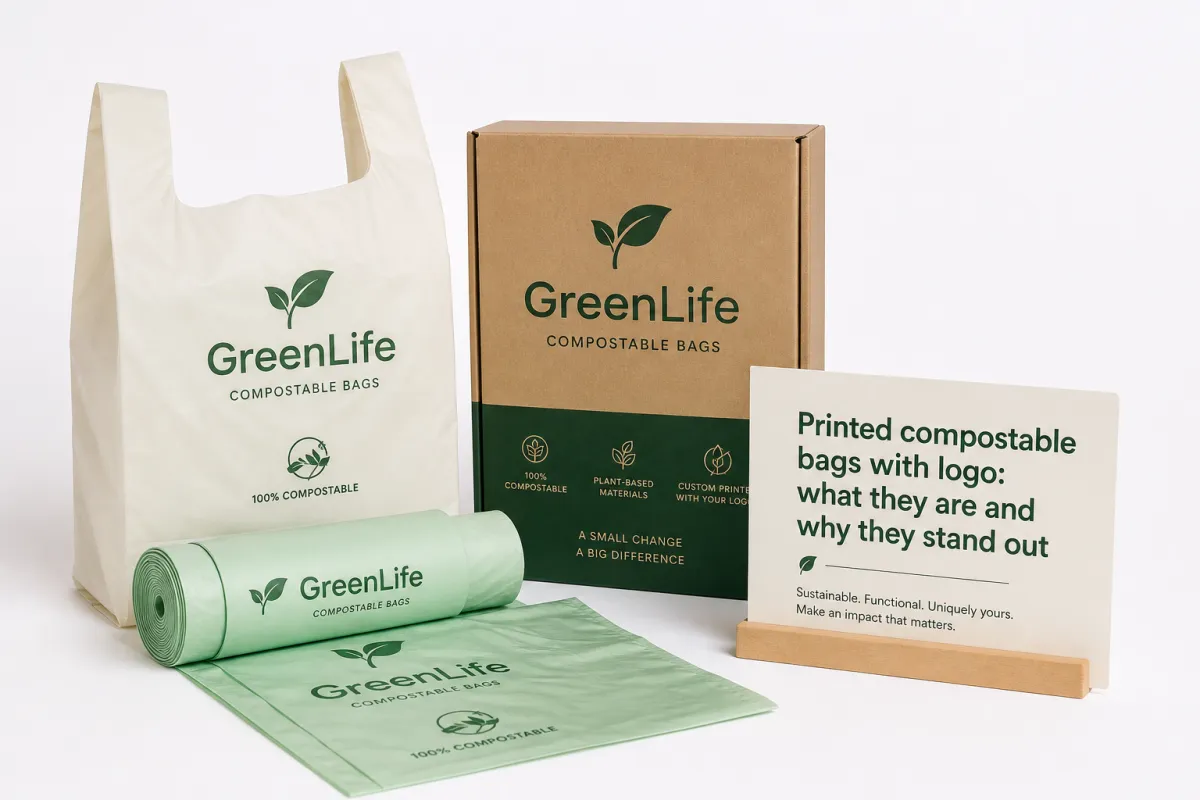
At the simplest level, compostable bags are built to break down into carbon dioxide, water, biomass, and inorganic compounds under the right conditions. The conditions matter. Industrial compostable structures behave differently from home compostable ones, and a paper pouch with a compostable liner is not the same thing as a film made from PLA or PBAT blends. Buyers looking for printed compostable bags with logo are usually choosing a material system, not just a label.
Adding a logo turns a basic container into branded communication. That sounds obvious, but the result is more useful than the theory suggests. A logo on printed compostable bags with logo can make a coffee sample feel premium, make a snack pouch feel more trustworthy, and make an e-commerce mailer feel deliberate instead of thrown together. The bag still holds the product. Now it also carries identity. That matters on a crowded shelf.
Where do these bags work best? Food brands use them for dry goods, tea, coffee, bakery items, and snacks. Retailers use them for cosmetics samples, apparel accessories, and small add-ons. E-commerce teams use them for lightweight mailers or inner packs. Even then, performance testing is not optional. If a product is oily, sharp-edged, moisture-sensitive, or heavy, the structure needs to be checked for seal strength, puncture resistance, and barrier performance before the artwork is approved.
One packaging buyer once put it bluntly: a bag can say "eco-friendly packaging," but if it shows up wrinkled, weak, or off-spec, the brand signal flips fast. That is why printed compostable bags with logo should be specified with the same seriousness as any other production packaging. The look and the engineering have to agree with each other.
There is also a terminology trap. Compostable does not mean recyclable, and recyclable does not mean compostable. A bag can be one, the other, or neither, depending on material, additives, ink system, and closure components. If a supplier cannot explain the claim clearly, the claim is not ready for market. Buyers looking for greener packaging should ask for certifications, not cheerful hand-waving.
Practical rule: if the packaging claim cannot be verified on the spec sheet, it should not be treated as a selling point.
How printed compostable bags with logo are made
The base material drives most of the bag's behavior. Common structures include compostable films made from PLA or PBAT blends, paper-based pouches with compostable liners, cellulose films, and hybrid structures that combine fiber and bio-based layers. Each one affects print quality, sealing temperature, moisture resistance, and shelf feel. That is why printed compostable bags with logo are rarely a simple copy of standard plastic packaging.
Print methods vary. Flexographic printing is common for medium and large runs because it can handle repeatable branding at scale. Digital printing works well for shorter runs, artwork changes, and SKU testing. Some applications still use gravure or screen elements, especially when a brand wants saturated blocks of color or a special finish. The label on the press matters less than the way the ink behaves on the substrate. A logo can look crisp on a sample and soft in production if the ink load is too heavy or the film stretches during sealing.
That interaction matters because compostable substrates can be more sensitive than conventional films. Heat can distort the material. Thick ink layers can affect fold lines or blunt the clarity of fine typography. White ink can help contrast, but too much coverage can create a heavy visual field that works against the natural look many brands want from printed compostable bags with logo. Print design and structure design should be developed together. Not one after the other. Together.
Certifications sit behind the material choice and the print stack. For compostability claims, buyers often ask about ASTM D6400, ASTM D6868, EN 13432, or ISO 17088, depending on the market. If the bag includes paper, third-party fiber sourcing can also matter; FSC certification helps separate responsible sourcing from vague sustainability language. For readers who want a broader packaging framework, the Sustainable Packaging Coalition at packaging.org is a useful reference point.
Closure style changes what is printable. Zippers, tear notches, euro holes, vent valves, windows, and hang tabs all affect how much surface is left for branding. A window may help product visibility, but it cuts print space. A high-barrier layer may protect freshness, but it can limit compostability claims if the structure is not designed carefully. That is where printed compostable bags with logo become more than decoration. The bag format itself becomes part of the sustainability story.
For shipment-heavy applications, transit testing is worth the extra time. ISTA's testing methods at ista.org are useful when a mailer, pouch, or inner bag needs to survive vibration, drop, and compression before it reaches a customer. That matters for eco-friendly packaging used in e-commerce, where the carbon footprint argument disappears quickly if damage rates climb.
There is one more honest detail. Compostable packaging is not magic. It only does its job when the end-of-life system exists and the product actually fits the certification path. A bag that is certified for industrial composting does not become home-compostable because the marketing team wants it to. That distinction sounds boring until a claim gets challenged. Then it gets very interesting, very fast.
Key factors that change cost, pricing, and print quality
Price is rarely just a material story. For printed compostable bags with logo, the biggest drivers are usually bag size, material thickness, print colors, surface finish, order quantity, and setup fees. A small pouch with one-color branding can land in a very different price band from a high-barrier mailer with multiple colors and a custom zipper. Buyers sometimes compare quotes as if they are buying the same thing. They are not.
Here is a practical way to think about cost. For 5,000 units, a basic printed compostable bag with logo might fall around $0.18-$0.32 per unit for a simple structure and limited color coverage. A more complex pouch with windows, zipper closures, or heavier barrier performance can move into the $0.28-$0.45 per unit range. Very small runs, especially below 1,000 units, can jump to $0.55-$1.10 per unit because setup costs are spread across fewer pieces. Those numbers vary by region, spec, and tooling, but they are close enough to help a buyer sanity-check a quote.
Small runs carry another cost penalty: proofing. If you need a digital sample, a strike-off, or a physical pre-production sample, the labor cost is still there whether you order 500 pieces or 50,000. Larger runs spread that cost out. That is why printed compostable bags with logo often look expensive in pilot-stage quantities but more competitive once the product line settles down.
Print coverage influences the final number more than many teams expect. Heavy artwork, full background coverage, and multiple spot colors usually increase press time and can create more waste during make-ready. Higher coverage also changes the visual feel of the pack. A restrained layout often looks more premium on compostable substrates, and it can reduce the carbon footprint of the packaging process by lowering ink usage and production waste. No magic. Just cleaner specs.
The table below is a useful shorthand for comparing common structures. It is not a quote, but it gives a buying team a realistic frame for comparing printed compostable bags with logo across different build types.
| Structure | Best use | Print behavior | Typical unit price at 5,000 pcs | Notes |
|---|---|---|---|---|
| PLA/PBAT compostable film | Dry food, samples, lightweight retail | Sharp logo reproduction, moderate coverage works well | $0.18-$0.32 | Good for simple formats; check heat sealing settings |
| Paper pouch with compostable liner | Premium retail, coffee, bakery items | Natural texture, strong contrast needed | $0.22-$0.40 | FSC sourcing may strengthen the paper story |
| Cellulose-based pouch | High-visibility branded packs | Clear, elegant look; careful drying needed | $0.28-$0.45 | Good for premium green packaging positioning |
| Hybrid high-barrier compostable structure | Moisture-sensitive foods, longer shelf life | More technical; fewer design freedoms | $0.35-$0.60 | Best when performance matters more than the lowest price |
Freight can distort the math as well. A supplier quote that looks lower at the unit level may be higher once shipping, duties, and cartonization are included. Ask for landed cost, not just ex-factory pricing. Also ask whether artwork fees, plates, or tooling are separate. That one habit prevents a lot of unpleasant surprises when comparing printed compostable bags with logo across multiple vendors.
There is a trade-off packaging teams miss more often than they should. A lower-cost structure might save pennies per unit but lose value at the shelf because the brand looks generic. A higher-grade printed compostable bag with logo can improve perceived quality enough to support a better selling price or lower product return rate. That is not guaranteed, but it happens often enough to justify a real comparison beyond the invoice.
Ordering timeline: from artwork approval to delivery
Ordering printed compostable bags with logo usually follows a predictable sequence, but delays cluster in a few familiar places. The process starts with the brief: product type, fill weight, storage conditions, size, closure style, print colors, target quantity, and any required certifications. If that brief is vague, the quote will be vague too. A supplier cannot recommend a film gauge or barrier level without knowing what the bag is supposed to protect.
Next comes material selection and artwork prep. This is where many projects slow down. Artwork files need to be print-ready, with correct bleed, vector logos, font outlines, and color specs. If the file arrives as a low-resolution mockup, the production team has to rebuild it. That is not just a design annoyance; it can push the schedule by several business days. For printed compostable bags with logo, the artwork stage often takes longer than the press stage.
After the proof, some jobs require a physical sample or strike-off. That step is useful if the bag will carry a food product, ship through rough transit, or need a very particular finish. A digital proof is enough for many simple projects, but a physical sample is more honest. It shows color shift, seal alignment, and how the logo reads on the real substrate. A buyer who skips this step often discovers the problem after production has started, which is the most expensive time to find it.
A realistic timeline for printed compostable bags with logo usually looks like this:
- Brief and quote: 1-3 business days
- Artwork setup and proofing: 2-5 business days
- Sample or strike-off, if required: 3-7 business days
- Production: often 12-18 business days after approval
- Transit: 3-20 days depending on location and shipping mode
That means a total project timeline of 3-6 weeks is common, and longer is not unusual if the design is complex or the bags need certification verification before production starts. For a launch date, buffer time is not optional. Build in extra days for revisions, customs clearance, and any lab or compliance review tied to food contact or compostability claims. A claim delay can hurt more than a press delay.
One more thing: ask whether the supplier's stated timeline starts from artwork approval or from purchase order receipt. Those are not the same. A lot of frustration around printed compostable bags with logo comes from misunderstandings at the calendar level, not the manufacturing level.
In practice, the slowest projects are usually the ones where nobody owns the specs. The printer thinks the product team handled compliance. The product team thinks the supplier checked the barrier structure. The brand team thinks the packaging sample is just a visual step. Then everyone acts surprised when the timeline slips. Cute, but not useful.
Common mistakes to avoid before you approve the order
The first mistake is treating compostable claims as design language instead of compliance language. A leaf icon, a green tint, or the word "compostable" on the artwork does not make the bag compliant. The full structure has to support the claim, including inks, adhesives, windows, zippers, and any coatings. If a supplier cannot provide documentation, the packaging is not ready for market, no matter how polished the mockup looks. That is especially true for printed compostable bags with logo, because the branding can distract teams from the technical proof.
The second mistake is overprinting. Dense ink coverage can create drying issues, reduce clarity on soft substrates, and make the package feel heavier than it needs to. Many teams want the logo to dominate the panel. Honestly, that is often the wrong instinct on compostable material. A restrained layout tends to look sharper, and it usually gives the bag a cleaner premium cue. With eco-friendly packaging, visual restraint often beats visual noise.
Size errors are the expensive mistake. A bag that is too small can stress seals and make filling awkward. A bag that is too large wastes material and makes the product look underfilled. Neither outcome helps the brand. For retail and e-commerce, product fit is part of the communication. If the fill weight is 250 grams but the pouch was built for 500 grams, the pack will look slack and retail value drops immediately. That is why printed compostable bags with logo should be sized from the product outward, not from the logo inward.
Another common failure is ignoring seal strength. Compostable structures can be sensitive to heat settings, dwell time, and pressure. A seal that looks neat may still fail under load, especially if the product is granular, oily, or heavy. Sample testing should include drop checks, compression checks, and real handling conditions, not just a visual review. If the bags will ship, ISTA-style transit thinking is worth the effort. If they will sit on shelf, a squeeze test is not enough.
Supplier-side mistakes are just as common. Some vendors approve artwork before checking print limitations on the chosen substrate. Others skip sample testing or fail to verify the exact compostability standard attached to the material. A buyer should ask direct questions:
- What exact substrate is being used?
- Which standard supports the compostable claim?
- Are inks and adhesives included in the certification path?
- What is the minimum seal temperature window?
- Has the structure been tested with my actual product weight?
Those questions take a few minutes to ask and can save weeks of rework. In a market crowded with green packaging language, clear documentation is what separates a legitimate claim from a marketing costume. Printed compostable bags with logo deserve that level of scrutiny.
Expert tips for better branding and stronger sustainability claims
If you want printed compostable bags with logo to feel premium, start with contrast. One or two strong colors usually outperform a crowded palette on compostable substrates. Typography matters too. Thin fonts can disappear on textured paper or slightly matte films, while sturdy letterforms keep the logo readable from a distance. The best-looking packaging is often the least cluttered one.
Use the logo as a trust signal, not a billboard. That changes the design brief. The bag should say the brand is careful, modern, and credible. It should not shout so loudly that the sustainability story gets buried. A lot of buyers think they need maximal print coverage to make branded packaging feel premium. In reality, printed compostable bags with logo often look more expensive when the brand mark is restrained and the material can speak for itself.
Match the structure to the use case. A food pouch that needs barrier protection is not the same thing as a retail garment bag or a sample mailer. That sounds obvious, yet mismatches happen all the time. If the product is dry and lightweight, a simpler compostable film may be enough. If it is moisture-sensitive, the bag needs a different barrier stack. If transit abuse is likely, the closure and seal geometry matter as much as the artwork. The packaging spec should follow the product reality, not the mood board.
On claims, plain language beats hype. Say exactly what the bag is, what standard it meets, and where it should be composted. If the bag is certified industrial compostable, say that. If it is home compostable, say that only when the certification supports it. That is where trust is built. For paper-heavy structures, FSC sourcing can strengthen the story, but only if the paper component is part of the final build and the claim is precise. Vague language around "plant-based" or "eco" is weak next to a documented compostability claim.
That precision also helps with the circular economy conversation. A bag that can be responsibly processed at end of life is not perfect, but it can reduce waste when the collection system exists. The same is true of carbon footprint claims. A lighter bag with lower material use can help, but not if it fails in transit and causes replacements. The smartest green packaging decisions usually reduce waste without dumping the burden somewhere else.
Best practice: a credible sustainability claim is always stronger than a dramatic one.
If you are unsure whether the design is doing too much, a good test is simple: can a buyer understand the product, the brand, and the compostable claim in one glance? If not, simplify. Printed compostable bags with logo should do more than announce the brand; they should make the packaging feel intentional, technically sound, and easy to trust. And yes, that sometimes means being a little boring. Boring can sell if the details are right.
Next steps for printed compostable bags with logo
Before you contact suppliers, build a brief with five essentials: product type, bag size, target order quantity, print colors, and the exact certification or performance requirement. That alone will make your quotes more comparable. Without it, you will get a mix of apples, oranges, and unrelated structures that all look "similar" in an inbox but behave very differently in production. For printed compostable bags with logo, clarity up front is the cheapest part of the project.
Then ask for samples. A physical sample tells you more than a PDF ever will. Check the logo edge, the seal quality, the feel of the substrate, and whether the bag holds its shape when filled. If the product is new, or if the bag will carry food, run a pilot lot before placing a larger order. That small test is often the difference between a controlled launch and a repair job.
Also ask for the quote in layers. Unit cost is useful, but it is only one line. Freight, setup, artwork, plates, testing, and compliance documents all affect the final spend. A quote that separates those items is easier to compare and easier to defend internally. Buyers who compare printed compostable bags with logo using a clean spec sheet usually make better decisions than buyers who compare headline prices.
Here is a simple ordering checklist:
- Confirm the product weight, dimensions, and shelf-life needs.
- Choose the structure that matches the use case.
- Verify compostability documents and printing limits.
- Review a digital proof and, if needed, a physical sample.
- Get lead time, freight, and production terms in writing.
That process is not glamorous, but it works. Printed compostable bags with logo are one of those packaging choices where good branding and good operations point in the same direction. If the bag feels right, performs right, and supports a real sustainability claim, it becomes more than packaging. It becomes part of the product story, part of the brand story, and part of the business case for better packaging decisions.
The practical move is simple: lock the product spec first, verify the claim documents second, and approve artwork last. That sequence prevents most of the expensive mistakes, and it keeps the packaging honest from the start. No drama. Just fewer surprises.
Are printed compostable bags with logo really compostable?
They can be, but only if the full structure meets compostability requirements, not just the base film or paper. Ask for certification documents and material data, and confirm that inks, adhesives, closures, and coatings do not break the claim. If a supplier cannot show proof, treat the sustainability label as unverified.
What affects the price of printed compostable bags with logo the most?
The biggest drivers are material type, bag size, number of print colors, order quantity, and setup or tooling fees. Special features such as zippers, windows, vents, or higher barrier performance usually raise cost. Compare quotes using the same spec sheet so you do not confuse a lower unit price with a weaker build.
How long does it take to produce printed compostable bags with logo?
Timeline depends on artwork readiness, proof approvals, sample requests, and factory capacity. Expect extra time if the design needs revisions or if certification paperwork must be checked before production starts. Build in buffer time for shipping, especially when the bags are needed for a launch date.
Can I print full-color artwork on printed compostable bags with logo?
Yes, but the material and print method may limit how bright, dense, or detailed the artwork can be. Simpler color palettes often print more consistently and look sharper on compostable substrates. Ask for a proof or sample so you can judge the actual finish before placing a full order.
What should I ask a supplier before ordering printed compostable bags with logo?
Ask for certification documents, minimum order quantity, lead time, sample options, and the exact print method used. Request a quote that separates unit cost, setup fees, freight, and any artwork charges. Confirm whether the bag is suitable for your product weight, storage conditions, and end-of-life requirements.


