Buyer Fit Snapshot
| Best fit | Printed Compostable Labels with Logo projects where brand print, material claims, artwork control, MOQ, and repeat-order consistency need to be specified before quoting. |
|---|---|
| Quote inputs | Share finished size, material target, print colors, finish, packing count, annual reorder estimate, ship-to region, and any compliance wording. |
| Proofing check | Approve dieline scale, logo placement, barcode or warning zones, color tolerance, closure strength, and carton packing before bulk production. |
| Main risk | Vague material claims, crowded artwork, missing packing details, or unclear freight terms can make a low unit price expensive after revisions. |
Fast answer: Printed Compostable Labels with Logo: Material, Adhesive, Artwork, and MOQ should be specified like a repeatable production item. The safest quote records material, print method, finish, artwork proof, packing count, and reorder notes in one written spec.
Production checks before approval
Compare the actual filled-product size with the drawing, then confirm tolerance on folds, seals, hang holes, label areas, and retail display edges. Reserve space for logos, QR codes, warning copy, and material claims before decorative graphics fill the panel.
Quote comparison points
Review material grade, print process, finish, sampling route, tooling charges, carton quantity, and freight assumptions side by side. A quote is only useful when the supplier can repeat the same color, closure quality, and packing count on the next order.
Printed compostable labels with logo live at the point where brand presentation, material behavior, and production reality all meet. A label has to look intentional on shelf, carry a logo cleanly, and still align with a compostability claim that can stand up to real use. Shipping, refrigeration, handling, condensation, abrasion, and storage all change the way a label performs. Printed compostable labels with logo are never just a decorative layer; they are a full construction made up of face stock, adhesive, ink, and liner, and each part influences the result.
Buyers usually reach for these labels because the packaging brief asks for two things at once: a strong brand presence and a lower-impact material choice. That combination makes sense for eco-friendly packaging, but it also raises the bar. The logo can affect ink density, dry time, color balance, and finishing choices before the job even reaches press. Printed compostable labels with logo show up often on produce, takeaway food, natural products, and small-batch consumer goods, where the package has to speak clearly about both the product and the brand.
Confusion starts when people use end-of-life terms as if they mean the same thing. Compostable, biodegradable, recyclable, and home compostable are not interchangeable. Printed compostable labels with logo only make sense when the label construction matches the claim being made, and that claim needs to be supported by the full material stack, not just the face stock. I have seen otherwise solid projects get tangled up because someone treated a marketing phrase like a technical specification, and that never ends well.
Before choosing a specification, it helps to understand how the label is built, how it is printed, what drives price, and where the usual technical problems appear. A label that supports green packaging and still looks polished on the shelf usually comes from careful decisions rather than guesswork.
Printed compostable labels with logo: what they are and why they matter
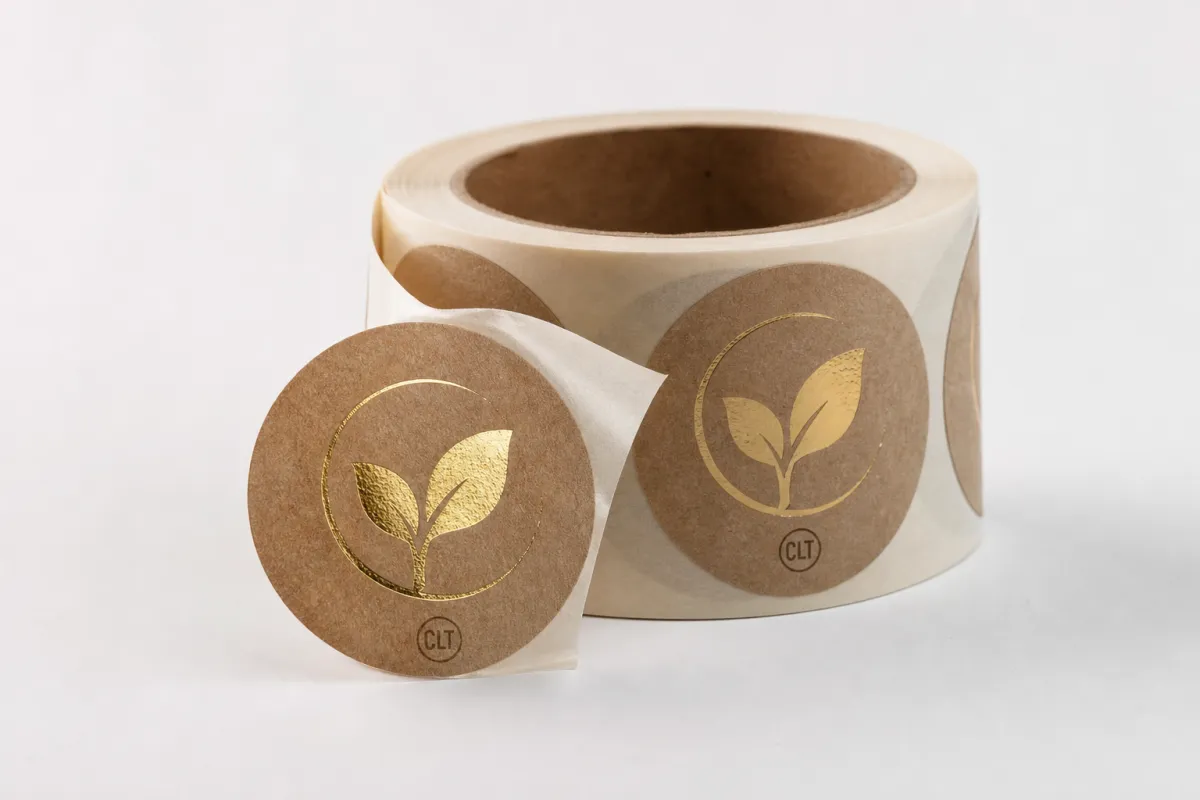
At the most basic level, printed compostable labels with logo are pressure-sensitive labels made with materials intended to break down in a composting environment under the right conditions. The label is a system rather than a single material. Face stock, adhesive, ink, and liner all play a part, and each one can strengthen or weaken the final claim. Buyers who only focus on the paper or film face often miss the piece that determines whether the label survives real-world handling.
The logo changes the job more than many teams expect. A simple text-only label may use minimal ink and leave a lot of open space. Printed compostable labels with logo usually demand more controlled color, sharper registration, and more careful artwork setup. That affects drying, waste, and sometimes even the print method. A bright red logo on a natural-looking kraft face, for example, may need a different print plan than a black one-color mark on white compostable paper. Good planning keeps the press run calm and the final label readable.
These labels fit well where a brand wants a sustainability message without making the package feel temporary or unfinished. I see them used on fresh produce, bakery packs, prepared foods, tea, wellness products, and short-run consumer goods. In those settings, printed compostable labels with logo carry both brand identity and product information, which is useful when the package itself is meant to support circular economy goals.
Consistency is the real value for the buyer. A label that looks finished makes the product feel finished, and that helps customers trust what they are holding. The effect shows up on direct-to-consumer boxes, retail cartons, and takeaway containers alike. Printed compostable labels with logo can deliver that polish, but only when the design fits the substrate and the use environment.
“Most label problems start before print, not after it. If the substrate, adhesive, and claim language are not aligned, no amount of pretty artwork will save the job.”
Language matters here. Industrial compostable, home compostable, and biodegradable are different claims with different expectations behind them. If you are buying printed compostable labels with logo for food service or retail packaging, the supplier should be able to explain exactly what the construction supports and what documentation exists behind that claim. The U.S. EPA has helpful composting guidance at EPA composting resources, which gives useful background when you are thinking through disposal pathways.
From a branding angle, printed compostable labels with logo let the package say two things at once: what the product is and what the brand stands for. That fits well with eco-friendly packaging strategies, but only when the visual system grows from the material instead of forcing the material to imitate a conventional label. The substrate should shape the design, not the other way around.
When the fit is right, the label becomes part of the product story rather than an add-on. When the fit is wrong, the label can wrinkle, lift, smear, or confuse the sustainability message it was meant to support. Printed compostable labels with logo reward careful planning, and the jobs that do best are usually the ones where the team asks a few slightly annoying questions early instead of trying to fix the problem after approvals are locked.
Printed compostable labels with logo: process, timeline, and lead time
The production path for printed compostable labels with logo usually starts with artwork review and ends with packed rolls or sheets ready to ship. That sounds simple enough, yet the steps between those points carry a lot of weight. Prepress checks come first, and they are not just a checkbox. A good prepress review confirms dieline fit, bleed, barcode readability, logo placement, color builds, overprint settings, and any variable data requirements. If the label goes on a curved jar or a cold carton, the artwork may also need small changes so the logo avoids seam lines and buckle zones.
After approval of the artwork, the supplier checks material availability and print method. Printed compostable labels with logo may run on digital, flexographic, or other specialty print routes depending on quantity, color complexity, and turnaround pressure. Digital printing often suits smaller runs and tighter timelines, while flexographic printing can be more efficient for larger repeat orders with simpler color setups. Neither method wins every time; the right choice depends on the logo, the quantity, and how much waste setup is likely to create.
Lead time usually comes down to five moving parts: material stock, certification review, sampling, press scheduling, and customer approval. If a face stock or adhesive has to be ordered in, the calendar can stretch quickly. If the project needs proofing for logo color or opacity, more time gets added. Printed compostable labels with logo are rarely delayed by one large obstacle; they are usually slowed by several smaller ones that stack up when the launch date is fixed and the artwork arrives late. That sounds kinda mundane, but in label production, those little delays are often the real schedule killers.
Small pilot runs often move faster once materials are on hand. Larger repeat orders usually give the schedule more room, though setup, quality checks, and packing still need a practical window. A realistic range for many custom label jobs is around 10-18 business days after proof approval, with rush work possible only when stock is ready and artwork is clean. Add more time if the label has unusual coverage or needs certification review. That is not bureaucracy for its own sake; it is the rhythm of printed compostable labels with logo when quality control is taken seriously.
Barcode and small-text verification should happen before full production, not after. A logo can look sharp on screen and still lose clarity on press if the contrast is too weak or the type is too fine. Proofing is about function as much as appearance. The package has to work in the warehouse, on shelf, and at checkout, not just on a designer’s monitor. If the label is gonna sit on a chilled carton or a busy retail shelf, it needs to stay legible from more than one foot away.
For brands that need a quicker route to market, it helps to work with a supplier who already understands Custom Labels & Tags and can turn sustainability goals into a practical label spec. The best partners do more than print. They narrow the choices so the project stays realistic.
Here is a simple way to think about the workflow:
- Define the package, environment, and compostability claim.
- Review artwork, dimensions, logo coverage, and legal copy.
- Confirm substrate, adhesive, and liner compatibility.
- Run proofing or samples for color, adhesion, and fit.
- Approve final production and delivery format.
That sequence looks straightforward, yet it prevents a lot of expensive rework. Treating printed compostable labels with logo as a packaging component rather than a decorative extra usually keeps the schedule steadier and the final result more dependable under real use.
Printed compostable labels with logo: cost, pricing, and MOQ factors
Pricing for printed compostable labels with logo depends on more than size and quantity. The biggest cost drivers are usually certified face stock, adhesive type, ink system, label dimensions, finish, and print coverage. A dense logo with bold color blocks and a large background area uses more ink and can call for tighter process control. A small one-color mark on a compact label is easier to run, but the sustainable material stack can still keep the cost above a standard conventional label.
Minimum order quantity matters because setup costs still exist on a small run. If the job needs a custom die, specialty stock, color testing, or a separate press setup, those costs have to be spread across fewer pieces when the order is modest. Printed compostable labels with logo can look inexpensive at first glance and still end up more costly per unit than a regular label once the production steps are counted. Buyers often compare only the quoted unit price and overlook proofing, freight, or storage costs that sit around the edges of the job.
A better comparison looks at the whole package, not just the sticker price. The table below gives a simple example of how different label paths affect cost and value. Numbers vary by supplier and spec, yet the pattern is consistent: once certification, compostable adhesives, and tighter quality control enter the picture, the price structure changes.
| Label type | Typical setup level | Approximate unit cost at 5,000 pieces | Best fit |
|---|---|---|---|
| Standard paper label with logo | Low to moderate | $0.03-$0.07 | General retail, low sustainability pressure |
| Printed compostable labels with logo on certified face stock | Moderate | $0.08-$0.18 | Eco-friendly packaging, food service, natural products |
| Printed compostable labels with logo using specialty adhesive or premium finish | Moderate to high | $0.14-$0.28 | Cold chain, moisture exposure, premium shelf presentation |
Those numbers are a guide, not a quote. A lower unit price can still cost more if the label fails in cold storage, smears during handling, or arrives without the documentation needed for the compostability claim. Printed compostable labels with logo work a bit like packaging insurance: the right performance is paid for up front so avoidable losses do not show up later.
Quoted price and true landed cost are not the same thing. Freight, storage, proof rounds, and reorder risk all affect the actual number. If the supplier cannot maintain consistency on a repeat order, the hidden expense becomes time spent re-approving artwork or fixing application issues. That matters most when the SKU is tied to a launch date or a retailer’s packaging standard.
A practical quote-comparison checklist helps keep the process honest:
- Is the face stock certified or only marketed as compostable?
- Does the adhesive match the intended use temperature and surface?
- Are proofing and sample costs included?
- What is the actual quantity threshold for the quoted price?
- Is freight, packing format, and delivery method included?
- What documents support the sustainability claim?
When a supplier can answer those questions clearly, printed compostable labels with logo become much easier to buy with confidence. The lowest quote is not always the best value, especially for a job that carries brand expectations and environmental claims at the same time. If a supplier also provides documented options from organizations such as the Forest Stewardship Council, that can help buyers judge whether the broader material story matches the packaging brief.
The best purchasing choice balances unit cost against reliability instead of chasing the cheapest number on paper. For brands that care about the carbon footprint of the full package, that tends to be the soundest approach.
Choosing materials and adhesives for printed compostable labels with logo
This is where the job turns technical in a useful way. The face stock, adhesive, and liner all have to work together, and printed compostable labels with logo only deserve the compostable label if the entire construction supports the claim. Some label structures use paper-based compostable face stocks. Others use certified compostable or bio-based films designed for a different look and performance profile. Paper usually gives a softer, more natural appearance, while film can provide better moisture resistance and a cleaner finish, depending on the exact material.
Adhesive selection is often the hidden variable. A label that performs well on a dry carton may fail on a chilled bottle, a lightly oily jar, or a frozen pack. For printed compostable labels with logo, the adhesive needs to hold during application, shipping, and consumer use, while still fitting the sustainability claim. Asking for a specific adhesive type is not overkill. It is part of responsible purchasing.
The liner matters too. It is easy to overlook because it does not stay on the package, yet it remains part of the construction. If a supplier is claiming compostability for printed compostable labels with logo, the liner and release layer should not quietly weaken that claim. The whole system should be documented. In many cases, the supplier will specify whether the claim applies to industrial composting, home composting, or another accepted end-of-life route. Those distinctions are not marketing fluff; they are the difference between a defensible claim and a misleading one.
Real-world testing tells you more than a spec sheet. Paperwork can describe the material, but it cannot fully predict what happens in a humid packing room, a refrigerated display, or a distribution cycle with vibration and abrasion. Printed compostable labels with logo that look perfect in a sample envelope can still lift at the edges if the jar is curved or the carton has too much texture. Testing on the actual package reveals those issues early enough to fix them.
For buyers who want a practical framework, this is a useful starting point:
- Dry cartons: often work with paper-based compostable label stocks and standard compostable adhesives.
- Chilled containers: usually need moisture-tolerant face stock and an adhesive tested for low-temperature application.
- Frozen products: need extra attention to condensation, thaw cycles, and edge lift.
- Curved jars or bottles: benefit from face stock and adhesive combinations that can conform without wrinkling.
- Lightly oily surfaces: may need stronger adhesion and careful surface testing before approval.
Certification and documentation belong in the material decision as well. Ask for technical data sheets, compostability certificates, and a plain-language explanation of what the certification actually covers. If a supplier references ASTM D6400, EN 13432, or related standards, check whether the exact construction meets the applicable requirement and whether the claim applies to industrial composting rather than home composting. If the job uses paper-based components, chain-of-custody information can matter too, especially when the outer carton or supporting materials use FSC-certified fiber.
That is where the balance between green packaging and actual performance becomes visible. A label can look environmentally responsible and still be wrong for the package. It can also be technically sound and visually forgettable. The best printed compostable labels with logo solve both sides of the problem without pretending the tradeoffs do not exist.
I usually tell buyers to ask one direct question before approving any material: “Will this still work after shipping, storage, and consumer handling, not just on the sample bench?” That question filters out a lot of weak specs, and it keeps everyone honest.
Step-by-step guide to ordering printed compostable labels with logo
The cleanest way to order printed compostable labels with logo is to begin with the package, not the artwork. Start by defining the container or carton, the surface texture, the storage conditions, the temperature range, and the sustainability claim the brand actually needs to support. A label for ambient retail shelves is not the same as a label for cold takeaway containers or frozen meal packs. If the use case is unclear at the start, the spec will drift and the project will cost more than it should.
Next, prepare artwork with production reality in mind. That means logo files with enough resolution, sensible color builds, readable legal text, and a label dimension that suits the package. If the logo includes fine lines or tiny type, check how much contrast it will have once printed on a compostable substrate. Printed compostable labels with logo often look best when the design respects the material’s natural tone rather than pushing every detail too hard. Large solid blocks of ink can look strong, but they also raise the stakes on color control and drying.
Before you approve the job, ask for samples or press proofs. This step matters more than many teams admit. A sample lets you test adhesion, opacity, logo clarity, and handling in real conditions. If the package is chilled, test it chilled. If it goes onto a lightly textured carton, test it on that exact carton. Printed compostable labels with logo should be judged in context, not just on a flat desk under ideal lighting.
Here is a practical ordering flow that keeps projects from unraveling:
- Confirm package type, dimensions, and surface condition.
- Decide whether the claim needs industrial compostable, home compostable, or another specific pathway.
- Share logo files, copy, barcodes, and any compliance text.
- Ask for material options with real documentation.
- Review a proof or sample against the actual package.
- Approve quantity, finish, pack format, and delivery timing.
- Plan a repeat order baseline once the first run is approved.
That last step is easy to overlook, yet it pays off. The first production run of printed compostable labels with logo becomes the reference point. Once the face stock, adhesive, and print method are confirmed, future orders become faster and less risky. That matters for brands with seasonal launches or multiple SKUs that need the same look across different package sizes.
Ask for the supplier’s technical data sheets and certification documents before approval, not after. Ask what the adhesive is designed to do. Ask whether the liner is part of the compostability story. Ask how the labels are packed and whether the rolls are oriented for your application equipment. Those are not nuisance questions; they are how you avoid downtime.
A small pilot order is often the smartest path if the packaging is new. A pilot can reveal issues with print density, handling, unwind behavior, or application speed long before volume increases. That is one of the most practical ways to reduce waste and keep the carbon footprint of the launch under control. A short test run may feel slower on paper, but it often saves time later.
For brands buying through an agency, operations team, or procurement group, it helps to keep the brief short and specific. Printed compostable labels with logo work best when the supplier receives a clear package map, a real use case, and a clean approval chain. That gives everyone a better chance of getting the label right the first time.
Common mistakes with printed compostable labels with logo
The most common mistake is treating all compostable labels as interchangeable. They are not. Industrial compostable and home compostable claims differ in meaningful ways, and printed compostable labels with logo need to match the right end-of-life pathway. A label that performs well in one composting system may not be valid or practical in another. If the claim is vague, the package story becomes vague too.
Another frequent issue is focusing only on face stock. Buyers sometimes approve a nice-looking compostable paper and assume the work is finished. Then the adhesive fails, the liner is inconsistent, or the ink system does not suit the substrate. Printed compostable labels with logo depend on the whole construction. Ignoring one component is one of the quickest ways to create lift, curling, or a misleading sustainability claim.
Logo design is another hidden risk. Very fine lines, tiny legal copy, weak contrast, and overly dense artwork can all make printed compostable labels with logo harder to read. If the logo needs high ink coverage but the substrate is naturally textured or off-white, the print may look muddy unless the art is adjusted. Strong packaging design starts with the label surface in mind, not after the artwork is already locked.
Skipping real-world testing is a mistake that shows up later in the worst way. A label may pass a visual check and still fail after refrigeration, condensation, or repeated handling. That is especially true for takeaway food, cold-chain packs, and products stored in humid environments. A bench sample tells you very little about how the label behaves after a full distribution cycle.
Late ordering is expensive too. Sustainable materials often have tighter supply windows, and certification review can add time. If a team asks for printed compostable labels with logo at the last minute, the result is usually rushed proofs, limited material options, and more pressure on the press room. None of that helps the final package.
Here are the mistakes I see most often, in plain language:
- Assuming the word compostable covers every material in the label construction.
- Picking a label based on appearance alone, then discovering adhesion problems.
- Using artwork that is too detailed for the chosen print method.
- Skipping cold, moisture, or abrasion testing on the actual package.
- Waiting until the launch week to place the order.
One more point is worth stressing: not every product benefits from the same label spec. A carton, a clamshell, a jar, and a pouch each behave differently. Printed compostable labels with logo should be matched to the surface, the environment, and the customer experience, or the packaging promise gets weaker than it should be.
Expert tips and next steps for printed compostable labels with logo
If I had to reduce the whole topic to one rule, it would be this: start with the package and environment first, then choose the label construction that fits the job. A lot of teams work the other way around because it is tempting to pick a material they like and force the design around it. Printed compostable labels with logo reward the opposite approach. The package should drive the label spec, and the label spec should guide the artwork.
A useful next step is to request technical data sheets, certification documents, and a clear explanation of what the compostable claim actually covers. If the supplier cannot explain whether the claim is industrial compostable, home compostable, or tied to a specific standard, that is a red flag. Strong documentation matters because printed compostable labels with logo sit at the intersection of packaging design, regulatory language, and customer trust.
It also helps to build a small test matrix before committing to volume. Test temperature, moisture, shelf life, rub resistance, and application speed. The point is not to create busywork. The point is to find the weak point before it becomes a production headache. A simple matrix can reveal whether the label lifts on refrigerated cartons, whether the logo stays crisp after handling, and whether the adhesive behaves during application.
For new SKUs, a pilot order is usually the safest route. A short run allows the team to confirm color, adhesion, stack behavior, and pack-out without tying up too much budget. It also shows how printed compostable labels with logo behave in the hands of operators, warehouse staff, and end users. That feedback is worth far more than a perfect-looking proof.
Use this final checklist before you approve anything:
- Package type and surface are confirmed.
- Sustainability claim is defined clearly.
- Artwork is clean, readable, and sized correctly.
- Face stock, adhesive, and liner are documented.
- Samples or proofs have been tested on the real package.
- Quantity, finish, freight, and lead time are agreed.
- Repeat-order notes are saved for the next run.
For brands focused on green packaging, that last point is especially useful. A good repeat-order plan reduces waste, lowers stress, and helps the label stay consistent across future launches. It also supports a more credible circular economy message because the package system becomes easier to standardize and improve.
Printed compostable labels with logo are not complicated because the idea is difficult; they are complicated because each piece of the system has to work in the real world. Once you understand the materials, the process, the timeline, and the cost drivers, the job becomes much more manageable. If your next label project needs both brand presence and a compostability story, printed compostable labels with logo can be a smart fit, provided the spec is chosen carefully and tested honestly.
The strongest results come from practical decisions, not wishful thinking. Match the label to the package, verify the claim, and keep the artwork grounded in the material. If you want the shortest possible takeaway, it is this: choose the substrate and adhesive for the actual environment first, then prove the logo and claim on the real package before you place volume. That is how printed compostable labels with logo do their job properly and still look like they belong on a premium product.
Are printed compostable labels with logo safe for food packaging?
Yes, when the label construction and any required food-contact rules match the packaging use case. The key question is whether the label touches the food directly or only the outer package, because that changes what compliance and testing are needed. For printed compostable labels with logo used on food packaging, ask for documentation and confirm performance in the actual storage conditions before approving a full run.
What makes printed compostable labels with logo different from standard labels?
The face stock, adhesive, ink system, and liner are selected to support a compostability goal rather than only appearance. Standard labels may perform well but use materials that do not support the same end-of-life path. Printed compostable labels with logo also tend to require more careful print control because the logo adds ink coverage and design complexity.
Do printed compostable labels with logo need special adhesives?
Usually yes, because adhesive performance has to match the substrate, temperature, and compostability claim. A strong adhesive should hold during shipping and use without conflicting with the rest of the construction. Always ask whether the adhesive is intended for industrial composting, home composting, or another approved pathway before you place the order.
Why do printed compostable labels with logo usually cost more?
Certified materials and specialty adhesives often cost more than conventional label components, and smaller order volumes can raise the per-label price because setup and proofing are spread across fewer pieces. Testing, documentation, and lower-waste production methods can also influence the total quote. Printed compostable labels with logo are usually a better value when you look at performance and claim support, not just the unit price.
Can printed compostable labels with logo work on cold or frozen products?
Yes, but only if the adhesive and face stock are selected for low temperatures and moisture exposure. Cold-chain testing matters because Labels That Look fine on a bench may fail after refrigeration or freezing. Ask the supplier how printed compostable labels with logo behave during application, storage, and thaw cycles Before You Order at scale.


