A printed Custom Plastic Garment Bags quote for boutique buyers usually reflects more than the plastic itself. The number should account for garment protection, how the bag looks on the rack, the amount of handling it will take, and the cost of setup, proofing, freight, and reorders. For a boutique, packaging is part of the retail system, so the quote should be read the same way a buyer reads hang tags, labels, or shopping bags: as a working piece of the brand, not a commodity line item.
A well-made garment bag does quiet work. It keeps dust off inventory, reduces scuffs during backroom handling, helps separate seasonal styles, and gives the item a more deliberate presentation the moment it leaves the rack. That is why boutiques often judge garment bags alongside other retail packaging choices, including custom printed boxes for folded apparel or giftable sets. The goal is not decoration for its own sake. It is to make the product feel cared for before the customer even tries it on.
The best quote is the one that fits the actual use case. A bridal gown, a structured coat, and a light blouse do not need the same construction. If the bag is too light, it tears, wrinkles, or collapses in storage. If it is too heavy, the cost climbs without much benefit. The right spec sits in the middle, matched to garment weight, storage time, and how visible the packaging needs to be on the sales floor.
Why boutique garment bags protect inventory and support the sale
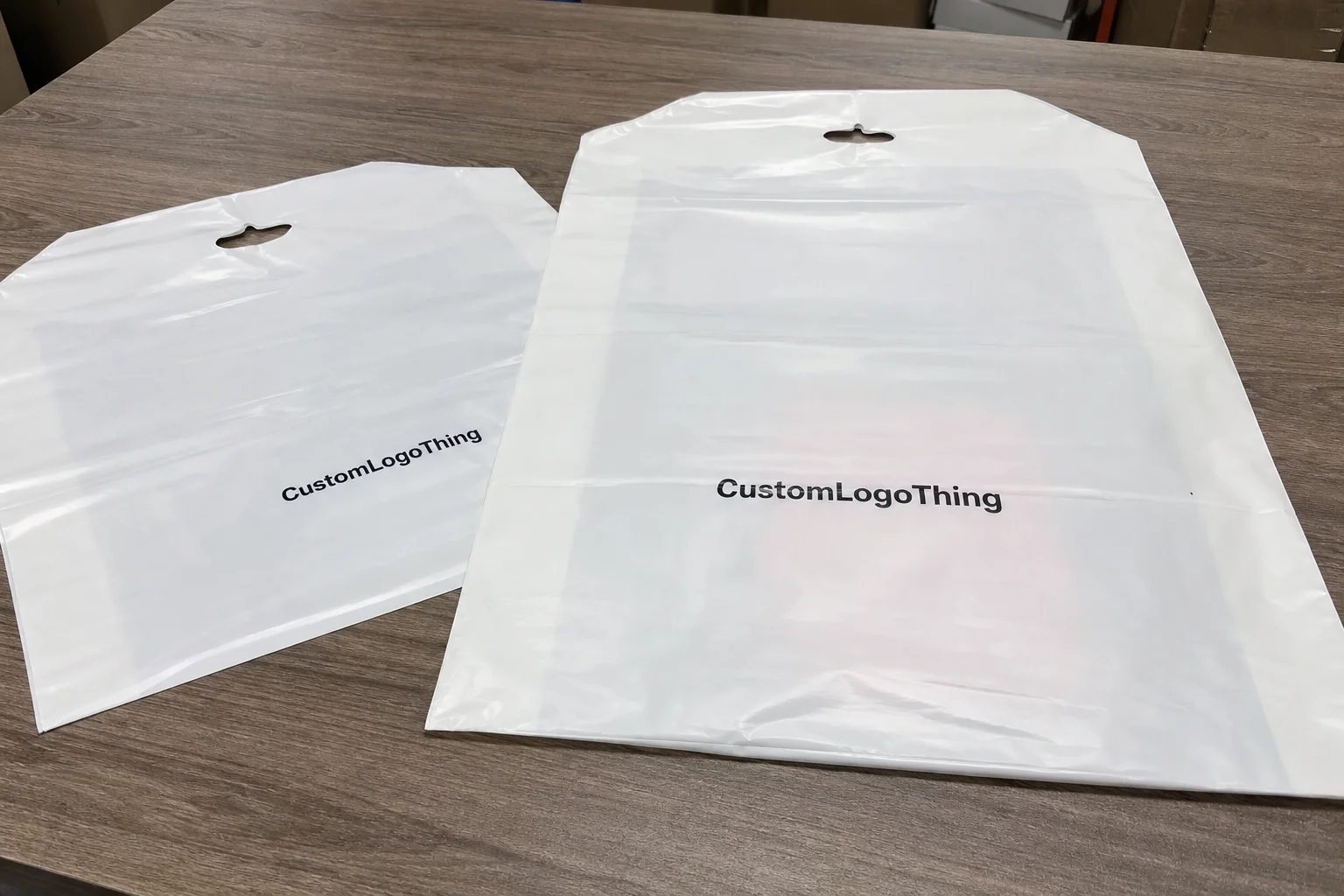
Boutique owners usually start with protection and end up caring just as much about presentation. A plain clear cover protects inventory, but a branded one tells the shopper that the item has been handled with attention. That distinction matters on dresses, occasionwear, outerwear, and other higher-ticket garments where the packaging becomes part of the perceived value.
There is a practical reason too. Garment bags reduce airborne dust, keep items organized during seasonal swaps, and make overstock easier to sort when the back room is moving fast. The labor savings are not dramatic on one bag, but they matter across a wall of inventory. Fewer rehangs, fewer repacks, and fewer damaged pieces all have a real operating cost behind them.
That is why the printed Custom Plastic Garment Bags quote for boutique buyers should be judged on use value, not on the cheapest unit price alone. A bag that holds its shape, prints cleanly, and fits the store’s visual system can perform better over time than a cheaper bag that tears at the seam or looks sloppy after a few uses. The difference is small on the first day and obvious after several weeks of handling.
"The right bag does not need to shout. It needs to protect the garment, support the sale, and make the price feel earned."
For boutiques that are building a consistent packaging system, garment bags sit in the same conversation as signage, labels, shopping bags, and display materials. That is where the decision becomes commercial, not cosmetic.
Bag styles, finishes, and branding choices that fit boutiques
The simplest option is a clear poly garment bag. It keeps the garment visible, which helps with merchandising and quick checks in storage. Frosted film gives a softer, more premium look and does a better job of hiding folds and hanger clutter. Tinted or lightly opaque film can push the presentation further toward exclusivity, although it also reduces immediate visibility.
Construction matters as much as appearance. Long-length covers fit dresses and gowns. Wider gusseted bags work better for coats, layered items, and structured jackets. Open-bottom styles slip over garments already on a hanger. Zipper closures improve repeat use, while hang-hole options keep the bag ready for rack display. Each choice changes not only the look, but also the cost structure and the way the item will be handled day to day.
Branding should follow how the bag will actually be used. A small one-color logo near the top edge is often enough for backroom protection or staff handling. A centered front-panel logo creates stronger retail presence. Repeated pattern printing works for fashion-forward boutiques, but it increases the risk of registration issues if the film is thin or the artwork is too detailed.
In practice, the tradeoffs look like this:
- Clear film shows the garment and usually keeps cost down.
- Frosted film looks more polished and hides visual noise.
- Gusseted construction gives room for coats, embellished pieces, and bulkier silhouettes.
- Zipper or closure styles improve reusability but add cost and production complexity.
- Top-placement branding keeps the logo visible without overpowering the garment.
For retailers that also sell accessories or gift items, the same visual language can run through shopping bags, tissue, hang tags, and custom printed boxes. That consistency usually reads as intentional rather than assembled piecemeal.
Film gauge, size, closures, and print specs to lock in
The quote becomes useful only after the specification is tight. Before production starts, confirm bag length, width, gusset depth, hanger opening, closure style, and usable print area. If any of those change later, price and lead time can move with them. For floor-length garments, a few extra inches can matter. For structured outerwear, gusset depth often matters more than height.
Film thickness affects both feel and durability. Thinner film can work for lightweight garments stored on a rack, while heavier coats, embellished items, and bags that are handled often usually need a stronger gauge. For many retail applications, buyers start looking in the range of 1.5 mil to 3 mil for lighter use, and 3 mil or above for heavier protection or repeated handling. There is no universal answer here. The garment should drive the spec, not a generic catalog number.
Print variables also affect the result. The number of colors, logo size, ink opacity, placement, and whether the artwork is a single mark or a repeat pattern all change the production path. A simple one-color logo is easier to control than a dense multi-color pattern with fine type. On film, thin lines and tiny text can disappear quickly if the artwork is not built for the substrate.
A practical prepress rule: send vector artwork whenever possible. If the brand file is locked in a raster format, the proof team will spend time cleaning edges and rebuilding line quality. If color matters, define spot color targets early. Otherwise, the proof stage turns into a negotiation instead of a check.
- Confirm dimensions first, then adjust print placement.
- Match film gauge to garment weight, not to a generic price target.
- Ask for the exact print area so the logo does not land in a seam or fold zone.
- Approve artwork only after the print method is fixed, because detail loss is common on thin film.
For buyers who need to think about durability and shipment readiness, packaging testing standards are a useful reference point. ASTM methods for material properties and ISTA transit standards help frame the discussion if bags will travel with merchandise or sit in warehouse conditions. The same discipline used for secondary packaging should apply here. See the broader testing framework at ISTA.
What drives a printed custom plastic garment bags quote for boutique buyers
The major pricing drivers are straightforward: size, film type, thickness, print colors, closure style, and quantity. The quote also reflects setup, waste allowance, proofing, and whether the order is a stock format or a fully custom shape. Two garment bags can look similar on paper and still land in different price brackets because one requires a new die or a more complex print process.
Unit cost usually drops as volume rises because setup gets spread across more pieces. That is basic manufacturing math. The first 1,000 units carry more of the fixed cost than the next 4,000. If the print is simple and the bag is a stock size, the drop can be meaningful. If the design is complex, the decline is less dramatic.
For reference, a simple clear bag with one-color branding might land around $0.18 to $0.28 per unit at 5,000 pieces, depending on film gauge and dimensions. Frosted film, heavier gauge, zipper styles, or larger custom sizes often move into the $0.30 to $0.55 range or higher. Small pilot runs cost more per unit, sometimes noticeably more, because the factory still has to set up the job.
| Option | Typical use | Relative cost | Buyer tradeoff |
|---|---|---|---|
| Clear poly, one-color logo | Everyday boutique protection, quick merchandising | Lowest | Best for simple inventory control and basic branded packaging |
| Frosted film, one-color logo | Premium presentation, seasonal collections | Moderate | Better visual finish, hides folds and hanger clutter |
| Gusseted bag, centered logo | Coats, dresses, embellished garments | Moderate to high | More room and better drape, but more material use |
| Zipper or closure style | Reusable storage and repeated handling | Higher | Convenient and durable, but setup and labor increase |
| Fully custom size and multi-color print | Specialty collections, high-visibility brand systems | Highest | Strongest brand expression, but the quote moves fast |
MOQ is the other lever buyers need to watch. Stock sizes and simple prints can often support lower quantities. Fully custom dimensions, multi-color graphics, and special closures usually raise the minimum. If the boutique is testing a seasonal line, it is smarter to ask for the lowest viable MOQ and then price two or three volume breakpoints. That gives a real purchasing view instead of a single number that looks cheap only because it hides the setup load.
Freight also changes the equation. Air shipping cuts time, but the landed cost climbs quickly. Sea freight lowers shipping expense, but the planning window gets longer. A fair quote should separate production cost from freight so the buyer can compare apples to apples.
Process and lead time: from artwork to shipment
A clean order follows a predictable path: inquiry, spec confirmation, artwork review, digital proof, sample approval if needed, production, inspection, and shipment. The more disciplined the buyer is at the start, the less likely the process is to stall halfway through. That sounds obvious, but many delays begin with a missing measurement or a logo file that was never production-ready.
Lead time depends on whether the order is a repeat run or a new setup. Reorders move faster because the factory already has the spec and print reference. New sizes, new film colors, or new closures usually add time. A straightforward run after proof approval often sits in the 12 to 15 business day range, but that can stretch if the plant is busy or the buyer keeps revising the artwork.
Delays usually show up in a few predictable places:
- Unclear measurements for longer garments or bulky silhouettes.
- Late artwork changes after the proof has already been issued.
- Missing vector files that force redraw work.
- Seasonal congestion before bridal, holiday, or special-event peaks.
- Shipping decisions made too late to secure the right freight window.
For buyers who need tighter brand control, it helps to separate artwork approval from production-spec approval. Those are not the same thing. A logo can look fine and still be placed incorrectly if the bag structure changes. That distinction matters in retail packaging, where one bad seam placement can ruin the visual effect.
EPA guidance on packaging waste reduction gives useful context for buyers trying to avoid excess material and overpackaging. The principle is simple: use only what the product needs. See the broader discussion at EPA waste reduction guidance.
Common order mistakes that inflate unit cost or cause delays
The fastest way to overpay is to guess on dimensions. A hanger shape, a floor-length hem, or an oversized coat can change the bag specification enough to push the job into a custom category. Measure the garment in use, not just the clothing label. That is where the surprises usually are.
Another common mistake is approving artwork before the print method is fixed. A design that looks clean in a PDF may lose legibility on film once the ink hits a glossy or frosted surface. Tiny reverse text, thin outlines, and low-contrast colors are the usual offenders. If the logo depends on fine detail, simplify it early.
Ordering too few units is also expensive. The unit price may look manageable, but the setup charge eats margin. Ordering too many creates a different problem: cash gets tied up in storage, and the next season may call for a different logo or bag size. Most boutiques are better off pricing a volume ladder before they commit.
Packaging assumptions can cause trouble as well. Carton count, master pack size, and pallet configuration affect freight and warehouse handling. A box count that looks efficient on paper can become awkward if the bags are bulky or if the receiving dock has limited space. The best quote is the one that accounts for the whole move, not just the line item cost of the bag.
There is also a sustainability angle. If a boutique is trying to reduce waste, ask whether the bag needs to be heavier than the garment warrants. Over-specifying film is a common habit. Better to match the load and, where relevant, use responsibly sourced paper components or cartons that support broader environmental goals. FSC is a credible reference point for paper-based packaging materials: FSC certified sourcing.
What to verify before you approve a production partner
A good supplier should speak plainly about specs, pricing, and tradeoffs. If the response is vague and thin on detail, that is a warning sign. Ask how they control film gauge, how they inspect print registration, and how they handle seal consistency. If those points cannot be explained without jargon, the risk sits on the buyer side.
Quality control matters more than sales language. Boutique buyers need consistent film thickness, clean seals, accurate print placement, and carton-level inspection before shipment. A bag that passes on one sample sheet but fails in bulk is not a savings. It becomes a second-order cost that shows up as rework, damaged inventory, or brand inconsistency.
Reorder reliability matters too. A store may use the same garment bag for a new season, a pop-up event, or a second location. If the supplier cannot keep the artwork and specification stable, the whole packaging system starts drifting. That is the opposite of efficient product packaging.
For buyers comparing vendors, a simple filter is usually enough:
- Clear spec sheet with dimensions, gauge, closure, and print area.
- Transparent quote that separates production, tooling, and freight.
- Proofing discipline before anything goes to press.
- Reorder record for repeatable runs.
- Practical guidance on whether the bag fits the garment, not just the budget.
That level of discipline matters because garment bags sit at the intersection of merchandising, storage, and customer perception. If those three parts are not aligned, the packaging becomes another cost center instead of a useful retail tool.
Next steps to request an accurate boutique quote
Before pricing is requested, it helps to have a short spec list ready: garment type, bag dimensions, film preference, logo file, number of print colors, quantity, and required delivery date. If the assortment includes dresses, coats, and lightweight tops, separate them. Mixed use creates mixed specs, and mixed specs lead to weak pricing.
Ask for both a unit cost and a landed estimate. Unit cost alone is incomplete. Freight, carton counts, and destination all matter. A quote that looks favorable at the factory gate may not be the best buy once it reaches the dock.
For a first run, a proof with exact artwork placement is worth the extra time. It catches mistakes that are expensive to fix after production starts. For established programs, keeping the final approved spec sheet and artwork file together makes the next reorder faster and cleaner.
The purchase makes sense when the bag does three things at once: protects the item, reinforces the store’s identity, and fits the retail operating model. If it only does one of those things, the spec probably needs another pass. For boutique buyers planning replenishment, seasonal launches, or new store openings, the useful question is not simply the unit price. It is whether the printed Custom Plastic Garment Bags quote for boutique use reflects the garment, the handling environment, and the life of the packaging after delivery.
What affects a printed custom plastic garment bags quote for boutique orders?
The biggest drivers are size, film thickness, print colors, closure style, and total quantity. Artwork complexity and whether you need a stock size or a fully custom size also change the price. Freight, rush timing, and carton configuration can shift the final landed cost.
What MOQ should I expect for custom printed garment bags for a boutique?
MOQ depends on whether you choose a stock format or a fully custom size. Simple one-color runs are usually easier to produce at lower quantities than multi-color or specialty finishes. If you need a pilot run, ask for the lowest viable MOQ and the unit cost at a few volume breakpoints.
Which material and thickness work best for boutique garment protection?
Lightweight everyday pieces can use thinner clear film, while heavier coats and premium garments benefit from thicker film and stronger seams. If the bag will be handled often or shipped to stores, durability matters more than the lowest possible price. Ask for a recommendation based on garment weight, length, and storage conditions.
How long does production usually take after artwork approval?
Lead time depends on whether the order is a repeat run or a new custom setup. Artwork approval, proof changes, and seasonal factory load are the most common schedule variables. If timing is tight, confirm production, inspection, and shipping dates separately instead of relying on one general estimate.
Can I reorder the same boutique garment bag later with the same print?
Yes, most buyers reorder the same dimensions and artwork once the first run performs well. Keep the final approved spec sheet, artwork files, and print reference so the next quote is faster and more accurate. Reorders are usually simpler and more cost-efficient than starting from scratch.