Bakery buyers searching for a printed Custom Plastic Garment Bags quote for bakery use are usually trying to solve a very specific packaging problem. A tall cake box may need to stay upright in a delivery handoff. A pastry tower may need a clear protective cover that does not hide the product. A holiday gift pack may need more height and polish than a standard carryout bag can provide. The phrase may sound unusual at first, but the structure behind garment-style packaging often fits bakery products better than short retail sacks or flat shopping bags.
The right bag can make a pickup order feel intentional instead of improvised. It can also reduce small handling problems for staff, especially during weddings, catered breakfasts, office dessert drops, and seasonal rushes, where the package has to move quickly but still look like it belongs to the brand. A clean quote starts with matching the bag format to the actual product, then confirming film, gauge, print method, quantity, and lead time before production begins.
Why Bakeries Ask for Garment Bags in the First Place
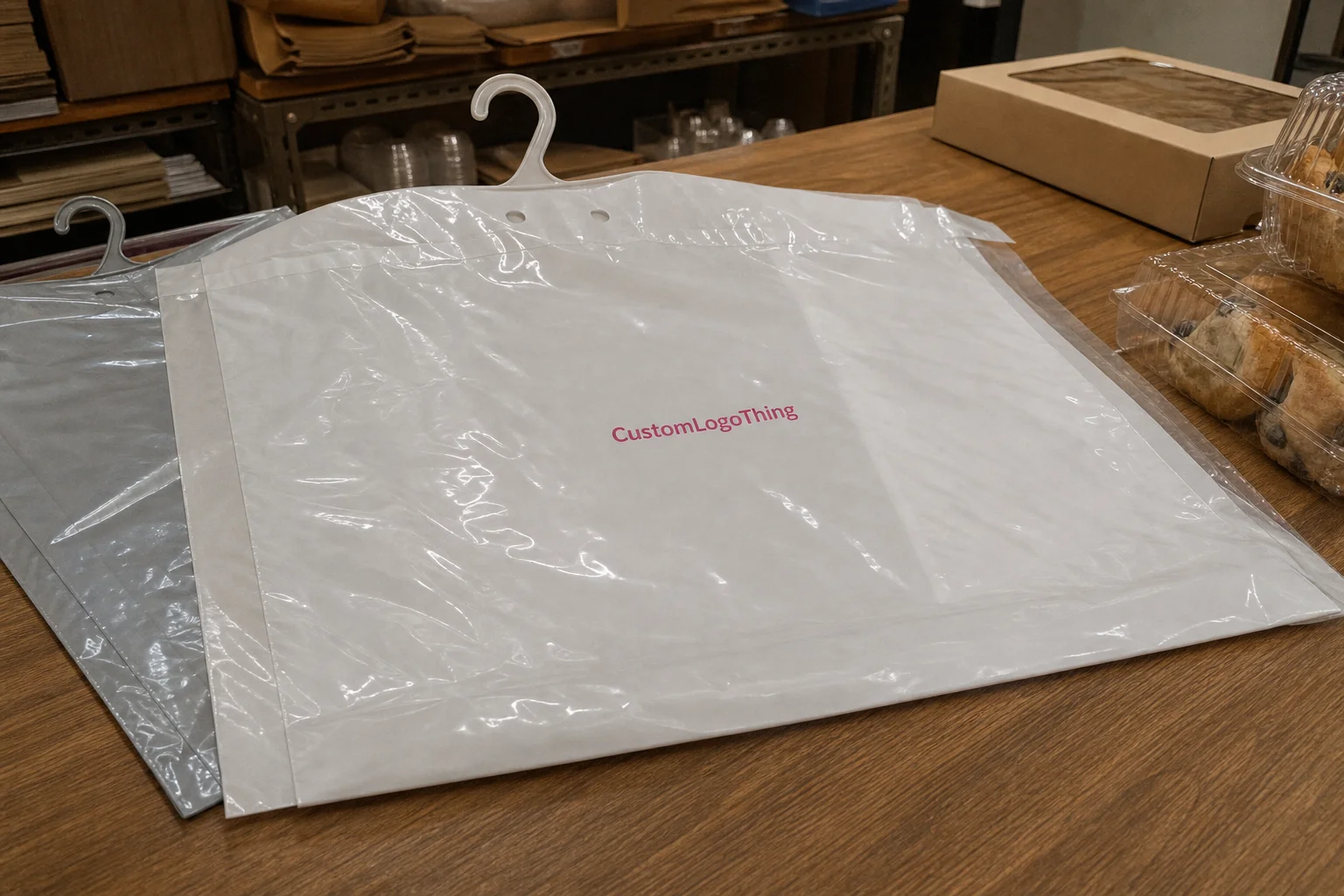
Garment bags were originally designed around vertical coverage. That simple design logic is why they can work well for certain bakery applications. Tall celebration cakes, stacked cookie towers, boxed pastry assortments, and presentation gift packs do not behave like flat grocery goods in transit. They need height, stable coverage, and enough internal space that the bag does not collapse into the corners of the box.
From a packaging buyer’s perspective, the appeal is practical. Paper shopping bags can crease under weight or soften in humid conditions. Rigid outer boxes protect well, but they take up storage space and can raise material cost quickly. Standard plastic carriers are often too short, too open at the top, or too casual for premium pickup orders. A tall plastic sleeve or garment-style carrier sits between those options, giving the bakery a lighter outer package without losing branded presentation.
There is also a visibility advantage. A printed sleeve turns a handoff into branded packaging that moves through parking lots, hotel lobbies, wedding venues, office receptions, and apartment buildings. That exposure only works if the logo is readable, the bag hangs correctly, and the proportions suit the product inside. A wide horizontal mark on a narrow vertical carrier often looks weaker than expected once the film folds around the box.
Many bakeries get the strongest value from choosing one well-sized format that can cover several order types. A carrier that fits a two-tier cake box, a pastry tray, and a seasonal gift pack can reduce SKU clutter and keep package branding consistent. It also makes staff training easier, because the team is not choosing between five similar bags during a busy pickup window.
“The best bakery carrier is not the fanciest one. It is the one that keeps the product upright, the logo visible, and the handoff fast.”
If the garment-style bag is part of a broader retail packaging refresh, it helps to review the rest of the packaging system at the same time. Cake boards, inner boxes, tray liners, labels, and outer bags should not fight each other visually or functionally. For related packaging formats, review Custom Packaging Products; once dimensions and artwork are ready, use Contact Us to send a complete quote request.
Bag Formats That Fit Bakery Products Without Guesswork
For bakery use, “garment bag” usually means a taller plastic bag or sleeve with enough vertical coverage to protect an elongated or presentation-sensitive item. Depending on the supplier’s catalog and production equipment, that may include open-bottom sleeves, die-cut handle bags, soft-loop handle bags, fold-over top bags, wicketed bags, or gusseted carriers with more internal volume.
The best format depends on the load. Tall cake boxes need height clearance so the top of the box does not rub against a sealed edge or tear the film. Pastry trays need enough width for tray corners and enough bottom support that the package does not sag awkwardly. Gift bundles often need side gussets so tissue, ribbon, inserts, or secondary cartons do not distort the face of the bag. A quote request should include product dimensions rather than a rough description such as “large cake bag” or “gift bag size.”
Closure style changes both appearance and workflow. An open top is fast for counter service, but it does not provide a tamper cue. An adhesive strip gives a cleaner closed package and may be useful for local delivery. A fold-over flap improves presentation for wedding favors, corporate gifts, or premium holiday sets. A hanger hole is usually unnecessary for bakery-only use, though it can make sense if the same bag also supports branded aprons, uniforms, or merchandise.
- Open-top sleeve: Fast for counter pickup and boxed bakery orders.
- Die-cut handle bag: Simple carry format for cakes, pastry boxes, and event orders.
- Gusseted garment-style carrier: Better for wider boxes, trays, and gift packs with more depth.
- Fold-over top bag: Cleaner presentation for weddings, corporate gifting, and seasonal collections.
- Clear protective cover: Useful when box artwork, ribbons, or product decoration should remain visible.
Choose the format that matches the product, not the one that looks familiar from another category. Loose baked goods still need a primary food-safe wrap, box, or liner before they go into an outer printed bag. Oily pastries, warm products, and items that release condensation are common trouble spots. If moisture collects inside the bag or oil transfers to the film, the package can look poor even when the print quality is good.
For bakery teams that also sell non-food items, a tall carrier may support uniforms, branded aprons, retail merchandise, event kits, or packaged gift cards. That cross-use can help justify a custom run, especially when the bag size and artwork remain consistent across programs. The caution is fit: a carrier that is too large for the everyday bakery order will look loose, even if it works well for a quarterly merchandise drop.
Material, Film Gauge, and Food-Contact Details Buyers Should Confirm
The film choice matters as much as the logo. LDPE has a softer, more flexible feel and is common for bags that need some stretch. HDPE is thinner and crisper, which can help control cost for lighter pickup orders. CPP and OPP are often chosen when clarity is the priority and the buyer wants the box graphics, ribbon, or decorated contents to show through the outer bag. Recycled-content and compostable or biodegradable options may be available in some programs, but they depend on supplier capability, local disposal realities, and the intended use of the package.
Food contact needs to be stated plainly. A bag may be suitable as an outer carrier for boxed goods but unsuitable for direct food contact. In bakery packaging, that distinction is normal. The cake sits in a box. Cookies sit in a tray with a liner. Pastries are wrapped or separated from the outer film. The printed carrier is there for transport and branding, not direct exposure. If the bag will touch food directly, the supplier needs that information before quoting because film selection, ink system, and documentation may change.
Gauge selection should be tied to the actual load. Lighter gauges can work for retail pickup bags carrying boxed items. Medium gauges are a safer middle ground for catered orders or heavier pastry assortments. Heavier films make sense when the product is large, the bag may be reused, or the order will be handled several times before reaching the final recipient. A thinner film may save money, but it can wrinkle more easily and make the printed logo look less controlled.
| Film / Build | Typical Use | Appearance | Practical Notes |
|---|---|---|---|
| LDPE, lighter gauge | Bakery pickup bags for boxed items | Soft, flexible, slightly cloudy | Often cost-effective for standard retail packaging |
| HDPE, lighter gauge | Quick-service orders and lighter packs | Crisp, thin feel | Useful for price control, but with less body than LDPE |
| CPP / OPP | High-clarity presentation bags | Clear, polished surface | Good for visible boxes, labels, ribbons, and premium branding |
| Heavier custom film | Catering, gift packs, repeated handling | More structure, less drape | Raises unit cost while improving durability and presentation |
Before approving a specification, ask whether the bag is being quoted for direct food contact, indirect contact, or outer-carrier-only use. That single detail affects the material recommendation, ink choice, and sometimes the compliance paperwork. If the order will support refrigerated pickup, ambient display, or local delivery, include that context too. Cold boxes can create condensation; hot products can trap steam; both conditions may change how the film performs in real service.
Be careful with sustainability language. An FSC reference applies to paper-based packaging, not plastic film. Recycled content should be described by percentage and material type. Compostable claims should be backed by the appropriate standard and should match the disposal environment available to customers. If a supplier references ASTM or ISTA testing, ask what was tested and under what condition. The goal is not to collect acronyms; it is to confirm that the packaging performs as expected. Useful reference points include ISTA for transit testing and Packaging School / packaging.org for broader packaging education.
Print Specifications That Change the Final Look
Printing is where a functional carrier becomes a sales tool. Front-center placement is usually best for pickup visibility. Repeated patterns can work for boutique bakeries that want a more decorative presentation. A tall vertical layout often suits garment-style proportions better than a wide landscape logo, especially after the film folds around a box or tray.
Flexographic printing is commonly used for repeat plastic bag orders because it keeps unit cost practical at scale. Screen printing can suit shorter runs with bold artwork and limited colors. Digital printing may be available for certain bag constructions when simplified setup matters more than the lowest possible unit cost. The right method depends on quantity, print coverage, color count, registration tolerance, and the type of film being used.
A one-color mark can look excellent if the contrast is strong and the logo is sized correctly. Three-color artwork can look richer, but each added color affects cost and proofing. For a bakery managing spend, the strongest result often comes from a compact logo, one accent color, and enough clear or white space for the print to breathe. Tiny text is risky on plastic film. Thin lines, delicate script, and small QR codes can break down or distort, especially on a soft film that flexes during handling.
Practical art prep matters. Send vector files in AI, EPS, or print-ready PDF format whenever possible. Include Pantone references if color matching matters, and state the expected printed logo size instead of only attaching the artwork file. If the bag is clear, specify whether the print should be read against a white cake box, a kraft box, a dark gift insert, or the product itself. Background color changes can make the same ink look different.
Heavy ink coverage deserves a careful review. Full floods can raise drying requirements, make scuffing more visible, and change the hand feel of flexible film. Large solid print areas may also show pinholes or minor variation more readily than a lighter design. For most bakery programs, restrained artwork is the better commercial choice: cleaner production, fewer surprises, and a bag that supports the product instead of overpowering it.
Pricing, MOQ, and Unit Cost Drivers for Bakery Bag Quotes
A bakery bag quote is built from a familiar group of variables: size, material, gauge, gusset depth, handle style, closure, print colors, ink coverage, order volume, packing method, and delivery destination. Change one variable and the quote moves. Change the size, film thickness, and color count at the same time, and the difference can be significant.
MOQ exists because production includes fixed steps. Film setup, printing plates or screens, press time, cutting, sealing, inspection, and packing all need to be absorbed by the run. A simple one-color printed carrier generally allows more flexible minimums than an oversized, heavy-gauge, multi-color structure. Larger quantities usually bring the per-bag price down, but volume does not erase every cost. A larger bag, deeper gusset, premium film, or heavier ink coverage can offset part of the quantity advantage.
For bakery buyers, a realistic budget conversation is more useful than asking for the cheapest possible bag. A standard-size printed carrier will sit in one price band. A tall custom sleeve with gussets, heavier film, and two-color printing will sit in another. Ask for tiered pricing at quantities such as 1,000, 3,000, and 5,000 units if storage space and sales volume support that comparison. The unit cost may fall quickly, while the cash tied up in inventory rises just as quickly.
Setup charges may be listed separately or built into the unit price. Ask about plates, dies, proofing, sampling, and repeat-order storage. A quote that looks higher at first may be more transparent if those costs are separated. That matters for reorders because a second run may reuse the same production tooling, provided the artwork and bag specification do not change.
| Order Approach | Best For | Typical Cost Behavior | Watchouts |
|---|---|---|---|
| Low MOQ, simple print | Seasonal tests and small bakery lines | Higher unit cost | Good for risk control, weaker for margin |
| Mid-volume standard size | Retail pickup programs with steady demand | Balanced unit cost | Requires storage space and predictable turnover |
| Higher volume with repeat artwork | Holiday, wedding, and catering programs | Lowest unit cost potential | Inventory planning becomes the main constraint |
Price ranges vary by supplier, size, film, and print method, so any estimate should be treated as directional. In many custom plastic bag programs, simple printed runs may price in the low cents per bag at higher quantities, while lower-volume, larger, thicker, or multi-color bags can move much higher. Freight can also change the landed cost, especially when cartons are bulky even if the bags are lightweight.
Seasonality is not a side issue for bakeries. Holiday gift packs, wedding orders, graduation season, and corporate dessert programs can justify buying packaging earlier than feels necessary. Rush fees are often avoidable when dimensions, artwork, and proof approvals are handled before the peak sales window. If the supplier can keep plates or production files on hand for reorders, ask how long they retain them and whether repeat runs qualify for reduced setup charges.
Process, Timeline, and Proofing Before Production
The production path should be straightforward: submit specifications and artwork, confirm material and size, receive a quote, approve a digital proof, review a physical sample if needed, then move into production and shipping. In practice, delays usually come from incomplete inputs. Unclear dimensions, late artwork changes, missing color references, and vague packaging goals slow down a quote before the order ever reaches the press schedule.
A quote for printed bakery garment-style bags should be based on real product dimensions. If the bag needs to fit a tall cake box, measure the full packed height, including toppers, handles, ribbon, or closure clearance. If the bakery uses several box types, test the largest one before approving the size. A sample that looks correct as a flat measurement can fail once the actual tray or box sits inside it.
Proof review is not a courtesy step. Confirm logo scale, print orientation, handle placement, gusset position, closure direction, and whether the product loads from the top or bottom. A bag can be technically the right size and still look wrong if the artwork lands too low, the fold line cuts through the brand mark, or the handle removes space from the visible print area. The proof should also identify color count, print side, repeat pattern, and any required recycling or handling marks.
Typical lead time depends on artwork readiness, proof approval, material availability, print method, order size, and shipping distance. A simple repeat order may move faster than a first-time custom structure. New sizes, new artwork, special films, and physical sampling add time. For event, wedding, or holiday programs, build in room for at least one correction cycle. Shipping time matters as well, particularly for bakery groups sending packaging to more than one location.
One practical rule: do not approve artwork until the bag dimensions have been tested against the actual box, tray, or gift pack. That single check prevents many avoidable reprints. It also helps the buyer catch small issues that a flat dieline cannot show, such as a handle sitting too close to a box corner or a gusset pulling the logo around the side.
Quality-control expectations should be discussed before production. Ask how the supplier checks print registration, seal strength, handle cut quality, carton counts, and tolerance on finished size. Plastic bags have manufacturing tolerances, and film can vary slightly from run to run. A professional quote should make the acceptable range clear enough that both sides understand what will be delivered.
Quote Request Checklist for Bakery Buyers
A clean quote starts with a complete brief. Include bag width, height, gusset depth, film type, gauge, handle or closure style, print colors, logo files, estimated quantity, delivery ZIP code, and target in-hand date. If the target date is tied to an event or seasonal launch, say so. A supplier can often suggest a safer production path when the deadline is visible from the beginning.
Product photos are helpful, but measurements are better. Send the exact dimensions of the cake box, tray, tower, or gift pack that will go inside the bag. Bakery packaging is often taller or more irregular than standard retail packaging, so a photo can help the supplier spot fit issues, while dimensions allow them to price accurately. If several product lines need coverage, ask for two or three size options and compare the tradeoff between a better fit and fewer SKUs.
For purchasing teams, the best question is not simply “What is the lowest price?” A better question is, “What is the lowest practical MOQ, and what production quantity gives the best value?” Those answers are different. A smaller run reduces inventory risk. A larger run usually improves unit economics. The right choice depends on sales turnover, storage space, design stability, and how often the bakery changes seasonal packaging.
- Send exact dimensions for the loaded product.
- Specify whether the bag touches food directly or only carries boxed or wrapped goods.
- Attach vector artwork and Pantone targets if color accuracy matters.
- Request tiered pricing to compare run sizes.
- Ask about plates, dies, proofing, sampling, and repeat-order costs.
- Confirm production lead time, shipping method, and carton packing details.
For buyers seeking a printed Custom Plastic Garment Bags quote for bakery packaging, the cleanest path is to send the whole specification in one message: dimensions, artwork, quantity, material preference, food-contact use, and deadline. That gives the supplier enough information to quote the right structure instead of guessing at a rough bag size. It also makes the final package easier to approve, because the quote, proof, and production run are all tied to the same facts.
What details do I need for a custom plastic garment bag quote for a bakery?
Provide bag width, height, gusset depth, material preference, film gauge, handle or closure style, print colors, order quantity, delivery ZIP code, and target delivery date. Include the dimensions of the bakery box, tray, tower, or gift pack that will go inside the bag. Send vector artwork when possible, such as AI, EPS, or print-ready PDF files.
Can printed plastic garment bags be used for direct bakery food contact?
Only when the film, ink system, and production specification are suitable for direct food contact. Many bakeries use printed plastic garment-style bags as outer carriers for boxed, wrapped, or tray-packed goods. Tell the supplier whether the bag will touch food directly or only carry packaged bakery items before the quote is prepared.
What is the MOQ for printed bakery garment bags?
MOQ depends on size, material, print method, color count, and whether custom tooling, plates, or screens are required. Simple one-color bags generally have more flexible minimums than large, heavy-gauge, multi-color bags. Ask for tiered quantities so you can compare the lowest entry order against the best unit cost.
How long does production take for custom printed plastic bakery bags?
Lead time depends on artwork readiness, proof approval, material availability, print method, order size, sampling needs, and shipping distance. Delays often come from missing dimensions, logo revisions, or late changes after proofing. For event, wedding, or holiday bakery programs, request the quote early enough to allow proofing and sample review.
How can I lower the unit cost on printed custom plastic bags for bakery orders?
Use standard sizes when possible, reduce print colors, limit heavy ink coverage, and order in larger production quantities if storage and turnover support it. Choose one bag size that fits several bakery products only if the fit still looks professional. Ask whether a simpler handle, thinner acceptable gauge, or repeat-order plate use can reduce the final cost.


