Printed Custom Plastic Garment Bags quote for coffee requests usually start with a practical packaging need. A coffee brand may need branded Bags for Apparel merch, tasting-room giveaways, staff uniforms, event bundles, or wholesale retail items. The goal is simple: protect the item, present it cleanly, and get a dependable price without vague back-and-forth.
Buyers should treat this as a procurement decision, not only a print request. The right bag improves shelf presence, reduces handling damage, and makes soft goods feel finished. A shirt folded in a clear printed sleeve looks ready for sale; the same shirt in a loose unbranded bag can look temporary.
Timing also matters. Coffee merchandising often moves around launches, seasonal drops, trade shows, and holiday programs. Packaging that can be specified, quoted, proofed, and produced on schedule is more useful than a premium concept that takes too long to define. If you already have dimensions and artwork, Contact Us with the specs so pricing can be narrowed quickly.
Why Coffee Brands Request Garment-Style Plastic Bags First
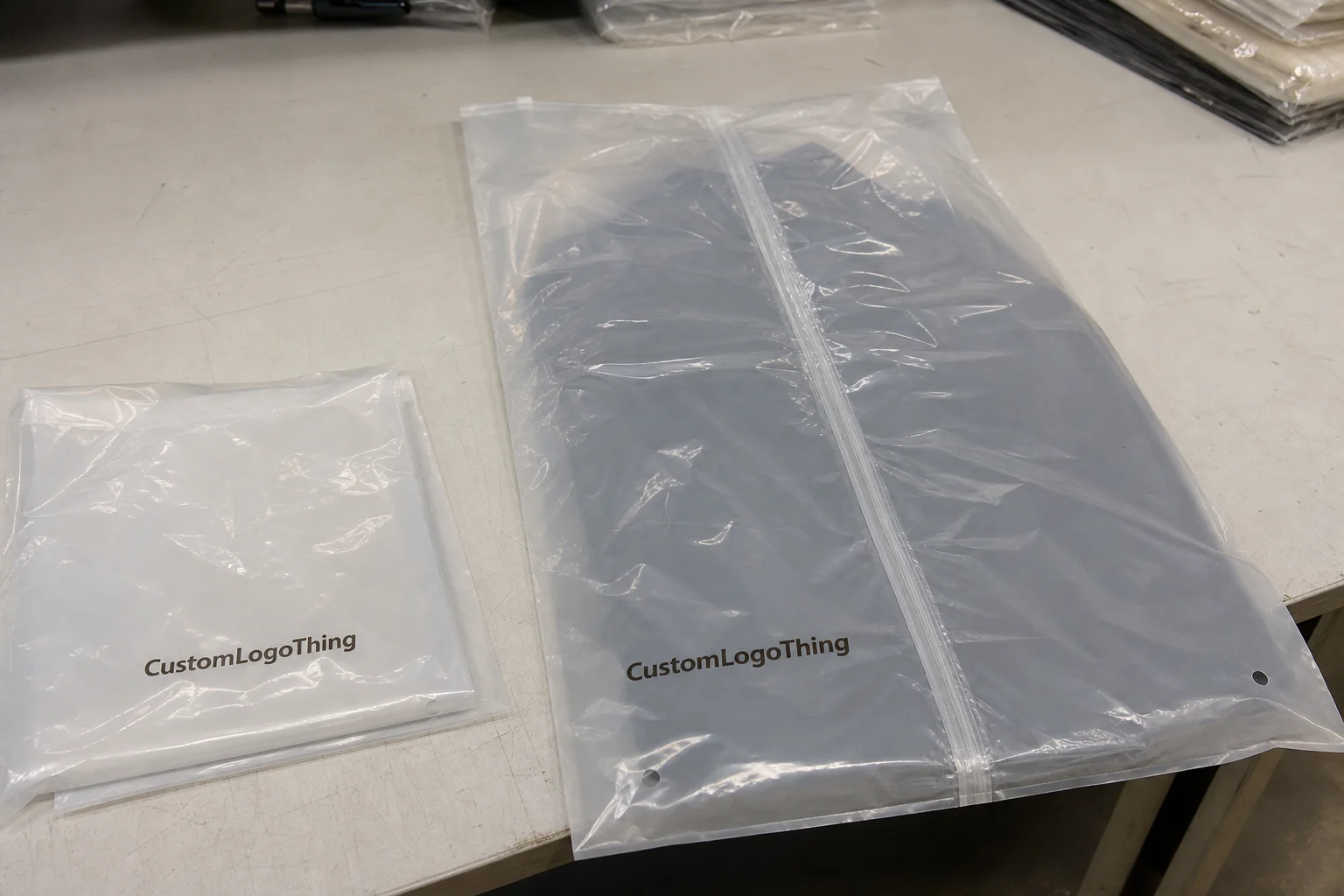
Coffee brands usually request garment-style bags because they need a low-friction way to package apparel, event merch, or bundled items. A clear or lightly tinted bag lets the customer see what is inside while the printed logo gives the item a more intentional retail presentation.
For a roaster selling a branded hoodie, limited-run tee, tote, or promo bundle, the bag supports both protection and merchandising. It keeps the product clean, helps with inventory organization, and makes a display table or shelf look planned instead of improvised. That matters at cafes, pop-ups, wholesale counters, and event booths where staff may be handling multiple sizes and styles quickly.
Cost is another reason this category is often quoted before more complex packaging. Garment bags are usually faster to specify than Custom Printed Boxes when the product is soft goods rather than a rigid retail item. Boxes may be right for premium goods, but they add structure, design decisions, storage space, and setup considerations. A garment bag is simpler to store, easier to reorder, and often enough for apparel presentation.
Reorders are important for coffee brands that run seasonal drops or replace graphics every quarter. If the dimensions, film, and print standards remain consistent, the bag can become a repeatable part of the merch workflow instead of a new sourcing project each time.
Product Details: Printed Options, Bag Styles, and Branding
Most requests use Custom Printed Polyethylene bags or a similar flexible plastic film. The common choices are open-top or sealed styles, folded or hanging formats, and one-side or two-side printing. For apparel, the usual layout is a bag sized to fit a folded shirt, hoodie, or soft item without forcing sharp creases or leaving too much empty space.
Print complexity affects both appearance and cost. A one-color logo on clear film is controlled, clean, and cost-efficient. Multi-color printing can create stronger shelf impact, but it adds setup work and can slow proofing if the artwork is not production-ready. A simple mark may be enough for a minimalist coffee brand, while a larger print area may be better for retail merch that needs to stand out.
Common style choices include:
- Clear bags for visibility and fast merchandising.
- Frosted or tinted film for a softer retail look or reduced visibility.
- Hanging styles for apparel displays and backroom organization.
- Folded or sleeve formats for compact shipping and storage.
- Printed size marks when SKU control matters across several merch items.
Printed size marks are useful when a coffee brand sells several apparel sizes or styles. A simple size callout can reduce sorting errors during fulfillment and make it easier for staff to pull the right item from a packed display or storage carton.
Some buyers add a slogan, event name, QR code, or care instruction. Use restraint. A plastic garment bag is not a full retail carton, and too much copy can make a small format look busy. The most effective designs usually balance visibility, brand recognition, and quick handling.
“The bag is doing more work than people think. It protects the item, presents the brand, and keeps inventory organized. If it misses any one of those jobs, it is not pulling its weight.”
For buyers comparing options, think in terms of the sales channel. A weekend pop-up, cafe retail shelf, wholesale program, and ecommerce fulfillment workflow may need different levels of film thickness, print coverage, and closure style, even when the bag is sourced from the same supplier.
Specifications That Affect Fit, Print Quality, and Durability
The fastest quote requests include the right specifications in the first message. A supplier needs width, length, thickness, print area, seam style, closure type, quantity, and delivery destination. Without those details, pricing becomes a placeholder and fit problems are more likely later.
Thickness has a direct effect on cost and performance. Thin film lowers unit cost, but heavier gauges hold shape better, resist tearing, and tolerate repeated handling in stores or warehouses. For apparel merch, common ranges often sit around 1.25 mil to 2.0 mil. A bag used only for display may work at a lighter gauge. A bag that goes through fulfillment, stacking, and shipping often benefits from a heavier film.
Print quality also depends on the material and artwork. Clear film can look crisp, but it exposes placement issues and ink coverage problems. If the design uses solid color, small type, or a QR code, confirm the print method, ink coverage, and whether a white underlay is needed. That choice affects both readability and price.
Bag packing should also be defined. Carton count, bundle count, and pallet pattern affect storage efficiency, receiving time, and damage risk. A merch manager with limited backroom space may prefer tighter carton packing even if the unit price is slightly higher. For warehouse teams, bags that stack and count cleanly reduce labor and receiving errors.
For critical programs, buyers can ask about film test data and transit durability. ASTM-style film properties or shipping validation aligned with ISTA methods are not always required, but they are useful when bags will face heat, compression, long-distance freight, or repeated handling before sale.
| Option | Typical Use | Common Spec Range | Buyer Impact |
|---|---|---|---|
| Clear film, one-color print | Basic apparel merch and event giveaways | 1.25-1.5 mil, 1 print color | Lowest setup cost, clean look, fast approval |
| Frosted film, two-color print | Retail packaging and premium merch | 1.5-2.0 mil, 2 print colors | Higher perceived value, stronger branded packaging |
| Heavy-gauge hanging bag | Display or repeated handling | 2.0 mil+, reinforced hanger format | Better durability, improved presentation on racks |
| Custom-sized sleeve | Bundled items or special promotions | Made to fit folded SKU dimensions | Best fit, but higher MOQ sensitivity and tooling impact |
Use the same discipline you would use for custom printed boxes. Measure the product, define how it will be handled, and decide whether the priority is speed, premium appearance, or cost control. Buyers who do that usually receive a cleaner quote with fewer revisions after proofing.
Cost, Pricing, MOQ, and What Moves the Printed Custom Plastic Garment Bags Quote for Coffee
Pricing is usually driven by five variables: bag size, material gauge, print colors, order quantity, and special packing requirements. Once those are set, the quote becomes much more reliable. Leave them open, and the estimate will carry assumptions that may not match the final order.
For smaller runs, setup costs matter more because prepress, plate work, and machine changeover are spread across fewer pieces. A 2,000-piece order can cost noticeably more per bag than a 10,000-piece order, even when the bag is identical. Quantity tiers usually reflect fixed setup work being divided across a larger run.
For a simple one-color run on standard film, buyers may see working ranges around $0.18-$0.28 per unit at 5,000 pieces. A larger size, heavier gauge, or multi-color print can move the range to $0.30-$0.55 per unit. These are planning ranges, not fixed promises. Artwork complexity, freight, packing requirements, and destination can move the landed cost quickly.
MOQ is tied to production economics. If a bag requires custom print plates, dedicated setup, or a custom size, the supplier has to recover those costs. Larger orders lower the unit price; smaller orders raise it. Buyers should compare setup fees, freight, and price breaks instead of looking only at the first unit price.
The strongest quote packet usually includes:
- Exact width, length, and thickness
- Artwork file in vector format
- Print colors and placement
- Target quantity and reorder expectation
- Preferred film finish and closure style
- Delivery ZIP, port, or warehouse destination
The cheapest quote is not always the lowest-cost purchase. A thin bag that tears, prints poorly, or arrives in the wrong size can cause rework, missed launch dates, and extra labor. The better comparison is landed cost plus operational risk.
For teams comparing suppliers, review the broader Custom Packaging Products lineup so the garment bag specification fits the rest of the branding program. A merch drop that uses one visual language across bags, tags, labels, and inserts usually looks more credible at retail.
Process, Lead Time, and Production Steps
A typical order moves through specification review, artwork confirmation, quote approval, proofing, production, quality check, and shipment. Most delays come from missing information at the start, not from the press itself.
Simple one-color orders usually move faster than multi-color or custom-size runs. A standard production window may be 12-15 business days after proof approval for a straightforward job, depending on plant capacity and material availability. Rush orders may be possible, but launch-date orders should be approved early and kept free of late artwork changes.
Proofing is where buyers prevent expensive mistakes. Check the dieline, logo placement, bag dimensions, print colors, copy, and barcode or QR readability before production starts. If the layout changes after proof approval, the price and schedule can both move.
Here is the practical sequence most teams should expect:
- Send dimensions, quantity, and artwork.
- Receive a priced quote with MOQ and lead time.
- Review the proof for size, imprint, and copy.
- Approve production and confirm shipping details.
- Inspect the first cartons on receipt if the order is critical.
Receiving inspection matters for repeat programs. Check carton count, print registration, bag dimensions, and closure quality before the shipment is fully used. If something is off, it is easier to correct before the same issue appears on the next reorder.
Industry resources can help when transit performance matters. The ISTA framework is useful for packages that will be shipped or compressed, and the Packaging Institute gives buyers a broader view of packaging performance and cost. Neither replaces a detailed spec sheet, but both reinforce the need to measure rather than guess.
Why Coffee Buyers Use Our Packaging Supply Chain
For coffee buyers, the supplier relationship needs to be operational. Consistent print registration, repeatable sizing, and documented production standards matter more than broad claims about quality. A bag that looks good in a sample but drifts in production can create problems at retail, in fulfillment, and during reorders.
This is especially true for seasonal merch and multi-SKU programs. One supplier who can manage reorders, artwork revisions, quantity planning, and packing standards reduces handoffs. It also helps the buyer forecast inventory without rebuilding the packaging process each season.
Source consistency lowers the chance of material variation, color shift, fit problems, and shipping complaints. Those issues are especially costly before a trade show, cafe launch, or holiday merch release. A few cents saved on the bag can disappear quickly if product has to be repacked or reworked.
Good packaging design is usually about reducing problems: fewer defects, cleaner presentation, fewer delays, and less labor spent fixing avoidable packaging mistakes. When garment bags are part of a broader retail packaging program, they can be paired with labels, inserts, or secondary cartons so the line looks cohesive across sales channels.
Next Steps: Send Specs for an Accurate Quote
If you are ready to request a quote, send bag dimensions, quantity, artwork file, print colors, material preference, closure style, and delivery destination in one message. A complete request usually gets a more accurate response and reduces the trial-and-error that slows production.
State the use case clearly. Bags for folded tees, event merch, staff uniforms, hanging retail display, and bundled coffee promotions can require different sizing, print coverage, and thickness. A bag that sits in a carton until shipping day does not need the same structure as one that hangs on a rack.
Ask whether tooling, freight, proofs, and packing upgrades are included. Then compare the total landed cost against MOQ, launch timing, and reorder expectations. If the quote needs to move quickly, Contact Us with target quantity and artwork so the estimate can be based on real production inputs rather than assumptions.
How do I request a printed custom plastic garment bags quote for coffee merchandise?
Send exact dimensions, quantity, artwork, print colors, delivery destination, and intended use. Include whether the bags are for apparel, event giveaways, staff uniforms, or bundled retail items because that changes the recommended specification.
What affects the price of printed custom plastic garment bags for coffee brands?
Bag size, film thickness, print colors, order quantity, and packing requirements are the main cost drivers. Artwork complexity, freight, custom sizing, and rush production can also raise the quote.
What is the usual MOQ for custom printed plastic garment bags?
MOQ varies by size and print method, but larger runs usually reduce unit cost. Ask for price breaks at specific quantity tiers and confirm whether setup or plate fees are separate.
How long does production take after quote approval?
Lead time depends on artwork approval, material availability, and print complexity. Simple orders often move faster than multi-color or custom-size runs, especially when proofs are approved quickly.
Can I get a sample or proof before full production?
Yes. Buyers should request a proof to confirm artwork placement, sizing, copy, and print readability before the full run starts.


