Buyer Fit Snapshot
| Best fit | Printed Ecommerce Mailer Boxes projects where brand print, material claims, artwork control, MOQ, and repeat-order consistency need to be specified before quoting. |
|---|---|
| Quote inputs | Share finished size, material target, print colors, finish, packing count, annual reorder estimate, ship-to region, and any compliance wording. |
| Proofing check | Approve dieline scale, logo placement, barcode or warning zones, color tolerance, closure strength, and carton packing before bulk production. |
| Main risk | Vague material claims, crowded artwork, missing packing details, or unclear freight terms can make a low unit price expensive after revisions. |
Fast answer: Printed Ecommerce Mailer Boxes: Design, Cost, and Fit should be specified like a repeatable production item. The safest quote records material, print method, finish, artwork proof, packing count, and reorder notes in one written spec.
Production checks before approval
Compare the actual filled-product size with the drawing, then confirm tolerance on folds, seals, hang holes, label areas, and retail display edges. Reserve space for logos, QR codes, warning copy, and material claims before decorative graphics fill the panel.
Quote comparison points
Review material grade, print process, finish, sampling route, tooling charges, carton quantity, and freight assumptions side by side. A quote is only useful when the supplier can repeat the same color, closure quality, and packing count on the next order.
Printed Ecommerce Mailer Boxes: Design, Cost, and Fit
A plain shipper gets a parcel from warehouse to doorstep. printed ecommerce mailer boxes do a little more than that, because they shape the customer’s first physical impression before the tape is fully lifted. The carton becomes part of the brand story, part of the protection plan, and part of the moment that tells a buyer whether the package feels considered or rushed. For direct-to-consumer brands, subscription programs, and premium fulfillment, printed ecommerce mailer boxes carry real commercial weight.
Brand teams often ask whether printed ecommerce mailer boxes are worth the extra effort over a blank carton. Most of the time, the answer depends less on taste and more on fit, material, artwork coverage, and unit cost. A well-built box can protect the product, reinforce the brand, and reduce the need for extra inserts or decorative add-ons. A poorly specified one can do the opposite, which is why the practical details matter so much.
I’ve seen this play out in real packing rooms: a box that looks beautiful on screen can turn into a nuisance once it has to be folded, taped, and stacked on a busy line. The reverse happens too. A simple structure with the right print treatment can feel polished without overcomplicating fulfillment. That balance is kinda the whole job.
What Are Printed Ecommerce Mailer Boxes?
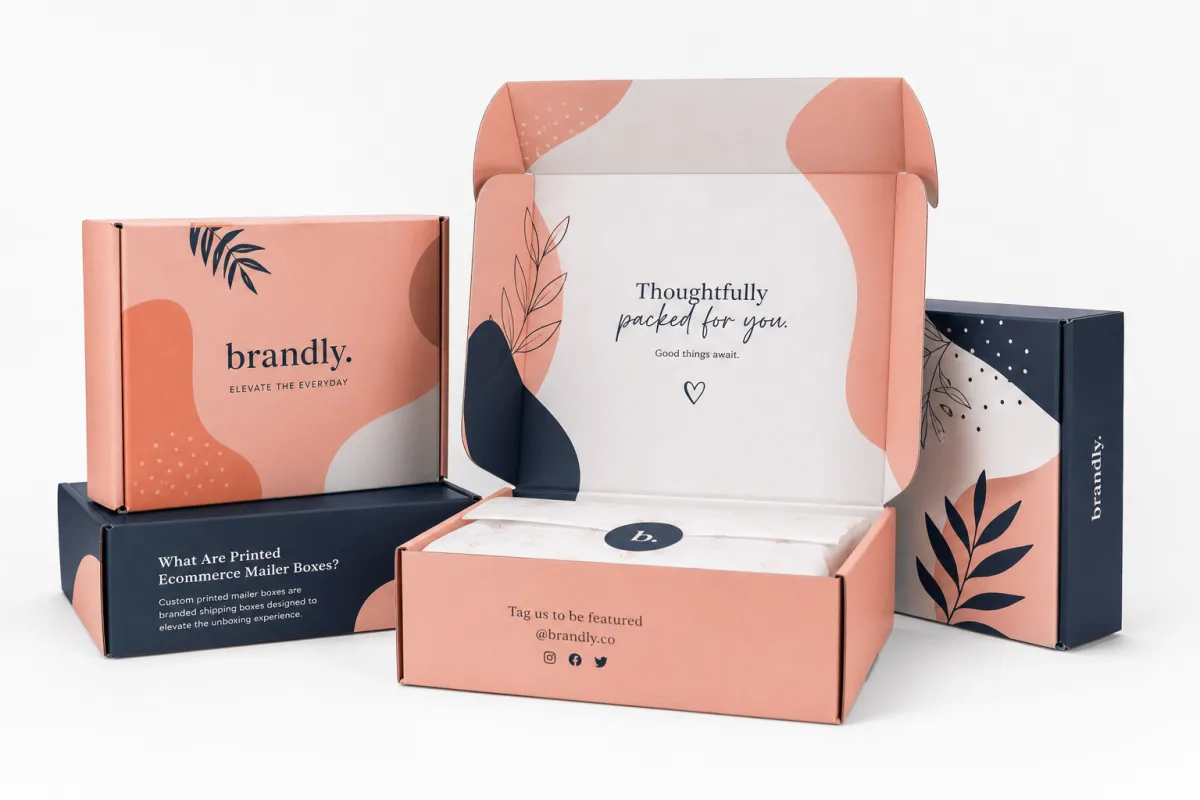
printed ecommerce mailer boxes are shipping-ready cartons customized with brand graphics, product information, campaign artwork, or care instructions. Corrugated board is the most common material because it handles parcel delivery well, though lighter applications sometimes use folding carton-style mailers for items that do not need heavy protection. The box carries the product and the brand at the same time, which is a useful combination for ecommerce operations.
That dual role makes these boxes different from packaging that only has to sit on a shelf. Ecommerce packaging has to survive warehouse handling, parcel sorting, truck vibration, stacking, temperature swings, and occasional moisture exposure, then still arrive looking intentional. printed ecommerce mailer boxes sit at the meeting point of logistics and presentation. A good spec lets the package do both jobs without drawing attention to the effort behind it.
They show up in subscription shipments, influencer kits, welcome boxes, seasonal launches, premium replenishment orders, and retail-to-door programs where the customer expects something closer to a gift than a shipping carton. Many brands use printed ecommerce mailer boxes to make repeat purchases feel personal instead of routine.
Compared with unprinted stock cartons, printed ecommerce mailer boxes usually create a stronger sense of value. Full-wrap art is not required for every order. A kraft mailer with a single-color logo can be enough for some products, while a restrained exterior paired with a printed interior can do the heavy lifting for others. Consistency matters more than decoration alone. Customers tend to remember printed ecommerce mailer boxes longer, and that memory can support repeat orders and social sharing.
There is a practical advantage too. printed ecommerce mailer boxes can reduce reliance on separate inserts, gift wrap, and oversized messaging elsewhere in the shipment. The box becomes a repeatable brand surface that marketing and operations can both trust. For many teams, that makes printed ecommerce mailer boxes one of the few packaging choices that influences cost control and customer experience at the same time.
printed ecommerce mailer boxes also fit into a wider packaging system. A brand might use them for premium kits, then use Custom Poly Mailers for lighter apparel, or standardize across a broader family of Custom Packaging Products to keep the visual language aligned. A system approach prevents packaging from drifting into one-off decisions that are hard to scale.
Stock mailers solve a storage problem. printed ecommerce mailer boxes solve a communication problem too. A basic carton can move product from one place to another. printed ecommerce mailer boxes can carry product facts, care notes, QR codes, referral prompts, and the tone of the brand itself. That extra layer is a big reason many teams treat the box as part of the sales funnel rather than a line item to minimize.
How Printed Ecommerce Mailer Boxes Work in the Unboxing Flow
The journey usually starts flat. A fulfillment team receives printed ecommerce mailer boxes as die-cut blanks, folds them into shape, places the product inside, closes the flaps, applies a shipping label, and sends the parcel into the carrier network. The sequence sounds ordinary until you unpack it: the box needs to fold cleanly, stay square, survive handling, and still deliver a polished opening moment at the door.
Structure does the real work during transit. Board grade, flute profile, score depth, locking tabs, and lid style all affect how printed ecommerce mailer boxes behave under pressure. Lightweight products may work well in E-flute or a similar thin corrugated profile, while heavier shipments often need B-flute or stronger board construction. Inserts can make a noticeable difference if the product has room to move inside the carton.
Print placement changes the customer experience more than many buyers expect. Exterior panels are the obvious branding surface, yet the interior often creates the strongest reaction because it appears only after the box opens. printed ecommerce mailer boxes can carry thank-you notes, care instructions, referral codes, or a short brand line that feels deliberate and private. Flaps are useful too. They can hold setup instructions, small compliance details, or a compact promotional line that would look crowded on the outside.
The best printed ecommerce mailer boxes do more than look attractive in a mockup. They survive drops, vibration, stacking, and moisture exposure while keeping the artwork legible and the edges crisp. A package that has to survive parcel-network abuse deserves a test against a recognized distribution standard such as ISTA methods instead of relying on a screen proof alone. That matters even more for shipments traveling long distances or moving through several handling points.
Psychology plays a part as well. A customer opening printed ecommerce mailer boxes is not thinking about flute height or board caliper. They notice the clean fold, the exact fit, the visual balance, and whether the carton seems made for the product. Those cues lower friction. The parcel feels intentional. The brand feels present. The effect can stay with the customer longer than most teams expect.
The unboxing flow is half logistics and half theater. A crowded top panel can make the shipping label fight with the artwork. An interior message with too many words can drain energy from the reveal. A loose protective fit can erase the premium feeling as soon as the product shifts inside the box. printed ecommerce mailer boxes perform best when each surface has a job and no panel is forced to do three at once.
A parcel is the first physical touchpoint. Treat it like shelf space, not filler.
With that mindset, printed ecommerce mailer boxes become easier to specify. The carton is no longer just a container. It becomes a sequence: form, protect, reveal, confirm. Each step supports the next one, which is where a good packaging experience starts to feel inevitable rather than accidental.
Printed Ecommerce Mailer Boxes Cost Factors and Pricing
The price of printed ecommerce mailer boxes usually comes down to five variables: size, board thickness, print coverage, finishing, and quantity. Small changes in any one of those can move the unit cost noticeably. A larger footprint uses more board. Heavier products can call for stronger corrugate. More artwork coverage means more ink, more setup time, and sometimes more press passes. printed ecommerce mailer boxes are simple to describe and surprisingly specific to price.
Volume changes the economics more than anything else. Setup work, die cutting, proofing, and press preparation get spread across every unit, so a 500-piece order often carries a much higher unit cost than a 5,000-piece order. That is why printed ecommerce mailer boxes can feel expensive in small runs and much more reasonable as volume rises. Buyers sometimes compare only the invoice total, but the better comparison is unit cost across several order sizes. That shows the real curve.
Hidden costs deserve attention too. Inserts, specialty coatings, white ink on kraft stock, custom shapes, freight, and storage all affect the final number. A simple kraft mailer with one-color print may stay economical. A full-color carton with matte film, interior print, and a custom insert can climb quickly. Asking for pricing with and without finishes helps a team see where the extra spend is coming from. printed ecommerce mailer boxes should be priced as a system, not as a single line item.
Here is a practical pricing lens that buyers can use when comparing printed ecommerce mailer boxes across vendors:
| Option | Typical Use | Approx. Unit Cost at 500 | Approx. Unit Cost at 5,000 | Notes |
|---|---|---|---|---|
| Stock mailer | Basic shipping without brand print | $0.45-$1.20 | $0.28-$0.70 | Lowest setup burden, limited brand impact |
| Simple printed mailer | Logo, one or two colors, light coverage | $0.90-$2.10 | $0.42-$0.95 | Often a practical middle ground for ecommerce brands |
| Premium printed ecommerce mailer boxes | Full-coverage graphics, interior print, finish upgrades | $1.50-$3.50 | $0.65-$1.40 | Higher cost, stronger unboxing and presentation value |
Those numbers are directional rather than universal. Board grade, dimensional size, and shipping destination can move them around. Even so, they give a useful view of how printed ecommerce mailer boxes behave economically. A lower-cost carton may win on purchase price, while a premium carton may win on perceived value, fewer damages, or stronger brand recall. The buyer’s job is to compare those outcomes honestly.
Quantity breaks are where the conversation gets interesting. Ask for quotes at 500, 1,000, 3,000, and 5,000 units if the supplier can provide them. The steepest drop usually appears between low-volume and mid-volume runs. That can justify a modest inventory buffer, provided storage is not a problem. printed ecommerce mailer boxes are one of those packaging items where ordering a little more can lower the average cost in a meaningful way.
Brands also need to account for the cost of inconsistency. A box that looks premium but arrives crushed erases the savings in returns, replacements, and support time. A package that feels too plain may push the team to add stickers, tissue, or extra inserts just to create the impression it wanted in the first place. printed ecommerce mailer boxes can replace several smaller touches with one controlled piece of packaging, and that often changes the budget conversation.
For brands comparing packaging formats, it helps to look beyond boxes alone. Custom Packaging Products may include sleeves, inserts, and mailers that build a fuller brand system. In some channels, a box is the right answer. In others, Custom Poly Mailers make more sense for weight, storage, or shipping efficiency. printed ecommerce mailer boxes are not always the cheapest route, but they are often the most complete brand statement.
printed ecommerce mailer boxes also intersect with sourcing decisions. If a buyer wants documented fiber sourcing, FSC-certified board can be part of the specification. The FSC system is not a design detail, but it gives procurement teams a useful signal when they need stronger documentation around responsible fiber sourcing. That matters to retailers, ecommerce teams, and consumers who ask about packaging materials.
One practical rule helps keep the quote honest: never accept pricing without asking what is included. Does it cover tooling, dieline revision, proofing, and freight? Is the sample a production sample or only a structural mockup? Do artwork changes after approval trigger extra charges? These questions do not sound glamorous, yet they change the real cost of printed ecommerce mailer boxes more than many teams expect.
Step-by-Step Process and Timeline for Ordering Printed Ecommerce Mailer Boxes
The ordering process becomes much easier once the team treats it like a packaging project rather than a one-time purchase. The first step is a precise brief. Before quoting printed ecommerce mailer boxes, the supplier needs product dimensions, product weight, packing method, shipping method, branding files, and any insert or finish requirements. Without that information, every estimate is a guess.
Structure selection comes next. A buyer might choose a tuck-top mailer, a self-locking corrugated box, a rigid presentation box, or a folding carton-style mailer depending on the product and transit profile. That structure decision matters because printed ecommerce mailer boxes cannot compensate for a bad fit. If the product shifts inside the carton, the artwork will not save it. If the fit is too tight, packing slows down and the corners can crush.
Once the structure is set, the artwork moves onto a dieline. This is where many delays begin. A design that looks clean on a digital layout can fail in the real world if the safe zones, folds, glue areas, or shipping-label panel are ignored. printed ecommerce mailer boxes need artwork that respects structure. The box is not a poster; it is a three-dimensional object that folds, locks, and ships.
A realistic timeline often looks like this: concept and quote, structural sample or spec review, artwork revision, prepress check, proof approval, manufacturing, then transit. Depending on complexity, printed ecommerce mailer boxes may take roughly 12-15 business days after final proof approval for a straightforward run, with more time needed for sampling or complex finishes. Freight adds another layer, especially for long-haul or import-related moves. A launch that depends on packaging needs margin built into the schedule.
Delays usually come from predictable sources. Late artwork changes are common. So are unclear dimensions, missing barcode placement, and slow sign-off from multiple departments. Sometimes a buyer approves a sample visually, then discovers that the packing process on the line is awkward. A fit test matters before volume production. printed ecommerce mailer boxes should be judged in the actual fulfillment workflow, not only in a photo.
Here is a clean way to think about the process:
- Measure the product and account for inserts, tissue, and protective fill.
- Choose the structure that matches weight, shipping method, and branding goals.
- Review the dieline so artwork, folds, and label zones are mapped correctly.
- Approve a proof after checking color, copy, and panel alignment.
- Run production once the spec is frozen and sign-off is complete.
- Inspect the first lot before the full shipment moves into operations.
The strongest printed ecommerce mailer boxes projects are the ones where each handoff is documented. Who approves structure? Who owns artwork? Who confirms print color? Who signs off on fit? Clear roles keep the work manageable. Without that clarity, a project can drift for weeks over tiny details that should have been settled much earlier.
Sequencing also affects cash flow. Some brands order the box before finalizing the product insert. That can work if the insert dimensions are locked separately, but it can also create an expensive mismatch. printed ecommerce mailer boxes are easiest to execute when the product, insert, and outer carton are designed together or at least checked against one another before production begins.
Common Mistakes When Specifying Printed Ecommerce Mailer Boxes
The first mistake is measuring only the product. An item that fits on paper may not fit in a real packing workflow once tissue, inserts, void fill, or finger clearance are added. printed ecommerce mailer boxes should be sized around the full packing system, not the bare item. A box that is technically large enough can still be frustrating to pack if the opening is too tight or the clearance is too generous.
The second mistake is overprinting. Heavy ink coverage, dense black solids, and elaborate finishing can make printed ecommerce mailer boxes more expensive and slower to produce. They can also create drying or scuff concerns depending on the board and print method. Some brands need that rich visual effect. Others do not. The smarter move is to ask what the artwork is doing for the customer, then decide whether every square inch needs coverage.
A third mistake is choosing appearance over strength. A beautiful box that buckles in transit is not premium packaging. It is a liability. printed ecommerce mailer boxes need the right balance of board grade, flute profile, and closure style to survive stacking, vibration, and drop exposure. Fragile products deserve a real load test before sign-off. A formal distribution test such as ISTA or a disciplined internal drop protocol pays for itself quickly.
The label zone causes trouble more often than it should. Many teams design a strong front panel, then discover there is no clean space left for a shipping label, barcode, or carrier scan zone. That creates awkward workarounds. printed ecommerce mailer boxes should reserve a calm area for logistics. The branding can still be bold; it just needs to respect the operational side of the package.
Screen approval is useful, but it misses how the carton feels in hand, how quickly it assembles, and whether the product stays still during movement. A good spec is not only visually correct. It is operationally sane. That distinction saves money later.
Here are five errors I see more often than I should:
- Leaving no room for inserts, filler, or easy packing clearance.
- Choosing an attractive finish that adds cost without adding value.
- Ignoring the shipping label and barcode placement until the end.
- Using a board grade that looks fine but fails under stacking pressure.
- Approving printed ecommerce mailer boxes without a real fit test.
Some of those mistakes sound small. They are not. A one-cent issue at the design stage can become a one-dollar issue after damage, relabeling, or labor inefficiency. printed ecommerce mailer boxes reward careful specification because the carton touches both brand and warehouse realities at once.
Expert Tips for Better Printed Ecommerce Mailer Boxes
Design for the camera and the carrier. That is the simplest way to think about printed ecommerce mailer boxes. The parcel should look good in a doorstep photo, but it also has to survive the delivery network. The first opening moment often gets shared on social media, which means the package performs in public whether the marketing team planned for it or not.
Use the inside of the box wisely. Exterior print handles recognition, while interior messaging often creates the emotional lift. A short thank-you line, a care reminder, a QR code for reorder or refill instructions, or a small brand story can carry more weight than a crowded outside panel. printed ecommerce mailer boxes give you both surfaces. The second one should not sit idle.
Standardize a box family across SKUs where possible. That does not mean every package looks identical. It means the base structure stays stable while the print content changes by season, product line, or campaign. This approach supports inventory control and keeps printed ecommerce mailer boxes from multiplying into dozens of one-off sizes that take up storage space and complicate purchasing.
Sustainability works best when it is practical. Recyclable board, right-sized packaging, and minimal coatings usually do more for recovery than complicated claims ever will. Water-based inks and simpler finishes can help keep printed ecommerce mailer boxes aligned with recycling expectations, though local rules still vary. Not every glossy effect is worth the tradeoff. Not every natural kraft box is automatically better. The right answer depends on the product, the market, and the brand promise.
Keep brand systems consistent. Typography, spacing, icon style, and panel hierarchy should feel related from one box to the next. That consistency is underrated. Customers rarely say it out loud, yet they notice it. When printed ecommerce mailer boxes fit inside a larger visual system, the brand feels organized rather than improvised.
One way to think about packaging maturity is simple: the more the box needs to explain itself, the more the design is doing the wrong job. Strong printed ecommerce mailer boxes look clear at a glance, pack efficiently, and survive the trip. They do not need to shout to earn attention.
There is a useful finance angle too. If a brand spends slightly more on printed ecommerce mailer boxes but reduces damage claims, lowers insert spend, or improves repeat purchase behavior, the net effect can be favorable. That will not be true for every business. It depends on gross margin, average order value, and fulfillment labor. Still, the arithmetic is worth checking before defaulting to the cheapest carton.
Good packaging does not ask the customer to work harder. It removes confusion, protects the product, and makes the brand feel deliberate.
That is the real promise of printed ecommerce mailer boxes. They are not just carriers. They are part of the product story, the shipping process, and the memory the customer keeps after the box is gone.
What to Do Next With Printed Ecommerce Mailer Boxes
Start with a packaging audit. List the current box sizes, product weights, damage issues, and places where the unboxing feels weak or too plain. Add any moments where the brand message could appear earlier. That gives you a factual starting point for printed ecommerce mailer boxes instead of a vague creative wish list.
Then collect the core specs before requesting quotes. Dimensions, quantity tiers, artwork files, finish preferences, insert needs, and target ship date should all be in the brief. If you want printed ecommerce mailer boxes compared accurately across suppliers, everyone needs the same input. Vague dimensions create vague pricing. Precise dimensions create meaningful comparison.
A short decision matrix helps too. Rank what matters most: lowest price, fastest timeline, strongest shelf or doorstep impact, or the clearest sustainability story. Most teams want all four, but the trade-offs are real. printed ecommerce mailer boxes are easier to approve when the team agrees on what wins if two goals conflict.
Over the next two weeks, the sequence usually looks like this: confirm the structure, review the proof, approve the sample if one is needed, and lock production timing before launch. That is a manageable path. It also keeps printed ecommerce mailer boxes from becoming a last-minute scramble that eats time from operations and marketing at the same time.
If you want the packaging program to scale, treat printed ecommerce mailer boxes as part of a broader family rather than a one-off print job. That means thinking about refill mailers, inserts, label zones, and seasonal graphics together. The brands that handle this well usually have fewer emergency fixes later because the system was designed to absorb growth.
For teams building out a larger packaging lineup, it is worth reviewing Custom Packaging Products alongside the box spec. Some assortments need a hybrid approach: mailers for lighter SKUs, Boxes for Premium items, and common print language across both. That is often the cleanest way to keep operations efficient while still making printed ecommerce mailer boxes feel branded and intentional.
The takeaway is straightforward: audit the product, test the fit, then price the box against the full packing system rather than the carton alone. If the structure, print, and workflow all line up, printed ecommerce mailer boxes stop being a decorative extra and become a dependable part of how the brand ships, protects, and presents the product.
How do I choose the right size for printed ecommerce mailer boxes?
Measure the product, insert, and protective fill together, not just the item alone. Leave enough clearance for easy packing, but avoid excess space that lets the product shift in transit. A sample fit test is the safest way to confirm the final size before a full run of printed ecommerce mailer boxes.
Are printed ecommerce mailer boxes strong enough for shipping?
Yes, if the board grade and structure are matched to the product weight and shipping method. Printing changes appearance, but box strength depends more on material, flute profile, and construction style. Test printed ecommerce mailer boxes under realistic drop and stacking conditions before approving the final design.
What affects the price of printed ecommerce mailer boxes most?
Quantity is usually the biggest lever because setup costs spread out as volume rises. Print coverage, number of colors, finishing, inserts, and custom sizing also push pricing upward. Freight and storage can matter as much as production if printed ecommerce mailer boxes are oversized or ordered too early.
How long does it take to produce printed ecommerce mailer boxes?
Timeline depends on artwork readiness, structural approval, and whether samples are needed. Delays usually come from revisions, missing specs, or late proof sign-off rather than the press run itself. Build in enough time for prepress review, production, and shipping so printed ecommerce mailer boxes arrive before launch pressure starts.
Can printed ecommerce mailer boxes be recyclable?
Often yes, especially when they use recyclable board and minimal plastic-based coatings or add-ons. Water-based inks and simple finishes usually support better recyclability than heavy laminates. Always check local recycling rules because accepted materials can vary by region and facility, even when printed ecommerce mailer boxes look similar on the surface.