Buyer Fit Snapshot
| Best fit | Printed Kraft Labels for Jars projects where brand print, material claims, artwork control, MOQ, and repeat-order consistency need to be specified before quoting. |
|---|---|
| Quote inputs | Share finished size, material target, print colors, finish, packing count, annual reorder estimate, ship-to region, and any compliance wording. |
| Proofing check | Approve dieline scale, logo placement, barcode or warning zones, color tolerance, closure strength, and carton packing before bulk production. |
| Main risk | Vague material claims, crowded artwork, missing packing details, or unclear freight terms can make a low unit price expensive after revisions. |
Fast answer: Printed Kraft Labels for Jars: Materials, Cost, and Fit should be specified like a repeatable production item. The safest quote records material, print method, finish, artwork proof, packing count, and reorder notes in one written spec.
Production checks before approval
Compare the actual filled-product size with the drawing, then confirm tolerance on folds, seals, hang holes, label areas, and retail display edges. Reserve space for logos, QR codes, warning copy, and material claims before decorative graphics fill the panel.
Quote comparison points
Review material grade, print process, finish, sampling route, tooling charges, carton quantity, and freight assumptions side by side. A quote is only useful when the supplier can repeat the same color, closure quality, and packing count on the next order.
Printed Kraft Labels for Jars: Materials, Cost, and Fit
Printed kraft labels for jars can make a plain glass container feel grounded, handmade, and a little more human, but the look alone never tells the full story. A label may look perfect on a dry sample sheet and still fail the moment a chilled jar starts to sweat in a refrigerator case, or when a sauce jar gets wiped down after a rushed kitchen shift. That gap between appearance and performance is where a lot of packaging decisions go sideways.
That is why printed kraft labels for jars deserve a packaging conversation, not just a design conversation. The face stock, adhesive, liner, and finish all matter, and the right combination depends on the jar shape, the product inside, and the conditions the package will face after it leaves the printer. If you are comparing options, the Custom Labels & Tags category is a practical place to start gathering formats and constructions.
Buyers usually want three things at once: a natural look, a label that stays put, and a cost that does not crush the margin. Printed kraft labels for jars can deliver that balance, but only if the construction matches the job. The rest of this piece breaks down what matters, where people get tripped up, and how to buy with fewer surprises. That part matters more than the mockup, honestly, because the shelf does not care how nice the proof looked.
What Printed Kraft Labels for Jars Really Are
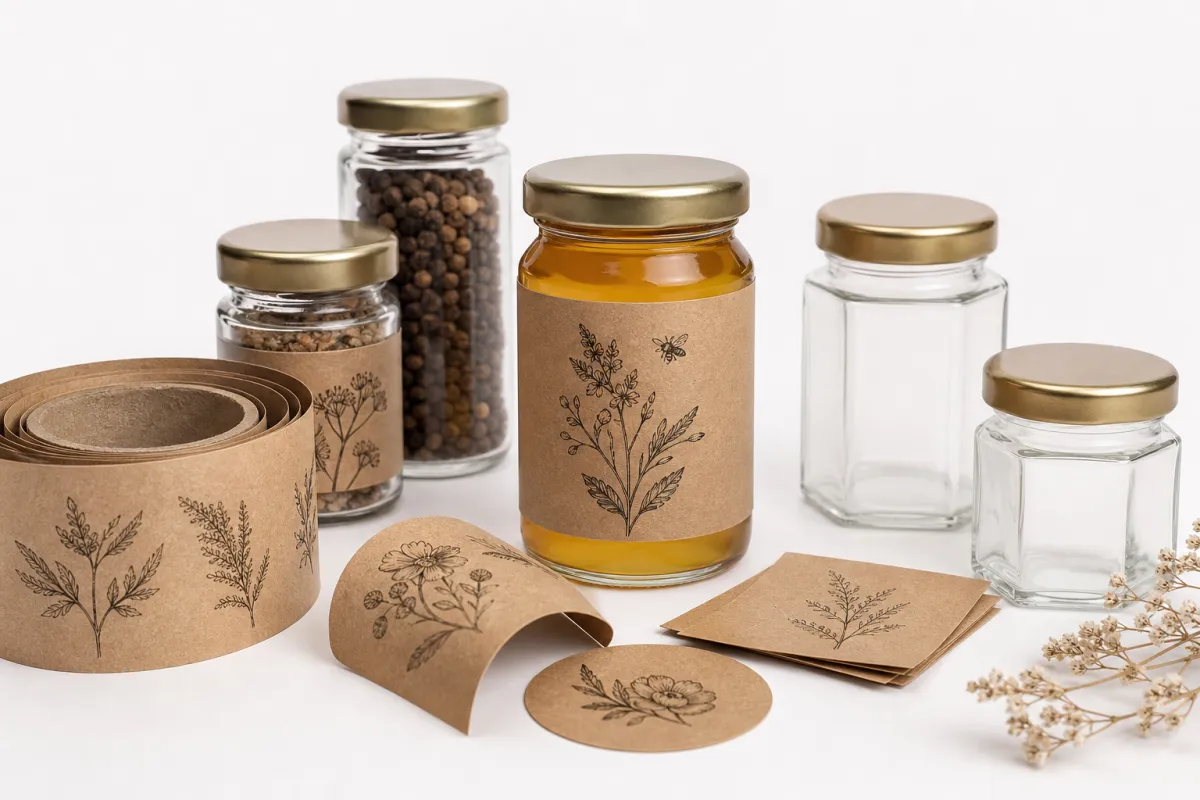
Printed kraft labels for jars are labels made to mimic, or sometimes use, the familiar brown, fiber-forward look of kraft paper, which signals rustic, artisanal, natural, or lower-intervention branding. That visual language is powerful. A jar of honey, salsa, candle wax, bath salts, or granola can feel more grounded the moment the label color shifts away from bright white and into that warmer, paper-brown territory.
The part that gets missed most often is simple: kraft is a look, a material family, and sometimes a marketing shorthand, but it is not a guarantee of performance by itself. A kraft face stock may be uncoated, lightly coated, or paired with a finish that changes how it handles moisture and abrasion. Printed kraft labels for jars can be paper-based and still be built for different levels of grease resistance, scuff resistance, or cold-chain use. The paper face is only one layer in the full label construction.
That distinction matters because a label can look natural and still be built with a standard permanent adhesive that dislikes condensation, or a finish that lets ink rub off too easily during shipping. I have seen buyers focus so hard on the rustic appearance that they never ask the right durability questions. Then the first refrigerated pallet tells the truth, which is a pretty expensive way to learn the lesson.
Appearance and sustainability also need to be separated. A brown kraft look does not automatically mean the label is compostable, recyclable, or made from post-consumer fiber. Printed kraft labels for jars may support environmental messaging, but the full build has to be checked. The face stock, adhesive, liner, and any coating all influence whether a package fits a recycling stream or an industrial composting claim. If you want a paper trail for responsible sourcing, FSC certification can be part of that discussion, but it is still only one piece of the broader specification.
From a buyer’s point of view, the tradeoff is straightforward: a kraft label brings warmth and authenticity, while the rest of the construction determines whether the package survives real use. That is why printed kraft labels for jars should be evaluated as a complete system, not as a color choice with a logo on top.
How Printed Kraft Labels for Jars Work on Glass and Lids
Printed kraft labels for jars usually start with four parts: the face stock, the adhesive, the liner, and any protective finish. The face stock is the visible printed surface. The adhesive is what bonds to the container. The liner holds the label in place until application, whether by hand or through a labeling machine. The finish, if used, can be a varnish, laminate, or other protective treatment that changes how the label handles moisture, abrasion, and print contrast.
Glass is a stable substrate, but it is not a perfectly easy one. Smooth glass gives good contact area, yet jars often have slight curvature, molded shoulders, embossed panels, or label bands that affect adhesion. A short round jar with a gentle sweep is one thing. A wide-mouth jar with a sharper shoulder is another. Printed kraft labels for jars need to fit the usable panel, not just the marketing artwork. If the label rides too close to a curve, the edge may lift sooner, especially after temperature swings.
Textured lids, matte-coated jars, and containers with oils on the surface can complicate things further. A label applied to a clean, dry jar behaves very differently from a label applied in a filling room where dust, condensation, or food residue is present. Surface prep is not glamorous, but it is one of the cheapest ways to improve performance. Alcohol wipe the glass where appropriate, let it dry fully, and keep the fill line or splash zone in mind during placement.
Printing and finishing matter just as much. Digital printing is often favored for shorter runs and variable artwork, while flexographic printing can be more efficient for higher volumes. On brown kraft, white ink support is often useful when logos, fine text, or pale brand colors need contrast. Without white ink or an underprint strategy, some artwork disappears into the paper tone and loses legibility fast. Printed kraft labels for jars are supposed to tell a story, and the story should still read at arm’s length on a store shelf.
For cold or frequently handled products, a varnish or laminate can be the difference between a label that looks good for a week and a label that still looks intentional after transit, stocking, and customer handling. A matte overprint usually preserves the paper feel better than a high-gloss finish, while a clear laminate can add stronger resistance to moisture and rub. The best answer depends on whether the jar sits in a pantry, a refrigerated case, or a bathroom shelf that gets steam and splash exposure.
Key Factors That Affect Performance, Shelf Life, and Appearance
Environmental exposure is usually the first thing I ask about. Printed kraft labels for jars have to survive whatever the product encounters after packing: refrigeration, condensation, heat from storage rooms, repeated wiping, shipping vibration, and the occasional oily fingerprint from a retail shelf check. If the product lives in a cold chain, the label has to tolerate the jar warming and cooling multiple times, because that is exactly when edge lift, bubbling, and wrinkle formation tend to show up.
Product type matters just as much. Dry goods like tea, spices, or bath salts are a gentler application than oily foods, sauces, spreads, candles, or jarred products that get handled with damp hands. A jar of peanut butter or a jar of lip scrub creates a different stress pattern than a jar of beans. Printed kraft labels for jars can be specified for many of those uses, but buyers should not assume one general-purpose construction works across all of them.
Visual design plays a bigger role than some teams expect. Brown paper lowers contrast compared with a white substrate, so small text, pale colors, and fine rule lines can vanish. Grain direction can also matter when the label is die-cut, because certain paper faces respond differently to bending and dispensing. If the label is oversized, it may bridge curves and release at the corners. If it is too small, the jar can look underdressed and the brand message gets lost in the shelf noise.
There is also a sustainability angle worth handling carefully. Buyers often ask for recycled-looking materials or compostable packaging, and that instinct is understandable. Still, printed kraft labels for jars should be judged on the complete build, not the paper face alone. A recyclable jar with a non-recyclable liner or a specialty adhesive can complicate the claim. That is where a clean specification sheet helps, because it keeps the conversation honest. If your packaging will face transit abuse, an ISTA distribution test can be a useful way to check whether the pack survives handling before launch.
The best-performing printed kraft labels for jars are usually the ones that respect the reality of the supply chain. Good design gets attention. Good construction keeps that attention from being wasted after the first cold shelf, wipe-down, or shipment shift.
“A kraft label sells the story in the first three seconds, but the adhesive and finish decide whether that story survives the fridge, the delivery box, and the customer’s kitchen.”
Step-by-Step Process and Timeline for Printed Kraft Labels for Jars
The smoothest projects start before anyone opens software or sends a quote. For printed kraft labels for jars, gather the jar diameter, panel height, lid style, fill type, storage conditions, and application method first. Then define the brand goal in plain language. Is the label supposed to read handmade, premium rustic, apothecary-style, or eco-forward? Those choices affect the material, the print coverage, and the finish.
Once the basics are clear, ask for a dieline and confirm the usable print area. A jar with a 3.5-inch diameter does not behave like a 4-inch jar, and a flat panel on the artwork screen may become a curve in the real world. If the artwork needs a wrap, check whether the seam lands where you expect it to. If you are comparing label formats, the Custom Labels & Tags catalog can help you think through size, material, and shape before you commit to a final spec.
The proofing stage should include both digital and, ideally, physical review. Digital proofs are good for layout, copy, barcodes, and dieline alignment. Physical samples are where the real story shows up. You can check tactile feel, print contrast on brown stock, adhesive grab on glass, and how the edge behaves on the actual jar. When a label is intended for refrigerated or high-humidity use, a sample should be tested in the same conditions the finished product will see. A label that looks fine at room temperature can fail after 24 hours in a cold case.
A realistic project timeline often looks like this: one to three business days for artwork setup or dieline confirmation, one to three days for proof review, several days for sample evaluation if a test build is needed, then production and finishing, then shipping. Simple jobs can move faster, but custom dies, specialty inks, and a second proof round add time. If the order involves white ink, laminate, or a complex shape, plan for that extra back-and-forth instead of treating it as a surprise.
Here is the practical way I like to frame it: approve the copy before you obsess over the finish, because an elegant label with a typo is still a failed label. Confirm jar dimensions early, test the adhesive on the real container, and make sure the label will be applied under the same temperature and humidity conditions as production. Printed kraft labels for jars are much easier to get right when the test conditions resemble the final use case.
Printed Kraft Labels for Jars: Cost and Pricing Factors
Price for printed kraft labels for jars is driven by a handful of variables buyers can actually control: quantity, label size, print complexity, face stock, finish, and whether a Custom Die Cut is required. The larger the label and the more colors or special effects involved, the higher the cost tends to climb. Short runs usually carry a higher unit price because setup and production overhead get spread across fewer pieces. Larger runs lower the per-label cost, but they also require more cash upfront and more storage space.
For budgeting, it helps to think in realistic ranges rather than vague promises. A basic short-run label on kraft-style stock might land in the low tenths of a dollar per label, while more involved constructions with white ink, moisture protection, or specialty adhesive can push higher. For example, a run of 5,000 pieces might price differently from a run of 25,000 pieces even if the artwork is unchanged, because press time, setup, and material yield shift the economics. Printed kraft labels for jars are not just a material line item; they are a production decision.
There are also hidden cost drivers that often show up after the first quote. White ink can add cost because it may require extra pass time or special handling. A laminate or varnish adds material and finishing time. Extra proofs cost money, especially if the team is changing copy or revising the dieline after the first sample. If you need testing for refrigeration, humidity, or abrasion, that testing has to be built into the schedule and sometimes into the quote as well.
To make the tradeoffs easier to compare, here is a simple view of common printed kraft labels for jars options:
| Option | Typical Use | Relative Cost | Strengths | Watch Outs |
|---|---|---|---|---|
| Uncoated kraft paper label | Dry goods, candles, low-moisture shelves | Lower | Warm texture, natural appearance, easy to brand | Less scuff resistance, weaker moisture tolerance |
| Kraft with varnish | Most retail jars, light handling | Moderate | Better rub resistance, still keeps a paper feel | Not always enough for heavy condensation |
| Kraft with laminate | Chilled jars, shipping, frequent handling | Moderate to higher | Stronger moisture and abrasion protection | Can reduce the raw paper look if film is too glossy |
| Kraft with white ink support | Small text, light logos, premium branding | Higher | Improves contrast and shelf readability | Extra setup, more proofing, more print complexity |
One practical rule saves a lot of budget headaches: compare the cost of a slightly better label against the cost of a failed pack. If a cheaper printed kraft label for jars peels in transit, buckles in refrigeration, or loses legibility after handling, the savings disappear quickly. Rework, spoilage, repacking, and customer complaints are expensive. A label that costs a little more but survives the use case often wins on total package cost.
For teams that are still deciding between label families, it can help to review a few constructions inside Custom Labels & Tags and then price the same artwork across two or three materials. That comparison usually reveals whether the business is paying for actual performance, or only for a look that sounds good in a meeting.
Common Mistakes That Cause Kraft Jar Labels to Fail
The first mistake is choosing printed kraft labels for jars because the look feels right and stopping there. A label can be a perfect visual fit and still be the wrong technical fit. If the adhesive is not matched to the jar surface, the label may lift. If the finish is too light for the environment, it may scuff. If the label face is too porous for the ink coverage, the art may dull out or look muddy.
The second mistake is skipping real-world testing. I see this most often with chilled jars, oily contents, and products that get handled repeatedly. A label that survives a desk test is not automatically ready for a cooler, a warehouse, or a grocery shelf. Printed kraft labels for jars should be tested on the actual container, filled with the actual product, and exposed to the same temperature swings, moisture, and handling the finished goods will see. A few hours of testing can save an entire run of repacking.
Another common problem is weak contrast. Brown stock is attractive, but it can swallow delicate artwork. Tiny type, thin strokes, pale grays, and low-contrast logos often lose legibility. If the brand relies on subtle color shifts, ask yourself whether the jar will be viewed from six inches away or six feet away. Shelf readability usually matters more than the design screen suggests.
Process mistakes can be just as damaging as material mistakes. Teams sometimes approve a proof without checking the jar curvature, then discover the label lands too close to a shoulder or seam. Others apply labels to dusty, damp, or oily containers and then blame the adhesive. Some buyers order too early, before the final fill level is fixed, and then the label overlaps the product line or leaves too much empty glass showing. Printed kraft labels for jars need a final check against the real bottle or jar, not the concept render.
If you want a short checklist, I would keep it this simple:
- Confirm jar dimensions and fill height before artwork starts.
- Test the adhesive on a cleaned, production-ready jar.
- Check print contrast at shelf distance, not just on screen.
- Run a moisture or refrigeration test if the product will ever feel cold.
- Verify the finish, because a matte label and a glossy label do not age the same way.
Expert Tips and Next Steps for Printed Kraft Labels for Jars
If you are getting serious about printed kraft labels for jars, start with a one-page spec sheet. Include jar diameter, label height, product type, storage conditions, quantity, application method, and the brand message you want the package to send. That sheet does more than keep everyone aligned. It also speeds up quoting, reduces proof revisions, and helps the converter recommend the right adhesive and finish.
I also recommend ordering two sample builds when budget allows. One can favor the warm, raw, paper-forward look that brand teams love. The other can lean toward durability with a stronger finish or adhesive. Put both on the actual jar and let them sit through refrigeration, room-temperature recovery, wiping, stacking, and shelf display. Printed kraft labels for jars often look similar on a sample card, then separate clearly once they start living on glass.
Pay close attention to handling cycle, not just first impression. A jar label should survive picking, boxing, pallet movement, retail stocking, and customer use. If the package will ship in parcel networks, a transit test modeled after common distribution practice can be very helpful. If the product is a premium pantry item, the label should also stay presentable after repeated touches, because the consumer may move the jar from shelf to counter to table many times.
For brands that need both style and control, the smartest next step is usually to refine the label spec before full production. Review where printed kraft labels for jars need stronger adhesion, cleaner contrast, or a better finish, then tighten the spec and retest. That small loop often saves more money than chasing a lower per-label quote. It also produces a package that looks intentional instead of merely trendy.
And if you are still sorting through formats, materials, and finishes, start with Custom Labels & Tags and compare a few constructions side by side. Printed kraft labels for jars can be elegant, practical, and cost-aware, but the winning version is usually the one that matches the jar, the product, and the real conditions of use. That is the version worth putting into production.
Are printed kraft labels for jars water resistant?
They can be, but only when the face stock, adhesive, and finish are chosen for moisture exposure. For refrigerated or wet-handled products, test printed kraft labels for jars on the actual container before approving a full run.
What adhesive works best for kraft jar labels?
A strong permanent adhesive is often the safest starting point for smooth glass jars. If the jars will be cold, oily, or handled a lot, ask for an adhesive that is matched to those conditions instead of assuming a general-purpose glue will hold up.
How much do printed kraft labels for jars cost?
Price depends on quantity, label size, print colors, finish, and whether a Custom Die Cut is needed. Short runs usually cost more per label, while larger runs lower the unit price but raise the upfront spend.
Can kraft labels handle refrigerated jars?
Yes, if the construction is specified for cold storage and tested for condensation resistance. Printed kraft labels for jars should be checked again after the jar moves from cold to room temperature, because that is when edge lift often shows up.
How long does it take to produce printed kraft labels for jars?
Simple jobs can move quickly, but custom sizing, specialty finishes, and sample approval add time. A realistic timeline includes proofing, sample review, production, finishing, and shipping, so plan ahead before launch. For most launches, printed kraft labels for jars are easiest to approve once the sample has proven the look, the grip, and the condensation performance.
Practical takeaway: before you place a full order, test printed kraft labels for jars on the real jar, with the real fill, under the real storage conditions. If the sample holds through condensation, handling, and shelf time, you have a label built for the job; if it does not, adjust the adhesive, finish, or stock first and save yourself a messy reprint.


