Buyer Fit Snapshot
| Best fit | Printed Folding Carton Supplier projects where brand print, material claims, artwork control, MOQ, and repeat-order consistency need to be specified before quoting. |
|---|---|
| Quote inputs | Share finished size, material target, print colors, finish, packing count, annual reorder estimate, ship-to region, and any compliance wording. |
| Proofing check | Approve dieline scale, logo placement, barcode or warning zones, color tolerance, closure strength, and carton packing before bulk production. |
| Main risk | Vague material claims, crowded artwork, missing packing details, or unclear freight terms can make a low unit price expensive after revisions. |
Fast answer: Printed Folding Carton Supplier: Board, Finish, Dieline, and Unit Cost should be specified like a repeatable production item. The safest quote records material, print method, finish, artwork proof, packing count, and reorder notes in one written spec.
Production checks before approval
Compare the actual filled-product size with the drawing, then confirm tolerance on folds, seals, hang holes, label areas, and retail display edges. Reserve space for logos, QR codes, warning copy, and material claims before decorative graphics fill the panel.
Quote comparison points
Review material grade, print process, finish, sampling route, tooling charges, carton quantity, and freight assumptions side by side. A quote is only useful when the supplier can repeat the same color, closure quality, and packing count on the next order.
Printed Folding Carton Supplier: How to Choose Well
A carton has three jobs: sell the product, protect it, and stack without drama. That is it. Which is why choosing a Printed Folding Carton Supplier is not a box-shopping errand. It is a risk decision with a print quote attached.
The wrong board thickness adds cost. The wrong finish changes how the carton reads on shelf. The wrong dieline can slow a packing line and ruin everybody's afternoon. A sharp printed folding carton supplier surfaces those trade-offs early, while the fix is still cheap.
For a brand team, the real question is simple: who can turn the product, the artwork, and the launch date into a carton that looks good, packs cleanly, and arrives on time without surprises? The answer usually comes down to structure, print discipline, and boring process control. Boring is underrated.
What a Printed Folding Carton Supplier Really Does
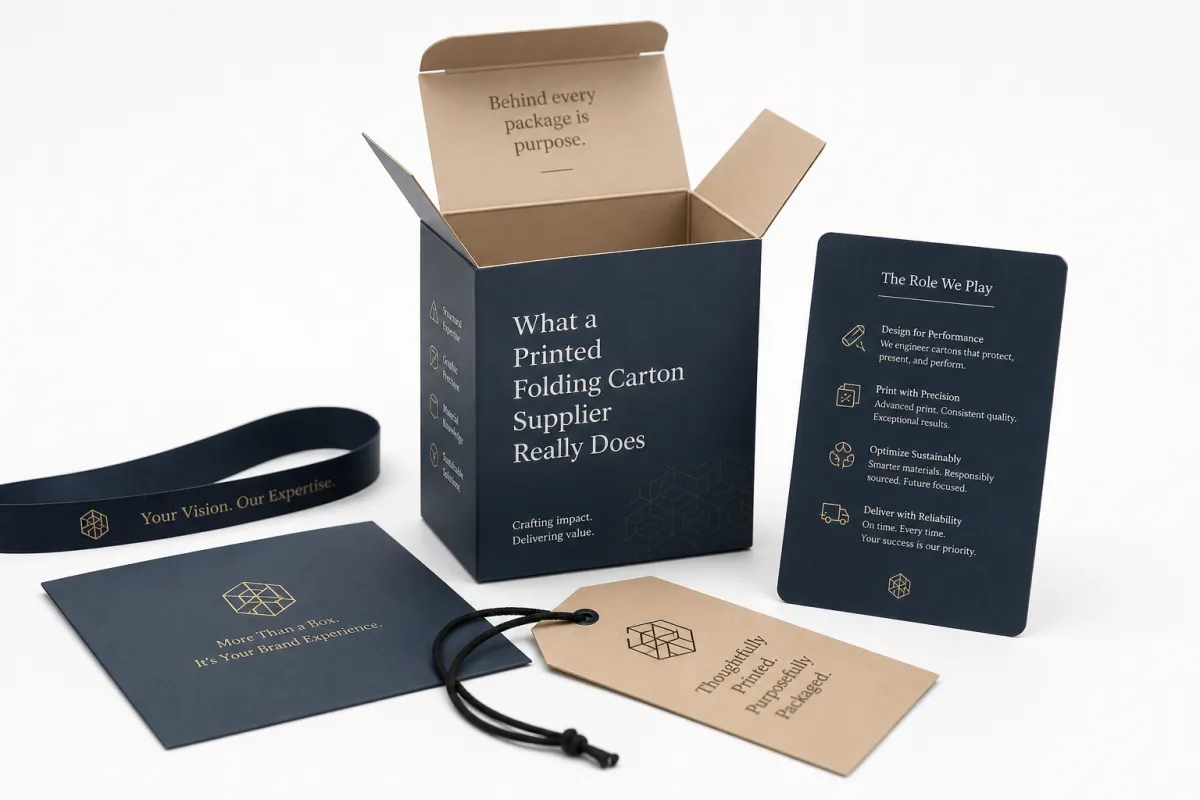
A printed folding carton supplier does a lot more than put ink on board. The job runs through structural design, prepress, production planning, converting, finishing, and shipping coordination. That matters because the carton is often the first physical thing a customer touches. It has to say "quality" fast, then survive packing, freight, pallet handling, and retail replenishment without collapsing like a flimsy excuse.
Small choices become big ones fast. A 16pt carton may look fine on a screen, but if the product is heavy or the shelf life is long, that same choice can create crush points, weak corners, or a dull feel that drags down the brand. A good printed folding carton supplier calls those risks out before artwork gets locked.
The roles matter too. A printer can reproduce graphics. A converter can turn board into a finished structure. A full-service printed folding carton supplier can usually advise on the whole path: carton style, board grade, coating, print method, die tooling, and run order. That broader view explains why one quote looks higher at first glance. The fuller quote may already include prepress checks, proof support, structural guidance, and fewer surprises later.
I have seen teams miss this more than once. They compare pretty samples and ignore how the carton behaves in production. That is backwards. A carton that looks great in a render but cracks on the fold line is still a bad carton. The best supplier is not the cheapest box maker. It is the one that aligns graphics, structure, and production reality so the package actually does its job.
If sustainability is part of the brief, the supplier's role gets wider. FSC-certified fiber, recycled-content board, water-based coatings, and lightweighting strategies all affect cost and performance. For transit testing, many teams reference ISTA methods. For fiber sourcing, FSC is a clear benchmark that procurement and brand teams both understand. I like those standards because they keep the conversation concrete instead of fuzzy.
In practice, the best printed folding carton supplier is part technical advisor, part production manager, and part risk filter. That combination protects the launch calendar and keeps the packaging from becoming the problem nobody budgeted for.
How the Printed Folding Carton Supplier Process Works
The process usually starts with a brief, but strong briefs include more than a product name and a logo. A good printed folding carton supplier wants dimensions, product weight, pack-out method, retail channel, shipping method, target quantity, and any regulatory copy that must appear on-pack. Leave those out and the supplier has to guess. Guesswork gets expensive fast in packaging.
A practical workflow often looks like this:
- Discovery call and spec intake.
- Structural recommendation or dieline review.
- Artwork and file check.
- Proofing and sample selection.
- Production planning and scheduling.
- Printing, converting, finishing, and packing.
- Freight arrangement and delivery.
That sequence looks tidy. Reality is messier.
The first hidden friction point is file review. An experienced printed folding carton supplier checks bleed, safe zones, barcode quiet zones, reverse type, varnish callouts, and whether artwork sits too close to folds or glue areas. A design file can look polished and still fail in production if the dieline gets ignored or a barcode lands across a score line. Glamour does not save bad prep.
Sample types matter too, and each one answers a different question. A flat proof checks copy, layout, and color intent. A structural prototype checks how the carton folds and whether the product actually fits. A color proof gives a closer read on appearance, even if it still does not fully mimic production board. A production sample is the closest thing to the final run. A careful printed folding carton supplier will tell you which sample is worth paying for instead of trying to sell every option in the room.
A carton problem is usually a process problem wearing a visual disguise.
That line sounds blunt because it is true. The worst packaging issues usually show up at handoff points: the designer assumes the printer will fix the dieline, the buyer assumes the vendor will catch a missing finish note, or the brand manager assumes a sample approval means the line will run without drama. A disciplined printed folding carton supplier keeps those handoffs visible and documented.
Timing is another place where expectations drift. A simple project with final artwork and a standard board might move from approval to shipment in roughly 10 to 15 business days. More complex jobs, especially those with embossing, foil, unusual board, or multiple approvals, can run longer. If material sourcing is tight, the calendar stretches again. A transparent printed folding carton supplier will point to the delay risk instead of hiding behind a fluffy lead-time promise.
For brands with multiple teams, communication structure matters almost as much as the carton. A buyer cares about unit price, a designer cares about typography and contrast, and operations cares about pallet efficiency and line speed. The better printed folding carton supplier can speak to all three without sending people into separate email rabbit holes. That alone saves a lot of back-and-forth.
What a Printed Folding Carton Supplier Charges and Why
Pricing is where many buyers get fooled by simplicity. A quote can look low until you notice different board, no sampling, a longer production window, or freight billed separately. A reliable printed folding carton supplier should be able to explain each cost component in plain language.
The main cost drivers are easy to name, but they interact more than people expect:
- Board grade and caliper - thicker or specialty board usually raises material cost and can affect die performance.
- Carton size and layout - larger panels use more board and can reduce the number of cartons per sheet.
- Print method - offset, digital, and flexographic setups each behave differently on cost and image quality.
- Ink coverage - heavy solids and rich backgrounds often raise waste sensitivity and prepress scrutiny.
- Finishes - matte, gloss, soft-touch lamination, aqueous coating, foil, embossing, and spot UV all add steps.
- Die and tooling complexity - a simple tuck-end carton is easier to run than a design with windows, inserts, or unusual closures.
- Quantity - the larger the run, the more the setup cost spreads out.
That last point causes the biggest misunderstanding. A small run can look expensive because setup cost sits on top of a limited number of units. A larger order lowers unit cost because the same press setup, die, and makeready get spread across more cartons. A seasoned printed folding carton supplier will show you the break points, even if that means recommending a smaller first run for a launch test. Not every project needs heroics on day one.
For a straightforward reverse tuck carton with moderate print coverage, many projects land around $0.18-$0.28 per unit at 5,000 pieces. At 2,500 units, the same carton may sit closer to $0.28-$0.45 depending on board, finish, and labor. By 10,000 units, the per-unit cost can drop materially, sometimes into the $0.11-$0.22 range for simpler builds. These are working ranges, not promises. A complex carton with foil, embossing, or a custom insert will sit higher, and freight can move the total more than buyers expect. I would treat any quote that looks wildly below that as a signal to ask harder questions.
| Carton choice | Typical use | Approximate quote behavior | Why buyers pick it |
|---|---|---|---|
| 14pt SBS, basic print | Light retail items, low compression risk | Lowest setup burden; unit cost usually improves quickly with volume | Clean print surface and efficient pricing |
| 18pt C1S or CCNB | Mid-weight products, higher shelf value | Often a moderate step up in material cost and sturdiness | Better feel, better rigidity, still economical |
| Coated kraft board | Natural look, premium eco positioning | Can cost more depending on finish and ink coverage | Warm brand story and strong shelf texture |
| Soft-touch laminated carton | Luxury, beauty, high-touch retail | Finish adds noticeable cost and can extend lead time | Distinct tactile feel and premium cue |
| Foil and emboss combination | High-visibility launches | One of the highest-cost finish mixes because of tooling and labor | Strong shelf impact and visual hierarchy |
There is a second layer of cost that buyers ignore too often: hidden operating expense. A cheap carton that jams on the line, slows hand packing, or crushes during shipping can cost more than a better-spec carton in the first place. I have seen teams save a few cents per unit and spend more on rework, damage allowances, and replacement shipments. A good printed folding carton supplier helps you think in total landed cost, not just factory price.
Watch for these extra charges as well:
- Plate or die charges.
- Sampling and proofing fees.
- Freight and palletization.
- Storage or staggered shipment fees.
- Rush production premiums.
None of those are automatically bad. They only become a problem when they show up late in the conversation. The clearest quotes come from a printed folding carton supplier that spells out what is included, what is optional, and what changes if the spec changes after approval.
Step-by-Step: Choosing the Right Supplier and Timeline
If you want a cleaner buying process, start with a needs audit instead of supplier shopping. Write down the product dimensions, pack weight, retail channel, shipping method, target finish, expected order quantity, and launch date. A printed folding carton supplier can only give you a useful quote if the brief is specific enough to support one.
Then build a shortlist based on fit, not just visibility. A website can look polished and still be a poor match for your carton style. Another vendor may look plain online but have strong technical depth in structural folding cartons, color control, or short-run digital work. The right printed folding carton supplier should match the project, not the other way around.
Use the same request format for every vendor. That sounds obvious, yet this is where quote comparisons usually go sideways. Ask each printed folding carton supplier for the same carton size, board grade, finish, quantity, print method, proofing approach, lead time, and freight assumptions. If one vendor prices a 4-color carton on 18pt board and another quotes 16pt board with no finish, the numbers are not the same thing.
What to ask before you request a quote
- What board options fit this product weight and retail environment?
- Which carton style will fold cleanly and pack efficiently?
- What proof or sample is included?
- How long does approval take before production begins?
- What are the minimum order quantity and reorder expectations?
Those questions do two things. First, they expose capability. Second, they show how the vendor thinks. A thoughtful printed folding carton supplier answers with context, not just yes or no.
Next, map the timeline backwards from launch. If product arrival is fixed, the artwork approval date, dieline freeze date, and sample sign-off date need to be fixed too. Most delays happen at the edges: late artwork changes, color approval loops, missing compliance text, or a last-minute finish upgrade after the quote is already locked. A disciplined printed folding carton supplier can absorb some changes. Endless changes are another story.
A realistic path often looks like this:
- Days 1-3: brief submission and supplier questions.
- Days 4-7: quote review and structure recommendation.
- Days 8-12: dieline confirmation and artwork prep.
- Days 13-18: proofing and sample review.
- Days 19 onward: production, finishing, and freight.
The schedule may be shorter or longer depending on complexity, but the logic stays the same. If the printed folding carton supplier cannot show you where the risk sits, your launch plan probably has blind spots.
Decision-making gets easier if you score vendors against a few practical criteria:
- Fit: Can they produce the carton style, finish, and quantity you need?
- Responsiveness: Do they answer technical questions quickly and clearly?
- Quality control: Do they show proofing discipline and process checks?
- Scalability: Can they support reorders, seasonal peaks, or future SKUs?
- Transparency: Do they explain pricing and lead times without smoke?
Common Mistakes When Comparing Suppliers
The first mistake is comparing only unit price. A low quote can hide weaker board, a bigger waste allowance, different finish assumptions, or freight charged later. A serious printed folding carton supplier should make those differences obvious, because the cheapest line item is not always the lowest true cost.
The second mistake is vague specifications. If you do not define board grade, carton size, print coverage, finish, quantity, and delivery terms, suppliers will fill in the blanks differently. Then the quotes look comparable when they are not. A good printed folding carton supplier prefers precision up front because it keeps waste down on both sides.
The third mistake is skipping samples. That is risky for color-critical brands, premium launches, and cartons with tight folds or inserts. A flat proof cannot tell you whether the tuck flap opens cleanly. A color proof cannot tell you whether the carton crushes too easily. A structural sample from a printed folding carton supplier is often the cheapest insurance policy in the whole process.
The fourth mistake is poor file prep. Barcode issues, missing bleed, text too close to a score, or a finish callout buried in an email thread can trigger delays nobody needs. Once the press is scheduled, every revision costs more. That is one reason the best printed folding carton supplier relationships feel calm: the work gets front-loaded, and the production run is far less chaotic. Less drama, fewer surprises.
The fifth mistake is choosing a vendor that cannot grow with the brand. A supplier may be fine for a test run but unable to support a seasonal reorder, a new size, or a larger volume jump. That creates a second sourcing project before the first one settles. A better printed folding carton supplier should have enough range to support future changes without forcing a reset.
Here is the comparison lens I use most often: ask whether the quote supports the product you have now, and whether the vendor can still support the product you are likely to have after the first round of market feedback. Those are not the same question. A smart printed folding carton supplier should be able to answer both.
Expert Tips to Improve Quality and Reduce Total Cost
If you want better economics, start by designing around standard board sizes and practical dielines. Custom shapes are not bad, but every unusual cut adds risk, waste, or tooling complexity. A thoughtful printed folding carton supplier can tell you whether a small structural change would reduce make-ready time or improve nesting on the sheet.
Use finishes with discipline. Spot gloss, matte coating, embossing, and foil are strongest when they support hierarchy. They should guide the eye, not coat every panel simply because the budget allows it. A restrained finish plan often looks more premium than an overloaded one, and a seasoned printed folding carton supplier will say so.
Keep structural design and artwork aligned early. I have seen beautiful graphics fail because the design team treated the dieline as a second-stage problem. That gets expensive fast. If the fold line cuts through a key logo element or the barcode sits too close to a flap, you may end up redesigning the carton after proofing. A good printed folding carton supplier can help catch those issues before they turn into rework.
Test cartons under real handling conditions, not just under studio lights. Put them in a case, stack them, ship them, open them, and see what happens after vibration or compression. Surface scuffs, corner wear, and opening force all matter. For shipping-sensitive products, the right printed folding carton supplier should support that kind of practical validation, even if the brief did not ask for it on day one.
One more thing gets overlooked: supplier relationships improve with consistency. If you keep the print spec stable, communicate changes early, and pay attention to reorder notes, you usually get better color consistency and fewer surprises. Over time, that relationship can be worth more than a small discount. A dependable printed folding carton supplier becomes part of your operating rhythm, not just a name on a spreadsheet.
Quality gets cheaper when decisions are made early. That is the real trick. The best savings are usually not dramatic; they come from a lot of small, correct choices.
Next Steps With Your Printed Folding Carton Supplier
The easiest next move is also the smartest one: gather your dimensions, board preference if you have one, target quantity, finish goals, compliance text, and delivery deadline before requesting quotes. A complete brief gives a printed folding carton supplier something solid to price, and it gives you a quote you can actually compare.
Then send one clean request to three suppliers. Not six. Three is usually enough to show the spread in pricing, service level, and technical approach without turning the process into a swamp of mismatched responses. Ask each printed folding carton supplier for a sample plan, proofing timeline, and a breakdown of what is included in the estimate.
From there, compare fit before price. Does the vendor answer technical questions clearly? Do they flag risks without getting defensive? Can they explain how a board choice will affect crush resistance, shelf look, or shipping durability? A strong printed folding carton supplier does not hide complexity; it manages it.
Here is a simple decision path:
- Shortlist the suppliers that can actually make your carton.
- Request matched quotes with the same spec.
- Review samples and proofing logic.
- Check lead time, freight, and reorder support.
- Place the first run with the supplier that shows the best mix of accuracy, responsiveness, and control.
If you treat the printed folding carton supplier as a production partner instead of a commodity line item, the first run is usually cheaper in the ways that matter: fewer rejects, fewer delays, and less rework. That is the real win. A carton that looks good, packs well, and arrives on time is worth more than the lowest number on a quote sheet, and the right printed folding carton supplier is the one that proves it before you commit.
The cleanest takeaway is this: lock the spec, demand a structural sample, and compare total landed cost in writing before you pick a printed folding carton supplier. Do those three things and you will avoid most of the expensive nonsense that sneaks into packaging projects.
What does a printed folding carton supplier do for a new product launch?
A printed folding carton supplier turns your product dimensions and brand artwork into a production-ready carton spec. They help confirm board, finish, and structural choices before you commit to a full run, then coordinate proofs, sampling, and production so launch timing stays realistic.
How do I compare printed folding carton supplier quotes fairly?
Use the same carton size, board, finish, quantity, and delivery terms for every quote. Check whether sampling, tooling, freight, and setup charges are included or separate. Compare total landed cost, not just the per-unit number, because the lowest factory price is not always the best deal.
What affects lead time from a printed folding carton supplier?
Artwork approval, dieline revisions, and proof sign-off often create the biggest delays. Material availability and finishing complexity can add days or weeks. Rush jobs are possible, but they usually trade speed for higher cost and less flexibility, so it helps to lock the brief early.
What files should I send to a folding carton supplier?
Send editable artwork on the approved dieline with bleed, safe zones, and finish callouts. Include barcode specifications, color references, and any regulatory copy that must appear on-pack. A written spec sheet prevents back-and-forth when multiple teams review the job, and it gives the printed folding carton supplier a cleaner path to proofing.
How many samples should I request before ordering from a printed folding carton supplier?
At minimum, request a structural sample and a color proof for any new carton design. If the product is delicate, ask for a packed test sample to check fit and protection. For high-volume or high-visibility launches, one additional preproduction sample can reduce expensive mistakes and give the printed folding carton supplier one more chance to catch issues early.


