Buyer Fit Snapshot
| Best fit | Printed Kraft Hang Tags Wholesale projects where brand print, material claims, artwork control, MOQ, and repeat-order consistency need to be specified before quoting. |
|---|---|
| Quote inputs | Share finished size, material target, print colors, finish, packing count, annual reorder estimate, ship-to region, and any compliance wording. |
| Proofing check | Approve dieline scale, logo placement, barcode or warning zones, color tolerance, closure strength, and carton packing before bulk production. |
| Main risk | Vague material claims, crowded artwork, missing packing details, or unclear freight terms can make a low unit price expensive after revisions. |
Fast answer: Printed Kraft Hang Tags Wholesale: Specs, Pricing, MOQ should be specified like a repeatable production item. The safest quote records material, print method, finish, artwork proof, packing count, and reorder notes in one written spec.
Production checks before approval
Compare the actual filled-product size with the drawing, then confirm tolerance on folds, seals, hang holes, label areas, and retail display edges. Reserve space for logos, QR codes, warning copy, and material claims before decorative graphics fill the panel.
Quote comparison points
Review material grade, print process, finish, sampling route, tooling charges, carton quantity, and freight assumptions side by side. A quote is only useful when the supplier can repeat the same color, closure quality, and packing count on the next order.
Printed kraft hang tags Wholesale: Specs, Pricing, MOQ. That short line covers the part of the buying process that looks simple until the first quote lands and the details start multiplying. Most brands do not need a dramatic tag; they need printed kraft Hang Tags Wholesale that feel solid, look considered, and keep the packaging budget from drifting into nonsense. I have watched a lot of packaging decisions get overcomplicated by design software and undercomplicated by real production, and the cleanest tags usually win on plain usefulness.
Kraft stock often outperforms coated paper in the places people actually notice. The texture reads as honest, tactile, and grounded, while the print still carries enough clarity to support branding, pricing, and product details. A restrained brown tag with clean typography can feel more confident than a glossy card trying to prove itself with extra effects. That is one reason printed Kraft Hang Tags wholesale keeps showing up in apparel, candles, skincare, coffee, gifts, and subscription packaging.
“If the tag needs three special finishes to look good, the base spec is probably wrong.”
The practical value is easy to overlook because it is not flashy. A repeatable tag format cuts down on decision fatigue, keeps shelf presentation tidy, and lets a brand use one system across multiple SKUs without rebuilding the whole packaging story each season. That is the real strength of printed kraft hang tags wholesale. It keeps the work consistent, reduces rework, and gives teams one dependable piece of packaging they can order again without reinventing it every time. Honestly, that reliability is half the battle in packaging procurement.
Why Printed Kraft Hang Tags Wholesale Works for Retail
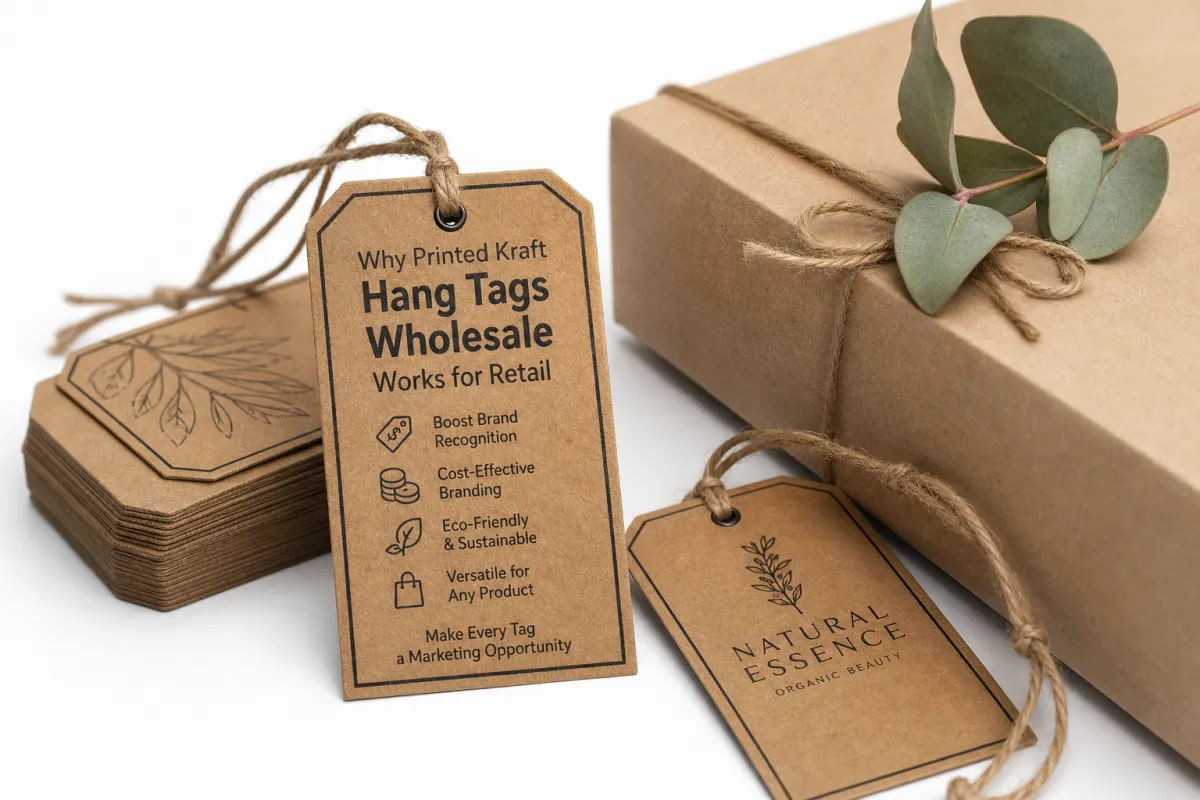
Printed kraft hang tags wholesale works because retail rarely rewards noise. Many buyers assume they need brighter ink, heavier coatings, or a more complicated finish to look premium, yet that usually misses the point. A tag has a few jobs to do well: stay legible, survive handling, and present the product clearly. If it handles those jobs with confidence, the rest tends to take care of itself.
Natural kraft stock has a visual advantage that is easy to underestimate. The paper texture contributes to the brand impression before the customer reads a single word, which is why printed kraft hang tags wholesale can feel more elevated than the unit price suggests. The fiber pattern softens the look just enough to communicate craft, but not so much that the tag appears unfinished. On a display hook or in a product photo, that balance carries more weight than an extra coating ever will.
There is a practical advantage too. Kraft accepts simple logos, price marks, care notes, barcode placement, and short product copy without crowding the design. That makes printed kraft hang tags wholesale useful for apparel, candles, handmade products, coffee bags, and gift sets where the tag needs to say something helpful quickly. A good tag can do the work of a compact sales sheet without taking over the package.
Wholesale ordering becomes even more useful once a brand grows beyond a handful of products. A stable tag format lets the team update copy, change size, or adjust print count while keeping the base spec familiar. That lowers ordering friction and helps seasonal programs stay consistent. Nobody wants to brief a fresh vendor on the same small paper component every quarter if the core structure does not need to change.
From the packaging buyer’s side, the benefits are easy to measure:
- Fewer decisions because the base format stays stable from run to run.
- Cleaner unit economics because setup cost is spread across a larger quantity.
- More credible sustainability messaging because kraft looks natural without pretending to be something else.
- Less shelf clutter because a minimal design can still feel complete.
That is the appeal of printed kraft hang tags wholesale. The tag does not need to shout. It just needs to show care.
Printed Kraft Hang Tags Wholesale: Paper, Shape, and Finish Options
Printed kraft hang tags wholesale begins with paper, and paper is where many quotes go vague fast. Kraft is not one single material or one single look. Buyers are usually choosing between natural brown kraft, bleached kraft, recycled kraft, and kraft board in different thicknesses and fiber mixes. The best option depends on the product, the artwork, and how polished the tag needs to feel in the hand. A quick mockup on screen can hide a lot; a paper sample in the hand tells the truth right away.
Natural brown kraft gives the strongest handmade impression. Bleached kraft looks cleaner and usually supports lighter branding with better contrast. Recycled kraft often carries more visible fibers and a rougher surface, which can suit artisan brands nicely but may not be the right choice for tiny type or very fine artwork. If the tag will carry detailed information, the paper tone matters almost as much as the layout. That is especially true for printed kraft hang tags wholesale, where the material is part of the brand story.
Thickness deserves real attention, not a passing note. Common hang tag stock tends to range from about 14pt to 22pt, which roughly translates to 250gsm to 400gsm depending on the supplier. Thinner stock costs less, but it can feel weak on heavier products. Thicker stock brings more presence, though it can slow packing or make the tag sit awkwardly on certain items. There is no prize for extra bulk that the customer never notices, and printed kraft hang tags wholesale should feel intentional rather than overbuilt.
Shape is another place where a buyer can spend money before asking whether the shape does useful work. A rectangle stacks efficiently and prints cleanly. Rounded corners soften the visual edge and help the tag resist scuffing. Square tags can look sharp on premium goods, even if they leave some unused space. Custom die-cuts can be memorable, but the silhouette should support the product, not compete with it. Otherwise the shape becomes decoration pretending to be strategy.
Folded tags deserve a place in the discussion when a product needs more space. Apparel care notes, ingredient lists, gift messaging, and QR code content can fit well inside a folded format. The tradeoff is assembly time. If the content fits on a flat tag, printed kraft hang tags wholesale usually stays simpler and less expensive that way.
Finish choices matter more on kraft than many buyers expect. Heavy gloss can fight the natural look of the stock. Soft-touch lamination may feel pleasant, but it can flatten the raw paper character that makes kraft appealing in the first place. In a lot of cases, the best result is plain printing, maybe with a light varnish on areas that need rub resistance. Foil can work, though on kraft it tends to perform best as a small accent instead of a full-surface effect.
Common finish and format choices look like this:
| Build | Typical MOQ | Unit Price Range | Best Use | Tradeoff |
|---|---|---|---|---|
| 14pt natural kraft, one-color print, single-sided | 500-1,000 pcs | $0.06-$0.12 | Simple retail branding, short product copy | Very limited design complexity |
| 18pt recycled kraft, full color, double-sided | 1,000-2,000 pcs | $0.10-$0.20 | Apparel, gifts, skincare, multi-line branding | Higher print prep and more ink coverage |
| Custom die-cut kraft with foil accent | 2,000 pcs+ | $0.18-$0.38 | Premium retail, limited runs, standout shelf display | Setup cost is higher and revisions cost more |
| Folded kraft tag with inside copy | 1,000 pcs+ | $0.15-$0.30 | Care instructions, storytelling, barcode space | Extra assembly and slightly higher labor cost |
The table tells the truth behind printed kraft hang tags wholesale: every added step carries a cost, and the best choice is the one the customer will actually register. Nobody buys the tag for its own sake. They buy the product, and the tag either supports that product or gets in its way.
Specifications That Actually Matter Before You Quote
Good quotes start with clear specs. Printed kraft hang tags wholesale is much easier to buy when the size, stock, print sides, hole style, and quantity are already pinned down. If those details are fuzzy, the numbers you receive may look comparable without actually describing the same product. I have seen projects lose a week because two quotes were for different paper weights and nobody caught it until the sample stage.
Begin with the essentials: finished size, paper thickness, print count, and whether the tag needs one-sided or two-sided printing. Those four items drive most of the cost in printed kraft hang tags wholesale. After that, you can define the hole diameter, corner radius, folding, stringing, and any special finishes. Leaving those details open too long turns the quote into a moving target, which helps nobody.
Thickness matters because kraft behaves differently than coated card. Too thin, and the tag feels cheap the moment someone picks it up. Too thick, and the stack becomes bulky, which can complicate assembly and storage. A practical range for many retail jobs sits around 14pt to 18pt for lighter products and 18pt to 22pt for items that need a more substantial presence. Printed kraft hang tags wholesale should feel deliberate in the hand, not just in the mockup.
Readability is another place where buyers can waste money by asking the paper to do too much. Kraft naturally softens contrast. Fine lines, thin scripts, and very small type can disappear into the fiber texture. If the logo depends on delicate detail, ask for a proof at the true size. If the tag includes a barcode, keep the quiet zone open and avoid crowding it with graphics. With printed kraft hang tags wholesale, the smallest design oversight often becomes the most expensive reprint.
File preparation can move the project quickly or stall it before production starts. A clean vector logo, outlined fonts, proper bleed, and safe margins make a real difference. If the art uses a spot color, name the Pantone reference clearly. If it prints in CMYK, check that the darkest areas still read well on kraft rather than only on a bright screen. Most delays are not mysterious. They usually come from vague files, last-minute edits, and proof notes that never should have been skipped.
There are a few compliance items that are easier to handle early than after approval:
- Recycled-content claims need supplier support if they appear on the tag.
- FSC requests should be confirmed before proofing begins.
- Retail barcodes need enough quiet space to scan cleanly.
- Origin labeling may matter for imported goods and larger retail programs.
If sustainability language is part of the packaging story, keep it precise. Buyers can verify certifications, and suppliers should be able to document what they are selling. For that reason, it helps to reference standards from Forest Stewardship Council and recycling guidance from the EPA recycling guidance page instead of leaning on vague language that sounds polished but says very little.
The practical takeaway is simple: printed kraft hang tags wholesale gets easier when the technical details are settled before the quote. That is how you avoid the familiar back-and-forth where everybody discovers the tag should have been two millimeters wider only after the proof is already approved.
Pricing, MOQ, and What Changes the Unit Cost
Printed kraft hang tags wholesale pricing is mostly a math problem, with a few inconvenient surprises tucked into the corners. Quantity, stock weight, print complexity, finishing, and whether the shape is standard or custom all affect the final number. Once those pieces are known, the quote starts making a lot more sense.
MOQ, or minimum order quantity, is where buyers either overpay or overcomplicate the order. A low MOQ helps when testing a new product line, but the unit price usually improves as the run gets larger. Setup cost is the expensive part, not the paper itself. In printed kraft hang tags wholesale, one-color tags usually have the easiest entry point, while foil, embossing, and custom die-cuts often raise the minimum.
Here is a realistic planning range for common wholesale orders, assuming standard production and no unusual rush:
- Simple one-color tags: often around $0.06-$0.12 each at 500-1,000 pieces.
- Full-color double-sided tags: often around $0.10-$0.20 each at 1,000-2,000 pieces.
- Premium die-cut or foil-accent tags: often around $0.18-$0.38 each at 2,000 pieces or more.
- Folded information tags: often around $0.15-$0.30 each depending on layout and finishing.
Those figures are a planning range, not a promise. Heavier stock, more ink coverage, or a custom silhouette can shift the price quickly. The same is true for a second print side, a specialty hole punch, or stringing requests. Printed kraft hang tags wholesale should always be read as a full system rather than a unit price pulled out of context and treated like the final answer.
There are also hidden cost triggers that tend to appear only after the first quote if nobody asked the right questions:
- Artwork changes after proofing can restart setup work.
- Split shipments add packing and freight cost.
- Rush production usually costs more than expected.
- Special stringing can add labor if the tags arrive assembled.
- Custom shapes require die setup, which is never free just because the shape looks nice.
The cleanest approach is to use the lowest spec that still fits the product, then upgrade only where the customer will notice the difference. A candle tag that lives mostly on a shelf does not need the same build as a premium apparel tag that gets handled all day. A gift item may need stronger visual presence, while a subscription box may need a flatter tag that packs neatly. That is the kind of judgment that keeps printed kraft hang tags wholesale useful instead of merely decorative.
For teams comparing vendors, ask every supplier to quote the exact same spec. Same size, same paper weight, same print sides, same finish, same quantity. Anything else turns the process into apples versus oranges with a sales pitch pasted on top. If you are building a larger packaging system, it also helps to align the tag with Custom Labels & Tags so the set looks planned rather than assembled from whatever was left on the shelf.
Proofing, Production, and Timeline
The order flow for printed kraft hang tags wholesale is usually direct, but it still works best in a clean sequence. Quote first. Artwork review next. Then the digital proof. A physical sample follows if the job needs one. After approval, production begins, the tags are packed, and the shipment leaves. That is the tidy version. The untidy version starts when artwork changes after proofing and the schedule begins to wobble.
Timing depends most on the approval stage. Proofing itself is often quick. The slower part is usually the revision round, especially when someone notices the logo should be larger, the barcode needs more white space, or the product name was approved in the wrong language. The fastest printed kraft hang tags wholesale runs usually come from clean files and a final spec sheet sent on the first pass.
A realistic production timeline often looks like this:
- Quote review: 1-2 business days if the spec is clear.
- Artwork and proofing: 1-3 business days for a clean file, longer if edits are needed.
- Sample approval: 3-7 business days if a physical sample is requested.
- Production: often 7-15 business days depending on complexity and volume.
- Shipping: domestic transit can be a few days; overseas freight takes more planning.
That puts many printed kraft hang tags wholesale orders somewhere around 10-18 business days after proof approval, while premium builds can run longer. If the job includes foil, embossing, folding, or Custom Die Cutting, build in extra time. If the order supports a launch date, seasonal reset, or trade show, cushion the schedule instead of gambling on the shortest possible path. A launch delay because of a tag reprint is the kind of headache that looks small until it eats a whole week.
Physical samples are worth the extra time when paper tone, color fidelity, or finish feel matters to the final sale. They help most with products that depend on touch, like apparel, gifts, and skincare kits. A digital proof is often enough for a simple one-color tag or a straightforward text update. The real question is whether the sample prevents a mistake expensive enough to matter.
Shipping method matters too. A domestic run can cost more per unit, but it often shortens the planning window and cuts down on freight headaches. An overseas run may be more economical at larger quantities, though the schedule needs more protection because transit time, customs, and port delays are never decorative details. For teams comparing packaging sources, Wholesale Programs keep repeat buying easier because the specs stay organized and the reorder cycle stops feeling like a scavenger hunt.
Printed kraft hang tags wholesale should be managed like a packaging project, not a casual print order. That mindset saves a lot of rescue work later.
Why Choose Us for Sustainable Packaging Programs
Printed kraft hang tags wholesale is more than ink on paper. It is part of the packaging language a product uses to introduce itself, and that language needs to stay consistent, believable, and easy to repeat. For brands that want a sustainable look without paying luxury pricing for every piece of the system, kraft tags are one of the most practical options available.
The value comes from balance. Strong supplier support keeps the tag aligned with the brand, the proof easy to understand, and reorders from turning into a second round of explanation. Procurement teams, brand managers, and operations staff already have enough moving parts. With printed kraft hang tags wholesale, consistency becomes the real premium feature.
Sustainable packaging programs also work better when the stock choice matches the message. Recycled-content kraft, FSC-certified options, and low-gloss finishes preserve the natural look instead of covering it up. That is where many brands drift off course. They ask for an eco-friendly presentation, then add coating, foil, and heavy ink until the tag no longer feels grounded at all. If you want kraft to carry the message, let the material stay visible. Keep it simple and it will usually look better, not worse.
There are a few support habits that separate a decent order from a dependable supply relationship:
- Clear quoting so the buyer can see what changed and why.
- Responsive proofing so revisions do not stall the schedule.
- Color consistency across repeat runs and multi-SKU rollouts.
- Predictable communication through production and packing.
- Clean reorder records so the next run starts from the right spec.
That matters most for brands carrying several product types. A clothing line may need a standard tag family. A candle brand may want one build for the core collection and another for seasonal sets. A skincare label may need room for ingredients, usage notes, and barcode placement. Printed kraft hang tags wholesale works best when the supplier helps Choose the Right version for each use instead of pushing the same build onto everything in sight.
That is where a good packaging partner earns trust. Not through hype, but through calm quoting, clear specs, and a production result that matches the approval. That is what buyers actually care about. A tag that arrives on time and looks right matters far more than a clever slogan.
Next Steps for Ordering Printed Kraft Hang Tags Wholesale
If you are ready to order printed kraft hang tags wholesale, start with the details that shape cost and approval most directly: finished size, quantity, print colors, paper thickness, hole placement, and any finishing requirements. Gather the artwork files as well. A vector logo, outlined fonts, and a clear note about bleed and safe area make the whole process much smoother.
For a brand testing a new packaging direction, one hero SKU is usually the smartest first move. Get the tag right on the product that matters most, then expand the system after the first run proves itself. That approach makes sense with printed kraft hang tags wholesale because once the base spec works, it can be adapted across related products without starting over.
Before you accept any quote, compare the same spec from each vendor. Matching unit prices only mean something if the build is actually the same. A lower number on thinner stock is not a better deal. A lower price with fewer print options is not the same product. Buyers who understand that usually make better decisions and waste less budget.
Confirm the operational details before payment too: proof approval, packing format, whether tags ship loose or strung, and the delivery window. Those items feel boring until they are the thing holding up a launch, retail reset, or trade show. If the order has to land on a specific date, build in buffer time now. That is cheaper than panic later.
Use this quick checklist before requesting a quote for printed kraft hang tags wholesale:
- Finished size and shape
- Stock thickness and kraft tone
- Print side count and color count
- Hole size and stringing preference
- Quantity per SKU or per design
- Artwork files and compliance notes
- Target delivery window
That is the clean path from guesswork to a real production plan. If you want the tag family to sit neatly alongside the rest of your packaging, start with Custom Labels & Tags, then map the order into a broader program through Wholesale Programs. It keeps the buying process organized, which is useful because so few things in packaging ever are.
Lock the spec first, then request the quote for printed kraft hang tags wholesale. Size, stock, print method, and delivery timing are the pieces that make the number meaningful, and once those are fixed, the rest of the order gets a lot easier to manage.
What should I check before ordering printed kraft hang tags wholesale?
Confirm the finished size, stock thickness, print colors, hole placement, and whether the tag needs one-sided or two-sided printing. Ask for a proof before production so artwork, spacing, and barcode placement are checked early. Most mistakes on printed kraft hang tags wholesale come from unclear specs, not from the printing itself.
What is the usual MOQ for printed kraft hang tags wholesale?
MOQ depends on the print method, size, and finishing steps, but larger runs usually lower the unit cost. Simple one-color tags often have a lower MOQ than custom die-cut or foil-finished tags. If you need multiple designs, ask whether the factory can split the MOQ across SKUs for printed kraft hang tags wholesale.
How much do printed kraft hang tags wholesale usually cost?
Price is driven by quantity, paper weight, print complexity, finishing, and whether the design is standard or custom cut. One-color tags are usually the most cost-effective, while foil, embossing, and special shapes raise the unit price. The cleanest way to compare pricing is to quote identical specs across vendors for printed kraft hang tags wholesale.
How long does production take for printed kraft hang tags wholesale?
Timeline usually includes proofing, approval, production, and shipping, with artwork changes being the biggest delay risk. Simple orders move faster than premium builds with special finishes or custom shapes. If you have a launch date, build in buffer time so a small proof revision does not become a supply headache for printed kraft hang tags wholesale.
Can printed kraft hang tags wholesale be made with recycled or FSC stock?
Yes, many buyers request recycled-content kraft or FSC-certified stock depending on the supplier and market requirements. Ask for documentation before ordering if you need to support a sustainability claim. Make sure the finish still matches the brand look, because heavy coatings can dilute the natural kraft effect on printed kraft hang tags wholesale.


