Buyer Fit Snapshot
| Best fit | Printed Kraft Pouches Wholesale projects where brand print, material claims, artwork control, MOQ, and repeat-order consistency need to be specified before quoting. |
|---|---|
| Quote inputs | Share finished size, material target, print colors, finish, packing count, annual reorder estimate, ship-to region, and any compliance wording. |
| Proofing check | Approve dieline scale, logo placement, barcode or warning zones, color tolerance, closure strength, and carton packing before bulk production. |
| Main risk | Vague material claims, crowded artwork, missing packing details, or unclear freight terms can make a low unit price expensive after revisions. |
Fast answer: Printed Kraft Pouches Wholesale: Specs, Pricing, MOQ should be specified like a repeatable production item. The safest quote records material, print method, finish, artwork proof, packing count, and reorder notes in one written spec.
Production checks before approval
Compare the actual filled-product size with the drawing, then confirm tolerance on folds, seals, hang holes, label areas, and retail display edges. Reserve space for logos, QR codes, warning copy, and material claims before decorative graphics fill the panel.
Quote comparison points
Review material grade, print process, finish, sampling route, tooling charges, carton quantity, and freight assumptions side by side. A quote is only useful when the supplier can repeat the same color, closure quality, and packing count on the next order.
Printed Kraft Pouches Wholesale: Specs, Pricing, MOQ, and What Buyers Should Actually Check
If you are comparing Printed Kraft Pouches wholesale options, start with the line item that gets missed most often: the lowest quote can become the most expensive pouch in the room if it smudges, splits, curls, or needs a second labeling step. Packaging buyers learn that lesson quickly. One bad seal is an annoyance. Ten thousand bad seals are a budget problem, a production delay, and, sometimes, a reputation issue all at once.
The paper look makes these pouches feel simple. They are not. Kraft is usually the outer face, while the real work happens in the laminate, the sealant layer, and the closure system. That difference matters because a pouch that photographs well can still fail in a warehouse, on a retail shelf, or inside a shipping carton after a temperature swing.
Wholesale orders exist for a reason. They reduce unit cost, but they also reduce variation. That matters for buyers managing repeat SKUs, multi-flavor ranges, or launch calendars that cannot absorb rework. A branded pouch that prints consistently is not just better-looking. It is easier to pack, easier to inspect, and easier to reorder without rebuilding the whole process.
Why Printed Kraft Pouches Wholesale Beat Piecemeal Packaging
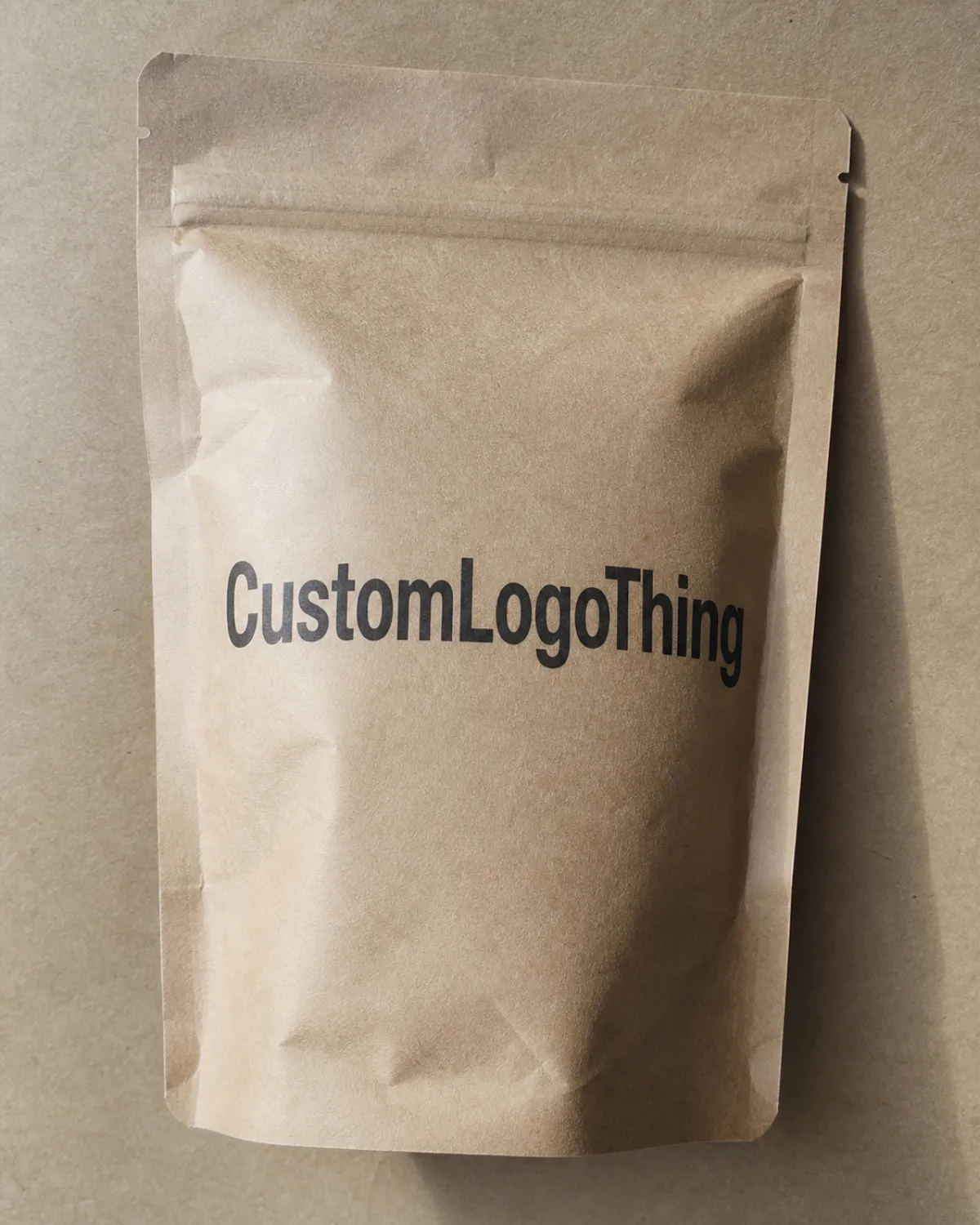
Wholesale ordering solves a problem that rarely shows up in a spreadsheet until it is already expensive. Brands do not want packaging to become a side project. Buy plain pouches, add stickers later, and you have created another handling step, another labor cost, and another place where the job can go wrong. A crooked label on 500 bags looks sloppy. A crooked label on 50,000 bags looks like a process failure.
For a buyer, the value of printed kraft pouches wholesale is not limited to a lower unit price. You also get repeatable print quality, a fixed spec for each SKU, and less risk of mixing finishes across a product line. That matters in coffee, supplements, dry food, pet treats, and shelf-stable liquids. Shelf presence matters, but so does the ability to pack and ship without improvising every carton.
There is a labor story underneath the branding story. Printed kraft pouches remove a step because the design lives on the pack, not on a separate label. Fewer touches usually means fewer mistakes. A warehouse team can fill, seal, and case a custom-printed pouch faster than it can sort stickers, align them, press them down, and inspect each front panel for a bubble, a crease, or a label that drifted a few millimeters off center.
Landing cost is the number that separates a smart buy from a cheap-looking spreadsheet win. Unit price matters, but it is only one column. Freight, duties, setup charges, proof costs, and labor all move the real number. If a pouch saves two cents and then needs a label, a second hand operation, and a reprint because the adhesive failed in cold storage, the “savings” were fiction from the start.
A quote only tells the truth when the specs match. If the size, barrier layer, print coverage, and closure are not identical, the lower number is not a bargain. It is a comparison error dressed up as value.
For general flexible packaging terminology and structure references, packaging.org is a useful neutral place to start. It will not choose a supplier for you, which is exactly the point. Buyers need definitions, not slogans.
Wholesale printed kraft pouches also keep a line visually coherent. One flavor in a matte kraft stand-up pouch, another in a glossy white bag, and a third in a plain mailer makes the range look assembled from leftovers. Wholesale orders let you lock the format early, so the shelf story looks deliberate instead of improvised.
There is a practical channel issue too. If your product moves through retail, e-commerce, and distributor warehouses at the same time, the pack has to survive all three environments. A pouch that looks elegant in a shop can still be the wrong choice for pallet stacking, temperature swings, or repeated handling in fulfillment centers. That is where wholesale planning pays off.
Printed Kraft Pouch Product Details: Styles, Liners, and Features
Kraft on the outside does not mean kraft is doing the protective work. That is the first detail buyers need to understand. The brown paper look is usually the outer face, while the product protection comes from the inner laminate structure. A common build may use a kraft outer layer with PET, BOPP, aluminum, or EVOH-based barrier layers and a PE sealing layer. The exact stack depends on what the product needs to survive in transit, on shelf, and after opening.
The most common formats are straightforward:
- Stand-up pouches for retail display, snacks, supplements, coffee, and pet treats.
- Flat pouches for sample sizes, single-serve goods, and lighter fills.
- Gusseted bags for bulkier products that need extra volume and a cleaner shelf shape.
- Spout pouches for liquids, sauces, concentrates, cleaners, and other fill types that need controlled dispensing.
Closure and usability features matter just as much as pouch shape. A zipper is useful if the customer will reclose the pack after opening. Tear notches make the first open feel planned instead of awkward. One-way degassing valves matter for fresh coffee because carbon dioxide needs a path out without letting oxygen back in. Hang holes matter when a pouch lives on peg hooks and has to carry its own display value. If the pack goes into a club store or a busy checkout fixture, that last point is not cosmetic; it is functional.
Finish changes the way a pack reads from three feet away and from three inches away. Natural kraft usually signals earthy, informal, and direct. Matte printed finishes can make the pouch feel more premium and less promotional. Gloss sharpens color and adds scuff resistance, but it can clash with the softer paper look that many brands want. None of that is moral. It is all branding, and branding always carries a production cost.
One detail buyers regularly underestimate: the print area is not a perfect rectangle. Seams, bottom gussets, zippers, valves, and tear notches all eat into the usable artwork space. If the front panel is crowded, a logo can drift too close to a seal or a legal line can disappear into a fold. Dieline review is not admin work. It is the difference between a pouch that looks designed and a pouch that looks negotiated.
For products that ship in warm trucks, damp storage rooms, or frozen distribution, the structure deserves extra scrutiny. A pouch that behaves well in a sample room may behave differently after condensation, compression, or multiple handoffs. That is not a theoretical concern. Food buyers, supplement brands, and private-label owners see it every year when a pack that looked fine in approval samples fails after real-world handling.
Best Fits by Product Type
If you are matching pouch style to product type, the best answer depends on fill weight, shelf life, and how the customer uses the pack after opening.
- Coffee: Stand-up pouch with zipper and one-way valve, usually with higher barrier requirements for aroma retention.
- Tea and dry snacks: Stand-up or flat pouch with zipper if reclosure matters, or heat seal only if the pack will be opened once.
- Supplements: Stand-up pouch with strong print clarity, especially when dosage and compliance text need to stay readable.
- Pet treats: Gusseted or stand-up format, often with a zipper for reseal and enough panel space for feeding instructions.
- Liquid or viscous goods: Spout pouch, but only if the filling setup and cap style fit the product flow.
For broader packaging structure language, sealing concepts, and format references, industry resources such as FSC are useful if your brand is making paper and fiber claims that need real documentation. A kraft face is not the same thing as a certified claim. Buyers should keep those separate.
Natural kraft can be the right move for some brands and the wrong move for others. If your artwork uses fine gradients, pale colors, or small white type, raw kraft may mute the print more than you want. White-backed or film-based structures usually give brighter art and better contrast. That tradeoff is simple: the paper look buys warmth and texture, while film and coated builds buy sharper graphics and usually better barrier control.
There is also a brand-positioning question hidden inside the material choice. A bakery line that sells on artisanal cues may benefit from the texture of kraft. A supplement company that depends on clinical clarity may need sharper contrast and more controlled color. The packaging should support the promise on the label, not compete with it.
Cost, Pricing, MOQ, and Quote Basics for Printed Kraft Pouches Wholesale
Pricing for printed kraft pouches is driven by a handful of variables, and most of them are boring in the best possible way. Size, material stack, print coverage, finish, zipper or valve add-ons, and quantity all push the number up or down. If you want the useful answer, ask for the structure first and the quote second. Otherwise you are comparing apples to laminated oranges.
| Pouch style | Typical use | Typical MOQ | Approx. unit price at 5,000 pcs | Approx. unit price at 10,000 pcs | Notes |
|---|---|---|---|---|---|
| Flat kraft pouch | Samples, tea, single-serve dry goods | 3,000-5,000 | $0.14-$0.26 | $0.10-$0.20 | Lowest material use, limited shelf shape |
| Stand-up kraft pouch with zipper | Snacks, supplements, pet treats | 5,000 | $0.22-$0.42 | $0.16-$0.30 | Best balance of display value and utility |
| Gusseted kraft bag | Coffee, bulk dry goods, heavier fills | 5,000 | $0.24-$0.48 | $0.18-$0.34 | More room, often better for tall product lines |
| Valve stand-up pouch | Fresh coffee and aroma-sensitive products | 5,000 | $0.30-$0.58 | $0.22-$0.40 | Valve adds cost, but it protects product quality |
| Spout pouch | Liquids, sauces, concentrates | 8,000+ | $0.70-$1.40 | $0.55-$1.05 | More complex fill, closure, and quality control |
Those numbers are directional, not a promise. They exclude freight, duties, and local handling because those costs move too much to pretend they are fixed. The exact number can shift if you change print coverage, panel count, film thickness, zipper style, or whether the finish is matte, gloss, or soft-touch. One extra feature can be worth it, but it should be selected on purpose, not by accident.
MOQ is where many buyers misread the market. Lower minimums look friendly until you realize the factory had to spread setup across fewer units. That usually raises the per-unit price. A larger MOQ often lowers unit cost, but only if you can actually use the inventory before your formula changes, your pack size changes, or your marketing team decides the color palette is going in a new direction.
There is another cost buyers overlook: change management. A lower MOQ can save cash if your product is still in flux. A larger MOQ can save more over time if the pack is stable and reorderable. The wrong number is not the smaller one; it is the one that leaves you with obsolete packaging on a pallet six months later.
Here is the buying math that matters:
- Unit price: the price per pouch before freight and extra fees.
- Setup or plate charge: a fixed cost tied to print preparation.
- Freight: air or sea shipping, plus domestic delivery if applicable.
- Import costs: duties, clearance, and handling if the order crosses borders.
- Labor: the time it takes to fill, seal, label, and pack the pouch.
The best quote is the one you can compare. If two suppliers are not quoting the same size, same barrier, same closure, and same print setup, the cheaper price is usually just the vaguest price.
Ask every supplier for the same package of details so the comparison is real, not decorative:
- Finished dimensions and fill weight.
- Exact material stack, not “kraft pouch” as a catch-all term.
- Print sides, color count, and coverage area.
- Closure type, valve, hang hole, or special feature.
- Quantity, ship terms, and estimated carton count.
If you are buying at scale, our Wholesale Programs page is the quickest way to see how volume orders are handled and what kind of support is available. That matters because the quote is only useful if the order can be produced repeatably.
Buyers often ask whether a slightly higher print cost is worth it for a cleaner finish or a better barrier. In many cases, yes. The answer depends on the product’s margin, shelf life, and launch cycle. A premium coffee bag with a degassing valve can justify a stronger structure. A sample pouch meant for a trade show may not need the same setup. The real job is matching spend to the packaging’s actual life span.
Specification Checklist for Printed Kraft Pouches Wholesale
The spec sheet is where good projects stay good. If the brief is loose, the result is usually loose too. Before you approve printed kraft pouches, lock down the variables that affect performance, shelf appearance, and cost.
- Dimensions: width, height, and gusset depth, plus any tolerance limits.
- Fill weight: the product load the pouch must carry without bloating or collapsing.
- Material layers: kraft outer layer, barrier layer, and sealant layer.
- Print method: digital, flexo, or gravure depending on volume and artwork complexity.
- Print sides: front only, front and back, or all visible panels.
- Finish: matte, gloss, natural kraft texture, or coated look.
- Closure: zipper, heat seal, tear notch, valve, spout, or hang hole.
- Barrier requirements: moisture, oxygen, aroma, and grease resistance.
- Food-contact suitability: if the pack touches consumables, confirm the structure is suitable for your market.
- Artwork format: vector files, image resolution, bleed, and safe area.
Barrier is the part that makes or breaks the product. If your item is dry and stable, a moderate moisture barrier may be enough. If it is coffee, seasoning, powdered nutrition, or anything aroma-sensitive, oxygen and aroma control become much more important. Kraft on the outside is the look. The inside has to perform.
Artwork needs extra care on kraft because the background is not a white sheet. Natural paper tones mute color. Browns, greens, and muted neutrals can look elegant. Pale colors, bright whites, and tiny text can lose punch. That is why a print proof on kraft matters more than a proof on plain white stock. The same design can look crisp on one substrate and muddy on another. Nobody gets credit for discovering that after production.
Do not guess on compliance either. If the pouch will touch food, supplements, or pet consumables, ask for the relevant material declarations and make sure the structure matches the intended market. If you plan to make recycled content, recyclable, or compostable claims, verify them before the label goes to press. A kraft face does not magically make a multi-layer laminate recyclable. Claims need proof, not hope.
For brands that want a certified fiber claim, chain-of-custody questions matter. The FSC system is a better place to verify those program terms than a random marketing deck. If you cannot document the claim, do not print it. That sounds obvious, yet it still happens.
One more practical note: sample approval saves money. A physical sample or print proof is worth the delay when the design uses a critical brand color, small type, a matte kraft look, or a zipper that sits close to the artwork. The sample is where you catch seal placement, color dulling, panel distortion, and zipper interference before the full order is committed.
Ask about storage conditions too. If your packaging will sit in a humid warehouse or be shipped through tropical lanes, paper-based looks can behave differently than they do in a climate-controlled sample room. A supplier who understands that difference is usually safer to work with than one who only talks about appearance.
Production Process, Timeline, and Lead Time Expectations
Custom packaging does not move instantly. If a supplier promises instant turnaround on a printed pouch with custom structure, print, and features, they are either skipping proofing or hoping you will not ask questions. The normal process is simple, but each step needs time.
- Request quote: send dimensions, artwork, quantity, and product details.
- Spec confirmation: the supplier confirms the structure, barrier, and features.
- Artwork review: dieline alignment, bleeds, panel placement, and file checks.
- Proof or sample: digital proof, printed proof, or physical sample if needed.
- Production: printing, laminating, curing, converting, and inspection.
- Shipping: domestic delivery or export freight, depending on route.
Typical timing varies, but buyers can work from realistic ranges. Quote turnaround is often 1-3 business days if the brief is clear. Artwork proofing can take another 2-5 business days, especially if the dieline needs cleanup. Physical samples may add 5-10 business days. Production for a standard wholesale run often sits in the 12-20 business day range after approval, with shipping on top of that depending on method and destination.
Rush orders can move faster, but there is always a tradeoff. Less time for proofing means more risk. Air freight can cut transit time, but it raises landed cost. A buyer who wants speed, low price, and zero revision usually gets to pick only two. The third one is the part where budgets drift.
Seasonal launches need more discipline. If the product launch is tied to a holiday, retail reset, or sales event, packaging should be locked early. A practical buffer is 6-10 weeks before the product has to ship, longer if the order is large or the artwork is still changing. The strongest packaging in the catalog is useless if it lands after the launch team has already built a workaround around it.
For shipping performance, suppliers should think beyond the pouch itself. How the pouches are carton-packed, palletized, and stored affects damage rate. Ask whether the final packed cartons were considered against common transit expectations such as ISTA-style distribution testing or similar packaging tests. If the pouches are supposed to travel in bulk, they should be treated like shipping goods, not fragile display props.
The supplier that says yes to everything in two minutes is not being efficient. They are probably skipping the checks that prevent expensive problems later.
If your line changes often, build in an approval rhythm. Lock the dieline, color targets, and closure spec before the print run. The second time you order the same pouch, the job should be boring. Boring is good. Boring means consistent.
That predictability helps in operations as much as it helps in purchasing. A packing team that knows the pouch will open the same way, seal the same way, and stack the same way can move faster with fewer errors. The benefit is real, even if nobody puts “fewer reworks” on the marketing deck.
Why Choose Us for Printed Kraft Pouches Wholesale
Working with a manufacturer is different from buying through a reseller. Manufacturers have more control over structure, print setup, and production scheduling, which usually means better visibility on pricing and fewer surprises halfway through the order. Resellers can be useful for convenience. Convenience is not control.
At Custom Logo Things, the job is to keep the spec clean and the quote honest. That means confirming dimensions, barrier needs, print coverage, and closure details before anybody starts talking about cost. It also means saying when a kraft pouch is not the right fit. If a product needs a heavier barrier, better aroma retention, or a different closure style, another structure may perform better. A pretty pack that fails is still a failure.
We also help buyers avoid the common traps: mismatched materials, vague quotes, and artwork that looks fine on a screen but lands poorly on kraft. That matters even more on repeat orders. Wholesale packaging only works if the second run matches the first run closely enough that nobody notices a difference unless they are looking for one.
Our Wholesale Programs page is designed for buyers who need volume, repeatability, and direct support around the spec. That support usually includes dieline guidance, material recommendations, proofing help, and timeline transparency. Those are not glamorous extras. They are the steps that prevent expensive rework.
Here is the practical value: a good packaging partner does not just sell pouches. They help you avoid buying the wrong pouch in bulk. That means watching for issues like print registration on natural kraft, zipper compatibility with the fill method, scuff resistance in transit, and whether the pouch format matches the sales channel. A retail display pouch and a warehouse-friendly pouch are not always the same answer.
Consistency across repeat orders is the real test. A customer may never say, “The seal profile matched the last run.” They will notice if the new order smells different, feels flimsy, or sits crooked on shelf. That kind of variation turns a good packaging decision into an ongoing headache.
There is also a trust issue that experienced buyers do not ignore. A supplier should be able to explain what changed if an earlier run and a later run differ in color, film feel, or zipper performance. If the answer is vague, the risk is probably still there.
Next Steps for Ordering Printed Kraft Pouches Wholesale
If you are ready to move, gather the facts first. The quote gets better when the brief is tighter. A clear packaging request should include the product type, fill weight, dimensions, closure preference, barrier needs, artwork files, and target quantity. If you know the launch date, include that too. “As soon as possible” is not a schedule. It is a warning sign.
Send the art files with the packaging brief. A die-line, even a rough one, cuts down on revision cycles. If you do not have final artwork yet, send the current logo files, brand colors, and the level of print detail you want. The more context the supplier gets, the less they have to guess. Guessing is where packaging quotes drift.
Ask for samples when the design is sensitive to color, texture, or closure performance. If the pack uses a natural kraft look, a small font, or a critical brand color, a proof is cheap insurance. The best time to discover a problem is before the full run. The second best time is never, but that route is closed once production starts.
Compare offers on landed cost, not just the neat number at the bottom of the quote. Add freight, duties, setup, and any local handling costs. If one quote looks much cheaper, check what is missing. The cheapest number often leaves out something annoying on purpose.
A clean ordering path looks like this:
- Choose the pouch style that fits the product.
- Confirm the spec and MOQ.
- Approve the dieline and print layout.
- Request a proof or sample if the design is sensitive.
- Lock the schedule and move into production.
Done right, printed kraft pouches wholesale should protect the product, fit the budget, and stay consistent when you reorder. If it cannot do those three things, it is not the right pack, no matter how nice it looks in a mockup.
The most useful takeaway is simple: treat the pouch as part of the product, not as a last-minute accessory. Choose the structure for the item inside it, confirm the print and closure details before ordering, and judge every quote on landed cost and repeatability. That is the difference between packaging that merely looks finished and packaging that actually performs.
What is the typical MOQ for printed kraft pouches wholesale?
MOQ depends on pouch size, print complexity, and factory setup, so there is no single number that fits every order. Smaller runs usually carry a higher unit cost because the setup cost gets spread across fewer pieces. Ask for MOQ by structure and print method so you can compare options honestly instead of guessing.
How much do printed kraft pouches wholesale orders usually cost?
Pricing is driven by size, barrier layers, zippers or valves, finish, and quantity. The number to compare is landed cost, not just the quoted unit price. Higher quantities usually reduce per-unit cost, but only if you will actually use the inventory before the pack changes.
Can printed kraft pouches wholesale be used for food products?
Yes, if the pouch structure is built for the product and the materials are suitable for food contact in your market. Dry goods, coffee, snacks, tea, and pet treats are common use cases. Barrier needs matter more than the kraft look, especially for moisture and aroma control.
How long does production take for printed kraft pouches wholesale?
Timeline depends on proof approval, order size, materials, and shipping method. Artwork changes and sample requests are the most common reasons schedules slip. Build in extra time before a launch so you are not racing the truck to the finish line.
What files do I need to get a quote for printed kraft pouches wholesale?
Send your artwork if you have it, plus dimensions, fill weight, quantity, and closure preferences. If you do not have final art, a basic brief and product specs still let the supplier quote accurately. A dieline or rough layout helps reduce revision cycles and speeds up approval. That is the cleanest way to buy printed kraft pouches wholesale without wasting money on avoidable revisions.


