Buyer Fit Snapshot
| Best fit | Printed Kraft Shipping Cartons Wholesale for Brands projects where brand print, material claims, artwork control, MOQ, and repeat-order consistency need to be specified before quoting. |
|---|---|
| Quote inputs | Share finished size, material target, print colors, finish, packing count, annual reorder estimate, ship-to region, and any compliance wording. |
| Proofing check | Approve dieline scale, logo placement, barcode or warning zones, color tolerance, closure strength, and carton packing before bulk production. |
| Main risk | Vague material claims, crowded artwork, missing packing details, or unclear freight terms can make a low unit price expensive after revisions. |
Fast answer: Printed Kraft Shipping Cartons Wholesale for Brands should be specified like a repeatable production item. The safest quote records material, print method, finish, artwork proof, packing count, and reorder notes in one written spec.
Production checks before approval
Compare the actual filled-product size with the drawing, then confirm tolerance on folds, seals, hang holes, label areas, and retail display edges. Reserve space for logos, QR codes, warning copy, and material claims before decorative graphics fill the panel.
Quote comparison points
Review material grade, print process, finish, sampling route, tooling charges, carton quantity, and freight assumptions side by side. A quote is only useful when the supplier can repeat the same color, closure quality, and packing count on the next order.
Change a carton by just two inches and the numbers can shift immediately. Void fill grows, dimensional weight can creep upward, and a box that looked fine on a spec sheet starts behaving like a bad fit on the packing line. I've watched that happen more than once, and the lesson is always the same: Printed Kraft Shipping cartons wholesale works best when the box is sized around the product first and the graphics second.
From a packaging buyer's point of view, the strongest carton is the one that does three jobs at once. It protects the product, keeps shipping costs under control, and carries enough brand presence to make the unboxing feel deliberate rather than random. printed Kraft Shipping Cartons wholesale can do all three without pushing a brand into rigid presentation packaging that was never meant to survive parcel handling.
There is also a simple reason kraft keeps showing up in serious shipping programs: it is honest material. It looks restrained, it prints cleanly when the structure is chosen well, and it does not pretend to be something it is not. When the carton is right-sized and the print is disciplined, the result feels more credible than heavy-handed packaging that spends money on surface effects and not enough on function. For brands shipping at volume, that balance matters because a small improvement repeated across thousands of orders becomes a real operating gain.
Why printed kraft shipping cartons wholesale can cut waste fast
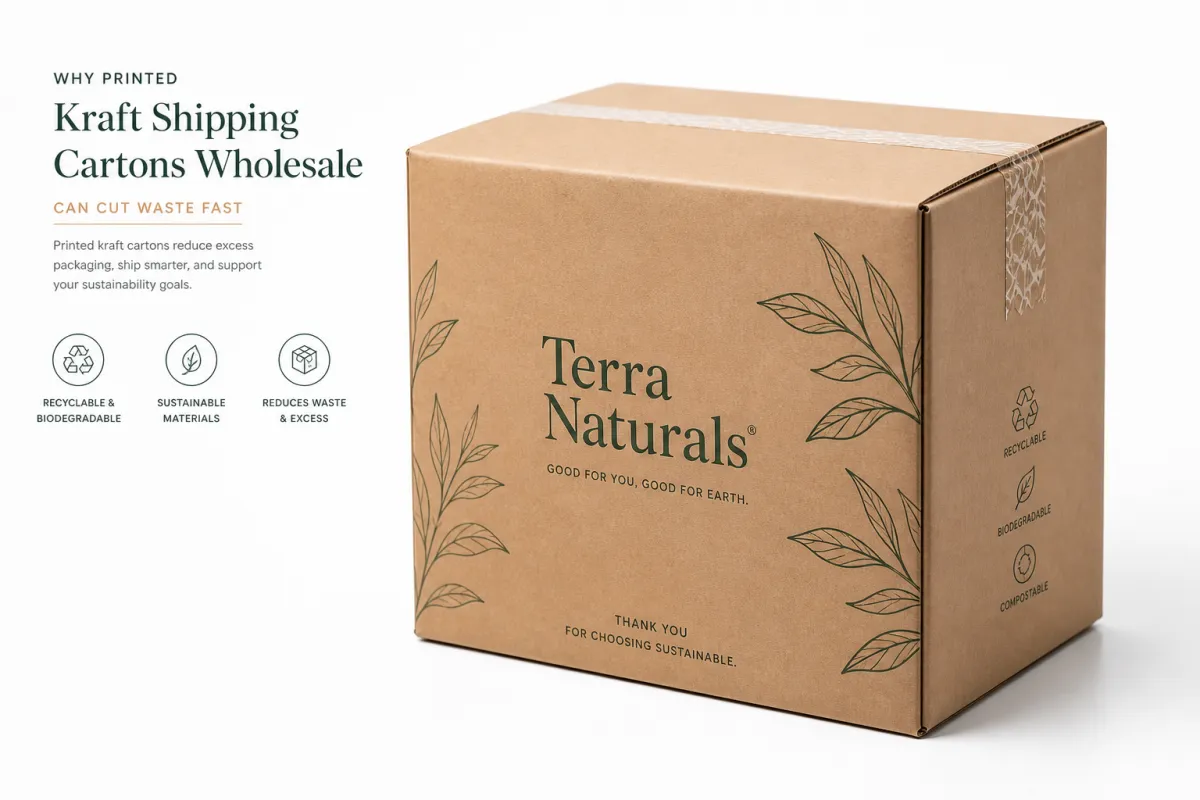
Most of the savings show up in fill material first. A carton that fits the product more closely needs less paper, less foam, and fewer inserts, and that reduction affects more than the sustainability story on a slide deck. It changes pack speed, labor effort, and damage prevention. Printed kraft shipping cartons wholesale can reduce all three when the box is designed around the item instead of the shelf display.
A plain brown shipper can feel generic, almost anonymous. A printed kraft shipper says the box was made for the product inside, and that signal changes perception faster than many buyers expect. A clean one-color mark, placed with restraint, often does more for brand memory than a noisy exterior ever could. I've seen teams spend too much on outer-packaging theatrics when a carefully sized kraft carton would have done the job better and cost less.
Kraft is not the answer for every shipment, and pretending otherwise would be sloppy advice. Heavy goods, liquid products, and unusually fragile items may need stronger board, custom inserts, or a different transit plan entirely. Even so, apparel, accessories, subscription kits, light home goods, beauty assortments, supplements, and many spare-parts programs fit comfortably within printed kraft shipping cartons wholesale. It sits between oversized generic boxes and rigid presentation packaging, which makes it a practical middle ground for a lot of ecommerce operations.
The recycling story is usually stronger than people realize, but it still needs a little honesty. Recycled content, less excess material, and curbside recyclability where local programs accept corrugated cartons all pull in the same direction. If your team wants a cleaner packaging story without writing a paragraph of copy on the side panel, printed kraft shipping cartons wholesale usually gives you that path. The EPA recycling guidance is a useful reference, though local rules still decide what actually happens after the box leaves the customer's hands.
A carton that fits right is cheaper than a carton that merely looks premium. In shipping, fit decides the economics long before surface finishes do.
Compare kraft cartons with plain brown shippers, poly mailers, and rigid packaging and the choice becomes easier to read. Poly mailers work well for soft goods that do not need crush resistance. Rigid packaging suits presentation-heavy retail moments and luxury campaigns. For many ecommerce brands, though, printed kraft shipping cartons wholesale lands in the most useful zone: better protection than a mailer, stronger branding than a plain box, and lower unit cost than rigid structures at similar protection levels.
There is another advantage buyers sometimes overlook. A standardized carton family simplifies replenishment. Fewer sizes mean less storage clutter, cleaner picking, and faster pack-out. In fulfillment centers, every extra SKU creates another chance for a mistake, and mistakes carry a cost. If one carton can support the brand and the warehouse at the same time, it earns its place quickly. That is the understated strength of printed kraft shipping cartons wholesale.
For brands building a broader packaging system, it helps to think in connected programs instead of isolated boxes. A corrugated shipper can be planned alongside inserts, labels, and secondary packouts from the same supply structure, which is where packaging starts acting like part of the operation instead of a separate purchase. The Wholesale Programs page is a practical place to see how recurring supply can be organized across packaging lines.
Product details: what printed kraft shipping cartons wholesale actually include
Buyers often ask for a "kraft shipping box" and then discover the phrase covers several carton styles. Mailer-style shippers, tuck-top boxes, self-locking cartons, top-load formats, and custom die-cut structures all sit under that umbrella. Printed kraft shipping cartons wholesale can cover each one, but the right fit depends on the product, the carrier, and how the packing line moves.
Mailer-style shippers are popular because they assemble quickly and present cleanly. They work well for apparel, stationery, sample kits, and accessory bundles. Self-locking cartons suit teams that want a fast fold sequence and a dependable close. Tuck-top cartons can be efficient for lighter contents. Top-load formats often work better for broader items that need easy loading or a specific presentation orientation. Each structure changes transit behavior and changes the feel of opening the box, which is why the structure choice matters as much as the print.
Material structure matters just as much as shape. Some programs use a kraft outer face with a corrugated core. Others use paperboard constructions for lighter loads. The outer kraft surface is where print quality and scuff resistance show up first. If the artwork is too dark, too dense, or mismatched to the substrate, the carton can lose the crisp appearance the buyer expected. That is why printed kraft shipping cartons wholesale should be treated as a material-and-print package, not just a box shape with a logo on top.
Branding can stay spare or become layered, depending on the program. A one-color logo on the lid may be enough for an ecommerce shipment. More involved versions can add full-panel graphics, inside print, QR codes, handling marks, seasonal copy, or product education. For some brands, the best answer is not full coverage but a disciplined layout that lets the kraft surface do some of the visual work. That restraint usually costs less and tends to stay in memory longer. It is kinda hard to argue with that when the box still has to move through a real shipping lane.
Small details can alter the customer experience more than the main print. Inserts and dividers keep units from knocking together. Tear strips make opening easier. Tamper-evident features add confidence for sensitive products. Fit-specific internal supports can stabilize fragile items without forcing the team to stuff the box with extra filler. Those pieces matter because package protection is not an abstract goal; it is the difference between a clean delivery and a support ticket.
Here is where printed kraft shipping cartons wholesale becomes practical. The same carton spec can be right for one category and wrong for another. Apparel can tolerate a slightly looser fit. Electronics accessories usually need tighter dimensions and better crush resistance. Supplement kits may call for cleaner print and moisture-aware handling. Sample boxes often need stronger compartment logic than a basic shipper would suggest. The carton should match the shipping behavior of the product, not just the marketing brief.
It also helps to think about where the box goes after it leaves the packing bench. Does it move straight to a parcel carrier? Does it pass through a 3PL? Does it sit on a pallet before the final dispatch? Those questions determine whether the carton only needs basic protection or whether it needs reinforcement. printed kraft shipping cartons wholesale is broad enough to serve all of those paths, but the specs need to reflect the actual shipping lane.
Specifications buyers should compare before ordering
The easiest mistake is comparing cartons on price alone. The more useful comparison is structural. Board grade, flute profile, ply count, burst strength, edge crush test, and stacking performance all influence whether the carton survives the trip. For many brands, printed kraft shipping cartons wholesale only becomes cost-effective once those variables are matched to the product and carrier conditions.
Size tolerance deserves close attention. A box that is nominally close but practically loose adds friction in pack-out, increases the chance of damage, and often pushes the team toward extra fill. A box that is too tight slows the line and can crush the product or distort the print surface. A box that is too large can trigger dimensional weight charges. That one issue alone can wipe out the savings from a lower per-unit price. Buyers comparing printed kraft shipping cartons wholesale quotes should always ask how the carton measures in production, not only how it appears on paper.
Print method affects economics and image quality. Flexographic printing is often chosen for repeat production and straightforward artwork. Digital printing fits faster setup, lower quantities, and more complex graphics without heavy tooling. Litho-lam can deliver a premium visual finish, though it adds cost and usually belongs in programs that need stronger shelf presence or a polished presentation. None of these is automatically the best choice; the right one depends on run length, coverage, and timeline.
Buyers who need to justify the decision internally should ask for standards-based testing. If the carton will travel through parcel carriers, request testing that reflects the lane. ISTA procedures are widely used for distribution testing, and ASTM-based checks can help validate durability. That is not bureaucracy for its own sake. It gives the team a realistic view of vibration, drop, stacking, and humidity conditions instead of relying on a guess.
Sustainability specifications belong in the first round of discussion, not the last. Ask about recycled content, fiber sourcing claims such as FSC if they apply, and whether the inks are water-based. Coatings deserve a careful look as well. Some coatings are perfectly appropriate, but unnecessary layers can complicate recycling and push the price higher. The cleanest solution is often the simplest one: a well-sized carton, clear print, and no decorative extras that do not improve function. That is one reason printed kraft shipping cartons wholesale appeals to operations teams and brand teams at the same time.
One useful buyer lens is this: if the carton fails in transit, the cost is not limited to the carton itself. Replacement goods, customer service time, carrier claims, reshipment, and brand damage all sit in the background. The cheapest quote on the page can become the most expensive decision in practice. With printed kraft shipping cartons wholesale, the best spec is usually the one that balances structure, print, and repeatability rather than chasing the lowest headline number.
| Option | Typical run fit | Indicative unit price | Strength profile | Best use case |
|---|---|---|---|---|
| Plain kraft corrugated shipper | 5,000+ units | $0.42-$0.68 | Good protection, minimal branding | Budget-led ecommerce shipping and internal transit packaging |
| One-color flexo printed kraft carton | 3,000-10,000 units | $0.52-$0.82 | Strong value, clean repeat print | Subscription boxes, accessories, and routine order fulfillment |
| Digital full-color printed kraft carton | 500-5,000 units | $0.78-$1.35 | Fast setup, more graphic flexibility | Launches, seasonal runs, test markets, lower volume ecommerce shipping |
| Litho-lam premium carton | 2,000+ units | $1.10-$2.10 | Best image quality, higher presentation value | Premium unboxing, retail-forward programs, high-visibility campaigns |
Printed kraft shipping cartons wholesale pricing, MOQ, and quote basics
Price comes from a cluster of variables rather than a single line item. Size, board grade, print coverage, number of colors, inserts, finishing steps, and total order volume all affect the quote. Printed kraft shipping cartons wholesale is often more affordable than buyers expect, but only when the design avoids unnecessary complexity and the order size fits the production method.
MOQ should be treated as a pricing lever, not as a fixed rule carved in stone. Digital production can support lower quantities because setup is lighter. Flexo and custom tooling usually reward larger replenishment orders because the start-up cost is spread over more units. The real question is not "What is the minimum?" The better question is, "At what volume does the carton hit the price and service level we need?" That is the kind of question that separates a quick purchase from a durable supply plan.
Buyers should read a quote line by line. Structure should be separated from print. Samples should be listed clearly. Tooling should be visible. Freight should be isolated. Any special finishing, such as inside print or partial coating, should be called out instead of hidden in a blended figure. When printed kraft shipping cartons wholesale quotes are presented transparently, procurement teams can compare them on landed cost instead of a misleading unit price.
The hidden cost of ordering too few cartons is a recurring problem. Small buys can look attractive on a spreadsheet, then the brand pays for rush freight, repeated setup, inconsistent carton color, and interrupted replenishment. In ecommerce shipping, those disruptions are concrete. They affect delivery speed, pack-line labor, and customer experience. For many businesses, a slightly larger initial order ends up cheaper by the time the second replenishment arrives.
A simple procurement framework keeps the decision grounded. Forecast demand by month. Decide the maximum acceptable unit price. Define the acceptable lead time. Then compare landed cost, not just ex-works pricing. That approach makes printed kraft shipping cartons wholesale easier to evaluate because it forces the team to account for freight, warehousing, and reorder discipline. A quote that looks higher at first can still be the better commercial choice if it keeps the line moving and avoids expensive rework.
One more practical point: when cartons are being bought alongside other packaging formats, the total program matters more than a single item in isolation. A carton, a label, a mailer, and an insert system often belong inside the same fulfillment logic. The Custom Packaging Products page is useful for seeing how a broader packout can be organized, and if your program uses hybrid shipping paths, Custom Poly Mailers can complement carton shipments for soft goods or overflow SKUs.
Process and timeline: from dieline to delivery
A strong carton program follows a predictable sequence: product brief, spec review, quotation, dieline creation, artwork setup, sample approval, manufacturing, quality checks, and shipment. Printed kraft shipping cartons wholesale moves faster when the buyer provides dimensions, product weight, quantity, and artwork early, because each of those details removes a decision point from the schedule.
Timeline changes quickly when any core input is missing. New carton sizes require structural review. Artwork that is still moving creates proof cycles. Products that need testing introduce another step before release. Buyers often assume production is the long part, yet the real delays usually happen before the press or converting line begins. A clean brief shortens lead time more effectively than a promise of speed, and that is something a lot of teams only learn after one rushed order goes sideways.
Rushed work is possible, but only when the structure is already approved and the buyer can sign off without hesitation. If the dimensions are still changing, the schedule becomes hard to predict. That is especially true for printed kraft shipping cartons wholesale programs with inserts, internal fit requirements, or barcoded packout instructions. One missing barcode can hold a shipment. One unapproved color can push a slot. One late artwork correction can add days no one budgeted for.
Common delay points are easy to recognize. Late proof revisions. Missing UPC or QR code data. Artwork that does not match the print method. Dimensions that do not match the product once samples arrive. Different expectations around crush strength or stacking. None of these is unusual, and that is exactly why they should be anticipated early. The best suppliers flag those risks before production begins, not after.
Buyers can keep the process moving with a short checklist:
- Provide final product dimensions, unit weight, and any insert requirements.
- Confirm ship method, carrier limits, and whether dimensional weight is a concern.
- Send artwork files early, even if they are rough, so print limitations can be checked.
- Request samples or a prototype if the product is fragile, premium, or irregularly shaped.
- Lock the reorder quantity before the first production slot opens.
That may sound basic, but basic is what protects launch dates. A carton program is not just a design project. It is a manufacturing schedule, a logistics plan, and a customer-experience tool. When those pieces line up, printed kraft shipping cartons wholesale becomes a dependable part of the supply chain rather than another packaging experiment.
It also helps to think about the full packaging ecosystem. If a carton family is being introduced alongside shipping boxes, mailers, and accessory packs, alignment matters. The Custom Shipping Boxes page can help you compare box families and decide how a carton program should sit next to the rest of the ship-ready line.
Why choose us for printed kraft shipping cartons wholesale
For Custom Logo Things, the value is not just in supplying a box. It is in helping buyers choose a carton that holds up across production, packing, and parcel delivery. printed kraft shipping cartons wholesale should be treated as a repeatable manufacturing program, which means sizing accuracy, print consistency, and predictable delivery matter more than polished sales language.
Direct accountability changes the outcome. Fewer handoffs mean less confusion when artwork needs adjustment or a structural detail needs clarification. If a box requires a different fold sequence, a better score line, or a revised insert fit, the issue can be handled without waiting for multiple intermediaries to translate the problem. That is a practical benefit for buyers who care about order fulfillment discipline, not just first-order aesthetics.
Prepress support is another place where a strong supplier earns trust. Dielines should be reviewed against the actual product, not only the marketing dimensions. Artwork placement needs to account for tuck flaps, glue areas, and panel shifts. Print coverage should be checked against the chosen substrate so color does not turn muddy or weak on kraft. This is where printed kraft shipping cartons wholesale moves from a generic purchase to a controlled packaging decision.
Quality control matters more than many buyers expect. Board inspection catches inconsistent stock before it reaches converting. Print checks help maintain color consistency across lots. Packaging tests reduce the chance of transit damage. A carton that looks good on a desk can still fail under stacking pressure. A carton that survives a lab test but prints poorly can still damage the brand. The right supplier pays attention to both sides of that equation.
That balance helps with sustainability and cost control at the same time. A well-designed kraft carton can reduce excess material, avoid unnecessary coatings, and keep shipping materials simpler. It can also lower the chance of chargebacks, replacements, and customer complaints. In other words, printed kraft shipping cartons wholesale should be judged by the total operating picture, not by one isolated metric.
Most packaging teams do not need more complexity. They need a carton that is right-sized, repeatable, and easy to defend in a budget meeting.
If your team is building a broader packaging roadmap, start with the carton and work outward. Decide how the box will behave in transit, how it will print, and how often it will reorder. Then align the rest of the shipping materials around that decision. The result is usually cleaner, cheaper, and easier to scale. It also keeps the packaging brief grounded in actual shipping behavior instead of theory.
Next steps for printed kraft shipping cartons wholesale orders
Before requesting a quote, gather the details that actually move pricing: product dimensions, unit weight, ship method, monthly volume, target launch date, and any insert or divider needs. When buyers prepare that information early, printed kraft shipping cartons wholesale pricing becomes much more reliable because the supplier is not guessing at the structure or the logistics.
Send artwork or brand references as soon as possible. Even a rough file can reveal whether the design will work on kraft, whether the print method matches the coverage, and whether any text or barcode needs to move. If the carton will carry fragile, premium, or unusually shaped contents, request a sample or prototype first. Sample-stage corrections are inexpensive. Full-run corrections are not.
A simple decision path keeps the purchase grounded. Compare landed cost. Compare lead time. Compare durability. Then confirm whether the carton can be reordered at the same spec without surprise changes. That last point matters more than many teams expect. A carton that cannot be repeated cleanly is not a packaging solution; it is a temporary fix wearing packaging clothes.
For most brands, the best outcome is not the most elaborate carton on the table. It is the carton that protects the product, keeps dimensional weight in check, and supports a cleaner unboxing with minimal waste. If those pieces line up, printed kraft shipping cartons wholesale becomes a serious business tool rather than a decorative line item. Once the specs, budget, and schedule align, move forward with the carton family that can be repeated without guesswork and keep the next replenishment slot open before the calendar tightens.
FAQ
What sizes are common for printed kraft shipping cartons wholesale?
The right size depends on the actual product dimensions plus any insert or padding needs, not on a generic catalog standard. Ask for a dieline matched to your product category so the carton is tight enough to protect contents but not so tight that packing slows down. If you ship through multiple channels, request a size that works for the most restrictive carrier or warehouse rule first. That approach makes printed kraft shipping cartons wholesale much easier to scale across fulfillment locations.
How many colors can printed kraft shipping cartons wholesale handle?
One- and two-color designs are often the most cost-efficient for kraft cartons and still deliver a clean branded result. Digital printing can support more complex graphics at lower volumes, while higher-volume methods may work better for simpler artwork. Large solid backgrounds and heavy coverage can change pricing, so it helps to compare artwork options before final approval. For many programs, printed kraft shipping cartons wholesale works best with restrained print that lets the kraft surface carry part of the visual identity.
What is a realistic MOQ for printed kraft shipping cartons wholesale?
MOQ depends on the print method, carton size, and whether tooling or custom cutting is required. Digital runs usually allow smaller quantities, while flexo and other production methods often make larger orders more efficient. Ask for a volume ladder so you can see how the unit price changes at each order level before you commit. That pricing ladder is one of the clearest ways to judge whether printed kraft shipping cartons wholesale fits your reorder plan.
How long does printed kraft shipping cartons wholesale production usually take?
Timeline usually includes quoting, dieline setup, proof approval, production, and freight time, so the full schedule is longer than the manufacturing stage alone. Artwork readiness has a major effect on turnaround, and changes after proofing can add days or weeks. Rush options may exist, but they work best when the structure is already approved and the buyer can sign off quickly. If the project is launching soon, start printed kraft shipping cartons wholesale planning earlier than you think you need to.
Can printed kraft shipping cartons wholesale be recycled after use?
In many cases, yes, if the carton is made from recyclable corrugated material and is not heavily contaminated with coatings or residues. Local recycling rules vary, so it is smart to confirm how your destination market handles Printed Corrugated Packaging. Keeping the design simple and using water-based inks can help preserve recyclability and reduce unnecessary finishing. That is one of the cleaner advantages of printed kraft shipping cartons wholesale for brands that want a practical sustainability story, not just a slogan.
If you are comparing specs, ask for a quote, or mapping a carton family across several SKUs, the clearest path is to start with the product dimensions, confirm the shipping lane, and lock the print method before the artwork drifts. That sequence keeps printed kraft shipping cartons wholesale focused on fit, repeatability, and actual freight performance, which is the part that matters once the boxes start moving.


