Buyer Fit Snapshot
| Best fit | Printed Luxury Rigid Boxes projects where brand print, material claims, artwork control, MOQ, and repeat-order consistency need to be specified before quoting. |
|---|---|
| Quote inputs | Share finished size, material target, print colors, finish, packing count, annual reorder estimate, ship-to region, and any compliance wording. |
| Proofing check | Approve dieline scale, logo placement, barcode or warning zones, color tolerance, closure strength, and carton packing before bulk production. |
| Main risk | Vague material claims, crowded artwork, missing packing details, or unclear freight terms can make a low unit price expensive after revisions. |
Fast answer: Printed Luxury Rigid Boxes: Design, Cost, and Process should be specified like a repeatable production item. The safest quote records material, print method, finish, artwork proof, packing count, and reorder notes in one written spec.
Production checks before approval
Compare the actual filled-product size with the drawing, then confirm tolerance on folds, seals, hang holes, label areas, and retail display edges. Reserve space for logos, QR codes, warning copy, and material claims before decorative graphics fill the panel.
Quote comparison points
Review material grade, print process, finish, sampling route, tooling charges, carton quantity, and freight assumptions side by side. A quote is only useful when the supplier can repeat the same color, closure quality, and packing count on the next order.
What Are Printed Luxury Rigid Boxes?
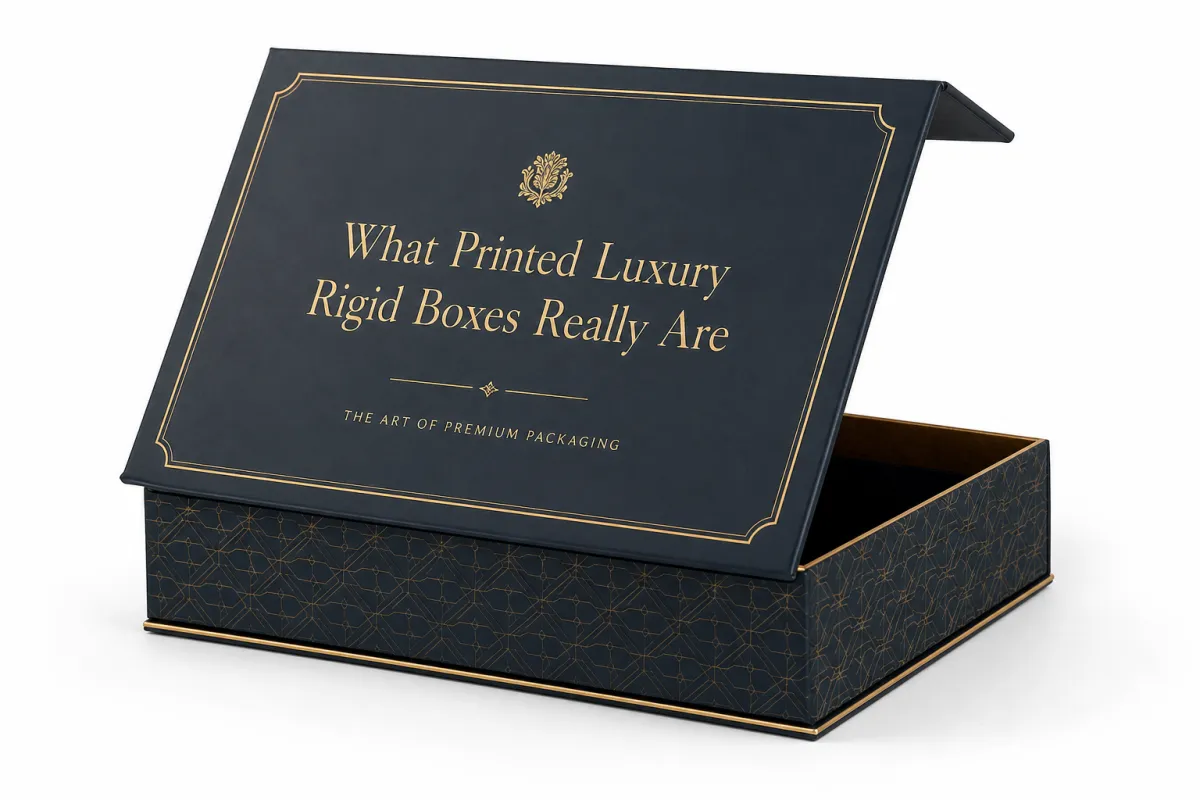
Printed Luxury Rigid Boxes do a job that most packaging never even tries to do: they make the product feel more serious before the seal is broken. I have watched buyers lift a box, pause for half a second, and decide the brand felt more credible simply because the corners stayed crisp and the lid landed with a clean, controlled fit. That reaction is not magic. It is structure, print, finish, and restraint working together.
A rigid box starts with thick board and a wrapped exterior that carries the artwork. Folding cartons collapse flat and save space; printed Luxury Rigid Boxes do not. They keep their shape, resist crush better, and create a more deliberate opening moment. That fixed structure matters in cosmetics, fragrance, jewelry, electronics, apparel, and curated gift packaging, where the box is part of the product story rather than an afterthought.
The premium feel comes from details people notice instinctively, even if they cannot name them. Corners need to stay sharp. Wrap paper needs to lie flat. Seams need to disappear into the structure instead of drawing attention to themselves. The lid should meet the base with confidence, not with a wobble. If the render looks expensive but the box flexes in the hand, the illusion falls apart fast. Customers may not explain the flaw, but they will feel it.
There is a useful split between visual luxury and structural luxury. Visual luxury comes from color, type, foil, and texture. Structural luxury comes from board thickness, build method, corner construction, and assembly precision. Printed luxury rigid boxes need both. A gorgeous exterior without stable structure feels hollow. A strong structure without thoughtful print feels plain. The best boxes make the two work together so the packaging feels complete from first glance to final lift of the lid.
“A premium box should feel precise in the hand. If the lid rattles, the corners round off too much, or the wrap shifts even slightly, the customer notices before they can explain why.”
From a buyer’s point of view, printed luxury rigid boxes are not just presentation pieces. They protect the product, support brand positioning, and can raise perceived value in gifting and retail settings. A well-built box photographs better, reduces damage, and gives the item stronger shelf presence. That is one reason many brands choose Custom Packaging Products with rigid construction instead of defaulting to standard cartons that disappear in the crowd.
How Printed Luxury Rigid Boxes Are Made
Printed luxury rigid boxes are built from the inside out. The process usually begins with rigid board cut into panels for the base, lid, tray, or drawer shell. Those panels are assembled into a fixed form first. After that, the printed wrap is mounted onto the structure with adhesive and careful pressure. The exterior may carry the brand story, but the internal board is the part doing the actual work.
Two print paths show up most often. One uses a decorative sheet printed before it is wrapped onto the board. The other prints directly onto the wrap stock, which may be coated, textured, or specialty paper chosen for premium finishing. Both routes demand close control over color, registration, and image sharpness. These boxes punish sloppy print. Soft edges, weak blacks, and thin type near a seam all become visible once the board is wrapped and turned.
Finishing is where the package begins to feel expensive in a way people can touch. Matte lamination gives the box a quieter, more modern presence. Soft-touch adds a velvety feel that many beauty and fragrance brands like because it slows the hand down. Foil stamping introduces shine and contrast, often on a logo or border. Embossing lifts a mark from the surface. Debossing presses it inward. Spot UV creates a glossy accent against a matte field. Textured papers can suggest linen, leather, or fine art paper, which changes the mood before the lid opens.
Inserts and closures shape the experience just as much as the outer print. EVA foam is common when a product needs a precise cavity and strong support. Molded pulp works well for brands trying to reduce plastic content while keeping items stable in transit. Paperboard dividers suit multi-item gift sets. Magnetic lids create a quiet closing action that reads as premium. Ribbon lifts and hidden hinges turn an ordinary opening into a more deliberate reveal. These details are not ornament alone. They are part of how printed luxury rigid boxes communicate value.
Quality control matters because the problems are usually small, then expensive. Glue marks can appear at corners. White stress lines can show up where the wrap turns tightly. Foil can drift a fraction of a millimeter and still read as off. Inserts can rise too high and stop the lid from closing flush. Seams can land on a visible face instead of a hidden edge. Each issue looks minor in isolation. Together, they decide whether the final package feels refined or merely assembled.
Shipping performance deserves attention too. If these boxes are going into parcel networks or broad retail distribution, transit testing can reveal weak points long before the first large run leaves the factory. Many teams reference ISTA testing standards when they want a practical way to judge vibration, stacking, and handling stress. ASTM-based methods are also common in packaging planning. A beautiful box still has to survive the trip, which is kind of the whole point once it leaves the table.
Key Design Factors for Printed Luxury Rigid Boxes
Brand positioning should steer every choice in printed luxury rigid boxes. A minimal skincare brand with soft neutrals needs a different language than a high-energy lifestyle label launching a seasonal kit. The first may work best with soft-touch lamination, blind embossing, and restrained typography. The second may need stronger contrast, brighter print, and a more expressive insert layout. If the package and the brand are speaking in different tones, customers notice the mismatch before they notice the product.
Board thickness is one of the earliest technical decisions, and it changes more than strength. Heavier board adds stiffness and a more confident feel, but it also affects corner build, wrap behavior, and cost. Wrap paper choice matters just as much. Coated art paper can carry sharp graphics and saturated color. Uncoated or textured stock gives the format a softer, more crafted look. Coatings change scuff resistance, sheen, and fingerprint visibility. Soft-touch feels elegant, yet high-contact areas can still shine if the box is handled often.
Artwork setup is where many good ideas go off track. A flat mockup helps, but rigid packaging needs dieline-aware design from the beginning. Bleed, safe zones, wrap turn-ins, magnets, and hidden seams all affect the final result. A logo that sits too close to the edge can disappear into the fold. A hairline rule across a crease can look uneven after assembly. Good packaging artwork is built for thickness, turn-ins, and corners, not only for a screen.
Typography and open space matter more than many teams expect. A premium box may be viewed from three to six feet away on a shelf, then again in a close ecommerce photo under hard lighting. Printed luxury rigid boxes need to read cleanly in both settings. Tiny type, pale copy, and crowded front panels can make a box feel noisy, even when the production budget is high. Luxury often comes from restraint. The eye needs room to settle.
Sustainability belongs in the design discussion from the start. Recycled board, FSC-certified paper wraps, and plastic-free inserts can support a strong brand story without flattening the presentation. The Forest Stewardship Council remains a useful reference point for certified sourcing; see FSC certification information for a practical baseline. Printed luxury rigid boxes do not need excess material to feel premium. The strongest results usually come from balancing protection, appearance, and material efficiency.
A few checks are worth making before approval:
- Confirm product dimensions with caliper measurements rather than nominal size alone.
- Check the clearance the insert needs for fingers, closures, cables, caps, or folds.
- Review the finish under daylight and retail lighting, since gloss and metallic effects shift a lot.
- Ask whether the outer wrap can hide seams on the least visible edge.
- Verify that the opening direction supports the reveal, especially for gifting and subscription formats.
Once those choices are set, the packaging becomes much easier to scale without losing the polish that made the concept appealing. That is a good moment to revisit the wider product family through custom packaging product options, especially when a brand needs matching retail and gift formats.
What Do Printed Luxury Rigid Boxes Cost and Why?
Pricing for printed luxury rigid boxes comes down to a few variables that interact more than buyers usually expect. Size leads the list. Larger boxes need more board, more wrap material, and more handling time. Board thickness also affects cost, since heavier board raises material spend and can slow assembly. Print coverage and finish complexity matter too, especially when a design uses full-surface graphics, multiple foil locations, or more than one coating step.
Quantity has a direct effect on unit cost. Setup, cutting, make-ready, and sampling all happen before the first saleable unit exists. Spread those costs over a small run, and the line item can look expensive per piece. Spread them over a larger order, and the unit cost falls quickly. A 500-piece project and a 5,000-piece project may share the same artwork, yet the economics can feel like different categories altogether.
Hand labor is another major driver. A sleeve-style rigid box often needs less work than a hinged magnetic box with an insert, ribbon lift, and foil across multiple panels. Every extra touch point adds time. Every change in structure asks for more precision from the packing crew. Printed luxury rigid boxes with unusual corners, mixed-material inserts, or elaborate closures usually sit in a higher labor band for that reason alone.
Here is a practical way to think about common build levels. These are broad planning ranges rather than fixed quotes, but they help teams budget more realistically for printed luxury rigid boxes.
| Build Type | Typical Features | Approx. Unit Cost at 1,000 pcs | Typical Use |
|---|---|---|---|
| Standard printed rigid box | Printed wrap, matte lamination, basic paperboard insert | $1.20-$2.40 | Cosmetics, small gifts, apparel accessories |
| Premium presentation box | Soft-touch finish, foil logo, magnetic closure, upgraded insert | $2.20-$4.20 | Fragrance, jewelry, premium kits |
| High-touch luxury box | Textured wrap, embossing, spot UV, complex insert, ribbon lift | $3.50-$6.50 | Limited editions, gift sets, launch packaging |
Special effects add cost in predictable ways. Foil stamping raises setup and decoration time. Embossing and debossing require tooling. Magnetic closures need parts and careful assembly. Specialty wraps, including linen textures and custom printed art papers, can increase material cost and create more waste during wrapping. When a design includes several components, each one needs its own check, which pushes both time and budget upward.
Hidden costs often show up late. Sampling may need more than one round if the fit is tight or the color lands off target. Freight can rise if the boxes ship in protective cartons or if a launch schedule calls for rush delivery. Storage matters too when the packaging arrives before the products. Rework is the cost most teams dread, and with good reason: once artwork, size, or material specs change late in the process, these boxes can become expensive very quickly.
Value deserves more attention than the lowest number on a quote sheet. A stronger board, cleaner print, or better insert can reduce damage and improve the unboxing experience enough to justify the extra spend. For giftable categories in particular, the packaging is part of the product story. A slightly cheaper box that feels thin or inconsistent can cost more in brand perception than it saves in manufacturing. That trade-off is easy to miss until the box is in the customer’s hands.
Teams that want a wider view of structural options and finish choices can use Custom Packaging Products to frame the decision before artwork is locked. Early planning tends to pay for itself once tooling, labor, and freight are part of the picture.
Process and Timeline for Printed Luxury Rigid Boxes
The workflow for printed luxury rigid boxes begins with a brief, and the brief should be more specific than many teams assume. Product dimensions, weight, insert needs, target audience, shipping method, and finish goals all belong there. Once the brief is clear, the supplier can prepare a dieline or a construction recommendation that fits the use case. A glass bottle, a metal device, and a jewelry set with delicate parts each ask for a different approach.
After the dieline is approved, artwork setup begins. Precision matters here because these boxes depend on exact positioning. A logo can look perfect on a screen and still land too close to a fold in production. Once the art is ready, sampling usually follows. That may be a physical prototype, a printed proof, or a small pilot build using the intended materials. Sampling is the moment when fit, finish, hinge action, magnet strength, and corner appearance can be judged in the hand.
That sample stage is not a formality. It is where the truth shows up. A physical sample tells you whether the lid closes flush, whether the insert pinches the product, whether the foil catches light the way the brand wants, and whether the wrap edge holds its tolerance after folding. Printed luxury rigid boxes reward patience at this point. A few extra days spent on a sample can prevent a far larger problem later in production.
Once the sample is approved, production moves into board cutting, wrap printing, wrap mounting, assembly, insert fabrication, and inspection. Simple printed luxury rigid boxes using standard materials may move through that sequence faster. Boxes with multiple decoration steps, custom inserts, or unusual closures will take longer. Lead time also shifts with factory capacity, seasonal demand, and how quickly approvals come back from the brand team. Launch calendars should include artwork review, proof approval, production, packing, and freight, not just the manufacturing window.
A realistic planning range for many projects looks like this:
- Concept and brief alignment: 2-4 business days.
- Dieline and artwork setup: 3-7 business days.
- Sampling and approval: 5-12 business days, depending on complexity.
- Production: 10-20 business days after approval.
- Inspection, packing, and freight: varies by destination and shipping method.
Those ranges are not hard rules, and printed luxury rigid boxes with tighter tolerances or intricate decoration can run outside them. They still help with planning. If the packaging supports a retail launch, a holiday rollout, or a subscription drop, the schedule should leave room for a second sample if needed. A launch looks cleaner when the box and product arrive together rather than waiting on each other.
Frozen specs make the whole job smoother. Late changes to size, finish, or insert design can push the calendar by days or weeks. They can also create waste if a partially completed run has to be restarted. These boxes are manageable, but they reward discipline. Clear files, clear samples, and clear sign-off save time and reduce avoidable friction.
Common Mistakes with Printed Luxury Rigid Boxes
The first mistake is designing without the dieline. It sounds basic, yet it happens often. A front panel may look elegant on a flat screen and still fail once folds, wraps, and seams are added. Printed luxury rigid boxes need packaging-aware artwork, not just brand artwork. If a logo crosses a fold, if small copy lands in a turn-in area, or if a border line runs too close to a corner, the final box can look careless even when the file looked polished.
Finish overload is another common trap. Foil, embossing, spot UV, soft-touch, texture, and metallic accents can all be tempting in one build. Printed luxury rigid boxes usually look more refined when the design is edited instead of crowded. Too many effects compete with one another. The eye lands on the decoration instead of the brand. One strong gesture, handled cleanly, often feels more expensive than four gestures fighting for attention.
Insert choice can also undermine the experience if it does not match the product. A cutout that is too tight makes the item hard to remove. A cavity that is too loose lets the product rattle, which makes even premium packaging sound cheaper than it is. Magnetic closures are popular for a reason, but they need precise alignment. Weak pull or a lid that sits off-center makes the closure feel unfinished rather than elegant.
Board strength is another place where brands sometimes under-specify. A box may look beautiful and still crush at the corners, bow at the lid, or lose shape after a few days on shelf. That risk rises when the product is heavy, the format is large, or the distribution path includes parcel handling. Printed luxury rigid boxes should feel firm at the edges and stable under moderate pressure. If they do not, the premium effect drops fast.
Skipping samples is an expensive habit. Color shifts can be subtle on a monitor and obvious in hand. Skin tones can drift warm or cool. Metallic inks can flatten. Dark brand colors can lose depth under matte finishing. Printed luxury rigid boxes are too visible to approve blindly. A physical proof under natural light and retail lighting is worth the time every time.
Here are a few warning signs to watch for before release:
- The lid closes with pressure instead of sitting smoothly.
- The insert marks or scuffs the product surface.
- The seam breaks a critical logo or image element.
- The corner wrap shows white stress lines after handling.
- The box looks impressive in photos but weak in the hand.
These problems are usually fixable if they are caught early. If they are not, the packaging can cost more through rework, delay, and lost brand confidence than through the original manufacturing line.
Expert Tips and Next Steps for Printed Luxury Rigid Boxes
The most useful habit is building a one-page packaging brief before asking for quotes. Keep it practical. Include box dimensions, product weight, material preferences, finish goals, target customer, shipping method, and whether the box is meant for shelf display, gifting, ecommerce, or all three. Printed luxury rigid boxes become much easier to quote accurately once those details are on paper. Vague requests usually lead to vague pricing, and vague pricing rarely helps anyone make a decision.
Always ask for a physical sample or prototype before full production, especially if the box uses magnets, an insert, foil, or a tight product fit. A sample tells the truth in a way a PDF never can. You can feel whether the lid lands correctly, whether the ribbon sits naturally, and whether the finish scuffs under handling. These boxes are tactile products, so tactile approval matters.
If budget is part of the discussion, compare two or three construction options instead of assuming the most elaborate version is the right answer. Sometimes a simpler structure delivers nearly the same presentation while saving real money on labor and finishing. Other times, the premium version makes sense because the product is high value and the unboxing moment is part of the sale. Printed luxury rigid boxes should support the commercial goal, not just the mood board.
Packaging calendars and launch calendars should move together. Include time for artwork review, sample approval, production, inspection, and freight. If the product launch is tied to a retailer reset or promotional window, plan for the packaging to arrive earlier than you think you need it. That buffer matters. These boxes stay stable when the specs are final, but late changes can ripple through the schedule quickly.
For buyers comparing packaging formats, a few practical questions usually clarify the right path:
- Does the product need a rigid presentation box, or would a folding carton be enough?
- Will the box ship directly to consumers, or stay mostly on retail shelves?
- Do the finishes support the brand voice, or are they only adding cost?
- Is the insert protecting the product, or only filling space?
- Will the design still feel premium after repeated handling?
If those questions stay in front of the team, printed luxury rigid boxes become much easier to specify with confidence. That same clarity can guide other Custom Packaging Products as well, especially when the brand needs a matching system for retail, gifting, and ecommerce packaging.
My strongest advice is to document the final material stack, finish stack, and insert construction once the box is approved. That record saves a lot of time on the next reorder and helps prevent small drift between production runs. If a box was approved with 1200gsm board, soft-touch lamination, and a paperboard insert, write that down and store it with the artwork files. Printed luxury rigid boxes stay consistent far better when the approved build is recorded clearly instead of remembered loosely.
For brands that want premium presentation without losing control of cost or lead time, printed luxury rigid boxes remain one of the strongest packaging tools available. They protect the product, sharpen the brand, and create a stronger opening moment all at once, as long as the structure, artwork, and finish choices are made with discipline. Start with the brief, sample early, and lock the approved stack in writing; that is the step that keeps the next run honest.
FAQs
What makes printed luxury rigid boxes different from folding cartons?
Printed luxury rigid boxes use thicker board wrapped in printed paper, so they hold their shape better and feel more substantial than folding cartons. They are usually chosen for higher-value items, stronger shelf impact, and a more Memorable Unboxing Experience. Folding cartons are lighter and less expensive, but they do not deliver the same premium first impression.
How do I choose the right finish for custom rigid presentation boxes?
Start with the brand mood. Matte and soft-touch finishes usually feel restrained and elegant, while foil and spot UV create sharper contrast and more visual energy. Then think about handling, because some finishes show scuffs more quickly than others. A physical sample under natural light and retail light is the safest way to judge the final result.
What affects the price of these boxes the most?
Size, board thickness, decoration steps, insert design, and order quantity are usually the biggest cost drivers. Special effects such as embossing, foil stamping, and magnetic closures add labor and tooling cost. Early artwork changes, extra sample rounds, and rush freight can also push the budget higher.
How long does production usually take?
Lead time depends on artwork approval, sampling needs, finish complexity, and factory capacity. Simpler builds move faster, while boxes with custom inserts, specialty wraps, or multiple decoration steps take longer. A realistic plan usually includes time for proofing and freight so the packaging arrives before the product launch.
Can rigid presentation boxes be made more sustainable?
Yes. They can use recycled board, FSC-certified paper wraps, and fiber-based inserts instead of plastic-heavy components. Reducing unnecessary coatings and designing for durability can improve the environmental profile without weakening presentation. The best result balances sustainability, protection, and brand value.


