Buyer Fit Snapshot
| Best fit | Printed Merchandise Bags Wholesale for Brands projects where brand print, material claims, artwork control, MOQ, and repeat-order consistency need to be specified before quoting. |
|---|---|
| Quote inputs | Share finished size, material target, print colors, finish, packing count, annual reorder estimate, ship-to region, and any compliance wording. |
| Proofing check | Approve dieline scale, logo placement, barcode or warning zones, color tolerance, closure strength, and carton packing before bulk production. |
| Main risk | Vague material claims, crowded artwork, missing packing details, or unclear freight terms can make a low unit price expensive after revisions. |
Fast answer: Printed Merchandise Bags Wholesale for Brands: Film, Print, MOQ, and Carton Packing should be specified like a repeatable production item. The safest quote records material, print method, finish, artwork proof, packing count, and reorder notes in one written spec.
Production checks before approval
Compare the actual filled-product size with the drawing, then confirm tolerance on folds, seals, hang holes, label areas, and retail display edges. Reserve space for logos, QR codes, warning copy, and material claims before decorative graphics fill the panel.
Quote comparison points
Review material grade, print process, finish, sampling route, tooling charges, carton quantity, and freight assumptions side by side. A quote is only useful when the supplier can repeat the same color, closure quality, and packing count on the next order.
Printed merchandise bags wholesale can seem like a small line item until the real costs start showing up in plain sight: replacement orders, customer carry time, and how long the branding stays in circulation after the sale. A bag that holds together, gets reused, and still looks good after a few trips usually ends up costing less than a cheaper option that has to be replaced fast.
For Custom Logo Things buyers, the job is bigger than slapping a logo on a carrier and calling it done. The right bag protects the product, supports the brand, and survives enough handling to justify the spend. That is why printed merchandise bags wholesale work best when they are sourced through a proper spec review instead of a quick yes to a mockup.
Once you are buying at volume, the details stop being minor. Material, size, handle type, print method, finish, and carton packing all shape the finished result. Miss one of those choices and the quote that looked attractive can turn into a bag that feels flimsy, lands over budget, or simply fits the product badly.
Recurring programs are another reason buyers keep coming back to printed merchandise bags wholesale. One approved spec can support multiple stores, seasonal releases, gifting campaigns, pop-ups, and ecommerce shipments without starting over every time marketing changes direction. That is a lot easier to manage than rebuilding packaging decisions from scratch for every launch.
Practical rule: a bag should look good, hold up under real use, and make reordering boring. Boring is a win. It means the spec is doing exactly what it should.
Why printed merchandise bags wholesale can cut costs and lift shelf appeal
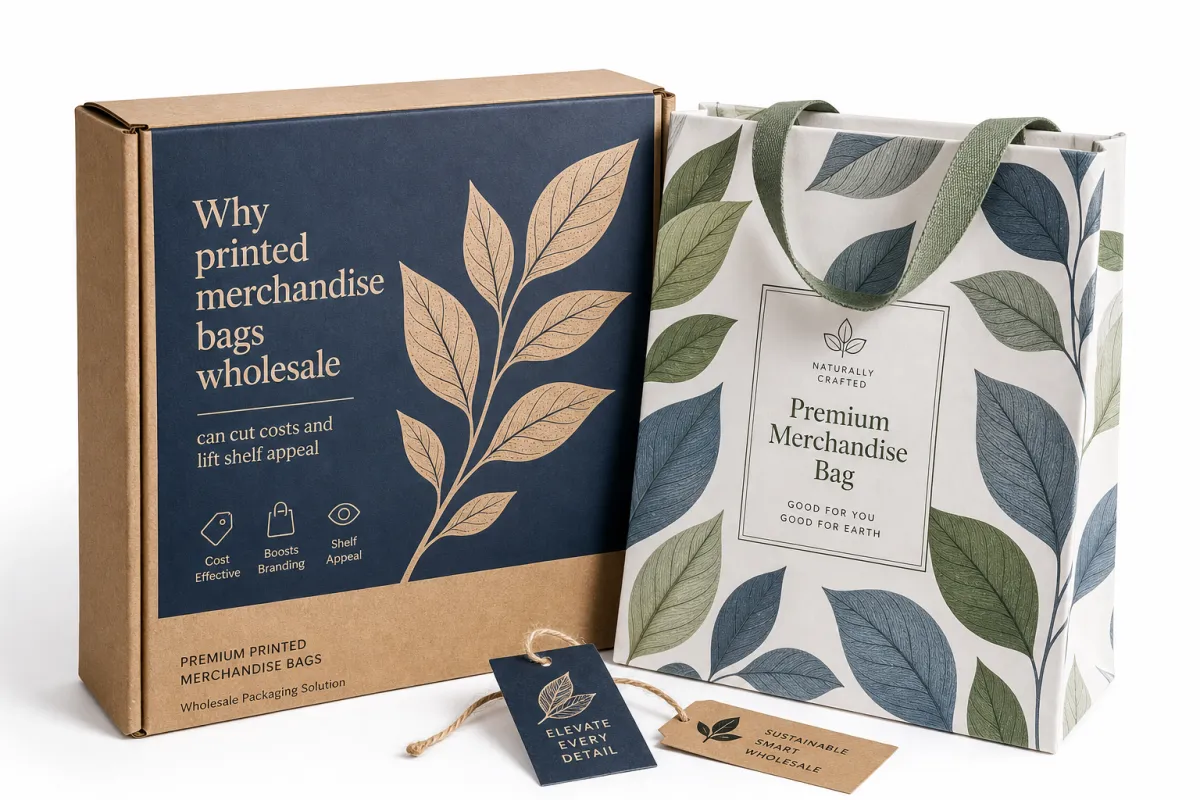
Printed merchandise bags wholesale solve a problem that trips up a lot of buyers: the tug-of-war between function and presentation. In retail, gifting, events, and ecommerce, the bag is part of the product experience. A bag that creases badly, tears on the way to the car, or looks cheap under store lighting sends the wrong signal. A bag that feels solid and looks intentional helps the brand stick in memory.
The lowest unit price is rarely the lowest real cost. A bag that gets reused three or four times spreads its cost across more impressions and pushes replacement farther down the calendar. That is why printed merchandise bags wholesale make more sense when they are evaluated by life cycle, not just by the first quote on the page.
From a packaging buyer's point of view, printed merchandise bags wholesale are also a straightforward way to keep branding consistent. One size can cover a family of products. One print spec can work across multiple locations. One approved color can stop a chain from drifting into a mess of near-matching blues, greens, and neutrals that all look slightly off next to each other.
Sustainability works better as a sourcing decision than as a slogan. Recycled paper, FSC-certified paper, cotton, jute, and reusable nonwoven options all bring different footprints and different reuse patterns. Fewer replacements, smarter material choices, and cleaner standardization often deliver more value than a trendy finish that wears out after one use.
Clear use cases make the buying process easier. Retail display calls for one kind of bag. Gift presentation asks for another. Heavy apparel needs something sturdier. Subscription send-outs and event handouts bring their own requirements. Once the use is defined, the material and structure are much easier to match.
I have seen buyers get stuck because they started with artwork instead of the product load. That usually leads to a pretty proof and a weak finished bag. In other words, the picture looks nice, but the bag is gonna struggle the moment it leaves the counter.
Buyers with recurring programs often treat printed merchandise bags wholesale as a long-term packaging system. Predictable reorders, predictable print quality, and predictable lead times matter because mystery packaging creates waste, delays, and avoidable complaints from customers and store teams alike.
Printed merchandise bags wholesale: material options and bag styles
The strongest printed merchandise bags wholesale programs start with the material, not the mockup. Kraft paper remains the workhorse for many retail and gifting orders because it prints cleanly, keeps costs practical, and comes in a range of weights. Recycled paper adds a clearer sustainability story, especially for brands that want a visible recycled-content message without making the bag build more complicated than it needs to be.
Cotton and jute are common reusable choices. Cotton feels softer and cleaner in the hand, while jute brings a textured, natural look that suits eco-conscious and premium artisanal positioning. Nonwoven and woven polypropylene can work for higher durability needs, though they should be selected with care. They are reusable, yes, but they are not paper, and the look, hand-feel, and print behavior are different.
For printed merchandise bags wholesale, the style matters as much as the substrate. Flat merchandise bags suit light apparel, stationery, and folded items. Gusseted shopping bags give products more room and reduce stress on the seams. Handled gift bags add presentation value right away. Reinforced bottoms and twisted paper handles are smart choices whenever the contents are heavier than a folded tee or a small box.
Use case drives structure. Boutiques usually want handled paper bags with stronger print coverage and a polished shelf presence. Trade shows often need bags that can survive flyers, samples, catalogs, and a few extra handouts stuffed inside at the last minute. Cosmetics buyers tend to care more about finish and logo sharpness. Food-adjacent programs need a closer look at suitability for the application, not only how the bag looks on a screen.
Weight guidance helps more than most marketing teams expect. A light retail item may fit well in 157gsm or 170gsm paper, while a heavier bundled order can require 200gsm, 250gsm, or a reusable build with reinforced seams. A bag can look attractive and still fail under load, and customers do not forgive the logo when the handle gives out.
Print coverage changes the outcome as well. A small one-color mark on kraft is a very different production job from a full-color design with edge-to-edge coverage. Specialty coatings, foil, embossing, and spot treatments can move a bag into premium territory fast. That is fine when the order supports it. It becomes waste when the finish does not actually improve the customer experience.
- Kraft paper: good for retail, gift, and event use; strong balance of cost and presentation.
- Recycled paper: useful for sustainability-led brands that still want a polished printed finish.
- Cotton: best for reuse-heavy programs and premium merch.
- Jute: strong visual texture and a natural look for higher-end positioning.
- Nonwoven or woven options: better for durable carry programs and repeated use.
Match the style to the product weight
Do not choose by appearance alone. A good-looking bag that cannot carry the item is the wrong bag. For printed merchandise bags wholesale, product weight, handle stress, and bottom construction should be settled before artwork is finalized. That keeps a beautiful proof from becoming a weak finished run.
A useful starting point is the heaviest product the bag will carry, then add a safety margin. That margin helps with variable loading, customer handling, and packing errors. It is far cheaper to specify the right structure now than to hear about split handles after the launch date.
Where buyers get caught out is in assuming paper thickness alone solves everything. It does not. Handle attachment, side seam strength, and the way the bottom insert is seated matter just as much, and sometimes more. If those details are sloppy, the bag will remind everybody of it right away.
Specifications that matter before you place an order
Before you buy printed merchandise bags wholesale, lock down the core specifications. Size seems obvious, yet buyers still lose time approving a bag that is too short for folded apparel or too shallow for boxed products. Handle style matters too. Twisted paper, rope, die-cut, and ribbon handles each change the look, the feel, and the load performance. Gusset depth also deserves attention. Ignore it, and the bag may bulge awkwardly or sit flat in a way that hurts presentation.
Paper weight or fabric weight should be set early. For paper, the right range depends on the load and the finish. For reusable textile bags, fabric weight and stitching quality matter more than any glossy render. Reinforcement is another detail buyers sometimes skip at their own risk. Bottom inserts, side gussets, stitched handles, and double-layer tops all help a bag survive real handling.
Print method affects more than color. Flexographic printing is common for high-volume simple graphics. Offset can deliver sharper artwork on coated paper. Screen printing suits textile surfaces and heavier ink coverage. Digital methods can help with shorter runs or complex full-color work, though the cost per bag usually rises as volume drops. Printed merchandise bags wholesale should match the print process that suits the artwork, not force the artwork to fit whatever process happens to be easiest.
Finishing choices deserve a careful look. Matte finish often feels more premium and hides scuffs better. Gloss can make colors pop, but fingerprints and glare show up faster. Soft-touch lamination feels upscale, though it adds cost and is not always the right fit for a reusable or heavily handled bag. Embossing and foil can support luxury positioning, but only when the rest of the packaging matches that price tier. Otherwise, the result can feel overworked rather than refined.
For packaging standards and sourcing references, two useful places to check are Packaging.org and the FSC site. If your bags move through shipping workflows, it also makes sense to think in terms of drop and transit performance using testing logic that lines up with industry expectations such as ISTA 3A or ASTM D4169. Not every bag needs a formal lab test, but expensive or widely distributed programs should not rely on guesses.
Performance specs often get overlooked because they are less glamorous than finish choices. Load rating, tear resistance, moisture resistance, and carton packing efficiency all matter. If bags sit in humid stockrooms or pass through repeated customer handling, those details are not optional. They are what separate a smooth rollout from a pile of damaged inventory.
- Confirm the exact dimensions, including gusset and handle drop.
- Approve the material and weight range with a physical swatch or sample.
- Lock the print area, color count, and artwork placement.
- Check reinforcement, load expectations, and carton pack count.
- Sign off on the proof before production starts.
A simple spec sheet saves more money than a long email thread. Put the details in writing, attach the artwork, and approve the sample or dieline before production begins. That is how printed merchandise bags wholesale stay predictable instead of turning into a guessing game.
Cost, pricing, and MOQ for printed merchandise bags wholesale
Pricing for printed merchandise bags wholesale usually moves on five levers: material, size, print complexity, finish, and order volume. Raise any one of those and the quote rises. That is normal. What should raise concern is a quote that hides setup, sample, freight, or carton fees until the end. Buyers should ask for the full landed picture, not just the headline number.
MOQ also changes by construction type. Simple paper bags can often start lower than reusable custom bags because the tooling and sewing burden is lighter. Once you move into cotton, jute, or more specialized builds, minimums usually rise. That is not a supplier trick. It is the math of production. Setup costs have to be spread across enough bags to make the order work.
| Material | Typical MOQ | Directional Unit Price | Best Fit | Notes |
|---|---|---|---|---|
| Kraft paper | 500-1,000 pcs | $0.22-$0.45 | Retail, gift, events | Good starting point for printed merchandise bags wholesale with simple logos. |
| Recycled paper | 500-1,000 pcs | $0.24-$0.48 | Sustainability-led brands | Often slightly higher than standard kraft, especially with full-color print. |
| Cotton | 300-500 pcs | $1.20-$2.80 | Reusable merch, premium retail | Price moves with fabric weight, stitching, and print coverage. |
| Jute | 300-500 pcs | $1.00-$2.40 | Natural, premium, reusable | Texture and construction usually matter more than tiny artwork details. |
| Nonwoven / woven PP | 500-1,000 pcs | $0.45-$1.10 | Durable reusable programs | Useful for repeated carry, though the look is different from paper. |
Those figures are directional, not fixed promises. A larger bag, more print colors, specialty coating, foil, or a more complex handle will push the price higher. A larger order can pull the price down, sometimes enough to change the decision. Printed merchandise bags wholesale are not expensive because they are bags. They get expensive when the specification keeps changing.
The most common mistake is comparing only the unit price. That is lazy buying. Compare unit cost, setup fees, sample charges, freight, carton charges, and any labeling or pallet fees. A quote that looks 8% cheaper can end up costing more once shipping and rework are included. That happens often.
For a fair comparison, send the exact same brief to every supplier. Keep the size, material, print colors, finish, quantity, and delivery location identical. Then ask each supplier to confirm whether proofing, sampling, and carton packing are included. That is the only way to compare printed merchandise bags wholesale on equal footing.
Quick quote checklist: quantity, finished size, material weight, handle style, print colors, finish, packaging format, delivery address, and approval deadline. Leave one of those out and the quote will shift later, usually upward.
For recurring buyers, bulk discounts often become meaningful once the tooling is set and the order crosses into the several-thousand-piece range. Before that point, chasing the lowest unit price can backfire if the bag is weak or the print quality is sloppy. A slightly higher quote from a better-built spec may save money the moment it reaches the customer.
Process, timeline, and production steps for wholesale orders
The order flow for printed merchandise bags wholesale should stay simple: inquiry, quote, artwork review, sample approval, production, quality check, shipping. If a supplier cannot explain that flow clearly, expect confusion later. The process itself is not hard. The execution is what separates a clean order from a headache.
Lead time depends on complexity, order size, and how quickly approvals move. Simple Printed Paper Bags can sometimes move faster than reusable custom builds. Add custom colors, a new die line, metallic finishes, or revision-heavy artwork, and the schedule stretches. In many production runs, the biggest delay is not manufacturing. It is waiting for the buyer to approve the proof.
Printed merchandise bags wholesale can move several days faster when the buyer comes prepared. Send print-ready files. Confirm dimensions before asking for a quote. Share the delivery address early. State whether the bags need palletized shipping or carton-only packing. Those details may look small, but they remove the back-and-forth that eats production time.
Practical checkpoint list:
- At quote stage, confirm the material, size, print method, and MOQ.
- At proof stage, check artwork position, color callouts, and handle placement.
- At sample stage, verify feel, fit, load, and finish.
- At production stage, ask for a clear schedule and inspection window.
- At shipping stage, confirm carton count, labeling, and destination details.
If the bag will be used for ecommerce, event shipping, or mixed-store replenishment, the risk goes up. One wrong carton count or one bad label can throw off the whole rollout. That is why printed merchandise bags wholesale should always include final sign-off on packaging format, not only on the artwork.
I also recommend asking how quality control is handled before production begins. Is the run checked for print alignment, handle attachment, and carton damage? Is there an approved sample on file? Are extra units included for overage? These are not glamorous questions, but they save real money. The fastest supplier is useless if the approval process is sloppy and the bags arrive wrong.
If you need recurring replenishment, this is where printed merchandise bags wholesale become easier to manage through a structured buying program. One approved spec. One revision path. One reorder method. That is the setup most procurement teams want because it reduces surprises and keeps forecasting manageable.
One thing I have learned after reviewing packaging specs for years: the projects that run best are rarely the flashiest. They are the ones where the buyer has already decided what the bag needs to carry, how it will be packed, and who signs off on the proof. That kind of prep sounds plain, but it saves a lot of grief.
Why choose us for printed merchandise bags wholesale
Buyers come to Custom Logo Things because they want bags that look right and perform the way they should. That sounds basic, but plenty of suppliers still act as if print quality is the only thing that matters. It is not. Reliable materials, clear specs, consistent print alignment, and communication that does not vanish after the quote are the real value points in printed merchandise bags wholesale.
We focus on sustainable packaging choices because that is where many projects either get smarter or get wasteful. If the goal is a lower-impact bag, we help match the product to the right paper stock, reusable build, or print method instead of forcing one material into every use case. Printed merchandise bags wholesale should support the brand and the load requirement, not just tick a green box for a slide deck.
Quality control matters just as much as material selection. That means checking artwork placement, confirming the dieline, reviewing the finish, and making sure the output matches the approved sample. When teams buy printed merchandise bags Wholesale for Retail chains, launches, subscription programs, or events, they need fewer errors and fewer last-minute corrections. Surprise costs are not a feature.
Different programs need different support. A boutique chain may need a clean paper bag with consistent logo placement across locations. A product launch may need a premium finish and a tight delivery window. An event team may need a practical bag that can hold samples, brochures, and a few extra items without tearing. Those are not the same job, and they should not be treated like the same job.
In practice, the best results usually come from a clear brief, a sample that is reviewed with real products inside it, and a reorder system that does not depend on memory. That is the kind of process that keeps the packaging steady month after month.
If your team is still comparing options, start with our Wholesale Programs page and build the order around a clear spec. That keeps printed merchandise bags wholesale from turning into a moving target. One spec. One approval path. One clean reorder process.
The payoff is simple: fewer delays, cleaner branding, and packaging that holds up in the real world. Pretty mockups are easy. Bags that survive customer use are the ones that matter. That is the standard we care about.
Next steps to order printed merchandise bags wholesale
If you are ready to move forward with printed merchandise bags wholesale, start with three essentials: target quantity, preferred size, and artwork files. That is enough to get most suppliers into the right range quickly. Without those three pieces, the conversation turns vague, and vague is where bad quotes live.
Next, compare at least two material options and one backup bag style. It sounds like extra work, but it gives you a real tradeoff between look, durability, and budget. A paper bag may be the cleanest fit for retail, while a reusable option might make more sense for a higher-touch brand experience. Printed merchandise bags wholesale should be evaluated with backup choices, not blind faith in the first sample that looks polished.
Ask for a sample or a dieline review before you commit, especially if the design uses handles, carries heavier contents, or needs full-coverage print. Small design issues grow fast in production. A 2 mm shift may not stand out on screen, yet on the finished bag it can make the whole piece feel off.
Final decision checklist:
- Confirm MOQ and whether it changes with print coverage.
- Confirm unit price plus setup, sample, freight, and carton charges.
- Confirm lead time from proof approval, not from the first email.
- Confirm artwork deadline and approval windows.
- Confirm whether the bag matches the product weight and intended use.
That is the cleanest way to buy printed merchandise bags wholesale without wasting time on guesswork. Give the supplier a clear brief, compare the real landed cost, and approve the spec only after the bag has been checked against the job it has to do. If you want a packaging purchase that feels boring in the best possible way, that is the path.
FAQ
What is the usual MOQ for printed merchandise bags wholesale?
MOQ depends on the material, bag style, and print setup. Simple paper bags often start lower than custom reusable builds, while cotton, jute, or more complex constructions usually need a higher minimum. Ask for a quote using the exact size, handle style, and print coverage, because one small change can move the minimum quickly.
How do I compare printed merchandise bags wholesale prices fairly?
Compare unit cost, setup fees, sample costs, freight, and carton charges, not just the headline number. Keep the same dimensions, material, print colors, and finish across every supplier quote. If the specs are different, the prices are not comparable.
Which material is best for sustainable printed merchandise bags wholesale?
Recycled paper is a strong choice for retail and gift use, while cotton and jute work well for reusable programs with longer life. The right material is the one that fits product weight, branding goals, and how many times the customer is likely to reuse it. Sustainability only helps when the bag still performs.
How long does production usually take for printed merchandise bags wholesale?
Lead time depends on complexity, approval speed, and order size. Custom runs usually take longer than stock-style builds, especially if the artwork needs revisions or the material is not a standard option. Fast approvals and print-ready files are the easiest way to keep the schedule from slipping.
Can I get custom artwork on printed merchandise bags wholesale without a huge order?
Yes, but lower quantities usually carry a higher unit price because setup costs are spread across fewer bags. Simple artwork and standard materials are the easiest way to keep smaller wholesale runs practical. If the design is complex, the economics change quickly.
If you are comparing printed merchandise bags wholesale right now, keep the decision grounded in quantity, size, material, artwork readiness, and how the bag will actually be used. That is the shortest route to a bag that looks right, carries properly, and reorders without drama.


