Buyer Fit Snapshot
| Best fit | printed paper bags price for packaging buyers comparing material specs, print proof, MOQ, unit cost, freight, and repeat-order risk where brand print, material, artwork control, and repeat-order consistency matter. |
|---|---|
| Quote inputs | Share finished size, material target, print colors, finish, packing count, annual reorder estimate, and delivery region. |
| Proofing check | Approve dieline scale, logo placement, barcode or warning zones, color tolerance, and any recyclable or compostable wording before bulk production. |
| Main risk | Vague material claims, crowded artwork, or missing packing details can create delays even when the unit price looks attractive. |
Fast answer: Printed Paper Bags Price: What Drives the Cost should be specified like a repeatable production item. The safest quote includes material, print method, finish, artwork proof, carton packing, and reorder notes in one written spec.
What to confirm before approving the packaging proof
Check the product dimensions against the actual filled item, not only the sales mockup. Ask for tolerance on folds, seals, hang holes, label areas, and retail display edges. If the package carries a logo, QR code, warning copy, or legal claim, reserve that space before decorative graphics fill the panel.
How to compare quotes without losing quality
Compare board or film grade, print process, finish, sampling route, tooling charges, carton quantity, and freight assumptions side by side. A lower quote is only useful if the supplier can repeat the same color, closure quality, and packing count on the next order.
Custom Logo Things
Printed Paper Bags Price: What Drives the Cost
A low Printed Paper Bags price can look like the safest buying decision until the bags start failing at checkout, fading under store lights, or looking thin beside the product inside. A paper bag is more than a carrier. It is a moving brand touchpoint, and the real cost shows up in strength, consistency, presentation, and how often you have to place the next order.
Printed paper bags price: why the cheapest quote can cost more
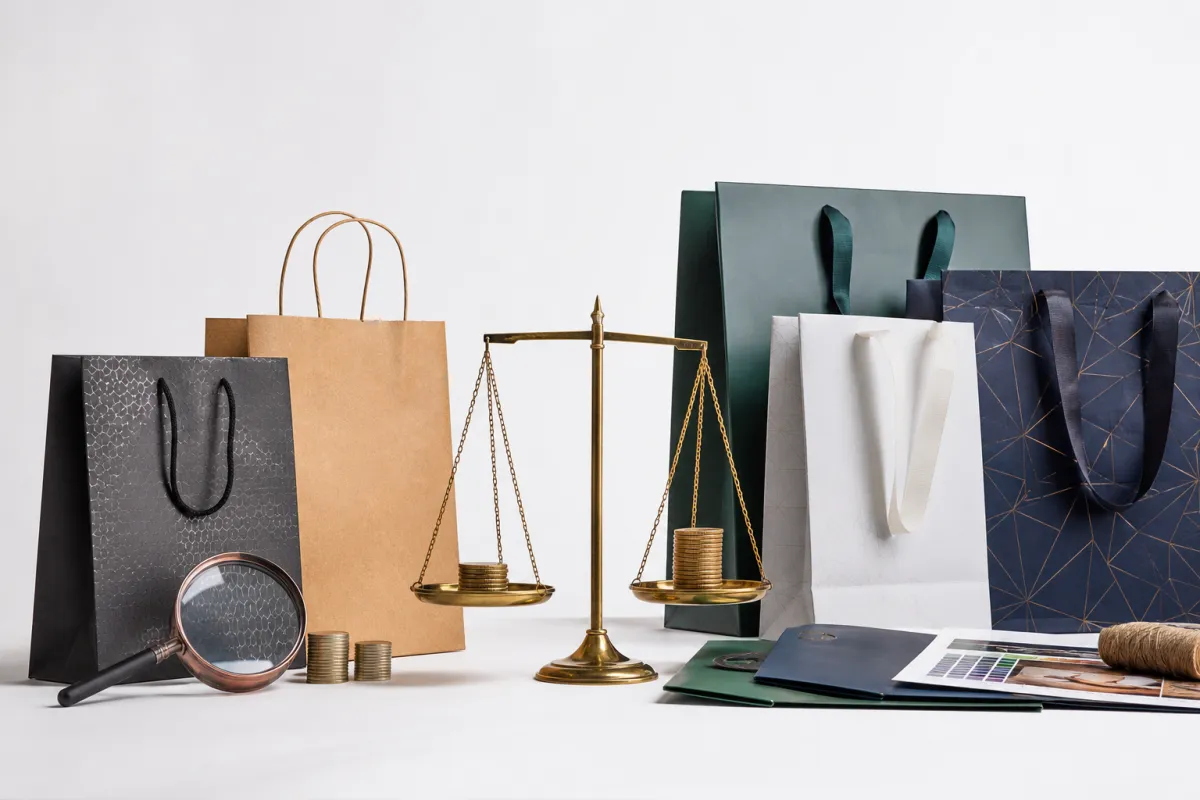
People usually start with Printed Paper Bags price because the number is easy to compare. That seems sensible on the surface, but it can hide the part that matters most. A bag that looks inexpensive on paper can become expensive in daily use if the handle pulls loose, the ink scuffs, or the gusset folds in before the customer even reaches the car. In retail, hospitality, and takeaway service, the bag is not just holding goods. It is carrying the brand experience too.
For a packaging buyer, the better question is not "Who is lowest?" The more useful question is, "Which specification gives me the best total value without creating quality problems?" That small shift changes the whole decision. Printed paper bags price depends on paper grade, size, print coverage, finishing, reinforcement, and quantity. If one of those pieces is underspecified, the savings can disappear into replacements, complaints, or slower service at the point of sale.
I have seen buyers save a few cents per bag and then lose more than that when a weak bag tears under a heavier order. I have also seen a boutique cut the printed paper bags price by choosing thinner stock, only to end up with a bag that felt flat and a little tired beside a premium product. Those are not dramatic failures, but they matter. They change how the customer reads the brand in the hand, and that is a detail people notice faster than they admit.
If the bag fails at the handoff, the quote was never truly cheap. It only looked that way before the first customer used it.
Good buying compares visible impact and functional performance side by side. A plain kraft takeaway bag, a reinforced retail bag with twisted handles, and a laminated luxury shopping bag can all serve the same broad purpose, yet they sit in very different cost bands. The printed paper bags price changes because the production requirements change. That part is simple, even if the quote sheet tries to hide it.
That is why this discussion stays practical. The sections ahead look at where the money goes, which details matter most, and how to read a quote without guessing. By the end, printed paper bags price should feel less mysterious and more like a set of choices you can control.
Printed paper bags price by bag type, size, and print coverage
Bag type is one of the quickest ways to move printed paper bags price. A simple SOS bag with twisted paper handles uses a different amount of paper and finishing work than a boutique bag with rope handles, board reinforcement, and a laminated face. Even before ink reaches the surface, the structure has already set part of the cost.
Size matters just as much. A small counter bag may need only a modest amount of stock, while a large shopping bag needs wider panels, deeper gussets, and stronger handles. That means more raw material and more converting time. If the bag has to hold bottles, boxed meals, or heavier retail items, the paper grade often rises too. The result is a higher printed paper bags price, and usually for a sensible reason.
Print coverage is the next major lever. A one-color logo on one panel is usually the most economical route. Add back-side printing, full-bleed artwork, metallic ink, or foil accents, and the quote changes quickly. Coverage affects setup, waste, and press time. It also changes the reject rate on press, especially when brand colors need tight matching. In practice, the more visual territory your artwork occupies, the more it tends to push printed paper bags price upward.
Many buyers underestimate how much the intended use case matters. Retail bags need a clean surface and a good hand feel. Hospitality bags need grease resistance and dependable carry strength. Event bags may need a strong visual impression more than long-term durability. Food service can require better moisture tolerance and stronger bottom reinforcement. Each use case shifts the spec and the final printed paper bags price.
For a quick comparison, the table below shows how style and print coverage influence pricing in a general sense. The ranges are illustrative and assume a mid-size order with standard commercial artwork. Real pricing can move up or down depending on paper market conditions, finish selection, freight, and the supplier's setup process.
| Bag type | Typical spec | Indicative printed paper bags price per unit | What pushes it higher |
|---|---|---|---|
| Twisted-handle SOS bag | 120-150 gsm kraft, 1-color logo | $0.18-$0.32 | Large size, full-color artwork, reinforced bottom |
| Flat-handle takeaway bag | Brown kraft, food-service grade, simple branding | $0.16-$0.28 | Grease-resistant lining, heavier carry load |
| Luxury boutique bag | Art paper or laminated board, rope handle, ribbon or foil detail | $0.55-$1.40 | Soft-touch finish, foil, embossing, high ink coverage |
| Reinforced retail bag | Thicker kraft, board insert, twisted or rope handle | $0.30-$0.75 | Oversized format, custom die-cut, double reinforcement |
The figures above are not a promise; they are a buying benchmark. If a quote lands well below the usual range, ask what was reduced. If a quote comes in far above it, ask whether you are paying for unnecessary finish, heavier material than the job needs, or a small MOQ. That quick check can save a surprising amount on printed paper bags price.
There is another comparison many buyers miss: standard size versus custom size. A standard format often benefits from existing tooling and familiar converting steps. A custom size may need fresh cutter setup, adjusted material usage, and extra waste during make-ready. Even when the artwork stays the same, the printed paper bags price can rise because the dimensions are no longer efficient for production.
For brands ordering multiple bag sizes, it can make sense to standardize one or two dimensions and use artwork changes to create variety. That keeps the printed paper bags price steadier across the line and reduces the number of cutters, molds, or plate changes the factory has to manage. It is a small operational choice, but it can shave real money off repeat runs.
Specifications that change printed paper bags price
Paper grade and GSM sit near the top of the cost equation. A lighter kraft stock can work well for light merchandise, while a heavier stock gives better rigidity and a more premium feel. For many retail projects, 120-200 gsm is a practical range. Luxury laminated bags may go higher because the board structure and finish add stiffness. Once the paper gets heavier, the printed paper bags price rises with it.
Finish is another major driver. Matte lamination, gloss lamination, soft-touch coating, water-based varnish, and spot UV all change both appearance and cost. A plain kraft bag with a clean logo is usually the least expensive. Add lamination, and the bag becomes more resistant to scuffing and moisture, but the production steps increase. Premium presentation almost always pushes printed paper bags price above a basic utility bag.
Handles and reinforcement deserve separate attention because they influence both strength and visual impression. Twisted paper handles are cost-effective and common on retail and takeaway bags. Rope handles feel more upscale. Die-cut handles can look cleaner on some styles, though they need careful reinforcement. Board inserts, top-fold reinforcement, and bottom pads all add durability. They also add labor and materials, which means a higher printed paper bags price.
Print technology changes the quote too. Flexographic printing is often efficient for simpler artwork and larger quantities. Offset printing is better when fine detail, richer color, or more complex graphics are involved. Digital printing can be useful for short runs or frequent design changes. The best choice depends on quantity and artwork, not only on the supplier's default equipment. If a supplier pushes one method for every order, the printed paper bags price may not match your actual needs.
Structural details matter more than many first-time buyers expect. Window cutouts, custom die-cuts, gusset variations, unusual proportions, and special fold patterns all increase complexity. More complexity usually means more waste, more setup, and tighter quality control. That is why a simple rectangle with a single logo often delivers a better printed paper bags price than a highly customized shape that only looks slightly different on the shelf.
Experienced buyers ask for the full specification before they compare suppliers for a reason. Without the spec, two quotes that look similar may actually describe very different bags. One may use 140 gsm kraft and basic handles. The other may use thicker board, reinforcement, and two finish layers. The printed paper bags price difference is not random; it reflects a different build.
If sustainability is part of your brand story, material choice becomes even more important. FSC-certified paper is often preferred for traceability, and recycled content can support waste-reduction goals when the end use allows it. For broader packaging and recycling context, the EPA recycling guidance is a useful reference, and the FSC site explains certification basics. Those choices do not automatically lower printed paper bags price, but they can strengthen the case when customers or procurement teams ask for documented sourcing.
Printed paper bags price: cost, pricing, MOQ, and quote structure
Most suppliers build printed paper bags price from several parts rather than one flat number. You will usually see setup charges, material cost, printing cost, finishing cost, and freight listed separately or bundled into a single line. That is normal. The problem starts when a buyer compares only the unit price without asking what is included.
MOQ, or minimum order quantity, affects the quote more than many people realize. A small order spreads setup and press preparation across fewer bags, so the unit cost rises. A larger order usually reduces the per-bag cost because the same setup is distributed over more pieces. That does not mean the bigger order is always better. It means the right printed paper bags price depends on how often you will reorder, how much storage you have, and how steady demand is.
Here is a practical rule: if your order sits close to the MOQ, ask for two or three quantity tiers. The price gap between 1,000, 3,000, and 5,000 pieces can be significant, and one of those breakpoints may offer the best balance between cash flow and unit cost. For many brands, the sweet spot is not the absolute lowest printed paper bags price; it is the most efficient point once storage and reorder frequency are included. That is the kind of detail that makes a buyer look like they have done this before, because they have.
Buyers should also ask whether artwork proofing, plates, sampling, tax, and delivery are included. Those items can change the final number by a meaningful margin. A quote that looks lower on day one may end up higher after freight, export packing, or express handling are added. The most useful quote is the one that makes the real landed cost visible. That is the number that tells you the true printed paper bags price.
To make that easier, compare the same quote across a few standard scenarios:
- Standard run: one-color logo, standard size, simpler handle, moderate MOQ.
- Upgraded run: thicker paper, two-color print, reinforced bottom, better handle.
- Premium run: laminated finish, rope handle, high coverage artwork, special detail.
Seeing those options side by side shows whether the supplier is pricing fairly or simply placing the most expensive configuration at the top. A well-structured supplier will make the printed paper bags price ladder easy to read. That is a good sign.
Negotiation is not only about asking for a discount. It is often about simplifying the specification. Standard sizes, fewer ink colors, a more common handle style, or a repeat-order schedule can reduce the printed paper bags price without sacrificing brand impact. In some cases, a slightly simpler ink layout saves more than trying to force the material price down. A factory can usually control a common spec better than an odd one, and that efficiency shows up in the quote.
There is also a working capital angle. A lower unit cost can still create a cash burden if the MOQ is too high. That is why smart buyers treat printed paper bags price as one part of the larger inventory equation. If the bags will sit in storage for months, the cheapest unit price may not be the wisest purchase.
Printed paper bags price: process, timeline, and lead time
The production process affects printed paper bags price more than many first quotes reveal. A clean job with final artwork, clear dimensions, and approved material choices moves through the system faster and with fewer corrections. A job with uncertain sizing, unfinished artwork, or changing print colors creates more labor, more make-ready time, and more risk of rework.
The usual workflow is straightforward on paper: brief, proof, sample if needed, approval, production, inspection, and shipment. In practice, the time spent at each stage depends on how complete your information is. If the art files are ready and the structural spec is fixed, some standard runs can move from proof approval to production in about 12-15 business days. If the design needs correction, the lead time stretches, and the printed paper bags price can rise if you need expedited handling.
Sampling is often worth the extra step for color-sensitive brands, heavier bags, or packaging that sits near premium products. A sample gives you a chance to check handle feel, print alignment, fold accuracy, and the way the bag stands when filled. That can prevent an expensive surprise later. A sample does add time, but it can also protect the final printed paper bags price by reducing rework and rejected batches. That kind of practical caution usually pays for itself.
Delay usually comes from a few predictable places:
- Artwork corrections after the order is placed.
- Material sourcing when the requested paper grade is not in standard stock.
- Color matching on brand-critical prints.
- Queue time during peak production periods.
- Packaging and shipment delays after the bags pass inspection.
Those five issues show up again and again. Buyers who prepare early tend to get a better printed paper bags price because the order is easier to schedule. Buyers who rush the job usually pay more for speed, and the rush charge is rarely small.
In courier or e-commerce packaging, some suppliers also consider transit testing concepts similar to ISTA-style handling checks so bags are not crushed or torn in shipment. That matters less for simple retail handouts, but it becomes relevant for bag sets, boxed inserts, and branded packaging kits that travel farther. When shipping is part of the job, the factory needs to think beyond print alone. That can influence both lead time and printed paper bags price.
If your schedule is tight, be direct. Ask what can be accelerated, what cannot, and where the extra cost appears. Sometimes the fastest route is to keep the spec standard and avoid custom finishes. Other times it is better to accept a slightly higher printed paper bags price in exchange for a reliable delivery date. A lower quote is not useful if the bags arrive after the campaign starts.
Why choose us for printed paper bags price and quality
A good supplier should act like a cost-control partner, not just a printing source. That means helping you match the spec to the budget before production begins. When the recommendation is honest, the result is better. You get a bag that meets the brief without paying for features you do not need. That approach usually improves the final printed paper bags price instead of hiding costs inside a fancier spec.
Consistency matters as much as the first order. If your retail chain, hospitality brand, or promotional campaign repeats the same bag across multiple shipments, you need the sizing, print color, and handle strength to stay stable. A slightly lower quote is not impressive if each reorder looks different. Reliable repeat production protects brand perception and lowers the chance that you have to scrap a shipment. That is a quiet but real part of the total printed paper bags price.
Transparency is the standard buyers should insist on. If the quote separates material, printing, finishing, MOQ, and freight, you can see exactly where the money goes. If the quote is vague, it is hard to know whether the number is competitive or just incomplete. A clear breakdown makes the printed paper bags price easier to evaluate and much easier to defend internally.
Production strength also matters. Stable output, routine quality checks, and experience with retail and promotional packaging reduce the risk of defects. A bag that is misfolded or poorly glued can create a much bigger cost problem than a small difference in unit price. The lowest printed paper bags price rarely stays low once defect rates rise.
The business case is simple. A slightly higher upfront cost can be cheaper over time if the bag holds weight, prints cleanly, and supports the brand. That is especially true for stores that use bags as part of the unboxing experience or as a visible walking ad. In those cases, the bag's appearance is part of the product, and people do judge it that way whether they say so or not.
For buyers comparing suppliers, the question should be: who can produce the right bag at the right cost with the least risk? That framing keeps the discussion grounded. It also keeps printed paper bags price in the context that matters most: value per use, not unit price alone.
Next steps: how to request a printed paper bags price quote
If you want an accurate printed paper bags price quote, send a complete brief. The basics are straightforward: bag dimensions, quantity, paper type, handle style, number of print colors, artwork files, and your target delivery date. The more complete the brief, the fewer assumptions the supplier has to make.
Artwork files should be shared early, even if the design is not fully final. A good production team can spot bleed problems, poor resolution, logo placement issues, or print coverage concerns before pricing is locked. That saves time for both sides and prevents a quote from being based on a spec that later changes. In practical terms, the earlier the art is reviewed, the more dependable the printed paper bags price becomes.
It also helps to ask for at least three versions: standard, upgraded, and premium. That side-by-side view often reveals where the biggest cost jump sits. Sometimes the jump is justified. Sometimes a simpler handle or a reduced coverage area gives nearly the same brand effect at a better cost. Comparing options is the fastest way to understand the real shape of printed paper bags price.
Use one decision rule and keep it simple: choose the lowest quote only after the bag has passed three checks.
- Strength: it must carry the intended load without failure.
- Appearance: it must match your brand and print expectations.
- Timing: it must arrive when you need it.
If one of those three fails, the cheapest quote is no longer cheap. That is the part many buyers learn the hard way. A well-specified bag is easier to price, easier to approve, and easier to reorder. That is exactly why a complete brief produces a better printed paper bags price than a vague request.
For brands that order often, a repeat schedule can help too. Once the size, artwork, and construction are locked, the factory can quote more confidently and often more competitively. Over time, that lowers friction and reduces the chance that the printed paper bags price drifts because every order starts from scratch.
Send the brief, review the options, ask for a sample if the project is color-critical, and confirm the quote line by line before approval. That process gives you a more accurate printed paper bags price and a bag that works in the real world, not just on a spreadsheet. It also makes the final decision a whole lot easier to defend when procurement or management asks why one quote beat another.
FAQ
What affects printed paper bags price the most?
Bag size, paper thickness, and print coverage usually have the biggest impact on printed paper bags price. MOQ also matters because setup costs are spread across fewer or more bags. Handle style, finishing, and delivery location can move the final quote as well.
Can I lower printed paper bags price without lowering quality?
Yes. A standard size, a simpler print layout, and fewer ink colors often reduce printed paper bags price while keeping the bag strong and presentable. Ordering a larger quantity can also lower the unit rate if you have the storage and demand for it. That is usually the cleanest place to trim cost before you start cutting into quality.
What is a typical MOQ for printed paper bags?
MOQ varies by bag style, print method, and how customized the construction is. Simple standard bags usually allow a lower MOQ than fully custom luxury bags, and that changes printed paper bags price. Ask for multiple quantity tiers so you can see where the unit cost drops. A small MOQ can be handy for a first run, but it is not always the best value if you know the bag will repeat.
How long does it take to get printed paper bags after ordering?
Timing depends on artwork approval, sampling needs, and the production queue. Straightforward orders move faster when final files and dimensions are ready, which can help keep printed paper bags price from rising due to rush handling. Rush work is possible in many cases, but it usually costs more.
What details should I send for an accurate printed paper bags price quote?
Send the bag dimensions, quantity, paper preference, handle style, print colors, and your delivery deadline. Include artwork files if you have them. If you are comparing suppliers, ask for the quote to separate setup, printing, finishing, and freight so the printed paper bags price is easy to compare.
If you are budgeting a new packaging program, start with the spec, not the headline number. The right printed paper bags price is the one that fits the load, supports the brand, and arrives on time. Compare the options, ask for a sample when the artwork is important, and send a complete brief so the quote you receive is accurate enough to approve with confidence. That order of operations keeps the buying process grounded and usually saves time, money, and a fair bit of back-and-forth.


