Buyer Fit Snapshot
| Best fit | Printed Pallet Boxes with Logo projects where brand print, material claims, artwork control, MOQ, and repeat-order consistency need to be specified before quoting. |
|---|---|
| Quote inputs | Share finished size, material target, print colors, finish, packing count, annual reorder estimate, ship-to region, and any compliance wording. |
| Proofing check | Approve dieline scale, logo placement, barcode or warning zones, color tolerance, closure strength, and carton packing before bulk production. |
| Main risk | Vague material claims, crowded artwork, missing packing details, or unclear freight terms can make a low unit price expensive after revisions. |
Fast answer: Printed Pallet Boxes with Logo: Board, Finish, Dieline, and Unit Cost should be specified like a repeatable production item. The safest quote records material, print method, finish, artwork proof, packing count, and reorder notes in one written spec.
Production checks before approval
Compare the actual filled-product size with the drawing, then confirm tolerance on folds, seals, hang holes, label areas, and retail display edges. Reserve space for logos, QR codes, warning copy, and material claims before decorative graphics fill the panel.
Quote comparison points
Review material grade, print process, finish, sampling route, tooling charges, carton quantity, and freight assumptions side by side. A quote is only useful when the supplier can repeat the same color, closure quality, and packing count on the next order.
Printed Pallet Boxes with logo look simple on a spec sheet. On a warehouse floor, they become something else entirely. They protect bulky goods, identify shipments fast, and keep a brand visible after the pallet has been wrapped, stacked, loaded, and moved through a receiving area that never seems to stand still. A pallet box is not the place for ornament. It is the place where a brand either holds its shape under pressure or disappears under film, dust, and handling.
These boxes show up in wholesale distribution, export lanes, industrial parts, food and beverage, seasonal promotions, and subscription-style bulk shipments. A 2023 MHI and Deloitte supply chain survey highlighted inventory visibility and faster fulfillment as recurring priorities, which helps explain why plain cartons are losing ground in programs where every dock move matters. Branded pallet packaging does not fix a broken operation, but it can reduce confusion at the exact points where mistakes get expensive: the dock, the stack, and the scan.
The right sequence is always function first, branding second. Compare structures, materials, and print methods only after the load requirements are clear. If you need a wider view of build options, our Custom Packaging Products page is a practical place to compare structures before artwork is approved.
Printed Pallet Boxes With Logo: Why They Matter
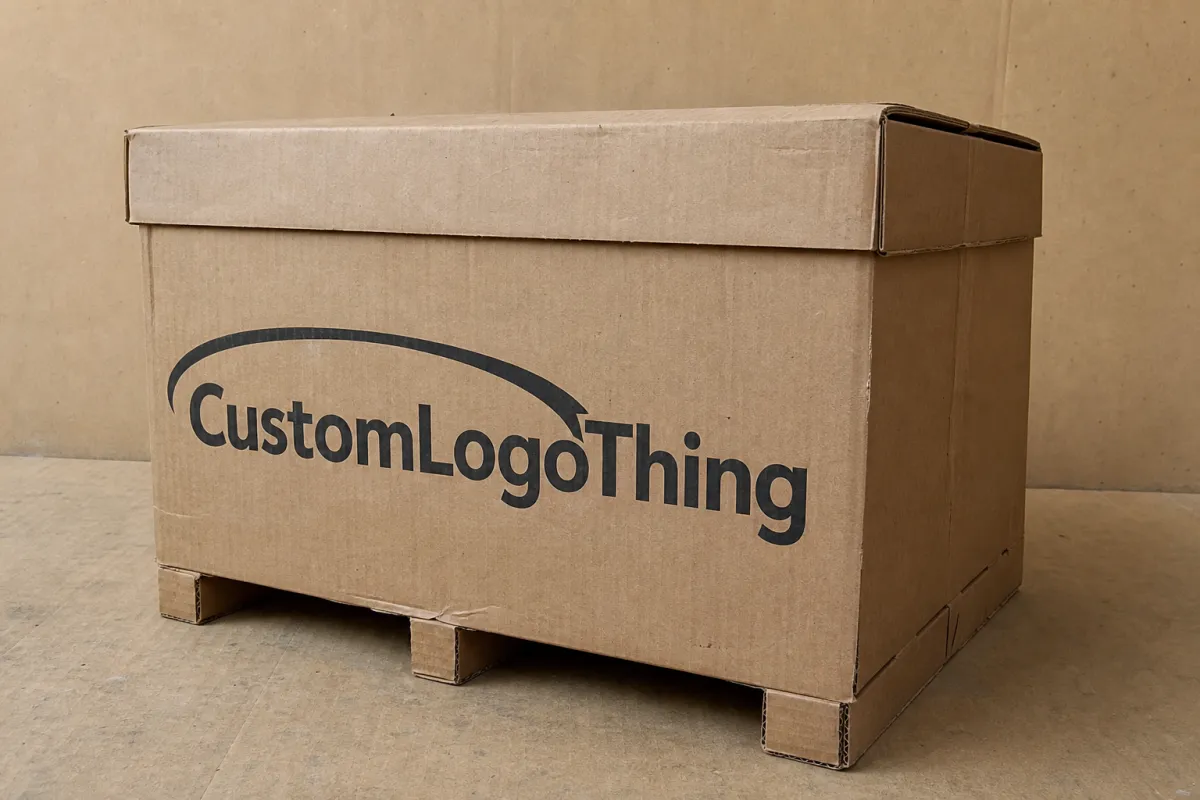
Branding at the pallet level is not decoration. It is identification, control, and presentation wrapped into a single shipping container. Printed pallet Boxes with Logo help teams spot the right shipment faster, cut down on SKU mix-ups, and make a bulk delivery look planned instead of improvised. That matters whether the load is headed to a retailer, a distributor, a plant, or a direct customer with a dock and very little patience.
There is a second benefit that gets missed often. A plain kraft pallet box tells the truth, but it says almost nothing about the company behind it. A branded container can make the same shipment easier to recognize from across a staging area. In retail programs and promotional launches, that difference shows up quickly. One pallet looks like a program. The other looks like freight that got separated from the rest of the order.
The biggest mistake is treating pallet packaging like oversized retail packaging. It is not. Compression strength, stackability, and handling discipline come first. A logo helps the shipment look deliberate, yet it cannot rescue crushed corners, bowed walls, or a load that shifts in transit. Nobody at receiving ever praised a beautiful print on a failed box.
Common use cases are consistent:
- Wholesale and distribution: fast identification in high-volume warehouses.
- Export shipping: cleaner labeling and easier brand recognition across long routes.
- Industrial parts: quicker sorting without opening every container.
- Food and beverage: branded bulk shipments that still need protection and compliance.
- Seasonal and promotional programs: visible branding that supports retail readiness.
- Subscription-style bulk orders: repeat shipments that benefit from consistent pack-out.
From a buyer's point of view, the value is easy to measure: fewer mistakes, better presentation, and less friction for the people who touch the shipment after it leaves your building. That is a warehouse-level advantage, not a marketing slogan.
Good pallet branding should stay readable in the pallet form, not just on the art board. If the logo vanishes once the box is wrapped, strapped, or stacked, the design is doing more work than the shipment can support.
How Printed Pallet Boxes With Logo Work
The structure comes first. A pallet box usually starts with a base sized to a pallet footprint, then adds walls, a top cap or lid, and sometimes inserts, liners, or dividers. The exact build depends on product weight, fragility, stacking pressure, and whether the shipment needs top access or side access. For some loads, a corrugated sleeve over a palletized base is enough. Heavy goods and export-sensitive freight usually need a reinforced container with a cap and internal support.
The branding method is chosen after the structure is defined. That sequence matters more than most buyers expect. Someone sends artwork sized for a screen, then asks why it looks awkward on a double-wall container with seams, folds, and wrap tension. Flexographic printing suits larger runs and repeatable designs. Digital printing fits shorter runs, more color variation, or faster artwork changes. Labels, sleeves, and direct print can all make sense when the visible panel space is limited by straps, corner boards, or stretch wrap.
Start With The Box, Not The Logo File
Panel size controls what the logo can do. Flute direction, board grade, seams, and die-cut limits all affect print placement. A logo that feels balanced in a mockup can land badly once the box is built. Structural drawings matter for this reason. A competent supplier will ask for product dimensions, pallet footprint, stack height, and the way the shipment will be handled. If those questions never come up, the quote is built on guesswork.
Visibility after packing deserves the same attention. Stretch wrap can dull a print. Bands can cover a face. Overhang can hide the exact panel you wanted in view. The design process has to account for warehouse reality, not just brand guidelines. Put the mark where it remains visible after palletizing, and use contrast that survives glare, dust, and fluorescent lighting. A glossy, low-contrast design may look sharp on a monitor and nearly disappear under dock lights.
If a load needs transit testing or environmental validation, standards are better than assumptions. The ISTA test methods are a useful reference point for distribution testing, and fiber sourcing claims should be checked against the FSC chain-of-custody system when sustainability language matters to the brief. Standards do not make a box perfect, but they keep the discussion tied to evidence rather than optimism.
Where The Artwork Usually Lives
Most designs place the logo on one or more external faces that remain readable in a palletized state. That may be the long panel on a corrugated bulk box, a front face on a display-style pallet shipper, or a top cap for loads seen from above in storage. For boxes that travel long distances, the best location is often the one least likely to be hidden by wrap tension and pallet bands. Boring advice tends to survive contact with a warehouse.
There is a simple rule here: if the brand mark cannot be identified from a normal warehouse viewing distance, the placement is wrong. You do not need five graphic treatments and a foil stamp. You need the right face, the right scale, and enough contrast for a picker to read it in a couple of seconds. If the mark is meant to help a dock crew sort freight, it has to stay legible under fluorescent light, from a moving forklift, and after a full day of scuffing.
Key Factors That Affect Performance and Branding
Performance and branding are tied together. A pallet box that looks polished but collapses under load is a bad box. A box that performs well but looks sloppy can also cause trouble when the shipment is customer-facing. The right answer depends on the product, the route, and the people who will touch the carton after production.
Size and load weight come first. Oversized boxes need stronger board grades, better edge support, and print layouts that stay readable at scale. Lighter palletized cartons may do fine with single-wall board. Heavier loads often push buyers toward double-wall or triple-wall construction, depending on compression needs. Wood-based containers and hybrid builds are common when impact resistance or stack strength matters more than print finesse.
Material choice changes the whole equation. Corrugated packaging is usually the easiest to print and the most common choice for branded pallet containers. Double-wall board gives better stiffness and more resistance to crush. Triple-wall can suit very heavy or export-sensitive loads, though it adds weight and cost. Wooden pallet boxes or crates offer strong protection, but the print treatment is often more limited and may rely on labels, stencils, or applied graphics rather than a full-panel brand image.
Material And Print Tradeoffs
| Option | Typical Strength | Print Appearance | Common Use | Cost Impact |
|---|---|---|---|---|
| Single-wall corrugated | Moderate | Clean, simple, good for bold logos | Lighter palletized goods | Lowest |
| Double-wall corrugated | High | Very workable for branded panels | Most wholesale and industrial loads | Moderate |
| Triple-wall corrugated | Very high | Can print well, but the build is heavier | Heavy export or stacked freight | Higher |
| Wood crate or pallet box | Very high | Usually label-based or limited direct print | Rough handling, premium protection | Highest |
| Hybrid structure | Variable | Depends on printable outer face | Mixed display and shipping needs | Depends on build |
Print visibility is the next variable. If the logo gets buried under stretch wrap, the value drops immediately. If straps cover the mark, the same problem appears. If the box overhangs the pallet and the visible face shrinks to a narrow strip, the branding reads like an afterthought. That is why pallet-ready artwork should be checked in a 3D layout or physical sample, not only on a screen where everything looks calm and well aligned.
Durability versus appearance is a real tradeoff. A crisp printed panel means little if the surface scuffs during transit or if moisture ruins the ink. In humid storage or export lanes, moisture resistance matters. Depending on the route, buyers may ask for wax alternatives, moisture-resistant coatings, or stronger liners. The right solution depends on the contents and the shipping environment. No supplier gets to skip that part just because the quote template is short.
One point gets missed often: the packaging has to work across the supply chain. The same container may need to look decent on a retail floor, survive warehouse sorting, handle barcode labels, and still arrive branded enough for the customer to recognize it. That is a demanding list for one box. Good design keeps the visual system simple and the construction conservative.
For buyers comparing formats, the easiest way to avoid confusion is to define the use case in plain language. Is the box shipping once or multiple times? Is it sitting in a warehouse for weeks? Is it customer-facing? Does it need to stack to a certain height? Clear answers narrow down board grade and print method quickly. Vague answers produce vague quotes, and vague quotes rarely fit the real shipment.
Printed Pallet Boxes With Logo: Cost, MOQ, and Pricing
Pricing is where the project becomes real. Printed pallet boxes with logo vary widely in cost because box size, board grade, print method, color count, finishing, inserts, and custom cutting all move the quote. A small run of Branded Pallet Boxes can look expensive per unit if setup work is heavy. A larger run usually spreads that setup cost out and lowers the unit price.
As a rough planning range, simple branded corrugated pallet boxes can land in the low single digits per unit at higher quantities, while more complex or heavier-duty builds can move well above that. For small runs, the unit price rises because setup is spread across fewer pieces. For larger runs, the economics improve once tooling and print setup are absorbed. That is not a sales line. It is how production math works.
What Drives The Quote
- Dimensions: larger panels use more board and more print area.
- Board grade: stronger corrugated or thicker wood-based structures cost more.
- Print method: flexo is usually efficient for larger volumes; digital can suit smaller runs better.
- Color count: more colors usually mean more complexity and more cost.
- Finishing: coatings, laminations, and moisture resistance add expense.
- Inserts and liners: internal protection increases material and assembly cost.
- Tooling: custom die-cut shapes and special structures add setup expense.
MOQ matters because production methods are not equally flexible. Setup-heavy printing methods tend to need higher minimums, often in the hundreds or low thousands depending on the supplier and the structure. Digital printing can support lower quantities, sometimes far below traditional print minimums, but the per-unit price is usually higher. That tradeoff can make sense for pilot programs, seasonal launches, or multiple SKUs where artwork changes often.
There is a hidden cost buyers should not ignore: damage, repacking, and poor presentation. A box that saves a few cents but crushes in transit can cost more in labor, replacement goods, and customer frustration. If the shipment is moving through distribution, a stronger board grade may be the cheaper move overall. Cheap packaging often gets expensive after the second problem appears.
One practical way to compare quotes is to ask for the same spec across vendors. Give exact dimensions, product weight, stacking needs, storage environment, and the delivery route. Include whether the box needs to be palletized, wrapped, strapped, or displayed. Vague RFQs create vague quotes, then everyone acts surprised when the sample does not match the use case.
| Order Profile | Typical MOQ Range | Typical Unit Cost Trend | Best Fit |
|---|---|---|---|
| Short-run pilot | 50-300 units | Highest per unit | Testing a new product or seasonal launch |
| Mid-volume program | 300-2,000 units | Moderate | Recurring wholesale or B2B shipments |
| High-volume distribution | 2,000+ units | Lowest per unit | Stable SKU with repeat ordering |
| Custom heavy-duty build | Varies by structure | Usually higher | Export, heavy parts, premium protection |
If budget and presentation need to stay in balance, compare a few build alternatives before locking the quote. Our custom logo packaging options are a good benchmark for comparing construction types, print coverage, and the level of visual impact the shipment really needs.
Production Steps, Timeline, and Lead Time
Lead time planning saves money and stops last-minute panic. The path from brief to delivery usually runs through sizing, artwork prep, structural sampling, print proofing, production, quality check, and shipment. Miss one of those steps and the schedule starts drifting. Not dramatically at first. Then the launch date gets close and everybody starts sending urgent emails like urgency changes the press calendar.
For a straightforward printed pallet box, the timeline can stay manageable. A standard build with clean artwork and no unusual structural requirements tends to move faster than a custom crate with special coatings or export testing. In many cases, the delay is not print time. It is approval time. Someone wants a logo adjustment, someone else wants a different board grade, then the sample arrives and the color needs one more round.
Where Time Gets Lost
- Missing dielines: artwork cannot be finalized without the correct panel layout.
- Unclear branding files: low-resolution logos or messy vector files slow proofing.
- Approval lag: waiting days for sign-off turns into schedule risk.
- Structural changes: changing dimensions late forces artwork and tooling to be reworked.
- Testing delays: if the box needs compression or transit validation, that adds time.
A realistic planning window for simple jobs is usually measured in business days rather than calendar optimism. Some runs can move from approval to shipment in roughly two to four weeks if everything is ready and the supplier has capacity. More complex jobs, especially those with custom inserts, special print treatment, or additional testing, can stretch longer. The right answer depends on the plant, the order size, and how many people need to sign off on the proof.
Samples are worth the wait. A plain structural sample tells you whether the box fits, stacks, and handles well. A printed prototype tells you whether the logo survives the true panel size and whether the visual treatment still works once it is wrapped or strapped. That one sample can save a lot of regret. Regret gets expensive quickly once freight is booked.
The cleanest schedules usually belong to buyers who keep the process simple: final dimensions, final artwork, one round of comments, and a clear delivery target. If the order supports a product launch, seasonal promotion, or warehouse move, build buffer time into the schedule. A two-day delay in approval can easily become a week of disruption once freight, staffing, and receiving windows are involved.
Speed is not a virtue if the carton is wrong. A pallet box that arrives on time and fails in use is still a failure. Buyers get better results when they treat schedule as one constraint among several, not the only one that matters.
Common Mistakes Buyers Make
The most common mistake is starting with a logo file made for screens, social banners, or a sales deck. Those files often lack the scale, contrast, and clean vector structure needed for print. A blurry or cluttered logo can look acceptable on a monitor and terrible on a pallet box. Print needs clarity, not hope.
Another mistake is placing the logo where nobody will see it. A buyer approves a polished layout, then the pallet gets wrapped, strapped, and stacked. The branding disappears under the logistics. That is not a design success. That is a planning failure with better color management.
Overdesign causes trouble too. Some buyers want too many colors, gradients, effects, and secondary graphics on a container that lives in an industrial environment. The result looks busy and reads poorly from a distance. In most pallet packaging jobs, bold, simple, high-contrast branding performs better than a crowded design system. The box is not a brochure.
Performance details get ignored far too often. Load rating, compression strength, moisture resistance, and pallet fit are not optional extras. They are the box. If the shipment is heavy, stacked, or exported, those specs matter more than whatever the logo is doing in the corner. A packaging buyer should know product weight, stack height, and storage environment before approving a print layout.
Logistics requirements are another blind spot. Some buyers forget barcode placement, warehouse labeling standards, export markings, or the way a carton will be scanned at receiving. Others forget that a box meant for retail display has different expectations than a box that will stay in a warehouse. A checklist often beats a stylish mood board for this kind of order.
Timing is another trap. Buyers request quotes before final dimensions are ready, then wonder why the numbers keep changing. Or they approve an order before the shipping lane is confirmed, then discover the carton needs better moisture protection or different handling marks. The quote was never the final answer. It was a response to incomplete information.
If you want fewer mistakes, treat the box as a system. Structure, print, handling, storage, and presentation all affect one another. Change one piece and the others may need to change too. That is normal. Pretending otherwise is how people end up paying for revisions nobody budgeted for.
Expert Tips and Next Steps for Better Orders
Start with the carton spec. Dimensions, product weight, stacking pressure, storage conditions, and whether the box needs to be display-ready should all be written down before artwork starts. The clearer the brief, the cleaner the quote. A supplier can only build what the specification supports.
Place the logo where it will be seen in the real shipping environment. That usually means the face visible to a forklift operator, warehouse picker, or receiving team without turning the pallet around. Use contrast that reads fast from several feet away. If the logo needs to be understood in five seconds or less, keep it simple. That is not a creative compromise. It is a packaging requirement.
Keep the branding disciplined. A strong single-color mark often works better than a busy multi-color design on large-format pallet packaging. If multiple graphics are necessary, each one should earn its place. Identification, brand recognition, handling instructions, and product sorting all count. Decorative clutter does not.
Ask for a printed prototype or at least a plain structural sample before approving a full run, especially if the goods are expensive, fragile, or shipping on a tight deadline. A sample can reveal weak corners, awkward seams, print misalignment, or visibility problems that are hard to spot in a flat proof. That one check costs less than discovering the problem after the freight bill lands.
Internal alignment helps too. Sales may want stronger branding, operations may want simpler handling, and procurement may want the lowest quote. All three positions can be valid, but not always in the same format. The best orders usually come from teams that agree on the non-negotiables before they start comparing prices.
If you are comparing suppliers, ask the same questions every time:
- What board grade or structure do you recommend for this load?
- Where will the logo remain visible after wrapping or strapping?
- What is the realistic MOQ for this print method?
- How long does sampling and approval take?
- What shipping or handling details could change the quote?
Those five questions reveal more than a polished sales sheet. They also push the conversation back to the actual use case instead of a generic packaging pitch. If a supplier cannot answer them clearly, keep looking.
For a cleaner buying process, gather measurements, define the shipping environment, confirm volume, request a quote, review a sample, and lock the schedule. That sequence keeps the project grounded and reduces late-stage surprises. Surprises are expensive in packaging, and the industry has plenty of them already.
Done well, printed pallet boxes with logo do more than hold product. They reduce confusion, support handling, and make freight look deliberate instead of improvised. If you want printed pallet boxes with logo that perform in transit and still present well at receiving, start with the structure, not the artwork. The logo is the visible part. The box does the real work.
What are printed pallet boxes with logo used for?
They are used to ship, store, and present bulky goods while keeping the brand visible. They help warehouse teams identify shipments faster, reduce mix-ups on docks, and support cleaner presentation in wholesale, industrial, export, and retail distribution.
Which print method works best for pallet boxes with logo?
Flexo is usually efficient for larger runs and simple artwork. Digital printing is useful for shorter runs or frequent design changes. The right method depends on the box material, color count, artwork complexity, and order size.
How much do printed pallet boxes with logo cost?
Price depends on size, board grade, print method, quantity, inserts, finishing, and whether the structure is custom. Smaller orders usually have a higher unit cost because setup is spread across fewer boxes. Detailed specs are the best way to get a real quote.
What affects the lead time for logo-printed pallet boxes?
Artwork approval, sample approval, print method, and structural complexity are the biggest timing factors. Custom sizes, special materials, and export testing can add time. Fast approvals usually shorten the schedule more than any sales promise does.
How do I make sure the logo stays visible on pallet boxes?
Place branding on faces that stay exposed after wrapping or stacking. Use strong contrast and artwork large enough to read from a distance. Review the design in pallet form, not just as a flat file, before you approve production.


