Buyer Fit Snapshot
| Best fit | Printed Poly Mailers for Dropshipping projects where brand print, material claims, artwork control, MOQ, and repeat-order consistency need to be specified before quoting. |
|---|---|
| Quote inputs | Share finished size, material target, print colors, finish, packing count, annual reorder estimate, ship-to region, and any compliance wording. |
| Proofing check | Approve dieline scale, logo placement, barcode or warning zones, color tolerance, closure strength, and carton packing before bulk production. |
| Main risk | Vague material claims, crowded artwork, missing packing details, or unclear freight terms can make a low unit price expensive after revisions. |
Fast answer: Printed Poly Mailers for Dropshipping: Film, Print, MOQ, and Carton Packing should be specified like a repeatable production item. The safest quote records material, print method, finish, artwork proof, packing count, and reorder notes in one written spec.
Production checks before approval
Compare the actual filled-product size with the drawing, then confirm tolerance on folds, seals, hang holes, label areas, and retail display edges. Reserve space for logos, QR codes, warning copy, and material claims before decorative graphics fill the panel.
Quote comparison points
Review material grade, print process, finish, sampling route, tooling charges, carton quantity, and freight assumptions side by side. A quote is only useful when the supplier can repeat the same color, closure quality, and packing count on the next order.
Printed Poly Mailers for dropshipping look ordinary until the shipment lands on a customer’s doorstep. Then they start doing something harder to measure than shipping cost: they set the tone for the brand before the product is even unwrapped. In dropshipping, that first physical touchpoint carries unusual weight because there is often no box, no tissue paper, no stack of inserts pretending to be luxury. A branded mailer has to do the work itself. If the choice is right, printed poly mailers for dropshipping can lift perceived value, keep weight down, and simplify packing. If the choice is wrong, the same mailer becomes a recurring expense with a shiny logo on top.
The math is where the story usually changes. Many sellers begin with plain packaging to defend margin, then discover that Printed Poly Mailers for dropshipping can improve recall and repeat orders, but only when the size, thickness, artwork, and fulfillment path all fit the product. A bag that is too thin tears. A design that is too busy looks cheap. A size that misses by half an inch slows the pack line. Small mistakes compound quickly in an order flow that moves by the hundred, then the thousand.
There is a practical middle ground between barebones shipping and overbuilt presentation. Apparel, soft goods, accessories, beauty kits, and folded textiles often travel well in custom mailers because they are light, compressible, and not easily crushed. In those categories, printed poly mailers for dropshipping usually hit a useful balance: they cost less to ship than a box, occupy less storage, and still give the parcel a brand identity customers can recognize at a glance. The question is not whether the mailer looks attractive in a mockup. The useful question is whether it earns its place in the margin stack.
What Are Printed Poly Mailers for Dropshipping?
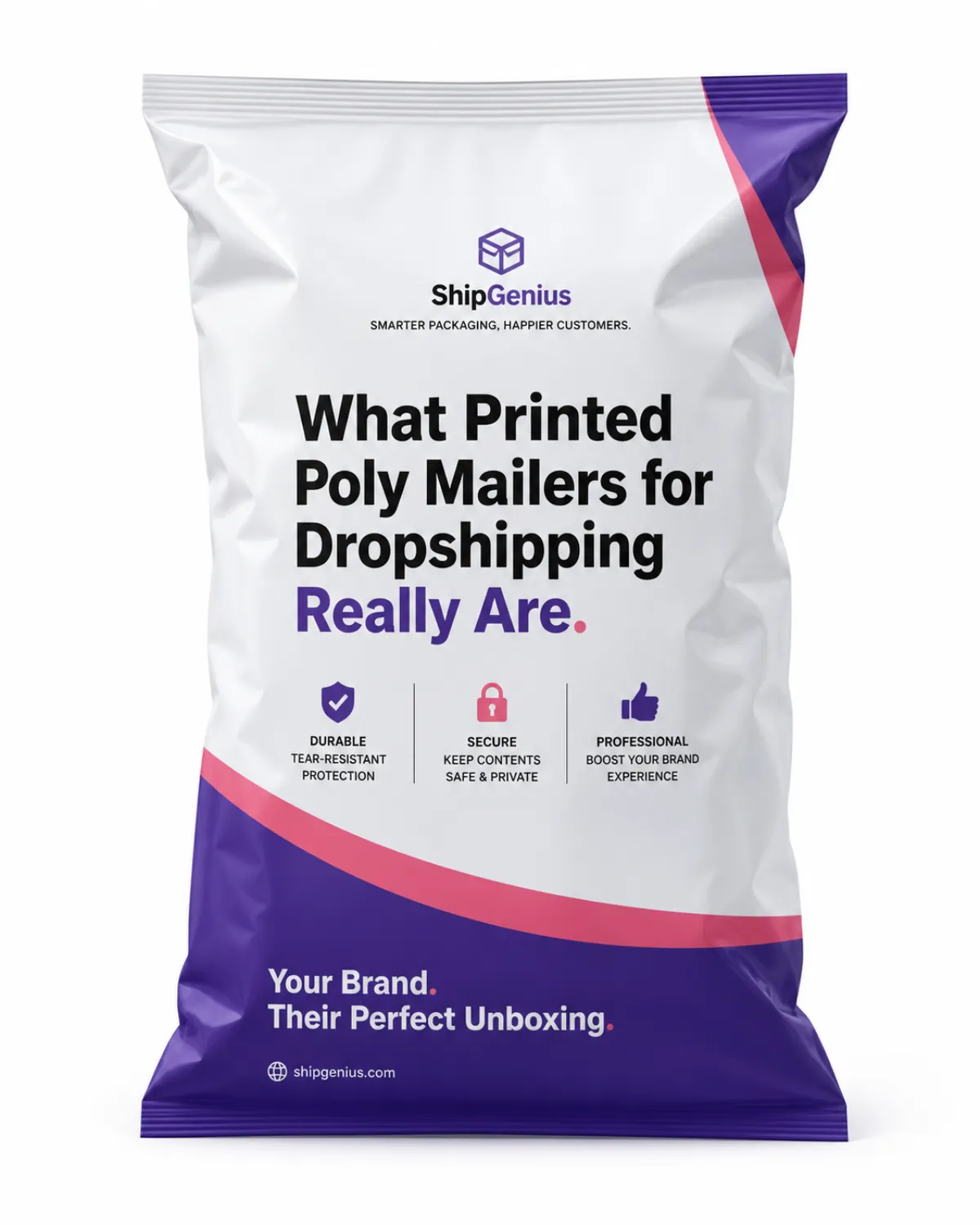
Printed poly mailers for dropshipping are lightweight polyethylene shipping bags customized with a logo, pattern, slogan, or full-surface design. In practice, they turn a plain dispatch sleeve into a brand surface without moving into rigid-box territory. Most are made from co-extruded polyethylene film, which usually gives the mailer a durable outer layer and a sealed inner layer while keeping the bag flexible enough to fold, stack, and survive ordinary carrier handling.
That flexibility matters because the customer notices the package before the product. A folded hoodie, scarf bundle, or small accessory set can travel in a poly mailer with little wasted space. The efficiency explains why printed poly mailers for dropshipping show up so often across fashion, wellness, and lightweight accessory brands. They do not fake premium in the way a rigid carton can, yet they still feel deliberate when the print is clean and the film quality is consistent.
Branding gets underestimated because it works quietly. A gray unbranded mailer disappears from memory. A one-color logo, a repeating pattern, or a short phrase has better odds of sticking. That is not just decoration. It is repeated exposure. Every shipped parcel becomes a small ad unit, and printed poly mailers for dropshipping put that surface in play at a lower unit cost than most custom packaging formats. If the item inside is soft and not fragile, the argument for the mailer gets stronger fast.
The format still has limits. Printed poly mailers for dropshipping work best with items that are flexible, low-profile, and not easily crushed. Sharp edges, brittle parts, and high-value goods often need more impact protection than a mailer can provide on its own. A packaging buyer who ignores that reality is not making a branding decision. They are making a damage claim in advance.
"A mailer can cost less than a coffee and still change how the customer judges the brand. That is why the print decision matters."
There is a technical side to the conversation as well. Shipping tests matter more than brochure language. Packaging teams often look to ISTA test protocols when they want a realistic view of how parcels behave under drop, vibration, and compression. For waste and recovery context, the EPA has guidance on packaging and materials management that helps frame sustainability claims without drifting into marketing fog.
From a buyer’s point of view, printed poly mailers for dropshipping are a fit problem. Fit for the product. Fit for the warehouse workflow. Fit for the margin target. When those three line up, the mailer stops being a cosmetic add-on and starts acting like infrastructure. They also sit neatly beside other packaging choices such as Custom Mailing Bags, mailer bags, and branded shipping supplies when a brand wants a tighter visual system.
How Printed Poly Mailers for Dropshipping Move Through Fulfillment
The fulfillment path for printed poly mailers for dropshipping is usually simple on paper and less simple in practice. Artwork comes first, often from a logo, a dieline, or a repeat pattern. The supplier then sets up the print method, whether that means plates, screens, or digital production depending on volume and design complexity. After printing, the film is converted into finished bags, packed into cartons, and shipped to the brand or to a fulfillment partner. Once on hand, the mailers are stored flat until orders start moving.
In a direct-to-customer dropshipping setup, the supplier may pack the order in your branded mailer before it leaves the facility. In a third-party fulfillment workflow, the mailers go to the 3PL ahead of time, then move into the packing line as orders arrive. Printed poly mailers for dropshipping work in both systems, but the 3PL model gives more room for quality checks, inventory planning, and packaging consistency. That control becomes valuable when a SKU starts selling faster than expected.
The time savings show up at the end of the packing process. A mailer weighs less than a box, needs less void fill, and often takes fewer steps to close. A few seconds saved per order sounds trivial until the volume climbs into the hundreds each week. At that point, seconds become labor, labor becomes cost, and cost becomes margin. Printed poly mailers for dropshipping are one of the few packaging formats where branding and speed can point in the same direction.
Not every product belongs in this category. Soft apparel, swimwear, socks, scarves, flat accessories, and some beauty tools travel well. Items with rigid edges, brittle components, or breakable contents usually need a more protective shipper. If the parcel can be crushed in transit, the mailer becomes a weak point. In those cases, a mixed system often makes more sense, with Custom Poly Mailers handling lighter items and Custom Shipping Boxes covering fragile goods.
Think of the mailer as part of the order path, not a decorative extra. Late arrival, misaligned artwork, or a size mismatch can slow the whole process. The strongest printed poly mailers for dropshipping programs start with warehouse reality and then layer branding on top. The brand still matters, just not at the expense of a process That Actually Works.
Storage is another operational angle worth looking at. Poly mailers take up far less space than cartons. For a small brand, that can mean less clutter and easier replenishment. For a larger one, the savings can show up in pallet efficiency and reorder planning. In a business where every inch of warehouse space carries a cost, printed poly mailers for dropshipping often win as logistics tools before they win as marketing tools.
Cost, Pricing, and Minimums That Affect Your Margin
The cost structure behind printed poly mailers for dropshipping comes down to a few variables that matter more than most buyers expect. Size is one. Film thickness is another. Print coverage, number of colors, and whether the design is a simple logo or a full-wrap pattern all affect the quote. Quantity matters too, since unit price usually drops as the run gets larger. Small test orders can look expensive on a per-piece basis, while larger orders spread setup and production costs across more bags.
Setup fees are easy to miss when people compare quotes quickly. Depending on the supplier and print method, there may be plate charges, screen charges, digital setup fees, or artwork prep charges. Samples are not always free, and freight can become a large piece of landed cost when the product ships from overseas. The sticker price on the mailer is only part of the ledger. For printed poly mailers for dropshipping, the real number is total cost per shipped order.
Here is a practical planning range for standard custom runs in common retail-style formats. The ranges are directional, not universal; film grade, domestic production, freight assumptions, and print method can move them more than people expect:
| Option | Typical Use | Approximate Unit Cost | Notes |
|---|---|---|---|
| Plain poly mailers | Lowest-cost shipping for commodity SKUs | $0.05-$0.12 | No branding, fast to source, minimal setup |
| Simple printed poly mailers | Logo, one-color mark, basic repeat print | $0.12-$0.28 | Often the best balance for printed poly mailers for dropshipping |
| Full-coverage custom mailers | Patterned designs, richer brand presentation | $0.20-$0.45 | More visual impact, higher setup and print complexity |
| Custom boxes | Fragile, premium, or presentation-led products | $0.35-$1.20+ | Heavier and usually more expensive to ship |
The table is a planning tool, not a universal price sheet. A mailer quoted at $0.18 can become $0.24 or more once freight and waste are added. A slightly more expensive mailer may still win if it reduces damage, shortens packing time, or improves repeat purchase behavior. That is the part many buyers miss: printed poly mailers for dropshipping should be measured against margin, not just against the per-unit sticker.
Minimum order quantities matter just as much. A lower MOQ helps a new brand test the artwork and gauge customer reaction, but it can push the unit price upward. Larger runs usually improve economics, while also increasing the cost of a sizing mistake or design revision. Ask for landed cost, MOQ, and the price of reproofs or revisions in writing. That is the only honest way to compare printed poly mailers for dropshipping across suppliers.
A simple margin test works better than a gut feeling. Add packaging cost, freight allocation, packing labor, and a cushion for damage or rework. Compare that total with the lift you expect from stronger brand recall, better perceived value, or more repeat orders. If the mailer adds 20 to 35 cents but changes behavior at checkout or after delivery, it may be doing exactly what it should. If the numbers do not move, plain packaging may be the smarter bridge until volume grows.
Artwork, Proofing, and Production Timelines
Artwork is where many printed poly mailers for dropshipping projects get decided before production starts. Clean files move quickly. Messy files do not. A supplier can only work as fast as the artwork permits, which means a vector logo, accurate color references, and a dieline that matches the bag size are not luxuries. They are the difference between a smooth order and a frustrating one. If the print area is crowded or the logo sits too close to the seal line, the final bag can look awkward even when the materials are fine.
A typical production path runs through concept, artwork prep, proof review, approval, production, packing, and shipment. The proof stage deserves more attention than it usually gets. That is where placement errors, bleed problems, and color mismatches are caught before they become waste. If you are ordering printed poly mailers for dropshipping, do not rush this step just because the design feels simple. Simple graphics still need exact placement to look deliberate on film.
Timelines depend on location and print method. Domestic orders can move faster once proofs are approved, often around 12 to 15 business days for standard custom work, though busy suppliers and complex orders can stretch that. Overseas production usually takes longer, and freight can add one to three more weeks depending on port congestion, customs, and the shipping method. That is why printed poly mailers for dropshipping should be planned with a buffer, not optimism.
The slowdown points are easy to predict. Revisions cost days. Color matching costs days. Freight can take longer than the print run itself. If a launch date depends on packaging arriving first, work backward from the ship date instead of forward from the order date. Brands built around seasonal goods, promotional drops, or limited-edition apparel need extra slack because a late mailer can break the entire release schedule.
Reorders should start earlier than most teams think. A winning SKU can burn through branded packaging faster than expected, and scrambling for more printed poly mailers for dropshipping while orders are already live is a bad place to be. A reorder trigger should allow time for proofing, production, and transit. That buffer feels dull. It also keeps fulfillment from turning into an emergency.
Color control deserves its own line in the budget. Film substrates do not behave like paperboard. A bright logo can shift slightly on glossy polyethylene, and dark backgrounds can swallow detail if the art is too fine. I have watched a brand sign off on a screen preview that looked crisp, only to find the physical sample washed out under warehouse lighting. Ask for a physical proof and compare it against a reference under normal light. With printed poly mailers for dropshipping, that extra check can save an entire run from looking almost right instead of clearly on-brand.
The rule is simple: the more exacting the design, the more exacting the process has to be. Minimal artwork forgives small imperfections. Busy artwork does not. That explains why so many brands begin with a strong logo and a single accent color before moving into more elaborate custom packaging. A little restraint goes a long way, honestly.
Step-by-Step: Choosing the Right Mailer Setup
The first step is a real SKU audit. Measure the packed product, not just the product on its own. Folded apparel, bundled items, polybagged goods, inserts, and protective wrap all change the final dimensions. A mailer that fits loosely on a desk can become too tight once a care card or size insert is added. That is why printed poly mailers for dropshipping should be sized from the shipped form, not from raw inventory.
Next comes film thickness. For light apparel, a standard thickness may be enough if the item has soft edges and shipping distances are not rough. If puncture risk is higher, go thicker. Buyers usually compare options in the 2.5 mil to 4 mil range, though structures vary by supplier. Thicker film can improve tear resistance, but it also raises cost and changes the feel in the hand. The goal is not the heaviest mailer available. The goal is the one that matches product risk.
Then choose the print strategy. A one-color logo is the simplest place to start and often the safest. It keeps cost lower and the design cleaner. A repeating pattern or full-wrap print can create a stronger visual punch, especially for fashion or lifestyle brands, but only if the artwork holds up across the whole surface. For many sellers, printed poly mailers for dropshipping work best when the design is memorable without feeling crowded.
Here is a structured way to choose:
- Audit the packed dimensions of your top-selling SKUs.
- Choose a thickness based on puncture risk and shipping distance.
- Pick a print style that matches brand maturity and budget.
- Request samples or a short test run before committing.
- Verify landed cost, MOQ, and production timeline in writing.
That sequence sounds basic because it is. It also prevents the expensive mistakes. A packaging buyer who skips step one usually overbuys or undersizes. A buyer who skips step four often discovers the problems after the order is already in motion. With printed poly mailers for dropshipping, a sample run is not a luxury if the order matters. It is the cheapest insurance available.
Comparing packaging systems by category can help when the product line is mixed. The broader selection at Custom Packaging Products makes it easier to compare mailers with inserts, boxes, and hybrid setups. Once the catalog gets complicated, a single mailer size rarely covers every SKU. That is normal. It is also why many brands keep one core branded mailer and one backup format for outlier products.
The final call should reflect operations, not just appearance. If a packaging choice slows packing, confuses the team, or creates sealing problems, it is the wrong choice even if the mockup looks polished. Printed poly mailers for dropshipping should simplify the order flow, not add friction to it.
Common Mistakes That Cause Waste, Delays, and Returns
The most common mistake is sizing the mailer from the product alone and ignoring the shipped configuration. That leads to overstuffed bags, weak seals, wrinkled graphics, and a higher chance of puncture. It can also increase postage if the parcel shifts into a higher dimensional category. This is why printed poly mailers for dropshipping should be tested with the actual packed SKU, not with a rough guess from the product listing.
Branding mistakes come next. A logo that is too small can vanish on film. A design with too much text can become unreadable once the package is folded or handled in transit. Dark print on dark film can look sharp in a mockup and dull in the real world. I have seen brands spend more on printed poly mailers for dropshipping only to learn that the artwork is too busy to register quickly in a warehouse setting. That kind of miss is frustrating because it is avoidable.
Skipping sample testing is another expensive shortcut. A sample should answer plain questions: Does the seal hold? Does the film tear where expected? Is the print sharp under normal light? Does the bag survive basic drop handling? Standards such as ISTA protocols exist for a reason. They force teams to think past the render and focus on transit performance. For printed poly mailers for dropshipping, that performance matters more than a glossy illustration.
Timing errors cause just as much trouble. Reorder thresholds are often set too late, which means a successful product runs out of branded packaging and the team has to switch to plain mailers or pause shipments. That is avoidable. So is underestimating supplier lead time. Overseas freight can be the bottleneck. Domestic production can be delayed by artwork revisions. Either way, planning is cheaper than haste.
Ignoring the actual fulfillment process is another trap. If the team has to pre-fold, pre-label, or re-stack mailers in a special way, that extra work should be measured. A packaging choice that saves 10 cents but adds 15 seconds of labor per order can erase its own savings. Good printed poly mailers for dropshipping fit the process cleanly and do not force staff to improvise.
Supplier clarity matters too. If a supplier cannot explain film structure, print method, MOQ, and freight assumptions in plain language, treat that as a warning. You are buying a production system, not a bag by itself. The best suppliers are the ones who can point out tradeoffs instead of pretending every option is equally good.
Are Printed Poly Mailers for Dropshipping Worth It?
For many stores, yes, but not automatically. Printed poly mailers for dropshipping are worth the spend when brand recall, repeat orders, or social sharing matter more than squeezing every cent out of packaging. They also make more sense when the product is light, low-profile, and easy to ship without excess protection. If a SKU is fragile, oddly shaped, or expensive enough to justify extra cushioning, the economics shift and a box or hybrid system may win instead.
The most useful test is not aesthetic. It is commercial. Compare damage rates, packing speed, customer reaction, and reorder behavior before and after the switch. If printed poly mailers for dropshipping improve the customer’s first impression and do not create labor or freight problems, they can earn their place quickly. If they only look nicer in a mockup, the budget is probably better spent elsewhere.
That is why some brands begin with a simple logo print and a single size. It keeps the risk low while still giving the parcel a branded identity. Once the order pattern is clear, a team can decide whether to expand into more colors, richer graphics, or a broader packaging family that includes custom mailing bags, inserts, or a second shipper format.
There is one more honest wrinkle: the environmental case depends on the use case, not the slogan. Lightweight Poly Mailers can reduce shipping weight and dimensional volume, which helps on transport emissions per parcel, but they are still plastic film. If sustainability is part of the brand promise, ask suppliers about recycled content, film thickness, and recovery pathways instead of assuming a printed bag automatically solves the problem. That conversation is a little less polished, but it is the truthful one.
Expert Tips and Next Steps for a Smarter Launch
Start with one hero design and one or two sizes. That keeps complexity under control while you learn what the market actually wants. A lot of brands try to cover every SKU with custom packaging on day one and end up with too much inventory, too many mistakes, and not enough useful data. Printed poly mailers for dropshipping make more sense when they support a focused launch than when they sit inside a sprawling packaging plan.
Use a pilot run to measure real performance. Compare damage rates, customer comments, packing speed, and repeat purchase behavior against the plain-mailer baseline. If the numbers move, scale. If they do not, adjust the design or the format before placing a larger order. The cleanest way to judge printed poly mailers for dropshipping is as a business decision with measurable outcomes, not a branding guess.
Keep an eye on the whole supply chain. If demand is volatile, packaging should not be fragile from a planning standpoint. A reorder trigger, a backup size, and a short list of approved variants give the fulfillment team options if a supplier delays or a SKU shifts shape. A steady packaging system is usually a quiet one.
Track packaging performance next to returns and retention. That is where the value shows up. A branded mailer may not produce revenue by itself, but it can affect how the parcel is perceived, how the product is shared, and how easily the brand is remembered next time. For the right product mix, printed poly mailers for dropshipping are a low-friction way to make the brand feel more complete.
If you are ready to move, the next steps are plain: gather SKU dimensions, request samples, compare quotes, approve artwork, and set a reorder trigger. That sequence is dull in the best possible sense. It cuts down surprises. It also tells you whether printed poly mailers for dropshipping are earning their keep or simply looking good on paper.
The sharpest takeaway is simple: choose the mailer from the packed SKU, not from the product photo, and confirm the result with a physical proof before the first run. That one habit prevents most of the avoidable pain. If the fit is right, the artwork is clean, and the reorder point is set early enough, printed poly mailers for dropshipping can do real work for the brand instead of just filling space in the carton.
From a packaging buyer’s perspective, that is the whole test. The right mailer should protect the product, reinforce the brand, and keep the math honest. If it does all three, printed poly mailers for dropshipping are worth the effort. If it does only one, there is still room to tighten the setup before the next order.
FAQs
Are printed poly mailers for dropshipping worth it compared with plain mailers?
They usually make sense when brand recall, repeat orders, or social sharing matter more than squeezing every last cent out of packaging. The price gap can narrow at higher quantities, especially when the design is simple and the order volume is stable. Plain mailers may still win for ultra-thin margins, but branded mailers often improve perceived value, which is why many stores move to printed poly mailers for dropshipping after a SKU proves itself.
What size should I choose for printed poly mailers for dropshipping?
Measure the packed product, including folding, inserts, and protective wrap, rather than the item by itself. Leave enough room for a clean seal without forcing the product, which helps reduce punctures and returns. Keep at least one backup size for products that vary by colorway, accessory bundle, or seasonal packaging changes, because printed poly mailers for dropshipping work best when the fit is based on the final shipped form.
How much do printed poly mailers for dropshipping usually cost?
Price depends on size, thickness, print coverage, color count, minimum order quantity, and supplier location. Setup charges, freight, and sample costs can change the real landed cost more than the unit quote alone. Always compare total cost per shipped order, not just the sticker price on the mailer itself, since printed poly mailers for dropshipping can look inexpensive until logistics are included.
How long do printed poly mailers for dropshipping take to produce?
Timeline depends on artwork readiness, proof approval speed, and whether the supplier is domestic or overseas. Revisions and color changes can add days, while freight transit can add much more if the order ships from abroad. Build a reorder buffer so production time never interrupts your fulfillment schedule, especially if printed poly mailers for dropshipping are tied to a launch or a seasonal campaign.
Can I order a small test run of printed poly mailers for dropshipping?
Yes, if the supplier offers a low minimum order quantity or a sample program. A test run lets you check print quality, seal strength, size accuracy, and how the mailer handles real shipping. Use the test to gather data on damage rates and customer reaction before committing to a larger order, because printed poly mailers for dropshipping are easiest to evaluate when you can see them in actual use.


