Printed Poly Mailers for clothing brands do a lot of work for a small object. They protect the product, carry the logo, and shape the first physical impression a customer has before the garment is even unfolded. That makes the mailer less like a shipping supply and more like a moving billboard with a function to satisfy.
For tees, leggings, socks, kidswear, and slim accessories, the format is attractive because it sits between two extremes. A corrugated box offers structure but adds weight, cube, and cost. A plain stock bag keeps the shipment cheap, but it misses the chance to reinforce the brand. The Custom Poly Mailer lands in the middle, where most apparel orders actually live.
The problem is that the details are easy to underestimate. Film thickness, adhesive strength, artwork coverage, and order volume all change the outcome. A bag that looks fine in a mockup can behave very differently once it is packed at speed, stacked in cartons, and shipped through a carrier network that does not care about brand aesthetics.
What printed poly mailers for clothing brands are
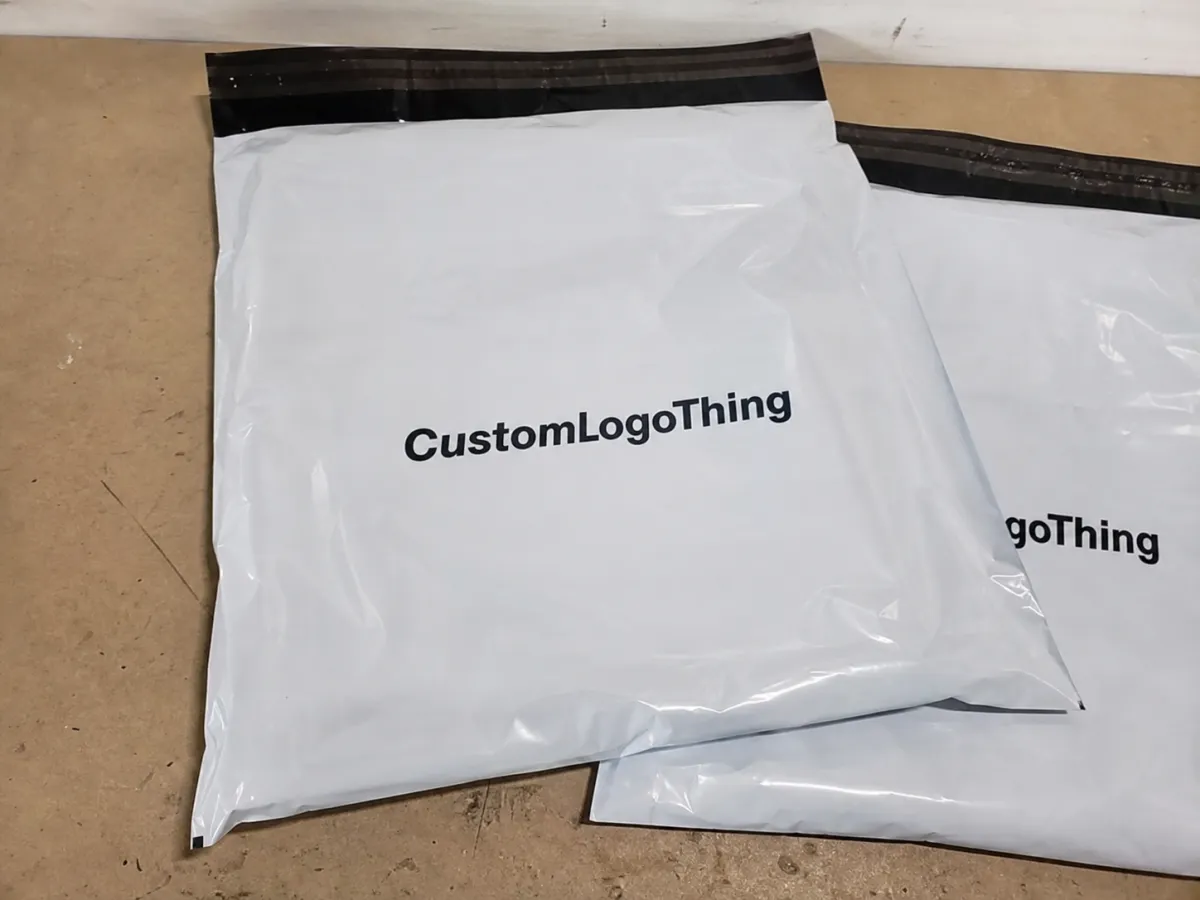
Printed Poly Mailers for clothing brands are flexible polyethylene shipping bags printed with a logo, pattern, brand mark, or full-coverage artwork. Most are made from LDPE or LLDPE film, chosen for their light weight, tear resistance, and ability to seal quickly in a fulfillment line. The typical structure includes a peel-and-seal adhesive flap, and some versions add a second adhesive strip for returns.
That combination matters because apparel is often compact, but not fragile in the same way as glass or electronics. A folded T-shirt does not need a rigid box to survive transit. What it needs is a clean closure, enough film strength to resist punctures, and a format that does not add unnecessary dimensional weight.
In practice, the packaging choice can affect both freight and perception. Carriers price many shipments using dimensional weight, so a compact mailer can be more efficient than a box even when the actual product weight is low. On the customer side, branded film can make an entry-level item feel more deliberate, especially if the rest of the order is simple.
That is why many apparel teams treat the mailer as part of the packaging system, not the only package. Inserts, labels, tissue, and thank-you cards can carry some of the visual load while the mailer handles transport. A coordinated set often looks more considered than a single oversized design trying to do everything at once. For brands building that system, Custom Packaging Products can help keep the touchpoints consistent without overcomplicating the shipper itself.
How the print, seal, and shipping process works
The production path starts with artwork, but not the finished-looking version most teams send in an email. A supplier needs a dieline, print area, bleed, and file format that can be translated into press-ready files. If the bag has gussets, return strips, or special seam placement, those details should be mapped before the proof stage. Otherwise, the logo may land too close to a fold or the repeat pattern may break in the wrong place.
Printing method changes the economics and the visual result. Flexographic printing is common for larger volumes and repeatable designs. It handles solid colors well and tends to be efficient once setup is complete. Rotogravure can deliver sharper imagery and deeper ink coverage, but the cylinders increase setup cost. Digital printing helps with short runs and design flexibility, though it usually carries a higher unit cost at scale. There is no universal winner; the right method depends on order size, artwork complexity, and how much variation the brand is willing to tolerate.
Closures are not a minor detail. A weak adhesive strip slows packout, creates rework, and frustrates the warehouse team. A reliable peel-and-seal flap saves time on every order. If returns matter, a second seal is useful because it reduces the need for extra tape on the reverse journey. Some brands also specify a tear strip so the bag opens cleanly without scissors or damage to the contents.
The bag itself influences packing labor more than most outside the warehouse expect. If the mailer is hard to open, folds too tightly, or clings to itself, every order takes longer. Multiply that by a peak season run and the “small” packaging difference becomes a real labor expense.
"The best mailer is the one that disappears in operations and still looks intentional in the customer’s hands."
Cost, MOQ, and unit pricing explained
Unit pricing for Printed Poly Mailers for clothing brands is shaped by size, film thickness, print coverage, number of colors, closure style, and quantity. A small one-color mailer with modest ink coverage can sit in a very different price band from a full-bleed design with a return strip and heavier film. The jump is not subtle once the specification gets more complex.
MOQ matters just as much. Many converters set minimums somewhere in the 3,000 to 10,000 unit range per SKU, although short-run digital options can go lower. Lower quantities are easier on cash flow but carry a higher unit price because setup costs are spread over fewer pieces. Larger orders usually lower per-bag pricing, then introduce storage and obsolescence risk.
For planning purposes, buyers often use rough ranges like these:
| Option | Typical Use | Planning Price Trend | Brand Impact |
|---|---|---|---|
| Plain stock mailer | Fast replenishment, low-profile shipping | Usually the lowest upfront cost | Minimal |
| One-color custom printed mailer | Core apparel orders, simple branding | Moderate; improves with volume | Clear logo visibility |
| Full-coverage printed mailer | Launches, campaigns, stronger presentation | Highest setup and print cost | Strongest unboxing presence |
In the current market, many buyers see plain stock mailers under roughly $0.20 each in bulk, one-color custom pieces in the $0.15 to $0.45 range depending on quantity, and heavier full-print mailers reaching $0.35 to $0.80 or more. Those numbers are directional, not universal. Freight, film market swings, and the exact print layout can move the quote faster than a lot of teams expect.
Hidden costs deserve attention. Plates, setup fees, proof revisions, freight, carton charges, and sample runs can change landed cost materially. A quote that looks cheaper on paper can end up costing more once the shipment reaches the warehouse. The real number is the one after you add everything the receiving team cannot avoid.
There is also a practical question about return on spend. A custom mailer can justify itself through better perceived value, lower need for extra packaging layers, and improved consistency across launch orders. But if the packaging is barely visible to customers, or if the assortment is narrow and repeat orders are driven by product alone, the premium may be harder to defend. Packaging should earn its place in the margin, not just in the mockup.
Process, timeline, and production steps from proof to delivery
A realistic project starts with quoting and artwork review, then moves to proofing, approval, production, inspection, and shipping. Straightforward one-color jobs usually move faster than full-coverage designs because there are fewer registration and color questions to settle. Once the proof is approved, lead time is driven mostly by production queue, film availability, and transit distance.
For planning, many brands should expect about 10 to 20 business days after proof approval for production on standard custom runs, plus shipping time. Short-run digital jobs can be faster, while complex print or overseas freight can push the schedule out. The safe assumption is that packaging takes longer than anyone wants it to take, especially when the product launch date is already set.
The most common delays come from avoidable issues. Files arrive without a dieline. Pantone references change after approval. A logo that looks sharp on a monitor prints too dark on film. None of that is unusual, but each correction adds time if it happens late in the process. The proof stage is where the money and the schedule are really won or lost.
For seasonal drops, build buffer stock into the order plan. Packaging should not arrive in the same week as the inventory it protects. If demand spikes, a reprint trigger should be set before the last pallet is opened. That is especially important for limited collections, subscription boxes, or brands that run paid media campaigns against fixed launch dates.
It also helps to match bag sizes to product families instead of trying to force every SKU into one format. Tees and lightweight knits can often share a size. Hoodies, denim, and multi-piece bundles usually need their own spec. A separate reference sheet for Custom Poly Mailers keeps the team from guessing when reorder time arrives.
Key factors that shape fit, durability, and brand impact
Size is the first variable to get right. A mailer should fit the finished folded product, not the product in the abstract. A tee, a pair of leggings, and a hoodie can produce very different pack dimensions once folded, labeled, and bundled. If the bag is too tight, packing slows down and the seam is stressed. If it is too loose, the shipment looks improvised and uses more material than it should.
Thickness matters next. Common apparel mailers fall somewhere around 2.5 to 4 mil, depending on use case and brand expectations. Lighter film can be fine for tees and accessories. Heavier film is better for garments with hardware, bulk, or sharper edges. The trade-off is simple: more film usually means more puncture resistance and a more substantial hand feel, but it also means higher material cost and sometimes more freight weight.
A useful test is to compare the bag against the real packing flow. If the product slides in easily, seals cleanly, and survives handling without stretching at the seams, the spec is probably close. If the warehouse team has to fight the bag, the spec is wrong even if the artwork looks good.
Artwork should be judged on the substrate, not in a clean digital preview. Dark film can swallow detail. Fine lines can soften. Small text can disappear once the bag is folded or stacked. Simple logos, strong contrast, and moderate ink coverage tend to reproduce more reliably than intricate graphics. That does not mean the design has to be boring. It means the design has to survive movement, friction, and imperfect lighting.
Recycled-content films and lower-impact options deserve careful review. Some are made with post-consumer or post-industrial recycled content, while others are designed for film recycling streams. The exact claim depends on the blend, additives, print coverage, and local collection infrastructure. A supplier should be able to provide the material spec and any claim support. Without that documentation, sustainability language turns vague fast.
Testing standards matter too, especially if a brand ships into strict retail channels or wants to validate transit performance. Procedures such as ISTA transit testing are useful references for more than just cartons; they frame how packages should be evaluated under vibration, drop, and compression conditions. A mailer that looks good on a shelf can still fail once it is packed on a pallet and pushed through a carrier network.
Common mistakes clothing brands make with mailer specs
The most common mistake is sizing by estimate. Teams look at the style sheet, imagine the fold, and order accordingly. Then the first packing run reveals that the garment is thicker than expected or that the label, insert, or return card leaves less room than planned. Measuring the finished fold is faster than fixing a bad spec.
Another common issue is overdesigning the print. A dense graphic can look great on a screen and weak on a flexible bag. Tiny type, narrow strokes, and low-contrast details are vulnerable once the film bends. Many brands would get a better result from a cleaner visual system that reads from arm’s length than from a crowded artwork file that tries to say too much.
Timeline mistakes are expensive because packaging rarely gets priority until inventory is already inbound. If artwork approval slips, the launch date does not. A reprint after a change order can easily create a freight problem, a storage problem, and a very real operations problem. Keeping the spec stable early is usually cheaper than chasing perfection late.
Freight and packout are easy to ignore because they do not always show up in the headline unit price. Yet a slightly heavier film can increase carton weight, alter pallet counts, or slow packers if the bags cling together. The difference between a smooth packout and a frustrating one often lives in details that never appear in a marketing mockup.
Returns are another weak spot. If the mailer is supposed to support reverse logistics, the secondary closure needs to work after the first opening. A flimsy return strip creates extra tape use and undermines the purpose of the feature. The spec should support the actual customer journey, not just the first shipment.
Expert tips for better artwork, sourcing, and replenishment
Send real garment data, not just a brand brief. Final folded dimensions, bundle count, insert thickness, and any outer label requirements all influence the bag recommendation. That one step can prevent oversizing, which is one of the easiest ways to waste money in apparel packaging.
Ask for proofs that show the design on the exact substrate and, ideally, at the actual scale. A logo that looks balanced on a PDF can land too close to the flap or disappear near a fold line. If the supplier offers multiple layouts, compare them side by side. In packaging, the better option is often the one that reads more clearly after the bag has been handled, stacked, and opened.
Use replenishment triggers instead of ordering by panic. A launch schedule can hide risk until the last carton is opened, then everyone starts calling for rush freight. A cleaner method is to define weeks of stock on hand, calculate average consumption, and set a reorder point before the buffer gets thin. That approach works better for mailers than for almost any other disposable supply because the bag is tied directly to shipping continuity.
Request samples under real conditions whenever possible. A flat swatch tells only part of the story. Filling, sealing, stacking, and opening reveal more. If the supplier cannot provide a live sample, test the film against your own product mix before the full run. Hardware, zippers, and multi-layer garments can behave very differently from a simple folded tee.
Keep the comparison set consistent. One quote should be for the same size, same thickness, same print method, and same freight assumption as the next. Otherwise, the cheapest quote may just be the least complete one. The goal is to compare apples to apples, not a one-color stock-style piece against a fully printed, return-seal package with freight excluded.
Next steps for ordering with fewer surprises
If the order is moving forward, start with a short checklist: finalize product dimensions, choose quantity range, confirm closure style, and gather the artwork files. That is enough to produce quotes that can actually be compared. It also reduces the back-and-forth that tends to stall packaging projects right when the merch team wants momentum.
Ask for three things in the same conversation: sample photos or a physical sample, a quoted timeline, and a breakdown of setup and freight charges. Those numbers reveal far more than a polished sales sheet. They show whether the bag is realistic for the schedule, the warehouse, and the budget.
It can also help to compare two spec directions before signing off. One may use lighter film and a simpler print. The other may add a stronger hand feel, a better-looking logo lockup, or a return seal. That decision is usually more useful than asking only for the cheapest possible unit cost, because the cheapest option is not always the one that performs best over a full selling season.
For most apparel teams, printed poly mailers for clothing brands work best when they are treated as a working part of the brand system. The right size, the right film, and a clean production schedule matter more than flashy artwork. Get those pieces right and the packaging supports the product instead of competing with it.
FAQ
How many printed poly mailers for clothing brands should I order first?
Most brands should start with enough inventory to cover one full selling cycle plus a buffer for damaged bags, forecast misses, and reorder lead time. A smaller test order can be useful if the size spec is still being refined or if the print has not been proven on the actual film.
Are printed poly mailers for clothing brands recyclable?
Some are recyclable in store-drop-off or film-recycling streams, but the answer depends on the material blend, print coverage, additives, and local collection programs. Ask for the exact film spec and recycling guidance instead of assuming all poly mailers follow the same rule.
What artwork works best on printed poly mailers for apparel?
Simple logos, bold typography, and strong contrast usually reproduce best because they stay readable on flexible film. If the artwork is detailed, request a proof on the actual substrate so you can see how the design behaves when the film bends or the bag is folded in transit.
How do I choose the right size for folded clothing?
Measure the final folded product, then add room for sealing, labels, inserts, and any return materials. Tees, hoodies, and bundle orders usually need different sizes, even if they seem close on paper.
What is the difference between custom and stock mailers for clothing brands?
Stock mailers are faster to source and usually cheaper upfront, but they do not carry the same brand signal. Custom printed mailers add visual consistency, help launches feel more deliberate, and can improve the overall unboxing experience without moving to a box.


