Buyer Fit Snapshot
| Best fit | Printed Recycled Corrugated Boxes Wholesale for Brands projects where brand print, material claims, artwork control, MOQ, and repeat-order consistency need to be specified before quoting. |
|---|---|
| Quote inputs | Share finished size, material target, print colors, finish, packing count, annual reorder estimate, ship-to region, and any compliance wording. |
| Proofing check | Approve dieline scale, logo placement, barcode or warning zones, color tolerance, closure strength, and carton packing before bulk production. |
| Main risk | Vague material claims, crowded artwork, missing packing details, or unclear freight terms can make a low unit price expensive after revisions. |
Fast answer: Printed Recycled Corrugated Boxes Wholesale for Brands should be specified like a repeatable production item. The safest quote records material, print method, finish, artwork proof, packing count, and reorder notes in one written spec.
Production checks before approval
Compare the actual filled-product size with the drawing, then confirm tolerance on folds, seals, hang holes, label areas, and retail display edges. Reserve space for logos, QR codes, warning copy, and material claims before decorative graphics fill the panel.
Quote comparison points
Review material grade, print process, finish, sampling route, tooling charges, carton quantity, and freight assumptions side by side. A quote is only useful when the supplier can repeat the same color, closure quality, and packing count on the next order.
Printed Recycled Corrugated Boxes Wholesale for Brands
Brands That Ship every day learn something fast: the box is not just a container, it is a signal. A plain carton moves product. A well-made one changes how the order feels before the customer even opens it. If you are looking for printed Recycled Corrugated Boxes wholesale that protect the shipment, carry branding cleanly, and avoid unnecessary waste, you are asking the right question.
Printed recycled corrugated boxes wholesale solve three problems at once for growing operations: protection, presentation, and material efficiency. One carton can move through fulfillment without extra handling, arrive looking intentional, and replace separate labels or outer wraps in a lot of shipments. That matters more than people think. I have watched teams shave seconds off packing time, and those seconds turn into real money once the order count starts stacking up. A few hundred orders is one thing; a few thousand is another story entirely.
At Custom Logo Things, the goal is practical, not theatrical. Build printed recycled corrugated boxes wholesale programs that ship reliably, print cleanly, and keep unit costs under control. Packaging should help the warehouse move faster, not create a new chore for it.
Why Printed Recycled Corrugated Boxes Wholesale Beat Plain Shipping Cartons
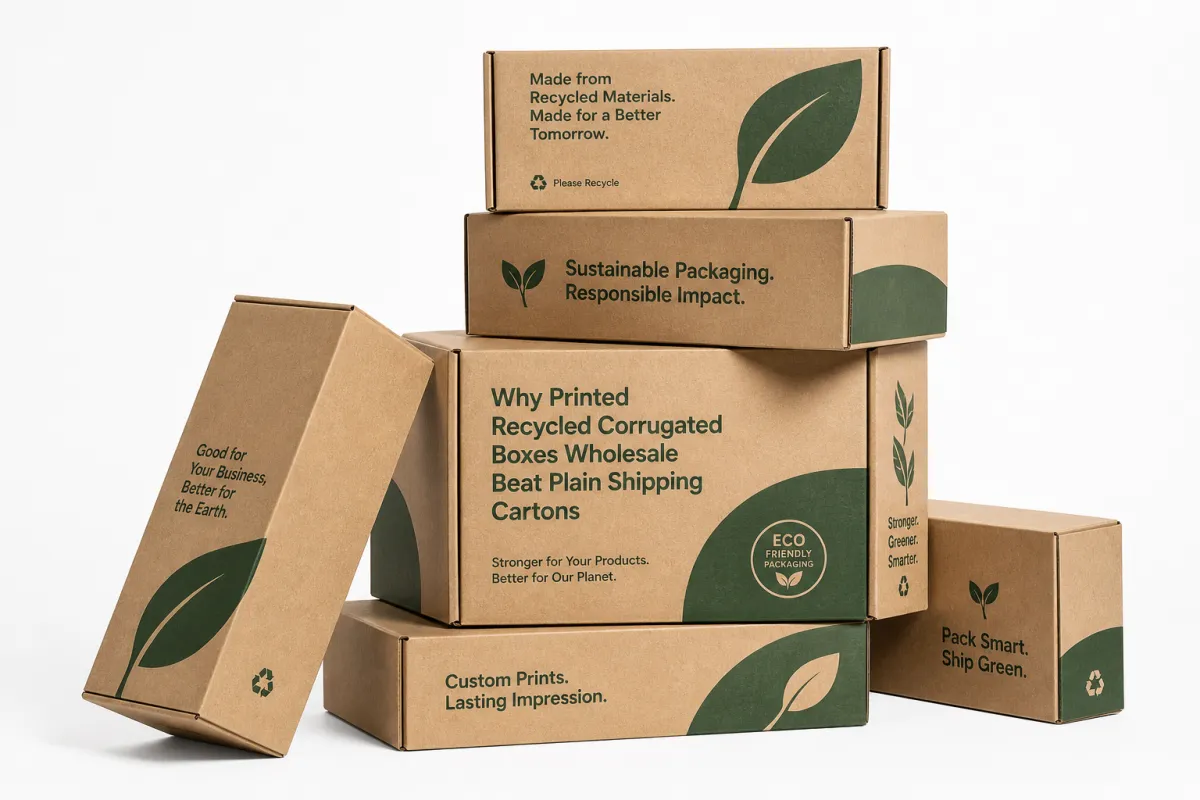
Plain brown cartons do one job well: they get product from point A to point B. That is useful, and for some shipments it is enough. But many brands are paying for acquisition, retention, and repeat purchases. A plain box leaves value sitting on the table. Printed recycled corrugated boxes wholesale turn a shipping expense into a brand signal. Not in a fuzzy marketing sense. In a measurable, practical one.
The first gain is visible right away. A branded carton feels complete the moment it lands on a doorstep or a receiving dock. A clean logo, a short message, or a restrained outside print can do more than a stack of stickers ever will. The second gain sits deeper in operations. A smart carton design can cut packing steps. In some programs, one box replaces a separate label, an insert, and an outer layer of protection. Warehouse teams notice that. Finance does too.
Printed recycled corrugated boxes wholesale also fit brands that care about waste and sourcing. Recycled corrugated board already belongs in a circular packaging model, and FSC-certified paper options are available when traceability matters. Buyers who need a neutral reference for chain-of-custody standards can look to the FSC site. For shipping performance and parcel testing, the ISTA standards are the usual benchmark.
Common use cases show up quickly:
- E-commerce shipments that need a stronger unboxing moment.
- Subscription kits that must arrive neat, consistent, and easy to stack.
- Retail replenishment where the carton still has to look presentable at delivery.
- Fragile goods that need a sturdy outer shell and less empty space inside.
- Multi-SKU fulfillment that benefits from one box family instead of a pile of odd sizes.
From a buyer’s perspective, printed recycled corrugated boxes wholesale earn their keep when the carton does more than carry weight. It should print sharply enough to support the brand, survive handling without collapse, and keep damage rates low. If it does those three things, the economics usually work.
A shipping box should disappear in transit and still look intentional at the door. A sloppy carton advertises the wrong thing, and the brand pays for it every time.
That is why many teams move away from plain stock cartons once order volume settles into a pattern. The box becomes part of the product experience rather than a disposable shell. And yes, printed recycled corrugated boxes wholesale can do that without becoming a packaging science project nobody can manufacture on time.
If your team needs a broader packaging mix, Custom Packaging Products covers the rest of the line. Recurring orders usually fit better inside Wholesale Programs, especially once the reorder schedule starts repeating every month or quarter.
What Are Printed Recycled Corrugated Boxes Wholesale Best For?
Printed recycled corrugated boxes wholesale work best for brands that need packaging to do more than sit on a pallet. They are a strong fit for e-commerce, subscription boxes, retail shipments, and any operation that wants the carton to carry branding without sacrificing protection. If the product is moving through a warehouse, onto a truck, and then to a customer or store, the box needs to perform at every step.
The strongest use cases usually share one trait: the carton has a job beyond containment. A well-printed recycled corrugated box can reduce label clutter, support a cleaner unboxing experience, and keep the supply chain easier to manage. That makes printed recycled corrugated boxes wholesale especially useful for teams that want consistent presentation across multiple SKUs or recurring shipments.
In practice, these boxes are a good fit for:
- E-commerce brands that want the packaging to reinforce identity.
- Subscription programs that need repeatable sizing and a polished look.
- Retail replenishment that still benefits from a presentable outer carton.
- Protective shipping where recycled packaging still has to meet handling demands.
- Multi-product operations that need corrugated shipping boxes with flexible print options.
If your shipment needs a printed exterior, a reliable structure, and a practical way to scale, printed recycled corrugated boxes wholesale usually beat generic stock cartons. They are not just packaging. They are a quiet part of the brand system.
Product Details: What You Can Customize in Recycled Corrugated Boxes
Printed recycled corrugated boxes wholesale is a broad category, which helps buyers and frustrates them in equal measure. The flexibility is real. So is the risk of vague promises. Some suppliers say “custom” and mean they can print a logo on one side of a standard carton. That is not a custom program. That is a standard box with a new face.
A proper corrugated program can usually be customized in several ways:
- Box style: mailer boxes, regular slotted cartons, die-cut shippers, and custom inserts.
- Print method: one-color flexo, two-color flexo, digital print, inside print, outside print, or both.
- Board face: kraft liner, white liner, or other recycled-facing paper options.
- Structural features: self-locking tabs, tear strips, hand holes, ventilation holes, and partitions.
- Brand placement: top panel, side panel, inside lid, or a full wraparound design.
Mailer boxes fit subscription kits and retail-style deliveries because they open cleanly and look intentional. Regular slotted cartons do the heavy lifting for transit, palletizing, and rougher warehouse handling. Die-cut shippers make sense when the product needs a snug fit or a more polished opening experience. Fragile products often benefit more from partitions and inserts than from flashy print. A smart insert can reduce movement better than a thicker logo ever could.
With printed recycled corrugated boxes wholesale, the face stock matters almost as much as the artwork. Kraft liners create a natural, earthy look that suits minimal branding and eco-positioning. White liners make logos and color fields appear brighter. Recycled content does not automatically mean dull or muddy, but the paper surface affects how ink sits, so design has to respect the substrate instead of fighting it.
Branding should support the structure, not hide it. A box with the wrong dimensions and a beautiful logo is still the wrong box. A sensible carton with a clean one-color mark can look sharper than an overdesigned package that ships badly. That is the part many teams miss. Graphic ambition is easy to approve. Fit, closure, and stack strength are what determine whether the program holds up in real life.
Printed recycled corrugated boxes wholesale work especially well when the packaging family needs variation without chaos. One footprint, several insert options, and a few print changes can cover multiple SKUs or seasonal versions. The warehouse gets one setup. The customer sees a consistent system. The business avoids stockpiling a different carton for every product line.
The smartest packaging families usually start with one structural base and adjust the insert or print for each product. That keeps sourcing cleaner, storage easier, and freight less complicated. Printed recycled corrugated boxes wholesale work best when the packaging plan is treated like a system, not a collection of one-off ideas.
Specifications That Matter: Board Grades, Sizes, and Print Limits
Specifications are where a packaging program gets saved or broken. Printed recycled corrugated boxes wholesale is not only about appearance. The carton has to survive compression, parcel sortation, stacking, and handling that no design mockup can fully capture.
Board construction should be the first decision. For many e-commerce and retail shipments, single-wall corrugated is enough. Common choices include 32 ECT and 44 ECT, depending on product weight, stacking needs, and shipping route. Lighter products with moderate handling often do well in single-wall cartons. Heavier, denser, or more fragile shipments may need double-wall construction. The correct answer depends on cube size, product weight, and how many times the carton gets touched before delivery. There is no universal spec that works for every brand.
Flute choice changes both performance and print behavior. E flute is thin and gives better print detail, which is why it often shows up in retail mailers and presentation boxes. B flute and C flute are thicker and can improve cushioning and stacking resistance. Combination boards can balance print quality and durability, although they add complexity and cost. Small text and fine line art usually print better on a smoother liner with a tighter flute profile. That is one reason printed recycled corrugated boxes wholesale should be specified from two angles at once: engineering and graphics.
Size planning carries the same weight. Measure the product first, then add space for loading, protective wrap, and the natural shape of the item. Inside dimensions are the numbers that matter for fit. Outside dimensions matter for freight and pallet counts. A box that is too tight slows packing and increases damage. A box that is too loose burns money on void fill and waste. A practical method is to allow enough room for the product plus protective allowance, then verify the fit with a sample before approving production.
Print limits should be discussed early. Recycled corrugated board can show natural fiber variation, especially on kraft liners, so full-color artwork needs to account for that texture. Fine lines below about 0.5 pt may soften on rougher surfaces. Heavy ink coverage can crack on tight score lines. Bleed zones matter. Safe zones matter. The difference between a crisp logo and a disappointing run often comes down to whether those constraints were respected from the start.
For transit performance, ask for measurable specs such as:
- ECT or edge crush test for stacking strength.
- Burst strength if puncture and tear resistance matter more.
- Compression targets for pallet stacking or warehouse storage.
- ISTA-style transit testing for parcel or distribution risk.
ASTM test methods often come into the conversation, and ASTM D642 compression testing is a standard reference point for box strength discussions. If a supplier cannot speak in clear numbers, that is a warning sign. Printed recycled corrugated boxes wholesale should be sized and tested like shipping equipment, because that is exactly what they are.
One more reality check matters here. Recycled fibers can vary more than virgin stock, so color consistency may shift from run to run a little more than some brands expect. That is normal, not a defect. It means proofing should happen against the actual board, with a realistic tolerance range set before production begins. If color accuracy is critical, request a proof on the intended liner instead of pretending packaging behaves like a screen.
Pricing, MOQ, and Unit Economics for Printed Recycled Corrugated Boxes Wholesale
Price is usually the first number buyers want, and almost always the first number they ask for too early. Printed recycled corrugated boxes wholesale pricing depends on box size, board grade, print method, color count, and order quantity. Those are the real drivers. A quote without those details is not much more than a guess with letterhead.
Small orders cost more per unit because setup and run time get spread across fewer cartons. Larger orders lower the unit price, but only if storage and cash flow can absorb the volume. Plenty of brands chase a lower per-box figure, then end up paying for pallets of unused cartons. That is not savings. It is a storage problem with a discount attached.
Typical MOQ ranges look something like this:
- Digital print: often lower MOQs, sometimes a few hundred units for short runs or multi-SKU testing.
- Flexo print: usually becomes efficient around 1,000 to 3,000 units and scales well above that.
- Complex custom structures: may require higher minimums because tooling and setup are more involved.
For planning, the ranges below help buyers sanity-check a proposal before moving forward. They are not fixed quotes. They are the kind of benchmark numbers that make procurement conversations less vague.
| Option | Typical MOQ | Common Use | Planning Price Range |
|---|---|---|---|
| Plain recycled corrugated carton | 250-1,000 | Basic shipping with no branding | $0.45-$1.20 per unit |
| One-color printed mailer or shipper | 500-2,500 | Logo branding, simple retail feel | $0.70-$1.80 per unit |
| Full custom printed box with insert | 1,000-5,000+ | Premium unboxing, product-specific fit | $1.20-$3.50 per unit |
Those ranges move quickly with size. A small mailer and a large shipping carton are different purchases. Board grade changes the number too, as does print coverage. A single-color logo on kraft is easier than full-panel artwork on a white liner with inside printing. None of that should be surprising.
Printed recycled corrugated boxes wholesale buyers should also ask for landed cost, not only factory price. Freight can shift the math more than many people expect, especially on bulky cartons. If the supplier quotes boxes but leaves shipping out, the comparison is incomplete. Ask for pallet counts, pallet dimensions, estimated shipping weight, and delivery destination. That is how a buyer compares programs honestly.
Cheap is not the same as efficient. A slightly higher-priced carton can still be the better choice if it cuts damage, speeds packing, or removes a separate step in the workflow. A lower unit price means little if the box crushes in transit or the print flakes off after handling. That is why smart buyers treat printed recycled corrugated boxes wholesale as a system cost rather than a single line item.
If you are comparing multiple packaging families, ask for two or three scenarios: low quantity, target quantity, and higher-volume pricing. That reveals the breakpoints, minimums, and scaling behavior much more clearly than one quote ever could. It also makes the decision between buying now, staging the order, or standardizing on one size far easier.
Process and Timeline: From Artwork to Delivery
Fast packaging orders usually come from prepared buyers. Printed recycled corrugated boxes wholesale projects move faster when dimensions, artwork, and quantity are settled early. A quoting team should not have to investigate for days just to learn the product weighs 2.4 pounds and needs a side-load mailer. That kind of back-and-forth costs time and often pushes a production slot into the next cycle.
The process usually follows a predictable path:
- Quote request with box size, product weight, quantity, print colors, and shipping destination.
- Dieline or structure review so the box shape fits the product and the fulfillment method.
- Artwork check to confirm bleed, safe zones, line weights, and logo placement.
- Proofing through digital proof, mockup, or physical sample.
- Production once the sample and artwork are approved.
- Shipping and delivery with pallet counts and tracking confirmed.
Good artwork files reduce friction. Vector logos are best when available. If the brand uses multiple colorways, the supplier needs to know which version is final. For printed recycled corrugated boxes wholesale, a clean file usually performs better than a complicated file full of hidden issues. Packaging does not reward clutter.
Sampling deserves real attention. A digital proof is useful for layout, but it does not always show how the paper surface will behave, how the print tone will read, or how the folds will hold. A physical prototype is better when fit matters, especially for products with rigid inserts or delicate closures. For larger orders, a pre-production sample gives the closest read on final output. That extra step often pays for itself the moment it prevents a fit issue or a print surprise.
Typical timelines vary with complexity:
- Simple printed runs: often 10-15 business days after proof approval.
- Custom structural work: often 15-20 business days or more.
- Large or highly finished orders: can take longer if tooling or samples need revision.
The most common delays are usually the least glamorous: missing artwork, changing dimensions, and internal approval bottlenecks between operations and marketing. One person wants the box smaller. Another wants the logo bigger. A third wants to revise the unboxing copy. Meanwhile, the production queue keeps moving. Printed recycled corrugated boxes wholesale orders move faster when one decision-maker signs off on the specs.
Repeat programs benefit from standardization. Lock a box family, then vary the artwork or insert as needed. Seasonal updates become easier. Reorders stop feeling like new projects. The supply chain gets less noisy. That may sound dull, but dull is often what efficiency looks like.
Why Choose Us for Printed Recycled Corrugated Boxes Wholesale
Many suppliers overcomplicate the buying process. You need printed recycled corrugated boxes wholesale that print well, ship safely, and do not require six follow-up emails every time you reorder. That is the baseline. A packaging partner should remove friction, not add another layer of it.
Custom Logo Things focuses on the practical details: board quality, print consistency, and communication that answers the actual question. If a carton needs a stronger flute, say so. If the artwork will lose detail on a rougher liner, say that too. Direct feedback saves money and prevents the kind of packaging decision that looks good in a mockup and fails in the warehouse.
Printed recycled corrugated boxes wholesale does not mean flimsy. Recycled content is a material choice, not a performance downgrade. The spec should match the shipment, not a catalog photo. A lightweight apparel box and a dense parts shipment should not share the same board assumption just because both are corrugated. Lazy assumptions are expensive.
Brands that care about consistency usually care about repeatability as well. That is where a dependable packaging supplier earns trust. The second order should resemble the first. The fourth reorder should not require rediscovering the entire project. If a business runs multiple SKUs or seasonal variants, a repeatable packaging family keeps operations calm enough to function.
Useful strengths for buyers include:
- Clear specs so the quote matches the actual need.
- Flexible order sizes for testing, scaling, and reordering.
- Stable print quality across runs and paper types.
- Packaging support that helps align structure, print, and shipping requirements.
- Wholesale programs that make recurring orders less chaotic.
There is a simple truth about branded corrugated packaging: every damage claim costs more than the box upgrade you skipped. That is why the best printed recycled corrugated boxes wholesale programs are engineered for the shipment, not just priced for the spreadsheet.
The cheapest box is rarely the cheapest order. Once damage, rework, and packing labor show up, the savings usually disappear.
For brands that need more than one packaging format, our Custom Shipping Boxes can cover transit-heavy needs without sacrificing presentation. If you are building out a broader packaging stack, the full line of Custom Packaging Products gives you room to keep everything aligned.
In practice, the strongest buyers ask simple, direct questions: What board grade are you quoting? What print method fits my quantity? What is the lead time after proof approval? Those conversations are refreshingly old-fashioned. They also produce better results.
Next Steps for Printed Recycled Corrugated Boxes Wholesale Orders
If you are ready to move, start with facts rather than a vague “send pricing” request. Printed recycled corrugated boxes wholesale quotes get accurate quickly when the supplier has the right inputs from the start. That means dimensions, product weight, print colors, quantity, shipping destination, and any special handling requirements.
The sequence below usually works best:
- Choose the box style that fits the product and fulfillment method.
- Confirm board grade and flute based on weight and transit risk.
- Select the print method that matches your volume and design complexity.
- Ask for sample or proof options before approving production.
- Request two or three quantity scenarios so unit cost and lead time are easy to compare.
That comparison step matters more than many teams expect. One quote at 500 units tells you very little. Two or three scenarios show where pricing breaks, how minimums behave, and whether the supplier can scale with you. For printed recycled corrugated boxes wholesale, that is the difference between guessing and buying with a plan.
If your team already knows the branding direction, send the logo files and artwork notes with the first request. If the packaging concept is still in flux, share the product dimensions and ask for structural recommendations first. That gives a better starting point than forcing a design before the carton is sized correctly.
One practical move helps nearly every operation: standardize a few box sizes, then use inserts or print variations to separate SKUs. Storage stays cleaner. Reorders get easier. Fulfillment becomes less chaotic. It is not glamorous, but it is efficient, and efficiency usually beats packaging drama.
For wholesale buyers who need recurring supply, the best next move is to build a clear spec sheet and request a quote package that includes pricing and sample options. Printed recycled corrugated boxes wholesale should make the brand look stronger, not make procurement harder. Lock the inside dimensions, board grade, print method, and target quantity before the artwork gets fancy, and the quote you get back will be useful instead of decorative.
What is the minimum order for printed recycled corrugated boxes wholesale?
MOQ depends on box style, print method, and size. Digital print usually supports lower quantities than flexo, and simple mailers often start lower than custom inserts or more complex structures. Ask for the minimum by SKU rather than a generic factory number, since mixed sizes can change the economics quickly.
Are recycled corrugated boxes strong enough for shipping?
Yes, if the board grade and flute match the product weight and the transit risk. Recycled content changes the fiber mix, not automatically the durability. For heavier or fragile items, ask for ECT or burst-strength specs and verify the carton with a sample before locking the order.
Can I print full-color artwork on recycled corrugated boxes?
Yes, though the print method matters. Digital and flexo have different limits for color coverage, detail, and surface appearance. Kraft liners usually create a more natural look, while white liners support brighter graphics. If exact color matching matters, request a proof on the intended board.
How long does production usually take?
Simple printed orders can move quickly once artwork and dimensions are approved, often within 10-15 business days after proof approval. Custom structures, special finishes, and high-volume runs add time. The fastest projects usually come from buyers who send complete specs the first time.
What should I send to get an accurate quote?
Send box dimensions, product weight, target quantity, print colors, and shipping destination. Attach artwork files or a simple logo file so the supplier can confirm print feasibility. If you want to compare options properly, ask for pricing at two quantities so the unit-cost break is easy to see.


