Buyer Fit Snapshot
| Best fit | Recycled Corrugated Boxes Bulk projects where brand print, material claims, artwork control, MOQ, and repeat-order consistency need to be specified before quoting. |
|---|---|
| Quote inputs | Share finished size, material target, print colors, finish, packing count, annual reorder estimate, ship-to region, and any compliance wording. |
| Proofing check | Approve dieline scale, logo placement, barcode or warning zones, color tolerance, closure strength, and carton packing before bulk production. |
| Main risk | Vague material claims, crowded artwork, missing packing details, or unclear freight terms can make a low unit price expensive after revisions. |
Fast answer: Recycled Corrugated Boxes Bulk: Pricing, Specs, MOQ should be specified like a repeatable production item. The safest quote records material, print method, finish, artwork proof, packing count, and reorder notes in one written spec.
Production checks before approval
Compare the actual filled-product size with the drawing, then confirm tolerance on folds, seals, hang holes, label areas, and retail display edges. Reserve space for logos, QR codes, warning copy, and material claims before decorative graphics fill the panel.
Quote comparison points
Review material grade, print process, finish, sampling route, tooling charges, carton quantity, and freight assumptions side by side. A quote is only useful when the supplier can repeat the same color, closure quality, and packing count on the next order.
Recycled Corrugated Boxes bulk orders make sense when the same carton moves through your shipping line day after day. The real win is not the lowest quote sitting in a spreadsheet. It is a carton program that cuts waste, keeps packouts consistent, and reduces the scramble that comes from last-minute reorders, surprise freight, and damage claims that could have been avoided with a better spec.
Buyers often chase the cheapest unit price and forget to ask what that number leaves out. Freight, storage, rework, and damaged goods show up later, and they usually cost more than the savings looked worth. That is why recycled corrugated boxes bulk should be judged as a landed-cost decision. If you ship every week or use the same carton size across a product family, buying in bulk usually gives you steadier margins and a calmer receiving dock.
Custom Logo Things keeps the process practical: define the carton, confirm the construction, compare price at more than one quantity, and make sure the box holds up in transit. No fluff. No guessing. Just a packaging choice that does its job without turning into a recurring headache.
Why recycled corrugated boxes bulk save money fast
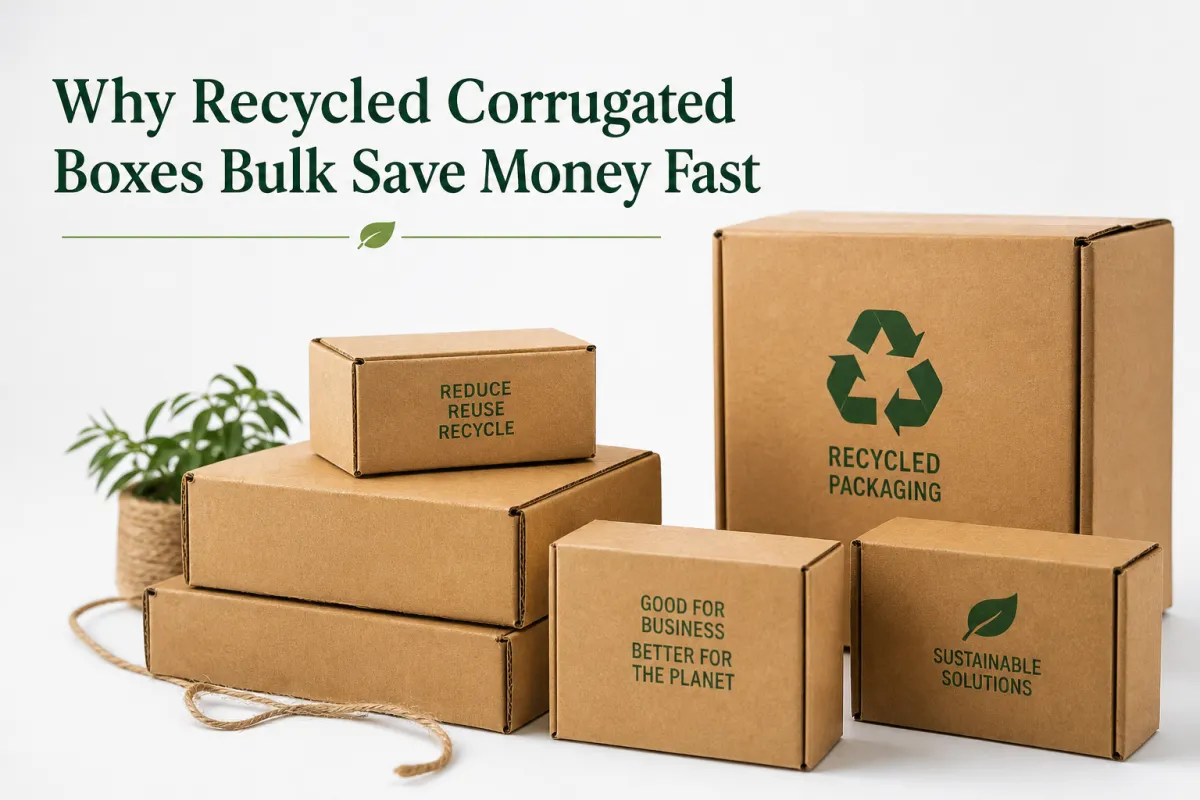
Small-batch buying can feel safer because the invoice is easier to absorb, yet that comfort gets expensive fast. Repeat freight charges stack up, receiving takes more time, reorder cycles get frantic, and carton sizes drift from one order to the next until the packing team is forced to work around the box instead of working with it. recycled corrugated boxes bulk help break that pattern for brands with steady shipping volume. One order covers a longer window, planning gets easier, and emergency buys stop eating into the budget every time inventory runs lower than expected.
Freight is usually the first place the savings show up. A small carton order still occupies pallet space and still has to move through the carrier network, so the freight cost is spread over fewer boxes. A larger run spreads that movement across more units, and the landed cost per carton falls. Labor is the second gain. Fewer deliveries mean less receiving time, while a standardized carton size means fewer packing decisions for the warehouse team. That kind of consistency sounds ordinary, then quietly saves a lot of money.
I have seen this over and over on the shop floor: the box that looked "good enough for now" turns into a monthly distraction. One quarter later, the team is dealing with a different carton height, a slightly different flute, and a new carrier bill nobody planned for. The box did not get worse because the business got busier. It got worse because the buying decision never really settled.
Picture a subscription brand that ships 2,000 units a month. It might start with smaller buys because the lower commitment feels comfortable. That comfort vanishes once box prices creep up, lead times stretch, and the carton spec keeps changing because someone picked the cheapest option each round. Shift that brand into recycled corrugated boxes bulk and the per-unit cost usually settles down, the board spec stays predictable, and the team stops treating packaging like a monthly experiment.
Ecommerce sellers, subscription brands, contract manufacturers, and warehouses with repeated carton demand see the biggest benefit. If the product line has a repeat size, bulk buying is usually the cleanest move. A brand still testing its product line may not need a large run yet, and that is fine. There is no prize for filling a storage corner with cartons before the business is ready for them.
"The cheapest carton is not the cheapest box. The cheapest box is the one that shows up on time, fits the product, and keeps the shipment out of the damage file."
That is the mindset that protects margins. A recycled corrugated carton that saves a few cents at quote stage but costs dollars in breakage is not a bargain. It is a very tidy-looking loss.
If you are comparing packaging paths, it helps to look at the wider carton strategy too. A plain shipping carton may be enough, or your product may call for a more branded structure from our Custom Shipping Boxes range. For buyers managing several packaging categories, our Custom Packaging Products page keeps the options together. And if your purchasing team prefers repeat ordering across sites, the Wholesale Programs route usually fits better than one-off buying.
Bulk purchasing also removes a layer of decision fatigue. One approved carton size is easier to stock, easier to forecast, and easier to train around. That sounds dull because it is dull. Dull is useful in packaging. Dull is what keeps a warehouse from improvising with extra dunnage every Tuesday afternoon.
What recycled corrugated boxes bulk actually includes
recycled corrugated boxes bulk can point to several different carton styles, and that is where buyers sometimes get tripped up. The phrase sounds simple, but the actual order may be a regular slotted carton, a mailer-style box, a die-cut shipper, a heavier shipping carton, or inner packs sized to support a larger outbound box. Leave the construction vague and you can end up with a quote that looks right while the carton itself behaves the wrong way.
Most bulk orders start with one of these common formats:
- Regular slotted cartons for standard shipping and warehouse use.
- Mailer-style boxes for eCommerce, presentation, or subscription programs.
- Die-cut boxes for tighter fits and a cleaner unboxing shape.
- Shipper cartons for heavier products that need stronger stacking support.
- Inner packers for multi-pack protection or kit assembly.
Recycled content needs careful wording too. Some board uses post-consumer fiber, some uses post-industrial fiber, and some blends the two. Those descriptions are not the same. Post-consumer content often matters more to sustainability teams because it tracks recovered material that already served a consumer use. Post-industrial recycled fiber still counts as recycled fiber, although it comes from manufacturing scrap. If your brand needs a precise recycled-content claim, say that before samples are made.
Board grade and flute choice matter just as much. A 32 ECT single-wall carton can handle light to medium products, while a 44 ECT or double-wall structure may be a better fit for heavier shipments or palletized movement. Flute selection changes crush resistance, surface behavior for print, and the way the carton folds under load. Recycled board is not automatically weak. That assumption usually comes from people who have not spent enough time around actual shipping conditions. The right recycled board performs well when the grade matches the product.
Customization is usually straightforward. You can order plain kraft-looking cartons, printed logo cartons, or size-adjusted runs built for a particular SKU. Many programs keep the print area modest so the box stays clean and the cost stays in line. Inserts, dividers, and product-specific packouts should be defined at the same time as the carton so the dieline and inside dimensions work together rather than fighting each other.
A proper bulk quote should spell out the essentials clearly:
- Box style and construction
- Inside dimensions and tolerance range
- Board grade and flute type
- Recycled content description
- Printing method, number of colors, and coverage
- Whether tooling, plates, or dieline work is included
- Packaging method, pallet count, and freight assumptions
If those details are missing, the quote is incomplete. That does not automatically make the supplier a bad fit. It usually means the buyer has not asked for enough detail yet. In packaging, vague specs are expensive. Specific specs are usually cheaper. That part never really changes.
For buyers who want a cleaner starting point, recycled corrugated boxes bulk can begin as a stock-size run with simple branding added later. That path works well when the product is still changing. You keep the recycled carton structure, the order stays efficient, and the print or size can be upgraded later without tearing apart the entire packaging program.
Specs that matter before you order
If you want recycled corrugated boxes bulk to perform in the real world, focus on the specs that affect shipping instead of the ones that merely look good in a sales sheet. The numbers that matter most are ECT, BCT, burst strength, board caliper, and the actual inside dimensions. Everything else is secondary unless the product has a truly unusual transit risk.
ECT, or Edge Crush Test, shows how much vertical load the board can handle before the edges start to fail. That matters for stacking. BCT, or box compression test, is often more useful because it shows how the assembled carton behaves under load. Burst strength still appears in buying conversations, but for shipping performance, stacking and edge strength usually tell you more than a vague promise that the carton is "strong."
Inside dimensions deserve more attention than they usually get. A carton listed as 12 x 9 x 6 outside does not give you 12 x 9 x 6 of usable space. Board thickness, flute profile, and folding tolerance all shrink the internal cavity. If your product uses inserts, protective wrap, or corner pads, those pieces need to be counted in the working size. Measure the product, measure the packout, then add only the clearance you actually need. Guessing from the outside dimensions is how buyers end up with a carton that looks right and packs badly.
Humidity and storage conditions matter too. Recycled board can perform well, yet it still reacts badly to moisture. If your warehouse gets humid or cartons sit near dock doors, storage discipline matters. Keep pallets off the floor, wrap them properly, and do not let cartons absorb moisture before use. Once corrugate starts to take on water, performance drops quickly. A box that was fine on arrival can turn soft after a bad week in a damp space.
Product weight changes the spec you should request. A lightweight apparel carton does not need the same structure as a heavy hardware box. Ceramic goods or dense components often need stronger crush resistance, tighter caliper control, or even double-wall protection. Fragile items also deserve a realistic drop profile. If the product can chip, crack, or dent, ask for a sample and test pack it before you approve the run. Packaging is supposed to prevent damage, not sit beside it.
The safest route is to approve a simple buyer checklist before production starts:
- Confirm inside dimensions, not outside dimensions.
- Define product weight and packout weight.
- Identify whether inserts, void fill, or dividers are needed.
- Choose board grade and flute type based on shipping conditions.
- Approve artwork placement and print area.
- Set tolerance limits for size and print registration.
- Confirm pallet count, case pack, and ship-to locations.
For transit-sensitive products, it helps to ask whether the carton should be checked against recognized distribution methods. The ISTA testing standards are useful when you want a clearer view of drop, vibration, and compression risk. If your team tracks fiber sourcing as part of a sustainability program, the FSC framework is another reference worth knowing. Neither replaces a real product test, though both give your purchasing team a cleaner way to judge the options.
One more practical point: ask for a tolerance range on size and print placement. A carton that is a few millimeters off can still work, but automated lines and tight fill systems do not care about good intentions. Those small differences become expensive quickly. Bulk runs move more smoothly when the spec is complete and the production team knows the acceptable limits before the first sheet is cut.
In the field, recycled corrugated boxes bulk work best when the carton spec matches the actual job instead of the ideal version of the job. That is the difference between a carton that ships well and a carton that only behaves on paper.
Recycled corrugated boxes bulk pricing, MOQ, and volume breaks
Pricing for recycled corrugated boxes bulk comes down to a few direct variables, and none of them are mysterious. Size, board grade, print coverage, tooling, pallet count, and freight zone usually drive most of the final number. Bigger cartons use more fiber. Heavier board costs more. Full-coverage print adds cost. Shipping farther adds cost. Packaging buyers do not need a song and dance here; they need the drivers laid out plainly.
MOQ, or minimum order quantity, exists because setup costs have to be spread across enough units to make the production run worthwhile. If the order needs a custom dieline, print plates, or a setup unique to your carton, the supplier has to recover that work somewhere. That is why custom programs often have higher minimums than stock cartons. It is not a penalty. It is how the production math works.
For reference, these are common bulk pricing patterns for standard recycled corrugated carton programs. The exact numbers shift with size, board, and freight, but the ranges help when you are checking whether a quote makes sense.
| Option | Typical MOQ | Common Unit Range | Best For |
|---|---|---|---|
| Stock recycled corrugated cartons | 250-1,000 units | $0.32-$0.78 | Standard shipping, fast replenishment, simple packouts |
| Custom size, no print | 1,000-2,500 units | $0.42-$1.05 | SKU-specific sizing, cleaner fit, fewer void fill costs |
| Custom printed recycled corrugated boxes bulk | 2,500-5,000 units | $0.58-$1.48 | Branding, subscription kits, eCommerce fulfillment |
| Heavier double-wall or higher-ECT cartons | 2,500+ units | $0.85-$2.20 | Weighty products, palletized shipping, fragile goods |
Those ranges are not a promise. They are a practical starting point. A small mailer with light print can sit toward the low end. A large custom carton with broad coverage and a freight-heavy delivery zone can climb fast. That is why landed cost matters more than unit price. Landed cost includes freight, setup, sample charges, and storage if the order is larger than your team can use right away.
Volume breaks matter because the same carton often gets cheaper once the run is large enough to absorb setup costs. A 2,500-piece order may land in one price band, while a 5,000-piece order on the same spec might lower the unit by 8% to 18%. A 10,000-piece run can reduce it further if the carton repeats across multiple SKUs or shipping locations. Bigger is not always smarter, though. If the box sits for half a year in your warehouse, you saved money on unit price and tied up cash in cardboard. That is a tough trade to call a win.
Hidden costs deserve attention. Sample charges are usually modest, yet they still count. Tooling or plate fees can rise quickly if artwork changes late. Rush fees appear when a deadline suddenly becomes urgent because someone treated the schedule like a suggestion. Split shipments also hurt because freight divides and handling climbs. Storage can quietly become the most expensive line item if pallet counts outrun available space. None of those items is dramatic on its own, but together they can tilt a quote in the wrong direction.
A useful quote comparison asks three things:
- What is the unit price at the target volume?
- What is the landed cost to my ship-to zip code?
- What changes if I move one volume band up or down?
That last question gets skipped more often than it should. A quote at 2,500 units and a quote at 5,000 units can show whether it is worth carrying extra inventory for a lower unit cost. Sometimes the answer is yes. Sometimes the math says the smaller buy is the better decision, and there is no point pretending otherwise.
For recycled corrugated boxes bulk, the cleanest buying strategy is usually to compare two scenarios: a conservative MOQ that matches current usage, and a second volume that shows the next break point. Once the actual dollar difference is on the page, the decision becomes much easier to make.
Ordering process and lead times for bulk runs
The ordering process for recycled corrugated boxes bulk is usually simple when the buyer arrives with good information. Most delays do not come from production. They come from dimensions that are still changing, artwork that has not been settled, or ship-to details that keep shifting. The cleaner the input, the faster the order moves.
A normal bulk order follows this path:
- Inquiry and spec review - share dimensions, product weight, style, print needs, and destination.
- Quote - receive pricing tied to volume, board grade, and freight assumptions.
- Sample or proof - review the carton structure or artwork layout before production.
- Approval - lock the spec, sign off on artwork, and confirm quantity.
- Production - the run is made, checked, packed, and palletized.
- Freight booking and delivery - the order ships to the agreed destination.
Lead times vary with complexity. A stock-size recycled carton can move quickly, sometimes within 7-10 business days once payment and shipping details are settled. A custom size without print often lands closer to 10-15 business days. A printed custom order can take 12-20 business days or longer if the artwork goes through revisions or the production calendar is already full. Heavy runs, special coatings, and unusual board requirements can push the window out further.
Lead time usually gets disrupted by indecision rather than machinery. If the buyer waits three days to answer a proof question, the schedule moves three days. If artwork changes after proof approval, the clock resets. If the freight address is wrong, the dock appointment slips. The easiest way to keep recycled corrugated boxes bulk moving is to get the decisions front-loaded.
Three things speed the order up:
- Final dimensions and packout details on the first request
- Print-ready artwork in the correct file format
- One ship-to destination, or a clean pallet split plan
Three things slow it down:
- Multiple rounds of size changes
- Artwork revisions after proof approval
- Unclear board grade or test requirements
If you are planning inventory, build in a buffer. Do not wait until the last pallet is already on the floor. That forces rush freight and weakens your negotiating position. A better approach is to place the order while there is still enough packaging on hand for the current production cycle plus a cushion. For many buyers, that means starting the quote when on-hand supply drops to 25% to 35% of normal usage.
If your operation runs multiple SKUs, set one reorder point for recycled corrugated boxes bulk and stick to it. Procurement teams get better results when cartons are treated as a controlled input rather than an afterthought. No one wants the packaging line waiting for boxes because someone guessed the warehouse "probably had enough."
There is a practical upside to a clear process as well: repeat orders get easier. Once the carton, artwork, and freight setup are approved, the next run usually moves faster. That repeatability is one of the strongest reasons bulk packaging buyers stop chasing one-off vendors and settle on a partner that can keep the spec steady.
Why choose us for recycled corrugated boxes bulk
People do not buy recycled corrugated boxes bulk because they enjoy comparing cardboard all afternoon. They buy because they want reliable cartons that show up with the right size, the right board, and the right print. That is the part we take seriously. Consistency beats clever wording. Predictable board quality beats vague promises. And easy repeat ordering beats starting from scratch every time procurement needs a refill.
At Custom Logo Things, the goal is to keep the process grounded. We help buyers sort out whether they need stock size, custom size, or printed cartons, and we keep the quote tied to the spec instead of wrapping it in extra noise. If your team needs a simple packaging path, our Custom Shipping Boxes page is a useful place to start. If you are building a broader packaging mix, the Custom Packaging Products catalog gives you a wider view. And if you are sourcing at scale, the Wholesale Programs option is built for repeat purchasing rather than one-off improvisation.
What buyers usually care about is not a pitch. It is whether the carton arrives with clean dimensions, acceptable print registration, and reliable board performance. That is fair. A packaging partner should reduce mistakes, not create them. In bulk programs, one mistake on the first run tends to become the same mistake on every reorder. The safer move is to be strict about the spec from the beginning.
Documentation matters too. Clear quote language, explicit quantity breaks, straightforward approval steps, and shipping details that procurement teams can actually use make the whole program easier to manage. If the carton needs recycled-content clarity, it should be identified early. If the box needs a different inside size because of inserts, that should be stated up front. If the ship date depends on artwork approval, say so before anyone starts relying on a delivery window that was never locked in.
Compared with marketplace buying, a controlled quote process usually gives better results. Marketplaces can work for very standard cartons, yet once repeat sizing, branding, or recycled-content claims enter the picture, the back-and-forth gets old fast. Bulk buyers do better with a supplier that treats the carton as a production spec, not a guess dressed up as a product listing.
That is why recycled corrugated boxes bulk work best with a partner who understands both carton structure and purchasing reality. You need a box that performs, and you need a buying process that does not drain your team's time.
The small details matter too. Clean pallet labels. Clear case counts. Straightforward reordering. Those are not flashy points, though they are the things that keep bulk packaging stable over time. Stable wins when shipping volume gets real.
Next steps to place a recycled corrugated boxes bulk order
If you are ready to buy recycled corrugated boxes bulk, start with the facts. Gather product dimensions, packout weight, monthly volume, print needs, and ship-to zip codes. If you ship to more than one location, say that from the start. Split freight changes the economics, and there is no reason to guess.
Then ask for at least two quote versions. One should reflect the most practical stock-size or near-stock approach. The second should show a custom size or a larger volume break so you can see the difference in cost. If branding matters, compare plain cartons against printed cartons. Those side-by-side numbers usually show whether the extra print belongs in the current run or should wait until the next one.
If your product is fragile, heavy, or sensitive to crush, request a sample or proof before you commit. That small step can prevent a lot of trouble. A carton that looks fine on a screen can still be wrong in hand. It is much cheaper to catch that early than to discover it after you own a full pallet of the wrong decision.
Use this decision path:
- Compare landed cost, not just unit cost.
- Confirm MOQ and storage capacity.
- Lock artwork and carton dimensions.
- Approve the production schedule.
- Book the shipment before your current supply gets tight.
That is the whole process. Clean spec. Clear price. Real lead time. No guesswork. If you want help quoting recycled corrugated boxes bulk, send the product size, board preference if you have one, target quantity, and whether you need print. The more complete the brief, the stronger the quote will be. Simple.
The takeaway is straightforward: define the carton tightly, compare landed cost at two volume levels, and approve a sample before you lock the run. Do that, and recycled corrugated boxes bulk become one of the easiest packaging buys to manage. They keep shipping consistent, hold cost per unit in check, and keep the team out of last-minute packaging fires.
What is the usual MOQ for recycled corrugated boxes in bulk?
MOQ depends on whether you are buying stock sizes or a custom size with printing. Stock programs can start in the low hundreds, while custom runs often begin around 1,000 to 2,500 units because tooling and setup need to be spread across the order. If you want a cleaner read on the price break, ask for quotes at two volume levels so you can see where recycled corrugated boxes bulk become more efficient.
Are bulk recycled corrugated boxes strong enough for shipping?
Yes, as long as the board grade matches the product weight and stacking load. Recycled content alone does not tell you whether the carton will perform. Look at ECT, board thickness, and compression performance. For heavier or fragile goods, ask for a sample or a compression-related spec before you approve recycled corrugated boxes bulk for full production.
How do I choose the right size for recycled corrugated boxes bulk orders?
Measure the product, then add the space needed for inserts, wrap, or dividers. Use inside dimensions, not outside dimensions, when you compare quotes. If you ship multiple SKUs, standardize on the smallest carton that still protects the product. That keeps recycled corrugated boxes bulk easier to stock and easier to reorder.
What affects pricing on recycled corrugated boxes bulk purchases?
Size, board grade, print coverage, freight distance, and order volume drive most of the cost. Custom tooling, rush production, and split shipments can push the landed price up quickly. Always compare the full landed cost, not just the quoted unit price. That is the only way recycled corrugated boxes bulk can be judged fairly.
How long does a bulk recycled corrugated boxes order take?
Lead time depends on whether the box is stock, custom-sized, or printed. Approval delays usually slow the job more than production does. If timing matters, send dimensions, artwork, and ship-to details with the first inquiry so recycled corrugated boxes bulk can move through quoting and production without avoidable backtracking.