Buyer Fit Snapshot
| Best fit | Printed Resealable Bags Wholesale projects where brand print, material claims, artwork control, MOQ, and repeat-order consistency need to be specified before quoting. |
|---|---|
| Quote inputs | Share finished size, material target, print colors, finish, packing count, annual reorder estimate, ship-to region, and any compliance wording. |
| Proofing check | Approve dieline scale, logo placement, barcode or warning zones, color tolerance, closure strength, and carton packing before bulk production. |
| Main risk | Vague material claims, crowded artwork, missing packing details, or unclear freight terms can make a low unit price expensive after revisions. |
Fast answer: Printed Resealable Bags Wholesale: Specs, Pricing, MOQ should be specified like a repeatable production item. The safest quote records material, print method, finish, artwork proof, packing count, and reorder notes in one written spec.
Production checks before approval
Compare the actual filled-product size with the drawing, then confirm tolerance on folds, seals, hang holes, label areas, and retail display edges. Reserve space for logos, QR codes, warning copy, and material claims before decorative graphics fill the panel.
Quote comparison points
Review material grade, print process, finish, sampling route, tooling charges, carton quantity, and freight assumptions side by side. A quote is only useful when the supplier can repeat the same color, closure quality, and packing count on the next order.
Printed Resealable Bags Wholesale: Specs, Pricing, MOQ
printed resealable bags wholesale is not just packaging. It is product protection, shelf presence, and a small piece of brand insurance all rolled into one. The bag has to open cleanly, close properly, and keep doing its job after the first use. If it fails on day two, customers notice. Fast.
I have watched buyers focus on print graphics and then get blindsided by zipper placement, seal width, or the wrong barrier film. That part is avoidable. Most of the pain comes from specs that were too vague to begin with. A good printed resealable bags wholesale order starts with the product, not with the pretty mockup.
It also helps on the operations side. Printed bags can replace separate labels, reduce pack-out steps, and make a launch look finished instead of temporary. For brands that need a practical starting point, our Wholesale Programs page is the easiest place to turn a rough idea into a real spec conversation.
A resealable bag that closes right is not a nice-to-have. It is the difference between packaging people keep using and packaging they mutter at once before tossing it.
Smart buyers look at three things at once: protection, presentation, and unit economics. Printed resealable bags wholesale can cover all three without pretending every pouch is some miracle solution. It can help hold back moisture, dust, and casual handling. It can keep the logo visible after opening. And it can cut out extra labels or inserts that add labor without adding much value.
That is why the format shows up so often in food, wellness, beauty, pet, and promotional programs. Snacks, coffee, tea, supplements, powdered mixes, pet treats, cosmetics sachets, and sample kits all fit the model. Larger printed resealable bags wholesale runs can also bring unit cost down enough to protect margin instead of letting packaging eat it.
Why Printed Resealable Bags Wholesale Fits Fast-Moving Brands
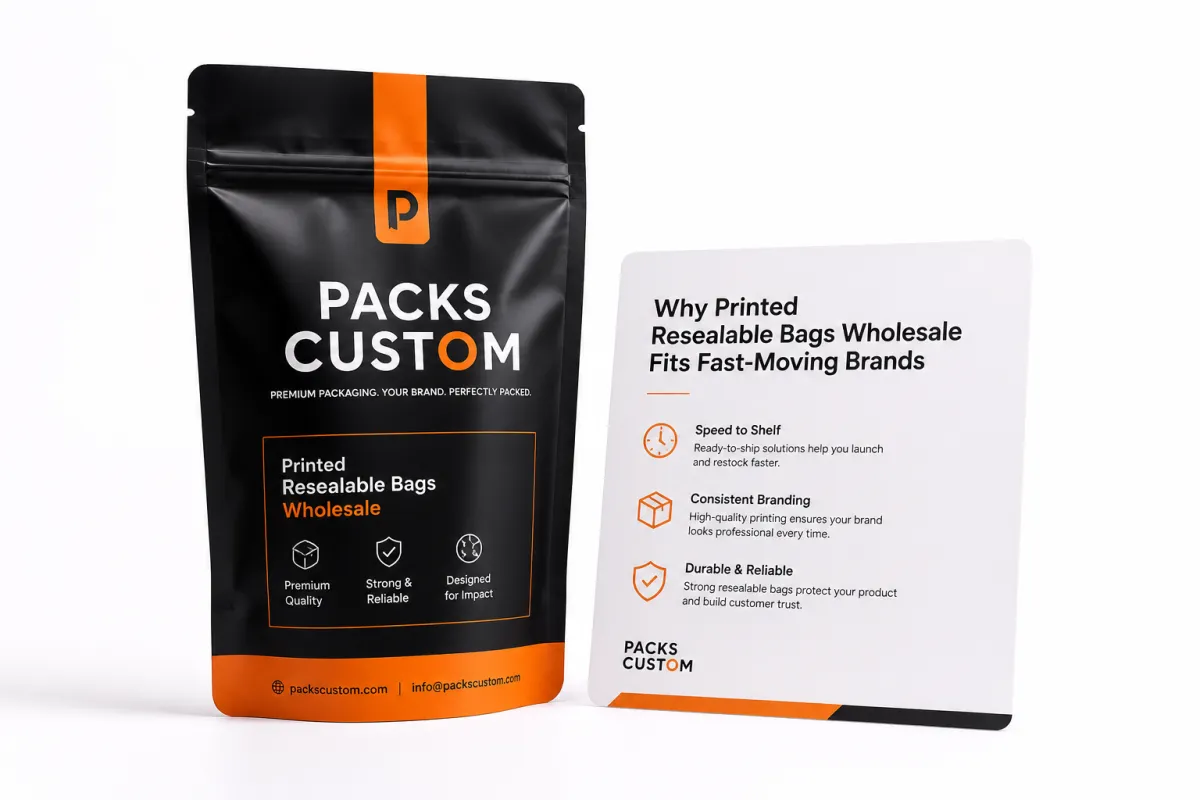
Fast-moving brands need packaging that can survive the trip from production line to shelf to pantry without turning into a headache halfway through. Printed resealable bags wholesale works because it supports freshness, keeps the brand visible, and lets the closure do its job after the first open. Basic? Yes. But basic is good when the bag has to perform in the real world.
There is also a cost side that gets ignored too often. Printed packaging often removes the need for a separate pressure-sensitive label, which saves labor and avoids the crooked-label look that can happen on flexible packs. A printed bag can also make a small SKU look deliberate instead of improvised. That matters for launches, subscription boxes, seasonal sets, and anything that has to look ready on arrival.
For buyers tracking shelf economics: a clean bag face shortens decision time. If the product name, logo, and main benefit are visible at a glance, the pouch is doing real marketing work. A plain bag with a sticker usually misses that. Sometimes badly.
Technical buyers care about the less glamorous part. Resealable packaging can reduce exposure to oxygen and moisture after opening, which helps products hold closer to their intended texture, aroma, or consistency. That does not make every pouch high-barrier, and it definitely does not mean every product needs the same structure. It just gives the product a better chance than a non-reclosable film.
For a broader industry reference, packaging.org is useful when you want the standard language buyers and suppliers use around print, structure, and application. It will not pick the bag for you. It will keep the conversation honest.
Wholesale also matters when replenishment is part of the plan. Printed resealable bags wholesale runs usually get better pricing as quantities rise, which makes packaging cost easier to forecast by SKU. That beats treating packaging like a mystery line item every time the order comes due.
And yes, the repeated opening matters more than people admit. A supplement pouch living in a gym bag gets handled differently from a coffee bag sitting on a pantry shelf. One gets tossed around. The other gets opened, closed, reopened, and judged. Kinda ruthless, honestly.
Printed Resealable Bags Wholesale Product Options
One pouch structure never fits every product. The best printed resealable bags wholesale order starts with the format, then moves to the closure, the material stack, and the print method. Each choice changes the look, the seal, and the final cost. Skip one of those pieces and the quote will come back and bite you later.
Common pouch formats
Stand-up pouches are the go-to for printed resealable bags wholesale because they sit well on shelf and leave plenty of room for branding. They work for snacks, coffee, supplements, and dry mixes. The bottom gusset gives the bag a stable base, while the front panel gives designers space to build a clean hierarchy for the product name, claims, and graphics.
Flat pouches make more sense for samples, sachets, travel sizes, and low-fill products. They use less film, so they tend to cost less in material and ship more efficiently. They do not carry the same shelf presence, which is fine if the pack is headed into direct mail inserts or lightweight promotional kits where footprint matters more than display.
Side-gusset bags suit taller fills and higher volumes. Coffee is the obvious example, though tea, pet treats, and bulk dry goods can fit too. They usually present cleaner side panels and offer more usable volume than a flat pouch with the same face size.
Lay-flat resealable bags are the practical choice when a product needs a closure but not a standing base. Small accessories, hardware, parts kits, and promotional items fit here. They are often the simplest structure to run and can be a solid first step for printed resealable bags wholesale buyers who want lower complexity.
Closure choices
Zipper style changes both the user experience and the quote. A press-to-close zipper is the standard for most consumer goods because it is familiar, simple, and cost-effective. A tear notch helps the first opening feel less annoying, especially when the zipper sits above the seal band. Child-resistant closures add another layer of control and are more common in regulated or higher-risk categories, but they raise cost and can slow packing if the line is not set up for them.
A supplier who knows the category will tell you the closure is not a cosmetic choice. It affects top seal width, pack speed, user confidence, and sometimes machine compatibility. If the zipper sits too high or too low, the fill can look cramped and the package can bow in weird ways. Printed resealable bags wholesale buyers should always confirm zipper placement on the dieline before artwork gets approved. That one step saves a lot of dumb surprises.
Material and finish tradeoffs
Material choice changes both shelf appeal and barrier performance. Gloss films create a bright, reflective look that works well for bold graphics. Matte films feel more restrained and premium, especially for wellness or beauty packaging. A kraft-look structure can suggest a natural position, but only if the material actually supports the claim. A paper-looking finish does not automatically mean the pack is paper-based. Marketing teams love that mistake. Production teams do not.
Clear windows can build trust for foods, treats, or textured products because the buyer can see what is inside. The tradeoff is obvious: more transparency means less print area and sometimes a tougher barrier build elsewhere. For powders, coffee, or oxygen-sensitive foods, barrier laminates usually matter more than visual openness.
For products that need something more specific, ask about oxygen barrier, moisture barrier, seal strength, and whether the material stack fits the storage profile. A 2.5 mil pouch may work for a lightweight sample. A 4 to 5 mil laminate may be the better call for a heavier fill or a product that gets opened many times.
Print methods in plain language
Digital printing usually fits shorter printed resealable bags wholesale runs, multiple SKUs, or artwork that changes often. Setup friction is lower, and colorful designs do not need big plate charges. The unit price tends to be higher, so it makes the most sense when quantity is modest or the design keeps shifting.
Flexographic printing sits in the middle. It works well for stable art, repeat orders, and mid-size volumes. Buyers who can commit to a fixed design and a larger quantity usually get better economics because setup gets spread out more efficiently.
Rotogravure is usually reserved for large-volume programs where the tooling pays for itself. It can deliver strong consistency and heavy ink coverage, but it is not the right answer for every buyer. Small orders do not justify the setup. No surprise there.
The real decision is not just print quality. It is whether the print method matches the order rhythm. A brand that changes artwork every month usually benefits from digital. A brand with one core SKU and predictable reorders may save more with flexo or gravure over time.
For buyers who want a more consultative route, the same Wholesale Programs page can help decide whether to start with a test run or move straight into a repeat program.
Handled well, printed resealable bags wholesale can support food, health, beauty, pet, and promotional categories without forcing every product into the same shape. That flexibility is the point. The bag should fit the product, not bully it into compliance.
Specifications That Change Printed Resealable Bags Wholesale Quotes
Most pricing surprises start with missing specs, not supplier mistakes. A reliable printed resealable bags wholesale quote needs dimensions, fill weight, barrier needs, closure type, artwork details, and any compliance requirements that affect the build. Leave those out and two quotes that look close on paper may actually be built on completely different assumptions.
The core list is not complicated, but buyers skip the items that matter most. Start with bag width, height, and gusset depth. Then confirm the fill weight and whether the product is dense, airy, fragile, or sticky. A pouch for roasted coffee behaves differently from one for a powdered supplement, even if the face size matches. Headspace matters too. Too little space can distort the top seal, and too much can make the bag look half-empty.
- Dimensions: width, height, bottom gusset, and top seal area.
- Fill weight: grams, ounces, or pieces per pouch.
- Barrier needs: moisture, oxygen, aroma retention, or light protection.
- Closure: press-to-close zipper, child-resistant zipper, or lay-flat seal only.
- Artwork: number of colors, ink coverage, front/back layout, and barcode space.
- Compliance: food-contact requirements, tamper evidence, or category-specific language.
Artwork setup can move the quote as much as the material does. A design with full coverage on both sides costs more than a simple front-panel print. Metallic effects, matte varnish, soft-touch finishes, and spot gloss can make the package look better, but each one adds process steps. If the pouch needs to show a QR code, barcode, or legal panel, those elements need a place before proofing starts. Crowded layouts always look like someone ran out of time.
There is also a line between what looks good and what runs well. Tight zipper placement, a narrow seal band, or a changed gusset depth can create machine issues on the packing line. That is why measurement discipline matters. Small changes in a printed resealable bags wholesale spec can affect fill efficiency, shelf appearance, and total waste during production. A buyer who checks the dieline early usually avoids expensive corrections later.
For performance-sensitive orders, ask about seal strength and transit testing. ASTM F88 is often used to evaluate seal strength, while shipping validation can be discussed against ISTA procedures if the bag will move through ecommerce or distribution channels. Those standards do not replace product-specific testing, but they give the conversation structure. For paper-based or paper-look components, FSC documentation may also matter if the brand needs a credible fiber claim.
One of the fastest ways to speed up printed resealable bags wholesale quoting is to send a simple spec sheet instead of a long email chain. Include product type, fill weight, dimensions, barrier needs, closure preference, quantity, artwork status, and target delivery date. A good supplier can work with that. A vague brief usually creates three rounds of clarification before the real quote even shows up.
That is not only a procurement issue. It is a margin issue. Every extra revision delays approval, and every delay pushes the launch back. If the bags are needed for a retail reset or a seasonal distribution window, the difference between a complete spec and a partial one can be several weeks.
One more thing: if your product has any regulatory hook at all, do not guess. Food-contact, child resistance, odor barrier, or shelf-life assumptions should be checked against the actual market and product category. I have seen buyers assume “standard pouch” means “safe for everything.” It does not. It means standard. That is a very different promise.
Printed Resealable Bags Wholesale Pricing and MOQ
Printed resealable bags wholesale pricing comes down to a short list of variables: material choice, print method, bag size, closure type, finishing, and total quantity. Buyers often lock onto unit price too early, then miss what the quote actually includes. Two quotes can look similar until one adds setup charges, plates, proofing, or freight. That is where the gap lives.
MOQ, or minimum order quantity, is not just a supplier rule. It is part of the cost structure. Higher minimums usually let the supplier spread setup and production costs across more pieces, which lowers unit cost. Smaller runs still make sense for test launches, seasonal items, or limited editions, but they usually carry a higher price per bag. That is normal. Printed resealable bags wholesale buyers should expect it.
Here is a practical comparison of common print paths. These are only indicative ranges, and they assume a standard pouch size with ordinary artwork coverage. Heavy ink coverage, metallic effects, special finishes, or unusual dimensions can shift the numbers quickly.
| Print Method | Typical MOQ | Indicative Unit Price | Best Fit | Main Tradeoff |
|---|---|---|---|---|
| Digital printing | 1,000-3,000 pieces | $0.28-$0.55 each | Launch SKUs, short runs, frequent artwork changes | Lower setup friction, higher piece cost |
| Flexographic printing | 5,000-20,000 pieces | $0.12-$0.28 each | Repeat orders, stable artwork, mid-volume programs | Good balance, but setup is less flexible |
| Rotogravure printing | 20,000+ pieces | $0.10-$0.22 each | Large-volume programs, strong color consistency, high coverage | Tooling and setup make it a larger commitment |
Those numbers only help if the comparison is fair. A quote for a 4 mil matte stand-up pouch with a zipper should not be stacked against a 3 mil gloss flat pouch with no zipper and lighter print coverage. Compare the same size, the same film stack, the same closure, the same finishing, and the same delivery terms before deciding which vendor is actually cheaper.
Landed cost deserves attention too. Freight, duties if applicable, proofing, plate charges, and storage can change the final economics more than the headline unit price does. A lower factory price can look great right up until freight wipes out the difference. That is why printed resealable bags wholesale orders should be judged on total delivered cost, not just the first number on the quote.
There is also a hidden cost in bad specification. If the bag is oversized, the fill looks weak and shipping volume increases. If the closure is too expensive for the SKU, margin shrinks. If the barrier is too light, product quality can slip. The cheapest quote is not always the best quote when the bag is part of the product experience itself.
For brands that want to stage volume carefully, a lower first order with a repeat-run plan often makes sense. That approach works for seasonal programs, test markets, or ecommerce launches where sales velocity is uncertain. It gives the buyer a usable package without locking into a quantity that exceeds storage or forecast demand.
If you are comparing Wholesale Programs, ask the supplier to quote at least two quantity tiers. A 3,000-piece quote and a 10,000-piece quote can show whether the long-term unit cost really improves enough to justify the extra inventory. That comparison is usually more useful than a single price.
I also like to ask for a “same spec, different volume” quote set. It keeps everyone honest. If the 10,000-piece number barely moves, you know the real constraint is setup or materials. If it drops hard, the savings are real and you can plan around them. Pretty simple, but people skip it all the time.
Order Process and Timeline for Printed Resealable Bags Wholesale
A clean order process is not extra polish. It is what keeps a packaging program from slipping. Printed resealable bags wholesale usually follows the same sequence: inquiry, spec review, artwork prep, proof approval, production, quality control, and shipment. The trouble usually starts when one handoff is incomplete.
Quoting moves fastest when the buyer sends the full spec sheet at the start. That means dimensions, fill weight, material target, closure preference, artwork status, and quantity tiers. If the design is not final, the quote can still be useful, but it should be labeled clearly as provisional. No one should mistake an estimate for a locked price.
Proofing is where a lot of printed resealable bags wholesale jobs slow down. Small color corrections, missing barcode placement, unclear logo scaling, or changes in compliance copy can all add days. The easiest way to avoid that mess is to send print-ready files and give one person the authority to approve changes. If five people are editing the proof, the schedule gets dragged around.
On a practical schedule, many suppliers can quote within 1-3 business days if the brief is complete. Proofs may take another 1-3 business days depending on artwork complexity and revision count. Production often lands in the 10-20 business day range after approval, though the exact number depends on the print method, order size, and current queue. Transit is separate. Domestic freight may take a few days; international shipping can take longer.
Common delay points include:
- Missing bag dimensions or gusset depth.
- Artwork that is not dieline-ready.
- Color revisions after proofing starts.
- Late decisions on zipper style or finish.
- Waiting until the last minute to approve the final proof.
If the bags are going into retail resets or promotional campaigns, build in buffer time. That buffer should cover production, freight, receiving, and any inspection steps on arrival. A launch can slip because of a few bad assumptions even when the supplier does everything right. Printed resealable bags wholesale works best when the buyer treats packaging as a managed supply chain item, not a last-minute design job.
For ecommerce shipments, transit validation deserves its own conversation. ISTA procedures help frame how a package behaves in distribution, which matters if the product needs to survive drops, vibration, or repeated handling before the customer ever sees it. Not every pouch needs a formal test suite, but the right supplier should be able to discuss it honestly.
It also helps to confirm the final bag geometry before production starts. A zipper that shifts by a few millimeters or a gusset that changes depth can change the appearance enough to matter on shelf. That is especially true for printed resealable bags wholesale programs where the pouch is carrying the brand story. Catching that in proof is cheap. Catching it after thousands of bags are printed is not.
From experience, the buyers who move fastest are not the ones who rush. They are the ones who arrive prepared. Spec sheet ready. Artwork labeled. Decision-maker identified. It is boring. It also works.
Why Choose Us for Printed Resealable Bags Wholesale
The right packaging supplier is not the one that talks the loudest. It is the one that helps you avoid spec mistakes, delivers on time, and keeps print quality consistent from the first run to the repeat order. That is the standard we use for printed resealable bags wholesale work.
We put reliability first. The bag should seal correctly, the print should register cleanly, and the finished dimensions should match the approved dieline. The order should also arrive with fewer surprises. A buyer managing several SKUs does not need extra chaos. Clear communication, realistic timing, and a packaging partner who understands margin matter more than fancy promises.
Our role is consultative, not just transactional. If a buyer wants a premium look but the product only supports a standard structure, we say so. If the product needs more barrier than the first draft allows, we flag it early. If a simpler closure or smaller artwork area will get a better result, we explain why. Printed resealable bags wholesale should be built around the product's actual needs, not around the most expensive possible spec.
What buyers usually care about most:
- Consistent color across repeat orders.
- Clear quotes with no hidden line items.
- Seal integrity and zipper function.
- Artwork support that avoids dieline mistakes.
- Enough flexibility to support both test runs and scale-up orders.
Quality control is not a buzzword. It means checking print registration, measuring the finished bag, inspecting the seal area, and testing the zipper action before shipment. For food and supplement brands, it may also mean confirming the structure meets the right food-contact expectations and supports the product's shelf-life target. For retail brands, it often means matching finish and color to the rest of the line so the pouch does not look like it belongs in another category.
We also know printed resealable bags wholesale buyers often need to move quickly without making sloppy choices. That is why the quote process should help you compare material, closure, and print method side by side. The answer is not always the fanciest pouch. Sometimes it is the one that protects the product, shows the brand clearly, and stays inside the target cost.
If you want to compare options for your own program, our Wholesale Programs page is a practical place to start. It is built for buyers who need a straight answer on what can be produced, what it may cost, and how the order can scale if the first run performs well.
Honestly, the best wholesale relationship is simple: good files, clear specs, honest pricing, and a production team that says early when something needs to change. That is what keeps a printed resealable bags wholesale order useful instead of annoying.
Next Steps for Printed Resealable Bags Wholesale Orders
If you are ready to move, printed resealable bags wholesale gets much easier once the product brief is complete. Start with dimensions, fill weight, closure preference, material target, and artwork status. Then decide whether the order is a test run, a seasonal buy, or a repeat program. That choice shapes the MOQ, pricing, and production path more than almost anything else.
A solid pre-quote checklist should include the following:
- Product type: snack, supplement, beauty item, pet treat, sample, or accessory.
- Fill weight or piece count: so the pouch can be sized correctly.
- Barrier needs: moisture, oxygen, aroma, or light protection.
- Closure preference: standard zipper, child-resistant zipper, or tear-notch layout.
- MOQ target: the volume that fits sales velocity and storage capacity.
- Delivery deadline: launch date, retail reset, or campaign mail date.
Once that is set, request two or three comparison quotes using the same spec sheet. That keeps the supplier conversation factual instead of vague. You will see whether one vendor is cheaper because the construction is thinner, the print method is different, or the freight assumption is lower. Printed resealable bags wholesale only gets easy to judge when the comparisons are actually equal.
Ask for sample packs or photos of similar builds before you approve the order, especially if the product is food, premium retail, or a launch SKU with high brand expectations. A flat sample can look great while a filled pouch behaves differently. If possible, test the bag with the actual product. Powder, snacks, gels, and hard goods do not fill the same way, and the zipper feel changes once the pack has weight in it.
It also helps to confirm whether the supplier can support repeat ordering with the same color target and the same finished dimensions. That consistency matters more than buyers sometimes admit. A first run that looks strong but cannot be repeated is not a real packaging system.
For the fastest route, use the same Wholesale Programs path to submit your dimensions, artwork, and quantity target in one clean package. Then ask for landed cost, proof timing, and a sample review step before release. Printed resealable bags wholesale rewards buyers who are precise up front. The better the brief, the faster the answer, and the less money gets burned on avoidable revisions.
The takeaway is simple: lock the spec before you chase the price. If the bag size, closure, barrier, and print method are set correctly, the quote becomes useful. If they are not, you are just shopping for a prettier mistake.
How much do printed resealable bags wholesale orders usually cost per unit?
Unit cost depends on size, material, print coverage, closure type, and order volume, so comparable specs are the only fair way to judge pricing. Larger runs usually lower the per-bag price because setup and production costs are spread across more pieces. Ask for landed cost, not just factory price, so freight and any setup or plate charges are included in the comparison.
What is the typical MOQ for printed resealable bags wholesale?
MOQ varies by print method, bag structure, and material, with digital runs often supporting lower quantities than long-run analog printing. If you are testing a new SKU or seasonal item, ask whether the supplier can offer a lower first order with a repeat-run plan. The right MOQ is the one that matches your sales velocity and storage capacity, not the lowest number on paper.
How long does printed resealable bags wholesale production take?
Timeline depends on artwork approval, proofing, production method, and shipping distance, so the quote should separate each stage. Rush timelines are possible in some cases, but they usually require tighter specs and fewer changes after proof approval. Build in extra time for launches because design revisions and freight delays are the most common schedule risks.
Can I use custom artwork on printed resealable bags wholesale without a large print run?
Yes, but the best print method depends on the artwork complexity, number of colors, and the quantity you need. Smaller runs are often better suited to digital printing, while large repeat orders may benefit from more traditional printing methods. Ask for a proof that shows logo placement, barcode area, and all mandatory copy before production starts.
What should I check before approving a printed resealable bags wholesale sample?
Check zipper function, seal quality, bag size, color accuracy, and whether the printed area aligns with the dieline. Fill-test the bag with your actual product if possible, because powder, snacks, supplements, and hard goods behave differently. Review shipping and shelf handling as well, since a bag can look good flat but fail once it is filled and resealed repeatedly.


