Buyer Fit Snapshot
| Best fit | Printed Retail Gift Bags projects where brand print, material claims, artwork control, MOQ, and repeat-order consistency need to be specified before quoting. |
|---|---|
| Quote inputs | Share finished size, material target, print colors, finish, packing count, annual reorder estimate, ship-to region, and any compliance wording. |
| Proofing check | Approve dieline scale, logo placement, barcode or warning zones, color tolerance, closure strength, and carton packing before bulk production. |
| Main risk | Vague material claims, crowded artwork, missing packing details, or unclear freight terms can make a low unit price expensive after revisions. |
Fast answer: Printed Retail Gift Bags: Design, Pricing, and Timing should be specified like a repeatable production item. The safest quote records material, print method, finish, artwork proof, packing count, and reorder notes in one written spec.
Production checks before approval
Compare the actual filled-product size with the drawing, then confirm tolerance on folds, seals, hang holes, label areas, and retail display edges. Reserve space for logos, QR codes, warning copy, and material claims before decorative graphics fill the panel.
Quote comparison points
Review material grade, print process, finish, sampling route, tooling charges, carton quantity, and freight assumptions side by side. A quote is only useful when the supplier can repeat the same color, closure quality, and packing count on the next order.
Printed Retail Gift Bags: Design, Pricing, and Timing
Printed retail gift bags are often the first branded item a customer touches, and sometimes they are the last thing that customer keeps after the sale. That sounds small until you watch an ordinary purchase feel a little more considered because the bag has weight, color, and a finish that looks intentional. In retail, the little details travel farther than people expect, and printed retail gift bags do a lot of that quiet work.
They are not just carriers. Printed retail gift bags shape how the purchase is perceived, reinforce the brand, and set the tone for the whole transaction. A strong bag can make a modest item feel more deliberate. A weak bag can drag the experience down before the customer even reaches the door. That is a tiny failure with a very visible cost.
What follows is a practical look at what printed retail gift bags do, how they are produced, which choices change quality and cost, and where buyers usually lose time or money. If you are comparing suppliers, start with the spec before you approve the order. That one habit saves a lot of headaches later.
What Printed Retail Gift Bags Really Do
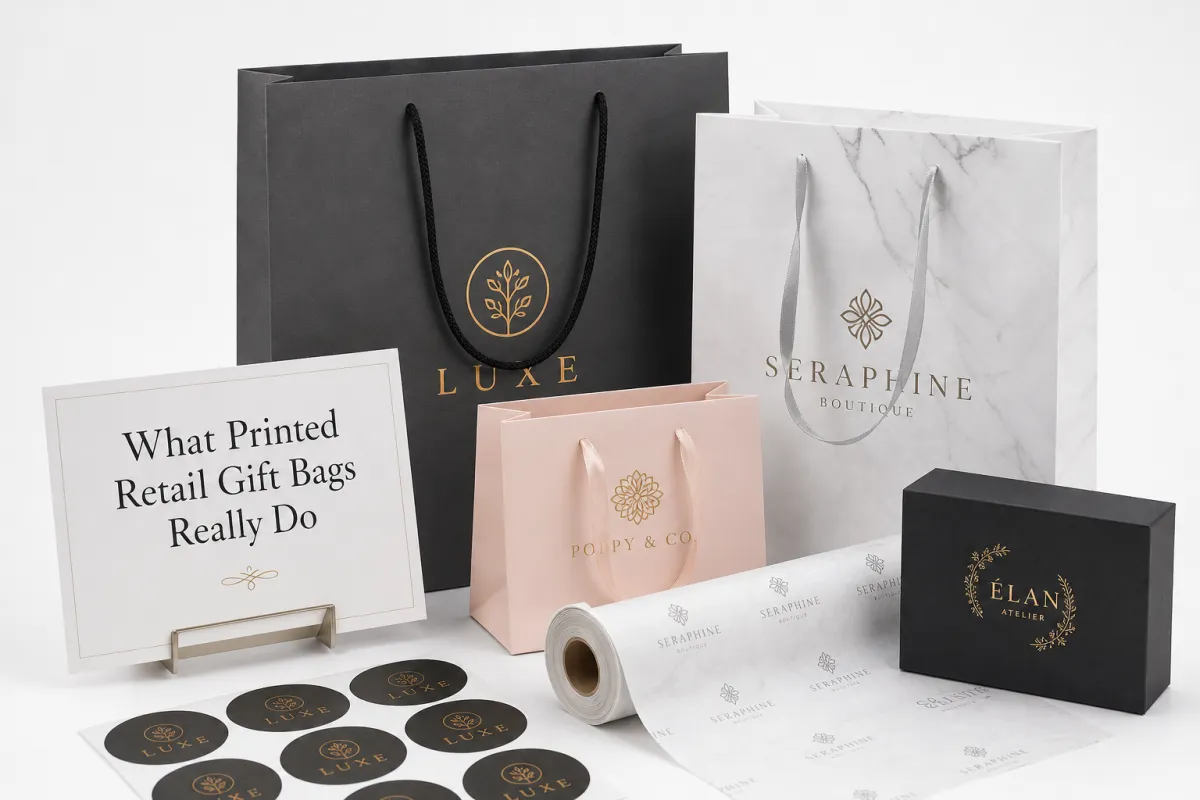
Printed retail gift bags are branded carry bags used in stores, events, pop-ups, promotions, and gift purchases. Some are straightforward kraft bags with a single-color logo. Others use coated or laminated stock, rope handles, foil, embossing, and a heavier build that feels closer to premium packaging. The function stays familiar, but the message changes quickly once the paper, finish, and handle change.
From a packaging buyer's point of view, printed retail gift bags do three jobs at once. They carry the product. They carry the brand. They carry a signal about how much care went into the purchase. That third job matters more than spreadsheets usually allow. The bag may be seen in public, set on a counter, carried through a mall, or photographed without warning. It becomes part of the brand's public life whether anyone planned for that or not.
They also help hold a retail program together. Store locations, seasonal launches, promotional events, and gift orders rarely look identical, yet the bag can keep the brand visually consistent across all of them. When signage, tissue, labels, and product packaging change from one campaign to the next, a stable bag design gives the customer something familiar to hold onto.
Stock bags are usually cheaper and faster. Printed retail gift bags cost more, but they give you control over size, color, finish, and presentation. For a one-off event with low visibility, stock may be enough. For retail environments where the bag leaves the store, gets reused, or becomes part of the experience, the printed version usually earns its place.
The cleanest way to judge value is to ask how the bag will live after it leaves the counter. If it gets tossed immediately, keep the spec lean. If it is likely to be reused, carried in public, or photographed, printed retail gift bags move from supply item to branding asset. That is where the spend starts to make sense.
A bag does not need to be ornate to do its job well. It needs to be strong, legible, and on-brand. Everything else is a choice, which is good news for buyers and bad news for unnecessary upgrades.
The bag should also match what sits inside it. A wrapped candle in a rigid-style bag sends one signal. The same candle in a thin, overloaded bag sends another. Customers notice that mismatch, even when they never say a word about it. The retail experience is full of those quiet comparisons, and they stick with people.
How Printed Retail Gift Bags Are Made
The production path for printed retail gift bags is not mysterious, but the details matter. It usually starts with a brief that covers bag size, product weight, quantity, brand colors, handle preference, and delivery date. From there, the supplier confirms a structure or dieline, then moves into artwork setup and proofing.
Artwork approval is where many jobs slow down. A logo that looks clean on a PDF can shift once it wraps a fold, crosses a gusset, or lands too close to a handle reinforcement. Printed retail gift bags need clear placement, safe margins, and a realistic view of how the design behaves on a three-dimensional object. Flat mockups help, but they never tell the full story.
Common print methods include digital, offset, and flexographic printing. Digital printing works well for smaller runs, versioned artwork, and projects with tighter revision cycles. Offset printing often makes sense for larger quantities when color control and sharper detail matter. Flexo can be a strong fit for some paper bag applications, especially when repeat efficiency matters more than decorative complexity.
Finishing choices come next. Foil stamping, spot UV, embossing, matte lamination, gloss lamination, and soft-touch coating all change the look and feel of printed retail gift bags. Each one adds appeal, and each one adds cost through setup, labor, or both. Sometimes all three. Packaging has a way of making every extra effect earn its keep.
Material selection matters just as much as print method. Paper bags may use kraft paper, coated paper, art paper, or laminated paperboard, depending on the desired look and the amount of support needed. Heavier stock usually holds shape better and supports richer print detail, while lighter stock can work for short-lived promotions. The right choice depends on how the bag will be used, not just how it looks in a mockup.
Handle style and structure are part of the build, not decorative extras. Rope handles, paper twist handles, ribbon handles, and die-cut handles all influence cost and carrying comfort. Gusset depth affects whether the product sits upright or tilts the moment it is loaded. Base reinforcement matters for boxed goods, glass items, and anything that carries real weight.
If you want a useful baseline for transit and handling, testing standards help. The International Safe Transit Association publishes practical guidance at ista.org. For paper sourcing, fsc.org is the place to check certified fiber claims. Printed retail gift bags do not need to be overengineered, but they do benefit from a little discipline.
Most bottlenecks show up in artwork revisions, color matching, and premium finishes. A simple printed retail gift bags order with one or two colors can move quickly. Add foil, soft-touch lamination, custom handles, and a tight delivery date, and the schedule starts asking for compromises. That is usually where the friction begins.
Key Factors That Change Quality and Cost
The biggest cost drivers for printed retail gift bags are easy to list, yet buyers still get surprised by them. Material choice, bag size, print coverage, color count, handle style, and finish level all change the spec. Change the spec, and the price moves. That is not a trick. It is how manufacturing works when paper, ink, and labor all have to line up at the same time.
Bag size is a major factor. A bag that is too small looks cramped and makes the product feel poorly planned. A bag that is too large wastes material and can make a modest item look lost. Most buyers should size the bag around the actual packaged product, then allow enough clearance for easy insertion and a clean top edge. If the item is boxed, measure the box, not the imagined version that lives in the meeting deck.
For apparel, folded textiles, or gift sets, common paper bag sizes often land around 5 x 3 x 8 inches for small items, 8 x 4 x 10 inches for boutique retail, 10 x 5 x 13 inches for standard shopping use, and 12 x 5 x 16 inches or larger for bulkier purchases. Those are starting points, not rules. Product weight and presentation still decide the final spec.
Print coverage also changes cost. A one-color logo on kraft paper is usually simpler and cheaper than a full-bleed design with multiple spot colors. Full coverage can look striking, but it raises ink usage, registration demands, and the chance of visible variation from run to run. If the brand can be carried by a strong logo and a controlled palette, that often gives better results than forcing the bag to do too much.
Finishes can quietly eat the budget. Matte lamination, gloss lamination, soft-touch coating, foil stamping, embossing, and spot UV all add visual appeal, but each one has a cost attached. A matte bag with a clean logo can feel restrained and premium. A soft-touch bag with foil can feel more elevated. A bag with every finish stacked together can feel confused, even if each individual choice looked attractive in isolation.
Handle choice affects both price and day-to-day use. Paper twist handles are practical and usually economical. Cotton rope handles feel more premium and carry well. Ribbon handles are decorative but less common for heavier retail use. Die-cut handles can keep the profile simple, though they are not always the best fit for heavier loads. If the handles fail or dig into the hand, the branding stops mattering almost immediately.
Strength and structure should never be treated like an afterthought. A bag that looks polished but collapses at four pounds is not premium. It is a problem waiting to happen at checkout. For heavier products, reinforced bases, board inserts, and stronger handle attachments are worth the extra spend because they protect both the merchandise and the customer's perception of the brand.
Brand goals also shape the spec. Luxury retail usually wants heavier stock, tighter color control, cleaner print, and a more restrained finish. Fast-moving promotions may care more about speed, unit cost, and clear brand visibility. Neither approach is wrong. They just solve different problems. Printed retail gift bags for a holiday launch are not the same as printed retail gift bags for a flagship jewelry counter, and treating them as interchangeable is a quick way to drift off budget.
A useful rule helps keep decisions grounded: if the bag is meant to be reused, material and finish matter more. If the bag is meant to support a short campaign, speed and consistency matter more. That single decision saves a lot of decorative drift later.
Printed Retail Gift Bags Pricing: What You Actually Pay For
Pricing for printed retail gift bags is usually built from a few fixed pieces: setup, materials, printing, finishing, assembly, and shipping. The part that catches many buyers off guard is that each piece behaves differently depending on quantity. Small runs carry more setup cost per bag. Larger runs spread that setup over more units, which is why the unit price usually drops as volume rises.
For anyone comparing quotes, the real question is not "What is the cheapest bag?" It is "What spec am I actually comparing?" Two suppliers can quote different numbers for what sounds like the same printed retail gift bags order, yet one may be using lighter stock, fewer finish steps, or a simpler handle. Low price is nice. Comparable price is better.
As a practical range, a simple paper bag with one-color printing might land around $0.18 to $0.35 per unit at 5,000 pieces, depending on size and paper weight. A laminated bag with rope handles and a cleaner premium feel can move into roughly $0.45 to $1.10 per unit at that same volume. Small runs, especially under 1,000 units, can cost much more per bag because the setup work does not shrink just because the order did.
Premium printed retail gift bags with foil, embossing, custom handles, or rigid-style construction can climb beyond that, especially if the order is small or the lead time is tight. Rush freight can also swing the budget more than people expect. Buyers often focus on the unit cost and then get blindsided by packing charges, pallet fees, or expedited shipping. That is not a pleasant surprise. It is a paperwork-shaped headache.
Here is a simple cost map for common printed retail gift bags options:
| Option | Typical Use | Approx. Unit Cost at 5,000 pcs | Main Tradeoff |
|---|---|---|---|
| Brown kraft bag, 1-color print, paper twist handle | Promotions, everyday retail, quick-turn programs | $0.18-$0.35 | Low cost, simple look, limited premium feel |
| Coated paper bag, 2-color print, reinforced base | Boutiques, apparel, general gift use | $0.28-$0.55 | Better presentation, moderate setup complexity |
| Laminated paper bag, rope handle, matte finish | Premium retail, launches, event gifting | $0.45-$1.10 | Stronger brand impact, more finish cost |
| Foil-stamped or embossed bag | Luxury retail, holiday programs, special collections | $0.70-$1.80+ | High visual value, longer production and higher setup |
| Short-run digital bag | Small campaigns, test launches, limited editions | $0.90-$2.50+ | Fast flexibility, expensive per unit at low volume |
That table is a guide, not a promise. Material markets, labor conditions, and freight all move around. Bag dimensions do too. A wider gusset or heavier paper can shift pricing faster than many buyers expect. Even so, ranges like these are enough to keep a buyer from comparing one clean quote against another quote that quietly changed the paper weight and the handle spec.
Budget usually disappears in a few familiar places. First, premium stock that exceeds the job. Second, finish layers that look impressive in a mockup but do not add much value to the shopper. Third, custom handle and reinforcement changes that keep getting approved because no one wants to slow the meeting down. The invoice never has that hesitation.
My advice stays simple: decide whether printed retail gift bags are a cost center, a branding asset, or both. If they support a launch, seasonal display, or customer retention effort, a stronger spec is easier to justify. If they are only carrying product out the door, keep the spec disciplined. No one gets a prize for overbuying paper.
Ask for an itemized quote. If the quote does not separate material, print, finish, and freight, you are not comparing real options yet. You are comparing optimism.
One more buying habit saves money quickly: request the same size, same paper weight, same print method, and same finish across every quote. That is the only fair way to compare printed retail gift bags. Otherwise, the cheaper quote may simply be a thinner bag with fewer features and a more persuasive sales email.
Printed Retail Gift Bags Process and Timeline
The usual timeline for printed retail gift bags begins with the brief and ends with cartons on the dock. Between those points sit size selection, artwork prep, proof approval, sampling, production, quality control, and shipping. If any one of those steps slows down, the order slows with it. Packaging does not reward skipped approvals. It simply waits and uses the calendar against you.
For simple printed retail gift bags orders, production can often move in roughly 10 to 15 business days after proof approval, assuming the artwork is clean and the spec is standard. Add custom sizes, foil, lamination, or heavier volumes, and the schedule may stretch to 20 to 35 business days or more. That is before freight. Rush requests can shorten the calendar, but they also narrow the available finish choices and reduce the room for correction.
The approval trap is real. One delayed logo signoff can hold the whole project, even when the factory is ready. Buyers often think production time is the only variable. It is not. Artwork approval, sample turnaround, and shipping method all sit in front of the press run like a line of people with clipboards waiting for someone to answer one last question.
Sampling deserves more respect than it usually gets. A digital proof shows layout and color intent, but a physical sample or press proof shows how the paper feels, how the handle sits, and whether the print looks right on the actual surface. For printed retail gift bags tied to a store launch or premium display, that sample is cheap insurance. A bad launch costs much more than a sample ever will.
Rush orders change the plan in predictable ways. Fewer finish options. More expensive freight. Less room for rework. Sometimes no time for a full sample cycle. If the date matters more than the decorative extras, say so early. There is no point pretending a five-day turnaround and a foil-stamped bag are natural companions.
Holiday peaks deserve extra attention. So do store openings, trade shows, seasonal promotions, and multi-location rollouts. Build more time into the schedule if the bags must arrive sorted, packed, or shipped to more than one location. A two-week delay on a holiday program can erase the usefulness of the whole order. Printed retail gift bags are easy to overlook until the first cartons fail to appear.
For orders where transit matters, package testing and pallet protection deserve a quick review. If the bags are shipping flat to stores or distribution centers, carton strength and stacking performance matter. Standards such as ISTA 3A or ASTM D4169 become useful here, because crushed master cartons create waste before the bags are even used. A pretty bag inside a bad carton still creates a problem.
- Step 1: Confirm size, quantity, material, handle, and finish.
- Step 2: Prepare the dieline and upload print-ready artwork.
- Step 3: Review the proof for color, placement, and fold safety.
- Step 4: Approve a sample or press proof if the order is high-visibility.
- Step 5: Run production, inspect quality, then pack for shipping.
If the timeline is tight, the smartest move is to simplify. Printed retail gift bags with one or two colors, a standard size, and a proven handle style are easier to approve and easier to ship. That is often the difference between "on time" and a project that suddenly needs a rescue meeting.
Common Mistakes With Printed Retail Gift Bags
The first mistake is choosing printed retail gift bags based on looks alone. A bag can look beautiful in a mockup and still fail in actual use because the handles are weak, the base is too small, or the paper is too light for the product. Beauty matters. So does not embarrassing the customer at checkout.
The second mistake is artwork that is too busy or too small. Logos need breathing room. High-contrast color usually prints and reads better than subtle low-contrast combinations. If the design is crowded, the branding can disappear at arm's length, which is usually where the bag gets seen. Printed retail gift bags are not billboards; they are moving surfaces with folds, seams, and handle anchors that interrupt the layout whether you plan for it or not.
The third mistake is underestimating lead time. Buyers often approve a concept late, then ask for a faster turnaround than the spec allows. That is how rush fees appear. If you are planning printed retail gift bags for a campaign, the calendar should include time for proofing, sampling, production, and freight. Skipping those steps does not remove them. It just makes them louder later.
Quantity mistakes are common too. Some buyers order too few and end up paying emergency rates for a second run. Others order too many and tie up cash in a design that changes before the year is over. A better approach is to match the run size to the campaign life, expected foot traffic, and refill pattern. Guessing is not a procurement strategy, even when the pressure is real.
Brand inconsistency is another easy way to weaken the result. If printed retail gift bags do not match store signage, labels, tissue, or product tags, the packaging starts to feel accidental instead of deliberate. That does not mean every surface must match perfectly. It means the palette, typography, and finish should feel like they came from the same brand system.
Another problem is ignoring what the bag is carrying. A gift bag for a lightweight scarf is not the same as a gift bag for boxed skincare or a glass candle. Printed retail gift bags should be tested with the real product weight, not a generic filler. If the base bows, the handles stretch, or the top edge tears, the bag has failed its one job.
Finally, some buyers chase the lowest quote without asking what is missing. Lower price can mean thinner paper, fewer color passes, less precise finishing, or weaker freight packing. That is how a "deal" turns into reorders, complaints, and a packaging reset nobody budgeted for.
Expert Tips for Better Printed Retail Gift Bags
Design printed retail gift bags for the shopping moment, not the studio render. In a store, at an event, or on a busy sidewalk, the bag is usually seen in motion from a few feet away. That means the logo should read quickly, the colors should stay clear, and the message should not depend on someone stopping to inspect the paper grain like it is a sample board in a museum.
Keep the design simple unless the brand truly needs a more layered treatment. One strong logo, one controlled color system, and one finish decision usually outperform clutter. Printed retail gift bags that try to include every graphic idea at once end up feeling busy and less premium. The customer should remember the brand, not the layout software.
Use the actual product weight before approving the order. That sounds obvious, which is probably why so many teams skip it. Put the real item in a sample bag. Lift it. Carry it. Watch the handles. Check the base. If the bag survives that test, you are in better shape than most projects that never leave the conference room. I have seen a lot of otherwise nice packaging fall apart at this stage, and it is never fun to explain.
When the order supports a launch, holiday campaign, or premium retail display, ask for a physical sample or press proof. Printed retail gift bags can shift once artwork meets the real substrate. Paper tone, coating, and finish all influence how color reads. A screen never tells the full story, no matter how polished the render looks.
It also helps to think in terms of the full package system, not just the bag alone. Tissue, tags, inserts, and signage should feel related. Printed retail gift bags are strongest when the shopper can tell the brand has a point of view, not a random pile of matching colors. The difference is subtle in a file preview and obvious in the store.
For buyers comparing suppliers, use the same spec sheet for every quote. Same dimensions. Same stock. Same handle. Same print method. Same finish. Then ask for the production timeline, freight method, carton count, and any sample charges. That is the cleanest way to compare printed retail gift bags without getting distracted by glossy language.
Here is the short version of the buying playbook:
- Measure the product and leave real clearance.
- Choose the material based on weight and presentation level.
- Keep the print simple unless there is a strong reason not to.
- Request a sample if the bags are tied to a launch or premium moment.
- Compare quotes line by line, not by headline price.
That approach usually gets printed retail gift bags that look good, carry well, and arrive on time without turning the project into a rescue mission. If you want the bag to earn its keep, make the spec do the hard work before the design tries to impress anybody.
For custom packaging buyers, the next step is straightforward: measure the product, decide on the finish level, gather print-ready files, and compare printed retail gift bags quotes on the same spec sheet. Do that, and you will get a cleaner quote, a safer timeline, and a bag that helps the brand instead of merely holding it.
What is the best bag type for printed retail gift bags?
Choose the bag based on product weight, presentation level, and where it will be handed out. Heavier paper or laminated stock works well for premium retail, while lighter options fit short-run promotions. If the bag has to survive real shopping use, prioritize handle strength and base reinforcement over decorative finishes.
How long do printed retail gift bags usually take to produce?
Simple orders can move quickly if artwork is ready and the print method is straightforward. Custom sizes, specialty finishes, and larger quantities usually stretch the timeline because proofing and setup take longer. Add extra time for holiday peaks, store openings, and anything that needs a sample before full production.
Are printed retail gift bags expensive compared with plain bags?
Printed bags cost more upfront because you pay for setup, printing, and finishing. The unit price drops as quantity rises, so larger orders usually make more sense for ongoing retail use. If the bag supports brand value or customer retention, the extra cost is often easier to justify than it first appears.
What artwork works best on printed retail gift bags?
Simple logos, high-contrast colors, and clean spacing usually perform better than dense, busy layouts. Design for real viewing distance, since the bag is often seen while moving rather than under studio lighting. Keep critical details away from seams, folds, and handle attachments so the print stays readable.
How do I order printed retail gift bags without wasting budget?
Start with the product dimensions, expected order quantity, and required delivery date. Ask for the same material, size, print method, and finish across every quote so you can compare apples to apples. Order a sample or proof first if the bags are for a launch, premium retail display, or high-visibility campaign.
Related packaging resources
Use these related guides to compare specs, costs, quality checks, and buyer decisions before making the final call.