Buyer Fit Snapshot
| Best fit | Retail Packaging Sleeves for Boxes projects where brand print, material claims, artwork control, MOQ, and repeat-order consistency need to be specified before quoting. |
|---|---|
| Quote inputs | Share finished size, material target, print colors, finish, packing count, annual reorder estimate, ship-to region, and any compliance wording. |
| Proofing check | Approve dieline scale, logo placement, barcode or warning zones, color tolerance, closure strength, and carton packing before bulk production. |
| Main risk | Vague material claims, crowded artwork, missing packing details, or unclear freight terms can make a low unit price expensive after revisions. |
Fast answer: Retail Packaging Sleeves for Boxes: Board, Finish, Dieline, and Unit Cost should be specified like a repeatable production item. The safest quote records material, print method, finish, artwork proof, packing count, and reorder notes in one written spec.
Production checks before approval
Compare the actual filled-product size with the drawing, then confirm tolerance on folds, seals, hang holes, label areas, and retail display edges. Reserve space for logos, QR codes, warning copy, and material claims before decorative graphics fill the panel.
Quote comparison points
Review material grade, print process, finish, sampling route, tooling charges, carton quantity, and freight assumptions side by side. A quote is only useful when the supplier can repeat the same color, closure quality, and packing count on the next order.
Retail Packaging Sleeves for Boxes: Practical Brand Basics
Retail Packaging Sleeves for boxes look modest until they hit a shelf and quietly do the heavy lifting. A plain carton can shift from forgettable to seasonal, premium, or promo-ready in one move. That is the whole point. A sleeve changes the story without asking you to rebuild the box from scratch.
For packaging buyers, that matters more than it sounds. Retail packaging sleeves for boxes give you more branding surface, quicker SKU changes, and cleaner packaging updates without forcing a full reprint every time marketing changes its mind. That saves time. It also keeps you from filling a warehouse with boxes nobody wants after the campaign changes. Very glamorous. Very real.
If the carton already handles the structure, the sleeve can handle the visual job. Still, retail packaging sleeves for boxes only work well when carton size, paper stock, print layout, and packing method are planned together. Treat them like separate decisions and the result usually looks exactly like that: separate, awkward, and expensive.
I once reviewed a sleeve sample that looked perfect on screen and a little smug in the mockup. On the actual carton, the fold hit the barcode and the opening flap kept snagging. Pretty on paper, annoying in hand. That is the kind of thing that happens when the sleeve gets designed before the box is final.
Retail Packaging Sleeves for Boxes: What They Are
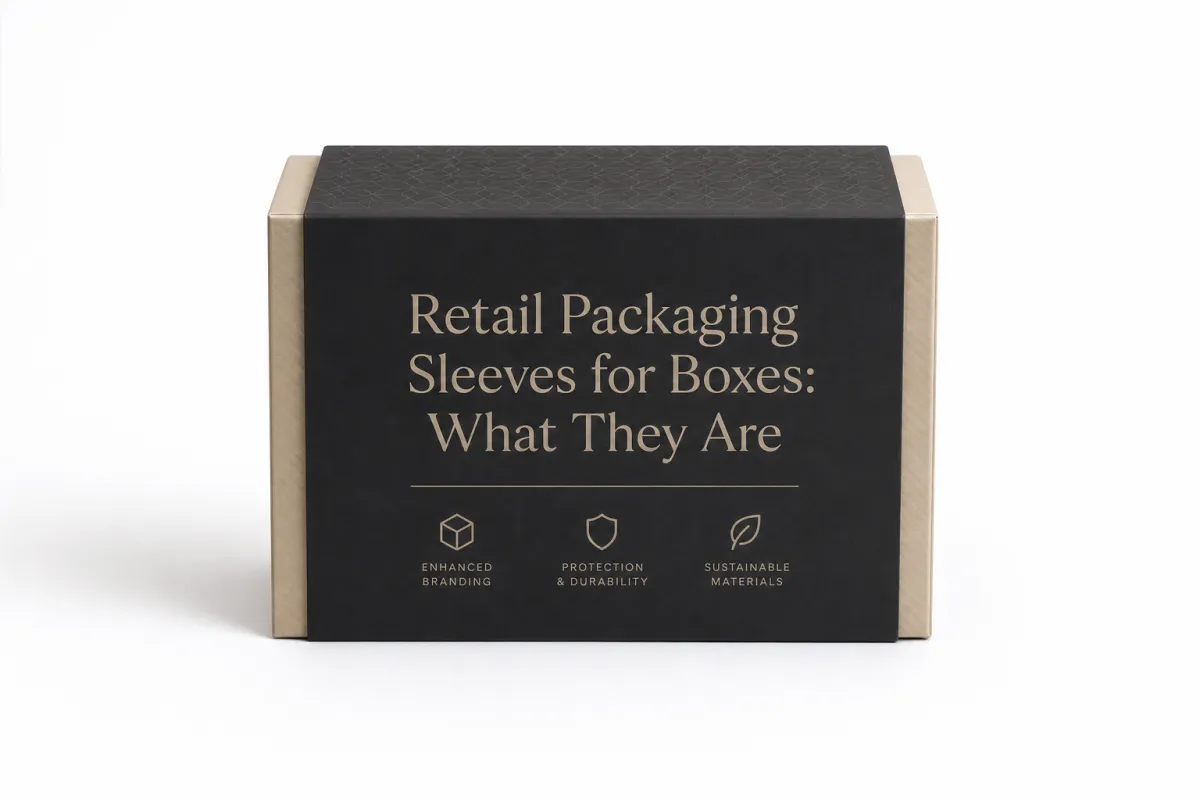
Retail packaging sleeves for boxes are printed wraps or bands that sit over a plain or lightly printed carton. They may cover one face, three faces, or the full visible perimeter depending on the structure. In plain terms, they add branding, messaging, barcode space, campaign copy, or seasonal artwork without forcing a new box every time the offer changes.
That is why retail packaging sleeves for boxes show up in packaging that changes often. Gift sets. Launch kits. Limited editions. Multipacks. Retail packaging with several variants built on the same base carton. The box stays put. The sleeve carries the message. Less waste, fewer artwork files, and fewer chances of discovering 8,000 useless cartons sitting in storage because a promo got moved up or killed.
Retail packaging sleeves for boxes also make inventory less chaotic. One carton can handle several campaigns if the sleeve shifts by color, copy, or panel layout. That helps with custom printed boxes programs where the structure stays the same but the retail story changes often. Smaller brands get another benefit too. They can test package branding without locking themselves into a massive full-box run.
There is a catch, though. A sleeve is only useful if the planning is solid. If the box size is off, if the paper is too thick for the fold, or if the print layout ignores the opening flap, the sleeve stops feeling premium and starts feeling like a workaround. Nobody buys a product because the wrap was annoying to apply. They just notice the annoyance.
A sleeve should make the product easier to understand, not make the packing line slower.
Retail packaging sleeves for boxes work best as part of the packaging system, not as decoration. That means the box size, how the sleeve sits on the carton, the way the retailer sees the front panel, and the way the customer opens the package after purchase all need attention. Good branded packaging handles those pieces together. Lazy packaging only fixes the mockup.
How Retail Packaging Sleeves for Boxes Work
Retail packaging sleeves for boxes usually wrap around the carton and stay in place through friction, tuck tabs, adhesive, or a locking point. Some sleeves cover the front and back panels only. Others extend across the sides. A few work like a band that slides on and stays put because the carton geometry supports it. The right choice depends on shelf display, shipping conditions, and how much labor your packing line can handle before it starts giving you side-eye.
On a shelf, retail packaging sleeves for boxes create a larger visual field. That lets the same base box support different campaigns without retooling the whole package. One run sells a holiday gift set. The next carries a value message or a new flavor callout. Same carton. Different story. That is a useful trade when your packaging design needs to stay flexible.
Several details have to line up for retail packaging sleeves for boxes to work well:
- Box dimensions: The sleeve should match the actual carton, not the spec in a spreadsheet that has not been touched since the last revision fight.
- Fold lines: Panel breaks need to land on the box faces so the graphics do not split across a corner like they were designed by someone racing a clock.
- Barcode placement: If the sleeve carries UPC or EAN information, the quiet zone needs space and the scanner path cannot be blocked by folds or gloss distortion.
- Openings and flaps: Tuck ends, lift tabs, and display windows need to keep working after the sleeve goes on.
- Assembly method: Glue, friction fit, or sealed wrap changes both appearance and packing speed.
That last point matters more than most teams expect. Retail packaging sleeves for boxes can look beautiful in a render and still be a pain on the line if they require careful manual alignment. A sleeve that slows packing by a few seconds per unit can wipe out the savings you thought you were getting by not printing a full custom box.
There is also a presentation tradeoff. A tight sleeve looks polished, but it leaves less room for variation in the carton. A looser sleeve is easier to apply, but it can shift in transit if the fit is sloppy. Good retail packaging sleeves for boxes land in the middle: snug enough to stay put, forgiving enough that operators are not wrestling every piece like it owes them money.
For brands with several SKUs, retail packaging sleeves for boxes can also simplify day-to-day retail packaging management. The base box stays constant while the sleeve changes by variant color, language, or promotion. That cuts down on separate print inventory and makes multi-SKU planning less chaotic. Not glamorous. Very useful.
Retail Packaging Sleeves for Boxes Cost and Pricing Factors
Retail packaging sleeves for boxes are often chosen because they can lower packaging spend compared with reprinting full cartons. That is usually true, though not always. Real pricing depends on quantity, paper stock, print coverage, finish, assembly complexity, and any special touches like foil, embossing, or spot UV. The sleeve itself may be cheaper than a new box, but the finished package is the point. Unit price in isolation tells only part of the story.
For a typical run, retail packaging sleeves for boxes might land around $0.10-$0.24 per unit for a simple printed sleeve at 5,000 pieces, depending on size and coverage. Heavier stocks, tighter tolerances, and premium finishes can push that closer to $0.28-$0.45 or more. Small runs are where the price climbs fast, because setup and press time get spread across fewer units. That is not a hidden scheme. That is print economics doing its thing.
Those numbers are ballpark, not a quote. And they move around. If your artwork uses heavy ink coverage, if the size is unusual, or if you need hand assembly, the budget can shift pretty fast.
Here is a useful comparison for retail packaging Sleeves for Boxes:
| Option | Typical Use | Indicative Price Range per 5,000 | Notes |
|---|---|---|---|
| Simple paper sleeve | Basic retail packaging, variant ID, temporary promo | $0.10-$0.18 | Best for clean layouts and standard finishes |
| Coated sleeve with matte or gloss finish | Most branded packaging programs | $0.16-$0.28 | Good balance of print quality and shelf presence |
| Premium stock with soft-touch or foil accents | Gift sets, premium product packaging, launch items | $0.28-$0.45+ | Stronger visual impact, higher setup cost |
| Short-run digital sleeve | Limited editions, test launches, fast-turn campaigns | $0.20-$0.40 | Useful when volume is low and timing is tight |
That table helps, but it does not cover everything. Retail packaging sleeves for boxes also come with hidden costs: proofing, freight, color correction, and packing labor. If the sleeve has to be hand-inserted or folded in a fussy way, labor can become the real expense. A two-cent sleeve that takes an extra minute to apply is not really a two-cent sleeve. It is a labor problem wearing a price tag.
Brands also overspend in predictable ways. They order a heavyweight stock when a lighter one would hold color just fine. They add foil because someone said "premium" in a meeting. They approve a finish before the dimensions are final. Then they act shocked when the quote climbs. Retail packaging sleeves for boxes work best when the goal is clear and the spec list is tight.
Compared with new custom printed boxes, retail packaging sleeves for boxes usually make more financial sense when the box structure stays the same across several product versions. If the base carton is already approved, sleeves let you refresh the message without paying for a complete packaging redesign. That is why sleeves often show up in seasonal campaigns, trial-size programs, and multi-SKU retail packaging lines.
Choosing the Right Materials and Print Specs
Material choice changes how retail packaging sleeves for boxes feel, print, and survive handling. Coated paper is common because it keeps color crisp and gives you a clean retail look. SBS board brings a smooth surface and strong print fidelity. Uncoated stock feels softer and more natural, but it can mute color a bit and absorb more ink. Heavier paperboard adds structure, though it is not always necessary if the sleeve is doing more branding than protecting.
For most retail packaging sleeves for boxes, a coated sheet in the 14pt to 18pt range or a comparable paper weight around 250gsm to 350gsm works well, depending on size and finish. That is a good starting point, not a law. If the sleeve needs to wrap a larger carton, hold a sharp edge, or resist scuffing during transport, a thicker stock may earn its keep. If the sleeve is short-lived and the carton is doing most of the work, lighter stock can save money and cut waste.
Finish choices are where packaging design gets emotional for no useful reason. Matte gives a restrained look. Gloss makes color punch harder. Soft-touch creates a smoother, more premium feel, though it can show wear depending on how the package is handled. Uncoated stock can support a more natural or artisanal look. For retail packaging sleeves for boxes, the finish should support the product story, not wrestle it.
These specs should never be guessed on the fly:
- Flat dimensions: Measure the actual carton, then add the correct wrap allowance for the chosen construction.
- Bleed: Give the design enough bleed so trimming does not expose white edges.
- Safe area: Keep text, logos, and key art away from fold lines and cut edges.
- Barcode quiet zone: Leave the required clear area so scanners can read the code without drama.
- Proof carton: Use the exact box sample, not a similar one that is "close enough" because someone is in a hurry.
Retail packaging sleeves for boxes also need to respect compliance requirements. If the sleeve carries ingredients, warnings, pricing, or retailer-specific labeling, those elements need to stay visible after the sleeve is applied. A pretty sleeve that hides a mandatory panel is not a design win. It is a reprint waiting to happen.
Standards matter here too. For transport testing, many teams look at ISTA methods or ASTM distribution testing such as ASTM D4169. For material sourcing, FSC certification can help when a brand wants paper from responsible forest management. Those links do not improve the sleeve by themselves, but they do help you ask better questions before production starts.
Strong retail packaging sleeves for boxes usually come from a boring habit: measuring twice, specifying clearly, and proofing on the actual carton. That is less exciting than saying "premium finish" in a meeting, but it saves more money. Kinda boring, yes. Also kinda the whole job.
Step-by-Step Guide to Ordering Retail Packaging Sleeves for Boxes
If you want retail packaging sleeves for boxes to go smoothly, start with the product and box, not the artwork. That sounds obvious until you see how often teams design the sleeve before the carton size is locked. Measure the real box, check how it opens, and note which faces the sleeve should cover. A sleeve that wraps the wrong surface is just an expensive apology.
Build the brief around one clear job. Retail packaging sleeves for boxes usually serve one of four goals: launch a new product, update a seasonal campaign, identify a variant, or create a more premium retail presence without changing the carton. Pick the job first. The design should follow that decision, not wander around trying to do everything at once.
A clean ordering process for retail packaging sleeves for boxes usually looks like this:
- Measure the carton: Record width, height, depth, flap style, and any windows or tuck points.
- Define the goal: Seasonal promo, everyday branding, short-run test, or multi-SKU line.
- Request a dieline: Use a structural template so artwork lands where it should.
- Place the design on the template: Do not eyeball it. Eyeballing is how teams end up paying for "slightly off" in 5,000 copies.
- Review a sample: Approve a printed proof on the actual box before the full run.
- Lock the spec: Confirm stock, finish, assembly method, and quantity before production starts.
That sequence keeps you away from the two biggest retail packaging sleeves for boxes mistakes: fit errors and last-minute artwork changes. It also keeps your packaging team aligned with the printer or supplier. If you are working with Custom Packaging Products, sending the real dimensions and a current box sample makes quotes more accurate. Guessing is a hobby. It is not a packaging strategy.
Approval timing matters as much as the design itself. Retail packaging sleeves for boxes often need a structural proof, then an inked proof, then a final sign-off. If one person says the color is too warm and another says the barcode is too close to the edge, you want that caught before the order is printed, packed, and sitting in a warehouse pretending nothing happened.
From a brand standpoint, the sleeve should also fit the larger package branding system. If your custom printed boxes already have a consistent logo panel, the sleeve should not fight it. If your retail packaging depends on a clean, minimal look, the sleeve should support that calm instead of piling on copy like it is trying to win a prize for volume.
Retail Packaging Sleeves for Boxes Process and Timeline
The usual timeline for retail packaging sleeves for boxes is simple right up until someone forgets a measurement or sends artwork that still needs three more rounds. In a normal run, the process includes briefing, dieline creation, artwork setup, proofing, revision, production, and shipment. Simple sleeves move faster. Heavy finishes, tight registration, and complex assembly add time. That is not a mystery. It is just how production works.
A practical schedule for retail packaging sleeves for boxes often looks like this:
- Brief and measurements: 1-3 business days if the carton is final and the information is complete.
- Dieline setup: 1-2 business days for a basic structure, longer if the sleeve is unusual.
- Artwork preparation and review: 2-5 business days depending on how many stakeholders want to "just take a quick look."
- Proofing and revisions: 2-7 business days, especially if color or fit needs correction.
- Production: Often 5-15 business days for standard retail packaging sleeves for boxes, longer with premium finishes.
- Shipping: Depends on location and freight method, plus how fast the receiving team wants to unload it.
Where do delays usually happen? Missing samples. Late approvals. Box dimensions that keep changing. Special finishes that need extra setup. Retail packaging sleeves for boxes are not especially complicated, but they do depend on clean input. If the carton is not final, the sleeve cannot be final either. Printing before dimensions are locked is the packaging version of cutting a suit before taking measurements. Bold move. Usually a bad one.
Good planning lowers risk. If the sleeve vendor sees the actual box early, fit problems can be caught before print. That matters even more for retail packaging sleeves for boxes that need to pass through ISTA-style transit expectations or basic internal distribution testing. A sleeve that survives the sample stage is far more likely to survive the real shipping lane.
Launch calendars make this even more critical. Retail packaging sleeves for boxes often tie into store resets, holiday programs, trade promos, or distribution windows that cannot slip. If the shelf date is fixed, count backward from that date and build in a buffer for proof revisions. Small projects need slack too. Small projects are where people get cocky and lose a week to a missing barcode or a forgotten copy change.
Common Mistakes with Retail Packaging Sleeves for Boxes
The biggest mistake with retail packaging sleeves for boxes is designing the sleeve before the box is final. One small carton change can ruin the fit. Then the sleeve slides, the fold lines miss the edges, and everyone acts shocked that a file-based decision does not behave like a physical object. Packaging has the annoying habit of being physical.
Another common problem is overdesign. Retail packaging sleeves for boxes do not need to say everything. Too much copy, too many icons, and too many claims turn the sleeve into clutter. Good retail packaging should help a shopper find the product fast. It should not read like a design committee trying to prove it was in the room.
Color mismatch is another classic. A sleeve that looked fine on screen can print warmer, duller, or darker than expected. That risk gets worse when the piece is not proofed under retail lighting. If the product is going to sit under bright store LEDs, proof it under conditions that resemble the shelf. Otherwise the packaging design review becomes a blame session.
Operational mistakes matter too. Retail packaging sleeves for boxes can snag, split, or rub if the stock and finish are not matched to handling conditions. A glossy finish may scuff less in some cases, but heavy coverage can still show abrasion. A tight sleeve may look neat but take too long to apply. A loose one may speed assembly but slide in transit. Every choice has a cost. The trick is picking the right one for the product and the line.
There is also a budget trap. Teams sometimes specify a premium finish for a product that competes mostly on price, not shelf drama. That money might be better spent on clearer branding, better structure, or a more readable retail package. Retail packaging sleeves for boxes should match the product's role. If the item is value-focused, the sleeve should look clean and credible. If it is a gift or seasonal item, the sleeve can carry more visual weight.
For brands building custom printed boxes programs, the mistake is often inconsistency. One sleeve has a different logo size. Another uses a different stock. A third changes the panel order. That is how package branding starts looking messy even when each piece seems fine on its own. Consistency is not flashy, but it keeps the system from drifting.
Expert Tips for Better Retail Packaging Sleeves for Boxes
The best retail packaging sleeves for boxes usually do one thing well instead of trying to do five things badly. Use the sleeve to create hierarchy: one strong message, one clear product cue, and one brand signal. Everything else is optional noise. If the product is seasonal, make the seasonal cue obvious. If it is a variant, make the variant easy to spot. If it is a premium item, let the materials and finish carry some of the load instead of stuffing the design with more copy.
If you have multiple SKUs, keep the base layout consistent and change only the color, offer, or variant panel. That is a cleaner system for retail packaging sleeves for boxes and a better one for production too. Reusing a consistent structure cuts errors, keeps assembly predictable, and reduces the chance that one SKU gets an accidental design deviation because someone thought "different" was automatically better. It is not.
Test a few paper and finish combinations before you lock the spec. With retail packaging sleeves for boxes, the cheapest material is not always the best value once you count print clarity, shelf impact, and handling. A slightly better stock may save you from color washout or corner fray. That can matter more than saving a few cents.
A useful move is to ask for a sample pack that includes the box, the sleeve, and any insert or label that shares the same panel space. That gives you a real-world view of how the parts interact. Retail packaging sleeves for boxes should not fight the label, block the opening, or create visual clutter where a shopper expects a clean read.
Build a repeatable spec sheet and keep it current. Include carton dimensions, sleeve size, material, finish, barcode placement, and any special handling notes. The next order will be faster, cleaner, and less dependent on tribal knowledge. That matters more than people admit. Good retail packaging sleeves for boxes are not just a one-off job; they are a repeatable system for branded packaging that can scale.
Here is the blunt version: if your sleeve program is working, it should make future orders easier, not harder. If every reorder starts from zero, the process is broken. A good sleeve process supports retail packaging, product packaging, and package branding without turning each launch into a mini disaster.
For teams that want to keep the structure and speed up future runs, consider aligning sleeve specs with your broader Custom Packaging Products workflow. That makes the sleeve part of a larger packaging system instead of an isolated file that nobody wants to touch later.
Retail packaging sleeves for boxes are not the flashiest packaging choice, but they are one of the smartest when you need flexibility, shelf presence, and controlled cost. Get the fit right, Choose the Right stock, proof on the actual carton, and the sleeve does its job without stealing the show. That is usually the sweet spot.
If you want the short version, here it is: lock the carton first, choose the sleeve structure second, and do not approve finish or artwork until the sample is on the real box. That order keeps the retail packaging sleeves for boxes program practical, which is the whole reason they exist.
How do retail packaging sleeves for boxes stay secure during shipping?
They stay secure when the flat size is correct and the wrap tension is tuned for the actual carton. Security usually comes from friction fit, a tuck design, adhesive, or a box shape that naturally supports the sleeve. Test retail packaging sleeves for boxes on the packed box, not just on a flat sample, because paper behaves differently once the carton is filled and taped.
Are retail packaging sleeves for boxes cheaper than full custom boxes?
Usually yes, especially when you keep the base carton and only change the outer wrap. Retail packaging sleeves for boxes are strongest on short runs, seasonal updates, and multi-SKU programs where the core box stays the same. Special finishes and very small quantities can narrow the gap fast, so compare sleeves and custom printed boxes line by line before you decide.
What materials work best for retail packaging sleeves for boxes?
Coated paper and SBS are common because they print sharply and give retail packaging a cleaner look. Uncoated stock works if you want a softer, more natural feel, though color may look less punchy. The best choice for retail packaging sleeves for boxes depends on shelf impact, handling, and whether the sleeve needs to resist scuffing in transit.
How long does it take to produce retail packaging sleeves for boxes?
The timeline depends on proofing, artwork readiness, quantity, and finishing. Simple retail packaging sleeves for boxes can move quickly, while revised dielines, sample approvals, and special coatings add time. The fastest way to lose days is sending artwork before the box dimensions are final, because then everybody gets to play the revision game.
What should I send when requesting a quote for retail packaging sleeves for boxes?
Send the box dimensions, quantity, material preference, finish preference, and whether you need assembly or just printed sleeves. Include artwork status, target launch date, and any retail requirements like barcodes or ingredient panels. A physical box sample makes retail packaging sleeves for boxes quotes more accurate and cuts down on guesswork, which is always a good thing.


