Buyer Fit Snapshot
| Best fit | Printed Return Labels With Logo projects where brand print, material claims, artwork control, MOQ, and repeat-order consistency need to be specified before quoting. |
|---|---|
| Quote inputs | Share finished size, material target, print colors, finish, packing count, annual reorder estimate, ship-to region, and any compliance wording. |
| Proofing check | Approve dieline scale, logo placement, barcode or warning zones, color tolerance, closure strength, and carton packing before bulk production. |
| Main risk | Vague material claims, crowded artwork, missing packing details, or unclear freight terms can make a low unit price expensive after revisions. |
Fast answer: Printed Return Labels With Logo: Benefits, Cost, Setup should be specified like a repeatable production item. The safest quote records material, print method, finish, artwork proof, packing count, and reorder notes in one written spec.
Production checks before approval
Compare the actual filled-product size with the drawing, then confirm tolerance on folds, seals, hang holes, label areas, and retail display edges. Reserve space for logos, QR codes, warning copy, and material claims before decorative graphics fill the panel.
Quote comparison points
Review material grade, print process, finish, sampling route, tooling charges, carton quantity, and freight assumptions side by side. A quote is only useful when the supplier can repeat the same color, closure quality, and packing count on the next order.
Printed Return Labels With Logo: Benefits, Cost, Setup
Printed return labels with logo are one of those packaging details that only really show their value after a customer has already had a reason to use them. The box is open, the purchase did not work out, and now the label sitting on the counter is doing a quiet but very real job: guiding the return, preserving the brand’s tone, and giving the customer one less thing to figure out. I have seen labels like this rescue a return experience that otherwise would have felt clunky, and I have also seen plain, confusing labels make a simple refund feel unnecessarily tedious.
For a brand, printed return labels with logo sit right between operations and perception. They help the return move faster, and they also keep the experience from feeling generic. If your packaging already uses branded inserts, coordinated mailers, or a consistent Custom Labels & Tags program, the return label belongs in that same visual system instead of feeling like a stray piece of paperwork from a different company.
Returns are not only a cost line. They are a pressure test. A clear, well-specified return label can reduce support friction, improve scan accuracy, and make the brand look organized even during a moment that usually feels inconvenient. Below, I break down how printed return labels with logo work, what drives cost, and how to set up a program that does not create new problems for the warehouse. If the label is built carelessly, the problems tend to show up later in the form of mis-scans, reprints, and a few annoyed emails that nobody wanted.
What Printed Return Labels With Logo Actually Are
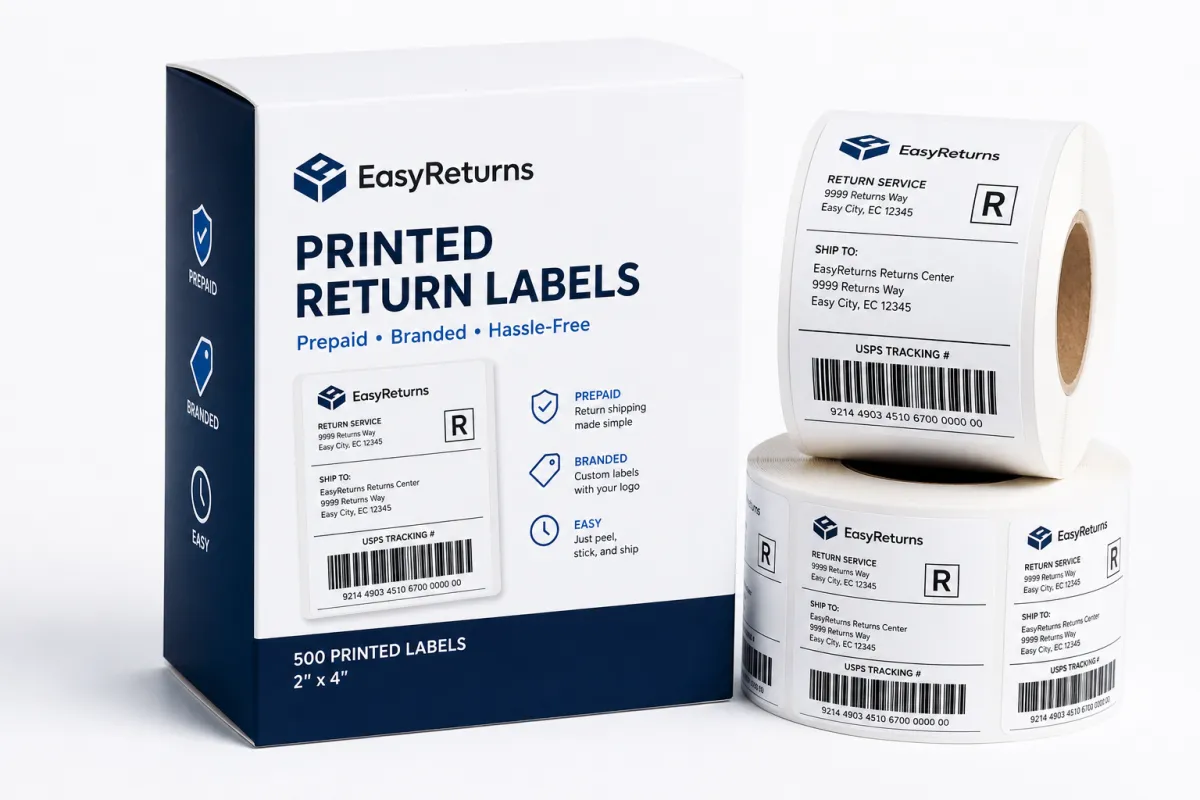
At the simplest level, printed return labels with logo are preprinted labels designed to send a parcel back to a brand, warehouse, or processing center while keeping the brand identity visible. A typical version includes the logo, return address, barcode or QR code, and any carrier-required routing details. In many programs, the label is tucked into the outbound box, attached to a packing slip, or included as part of a returns insert so the customer can use it if an exchange or refund is needed.
The logo is not just decoration. It reminds the customer that the return is still part of a real brand relationship, not a disposable transaction. That sounds minor until you see it in practice. A plain gray return strip with only routing data feels like logistics. Printed return labels with logo make the same step feel acknowledged, which matters when someone is already irritated about the purchase and just wants the process to be over with.
From a packaging buyer's point of view, these labels also solve a practical issue: they keep every return artifact consistent. The package, packing slip, and return label can share the same artwork, the same address logic, and the same tone. Customer service teams benefit from that consistency too, because a recognizable label usually leads to fewer questions about where the parcel is going and how it should be processed. That consistency sounds small, but it is the kind of small thing that saves time in a busy warehouse.
"A return label is not the flashy part of the package, but it is often the one piece the customer touches when emotions are lowest. If it looks organized, the brand feels organized."
Printed return labels with logo can live in several places in the post-purchase flow. Some brands include them inside the box as a ready-to-use insert. Others print them on a packing slip or as part of a multi-part return sheet. In more advanced setups, the label is tied to a preapproved RMA workflow and generated with customer-specific data only when needed. That is why this subject is not just a design choice. It affects warehouse speed, print accuracy, and compliance with carrier and retailer rules.
There is also a difference between a simple return label and a branded returns system. A generic label solves routing. Printed return labels with logo solve routing and presentation together. For high-volume sellers, that can mean fewer touchpoints later. For smaller brands, it can mean the difference between a return feeling like a dead end and a return feeling like part of a managed brand experience. That difference is not dramatic on paper, but in real operations it can be the thing that keeps a support queue from getting noisy.
How Printed Return Labels With Logo Work
The workflow usually starts before the label ever reaches a box. Artwork is approved, data fields are mapped, and the printer is told exactly what belongs on the label. Printed return labels with logo are often produced in rolls for thermal workflows or in sheets for short-run packing operations. If the program uses variable data, the label may include a specific order number, SKU, or return authorization code that is generated when an order ships or when a return request is submitted.
That variable-data step is where the label becomes more than branded stationery. Barcodes, tracking numbers, and QR codes connect the parcel to a specific record in the system. When the customer scans or the warehouse receives the parcel, the code can route the item to the right order, the right item, or the right disposition path. If the barcode is crisp and the quiet zone is respected, the return process is faster. If the code is crowded by graphics, the workflow slows down almost immediately. I have watched a team lose a half day because a logo sat too close to the code and the scanner kept refusing to read it. Nobody wants that kind of surprise on a Monday.
There are two basic print models. A static branded label is fixed artwork with a logo, address, and a consistent barcode structure. A variable-data label pulls in changing fields at print time. Printed return labels with logo can use either method, but the choice depends on how much flexibility the operation needs. Static labels are simpler and often cheaper. Variable-data labels fit better when the brand has multiple warehouses, changing return locations, or distinct return rules by SKU or region.
In the warehouse, the label usually moves in one of three ways. It can be picked with the order and inserted in the box, attached to an outbound pack slip, or kept as a customer-service backup that is emailed or printed on demand. None of those paths is automatically better. The right answer depends on how often items are returned, how many SKUs are in play, and how much control the brand wants over the customer journey after the sale.
Think of printed return labels with logo as the hinge between front-end branding and back-end processing. A plain label tells the carrier where the parcel goes. A branded label tells the carrier that the parcel belongs to a managed system. That distinction may look small on paper, yet small distinctions are where operations either stay tidy or start to sprawl. The label is part of the workflow, not just a finishing touch.
A useful comparison is simple: a generic label handles logistics, while printed return labels with logo handle logistics and brand continuity at the same time. The logo does not make the barcode scan better by itself, but it does create a cleaner customer-facing handoff. For many teams, that is enough to justify the extra setup work. For others, especially when returns are infrequent, the functional version may still be the right fit.
Key Factors That Affect Quality, Compliance, and Cost
Three things drive most of the performance difference in printed return Labels with Logo: substrate, durability, and layout. Substrate is the base material, and the usual choices are direct thermal, thermal transfer, or pressure-sensitive stock. Direct thermal is common for simple applications and shorter-life labels. Thermal transfer is better when the label needs more durability, because it resists smudging and tends to hold up better in handling. Pressure-sensitive stock is the broader category that covers most adhesive-backed label constructions, though the face stock and adhesive can vary widely.
Durability is where many brands underestimate the real environment. A return label may be handled in a warm room, sit on a damp porch pickup, ride in a truck, and then arrive in a sorting center that is not especially gentle. Adhesive strength, moisture resistance, and smudge resistance all matter. If the label peels early, curls at the edges, or blurs under friction, the brand pays twice: once in reprint cost and again in slower processing. That is the unglamorous part of packaging work, but it is usually the part that decides whether the program behaves itself.
Branding choices also shape quality. Logo size, color matching, and white space all affect readability. Printed return labels with logo need enough visual identity to feel branded, but not so much decoration that the barcode loses breathing room. A good rule is to protect the carrier information first, then build the branding around it. That sounds obvious, yet teams still get it wrong when the creative review happens before the operations review. If the design looks beautiful but fails at the scanner, it is not a good label.
Compliance deserves more respect than it usually gets. Carrier standards, retailer return authorization rules, and cross-border instructions can all shape the final layout. If a return label crosses borders, customs notes may matter. If a retailer requires a certain RMA code format, that needs to be built into the artwork or variable fields. For broader packaging guidance, the Institute of Packaging Professionals is a good resource for terminology and material basics, and ISTA publishes useful information around transport testing and package performance.
There is also an environmental layer. Brands that care about material sourcing can ask for FSC-certified paper stock, lower-waste liner options, or label formats that reduce overprinting. Not every return label program needs a sustainability statement, but if the brand already claims it on the pack, the returns piece should not quietly contradict it. That mismatch tends to stand out more than teams expect.
Cost is not only about ink and paper. Complex artwork, custom dies, tighter tolerances, and variable-data setup all add labor. Printed return labels with logo can be cost-efficient, but only if the brand understands how much design complexity it is adding. A cleaner layout often costs less to print and less to manage later. Fancy is not the same thing as effective, and in label production the difference can show up in the first proof.
Cost and Pricing for Printed Return Labels With Logo
Pricing usually breaks into a few separate buckets: artwork setup, prepress, material choice, print method, finishing, and fulfillment. With printed return labels with logo, the unit price tells only part of the story. A label that costs less on paper can still be more expensive overall if the minimum order quantity is high or if the brand has to reproof the design several times.
For small runs, buyers often see higher per-unit pricing because the press setup is spread across fewer labels. For larger runs, the economics improve quickly, especially for a simple static design. As a rough working range, a straightforward branded return label may land around $0.08-$0.20 per unit at modest quantities, while higher volumes can bring that lower if the artwork is simple and the substrate is standard. Once variable data, premium stock, or specialty finishing enters the picture, the number rises. That is normal, not a sign that the supplier is overcharging. It is just the math of setup and material.
Printed return labels with logo often make more sense when the cost is evaluated against the full return path. If a branded label reduces customer service tickets, lowers manual keying, or speeds warehouse intake by even a few seconds per parcel, the spend becomes easier to justify. In a return-heavy category, those seconds become labor hours. That is the comparison worth making. The label line item can look tiny while the operational effect is pretty large.
| Label Option | Best Fit | Typical Setup | Indicative Unit Cost | Notes |
|---|---|---|---|---|
| Static branded label | Single return address, stable process | Logo, address, barcode, standard artwork | $0.05-$0.15 | Lower setup complexity, good for repeat orders |
| Variable-data branded label | Multiple warehouses or order-specific returns | Dynamic fields, barcode logic, branded layout | $0.10-$0.30 | More setup work, but better for complex routing |
| Seasonal or multi-version label | Campaigns, regional programs, frequent updates | Several artwork versions, version control, proofing | $0.12-$0.35 | Useful when instructions change often |
The table above is not a quote sheet. It is a practical frame for comparison. Printed return labels with logo can vary a lot depending on size, adhesive, core size, print coverage, and whether you need rolls or sheets. A 4 x 6 label on standard direct thermal stock is a very different project from a custom-sized, laminated, multi-version label with a colored background. If a supplier cannot explain those differences clearly, that is a warning sign. If they can explain them clearly, you will usually get a better estimate and a better final result.
There are hidden costs too. Reproofing after a typo, rush production when a campaign slips, shipping labels to several fulfillment centers, and scrapping obsolete inventory all eat into budget. A buyer who asks for price by quantity tier, setup cost, and reorder cost will usually get a much clearer picture than one who only asks for the cheapest option. That is especially true when printed return labels with logo are part of a broader Custom Labels & Tags strategy and need to match other packaging pieces.
A useful pricing habit is to separate one-time setup from recurring print cost. If the art build takes two rounds of changes, that setup belongs in the true project cost. If the brand will reorder every month, the recurring price matters more than the first invoice. Printed return labels with logo should be judged on both numbers together. A low first quote can look attractive and still be the expensive option if reorders are awkward or the file needs constant babysitting.
Process and Timeline: From Proof to Warehouse Use
A clean launch usually follows a simple sequence. First comes discovery, where the supplier learns the label size, return logic, and carrier requirements. Then artwork is submitted, including the logo file, address, barcode content, and any mandatory wording. After that comes proofing, then revisions, then production, then quality check, then packing and delivery to the fulfillment site. Printed return labels with logo are easier to launch when the team treats each step as a gate instead of a suggestion.
The biggest delays are rarely technical. They are usually administrative. Missing vector logo files, a barcode spec that no one validated, a brand approval queue that sits for three days, or a last-minute address change can all push the timeline. If the program is simple and the artwork is ready, some suppliers can move quickly. If the program includes variable fields or multiple SKUs, testing becomes more important than speed. A fast launch is nice, but a clean launch is better.
To keep the project moving, send vector artwork if possible, define data fields early, and confirm the final label size before the proof round starts. If the label will be scanned by a warehouse team, test the barcode at final size, on the final stock, with the final printer settings. Proofs that look good on screen can still fail on press if the contrast is too low or the logo has been compressed into a noisy area. That is one of those things that feels small right up until it becomes a production headache.
Printed return labels with logo should also be planned around business timing. Do not wait until a promotion spike, seasonal rush, or warehouse migration to finish the label spec. That is how returns become a bottleneck instead of a support function. If the brand expects a surge in post-holiday returns, the labels should be in house before the spike starts. Otherwise the team ends up solving label problems while also trying to handle the return volume itself, which is a rough combination.
Typical timelines vary. A straightforward static program may take only a handful of business days from proof approval to delivery. A variable-data setup or multi-version project often needs extra testing and can take longer, especially if the brand insists on multiple sign-offs. That is not a setback. It is a sign that the project has enough moving parts to deserve more care. I would rather see one extra proof round than a pallet of labels that cannot be used.
- Discovery: confirm label size, adhesive, quantity, and return workflow.
- Proofing: verify logo, address, barcode, and quiet zones.
- Testing: scan the final artwork on the final material.
- Production: print, inspect, pack, and ship.
One more practical point: if the return label needs to sit in a box for months before use, storage conditions matter. Humidity, heat, and dust can affect adhesive performance. Printed return labels with logo are not fragile, but they are still a printed product. Store them like one. If the warehouse gets kind of warm in summer or the cartons are stacked near a dock door, that deserves to be part of the storage plan.
Common Mistakes That Turn Returns Into Friction
The most common mistake is crowding too much onto the label. A return label is not a billboard. If the logo competes with the barcode, the return address, or the carrier instructions, the customer may have trouble applying it and the warehouse may have trouble scanning it. Printed return labels with logo work best when the branding supports the label hierarchy instead of fighting it.
Poor file prep is another recurring problem. A logo pulled from a low-resolution web image may look acceptable on a laptop, then break apart on press. Wrong color profiles can shift the brand color enough that the label looks off-brand next to the rest of the packaging. These problems are preventable, and they are much cheaper to fix before production than after 10,000 labels are already printed. Once the press run is done, the fix gets expensive in a hurry.
Operational mistakes are even more expensive. An outdated return address, an old RMA instruction, or a carrier format that no longer matches the current workflow can create avoidable reprints. Printed return labels with logo should be treated like live operations documents. If the warehouse moves, the address changes. If the returns portal changes, the instructions change. If the carrier updates its spec, the label needs a review. That is not glamorous work, but it is the kind that keeps the whole system steady.
Customer experience failures are the ones that quietly hurt the most. If the label is hard to find in the box, if the adhesive fails when the customer tries to use it, or if the return steps force a support call, the brand has turned a simple return into friction. That is not just inconvenient. It can lower trust on the next purchase. In practice, the difference between a smooth return and a frustrating one is often a few millimeters of layout or a single instruction that was not clear enough.
And then there is rework. Every bad label can trigger reprints, slower intake, support tickets, and manual intervention at the warehouse. Printed return labels with logo should reduce labor, not create it. If they are causing more exceptions than the generic version, the setup needs to be revisited. That kind of review is not a failure; it is just good operations.
Here is the part many teams miss: returns are a brand touchpoint whether the company wants them to be or not. A label that looks careless can make the whole operation feel careless. A label that is clear, durable, and visibly branded can do the opposite. Customers notice that stuff, even if they never talk about it out loud.
Expert Tips and Actionable Next Steps
If the goal is to get printed return labels with logo right the first time, start with a pilot. Test one label size, one adhesive type, and one return workflow before rolling the program across every SKU. That sounds slower than a full rollout, but it usually saves time because the team learns where the real failure points are before volume increases.
Bring the right people into the proof review. Packaging, operations, customer service, and brand teams should all be looking at the same layout. Packaging cares about fit and material. Operations cares about scanability and throughput. Customer service cares about clarity. Brand cares about consistency. Printed return labels with logo sit in the overlap between all four, so a single-owner review is usually too narrow. I have been on reviews where everyone assumed someone else had checked the barcode, and that is exactly how avoidable mistakes sneak through.
Create a one-page spec sheet and treat it as the source of truth. Include dimensions, stock, finish, barcode placement, logo rules, carrier notes, storage requirements, and reorder thresholds. If your returns volume changes by season, add that detail too. The more the supplier knows up front, the fewer surprises you will have later. That is especially true if the label family sits alongside other Custom Labels & Tags for shipping, inserts, or product packaging.
A simple decision rule helps too. If returns are rare and the package is mostly functional, a basic return label may be enough. If returns are frequent, if customer perception matters, or if the brand wants a more polished post-purchase experience, printed return labels with logo are usually the better bet. They are a small asset, but they work in a high-stakes moment.
Honestly, the strongest return-label programs are the ones that respect both the customer and the warehouse. They do not overdesign the label, and they do not treat it like an afterthought either. They use a clear structure, durable materials, and a print method that fits the actual workflow. That is the sweet spot.
So the next step is straightforward: audit the current return materials, compare them to a branded version, and decide whether printed return labels with logo can reduce friction while improving the post-purchase experience. For many brands, the answer is yes. For others, the right answer is a phased rollout. Either way, base the decision on process, scan performance, and reorder cost rather than guesswork. If the label can keep a return moving without making the customer pause, you have the right design.
Are printed return labels with logo worth the extra cost for small brands?
Yes, if the logo helps reinforce trust, reduces support questions, or makes the return experience feel more polished. For very small volumes, a simple branded static label is often the smartest first step because it keeps setup manageable while still improving presentation. Judge the value by the total return experience, not only by the label line item.
How do printed return labels with logo differ from standard return labels?
Standard labels focus on routing and address data only. Printed return labels with logo add brand identity, which can include logo placement, brand color, and a cleaner hierarchy without sacrificing scan requirements. The operational function is similar, but the customer experience is not the same.
What file format is best for a logo on return labels?
Vector files such as AI, EPS, or PDF are usually best because they stay sharp at label size. If only raster files are available, use the highest-resolution version possible and avoid stretching or compressing the artwork. Always review the logo next to the barcode and small text before production starts.
Can printed return labels with logo include QR codes or barcodes?
Yes, and they often should if you want faster sorting, better tracking, or easier RMA handling. Keep the code in a quiet zone with enough blank space so scanners can read it reliably. Test readability on the final material, not just in a design proof.
What should I ask a supplier before ordering printed return labels with logo?
Ask about material options, minimum order quantities, proofing steps, turnaround time, and whether variable data is supported. Confirm how they handle carrier requirements, artwork changes, and reorders for multiple warehouses. Request a sample or proof so you can check scanability, adhesion, and logo quality before you commit.


