Buyer Fit Snapshot
| Best fit | Printed Shipping Bags Low MOQ for Custom Packaging projects where brand print, material claims, artwork control, MOQ, and repeat-order consistency need to be specified before quoting. |
|---|---|
| Quote inputs | Share finished size, material target, print colors, finish, packing count, annual reorder estimate, ship-to region, and any compliance wording. |
| Proofing check | Approve dieline scale, logo placement, barcode or warning zones, color tolerance, closure strength, and carton packing before bulk production. |
| Main risk | Vague material claims, crowded artwork, missing packing details, or unclear freight terms can make a low unit price expensive after revisions. |
Fast answer: Printed Shipping Bags Low MOQ for Custom Packaging should be specified like a repeatable production item. The safest quote records material, print method, finish, artwork proof, packing count, and reorder notes in one written spec.
Production checks before approval
Compare the actual filled-product size with the drawing, then confirm tolerance on folds, seals, hang holes, label areas, and retail display edges. Reserve space for logos, QR codes, warning copy, and material claims before decorative graphics fill the panel.
Quote comparison points
Review material grade, print process, finish, sampling route, tooling charges, carton quantity, and freight assumptions side by side. A quote is only useful when the supplier can repeat the same color, closure quality, and packing count on the next order.
For a growing brand, Printed Shipping Bags low moq are one of the few packaging choices that actually make sense early on. You get branded transit packaging without locking cash into a giant run that may be wrong by next season. That matters more than the packaging aisle wants to admit. It means you can test the format, keep unit cost in check, and still change sizing, print coverage, or material after the first order if the real world says the first idea was a little off.
Small batches teach fast. A mockup can look perfect on a screen, then the first shipment comes back with a bag that is a hair too large, a seal that feels weak, or a print panel that scuffs because the bags spent three days getting bounced around a distribution center. Printed shipping bags low moq are not just about order size. They buy a learning cycle that costs far less than a warehouse full of the wrong shipping materials. And yes, warehouses are expensive enough already.
Brands that need protection and presentation at the same time usually discover that a lower minimum order is the difference between waiting and shipping. Printed shipping bags low moq let you validate the structure, confirm the artwork, and build a consistent customer experience before the forecast gets big enough to make everyone nervous.
Printed Shipping Bags Low MOQ for Growing Brands
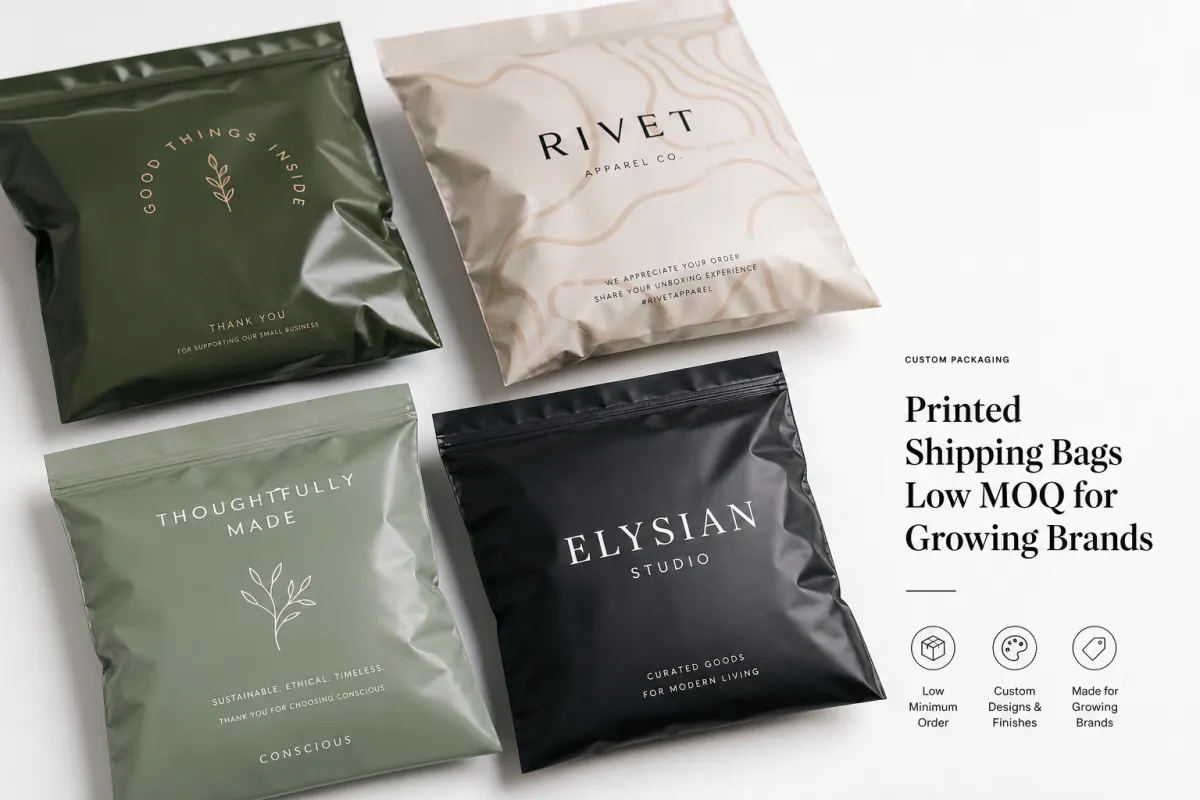
Many buyers reach for printed shipping bags low moq before they are ready for large-volume pricing, and that is usually the right move. Launch calendars shift. Size runs change. Color stories get trimmed. A new sales channel may need different transit packaging than the one used for direct-to-consumer orders. In that kind of churn, printed shipping bags low moq give you control without forcing you to overbuy inventory.
From a packaging buyer's point of view, the goal is not just a logo on a mailer. The goal is product protection, clean brand presentation, and a unit cost that stays inside margin. Printed shipping bags low moq work well because they let you test how appearance and performance hold up together. A polished bag that tears at the seam still fails. A strong film that is too large can increase dimensional weight and quietly mess with fulfillment economics. Not glamorous, but there it is.
Printed shipping bags low moq have become a sane choice for brands still shaping their packaging system. You can order a smaller quantity, compare the printed result to the proof, and make a better decision before you scale. That is usually cheaper than chasing the lowest quote on paper and discovering the spec was wrong after the bags are already in use.
Strong brands treat printed shipping bags low moq as a controlled test, not a compromise. The first batch should answer a few basic questions:
- Does the bag fit the product with enough room for a clean seal?
- Does the logo stay crisp after handling and transit?
- Does the material support package protection without unnecessary thickness?
- Does the finished format help or hurt order fulfillment speed?
Those answers matter because small mistakes in shipping materials can create bigger costs later. A mailer that is too thin may split in transit. A mailer that is too oversized may waste space, raise dimensional weight, and make the order feel less considered. Printed shipping bags low moq help surface those issues early, while the fix is still manageable.
The branding side is easy to miss. Customers often judge the professionalism of a shipment before they even open it. Printed shipping bags low moq let a business look organized and ready, even while the product assortment is still changing. That kind of confidence matters, especially for newer brands that need every touchpoint to feel deliberate.
Practical packaging rule: if the first run teaches you something useful about fit, seal quality, and presentation, printed shipping bags low moq are doing real work for the business, not just decorating the shipment.
For buyers comparing formats, printed shipping bags low moq often sit between plain stock mailers and a fully committed custom program. They leave enough flexibility to adjust and enough branding to keep the customer experience consistent. It is a pretty good middle lane, which is rare in packaging and even rarer in ecommerce.
Printed Shipping Bags Low MOQ Materials and Styles
Material choice matters as much as artwork. Printed shipping bags low moq can be made from standard polyethylene film, co-extruded film, or recycled-content film, and each option brings a different balance of cost, strength, and print appearance. The right answer depends on product weight, shipping route, and how much package protection the order needs in transit.
Standard polyethylene is still common because it is flexible, cost-effective, and familiar to order fulfillment teams. Co-extruded film gives more control over puncture resistance and seal performance, which helps when you are shipping items with corners, hardware, or heavier folded goods. Recycled-content options can fit brands with sustainability goals, but they still need to prove themselves in real shipping, not just in a spec sheet. If the bag fails in transit, the environmental story gets thin fast.
Printed shipping bags low moq also come in several styles that change both presentation and function. Plain mailers keep the look simple. Self-seal envelopes speed up packing. Tear-strip formats improve opening. Opaque bags hide the product and create a cleaner brand presentation, while translucent films can help with internal handling or product identification. Each choice changes how the printed logo reads, how the bag feels in the hand, and how well the shipping materials hold up while moving.
Finish matters too. A matte film gives a softer, more premium look. Gloss pushes color and contrast harder. Gloss can also show scuffs more easily, especially on bags handled a lot before delivery. Printed shipping bags low moq should be tested in the finish you plan to use, because a printed result on flexible film is not the same as a flat proof on paper. Too many teams learn that one the hard way, which is a pretty annoying way to spend money.
Higher-cost materials do not automatically mean better packaging. They only make sense if the product needs them. Lightweight apparel may ship fine in a simpler printed mailer. Denser goods or sharp-edged items may need stronger film, a tougher seal, or a different closure design. The best printed shipping bags low moq setup matches the product. No drama. No guesswork.
For buyers comparing options, it helps to think in use cases instead of style labels:
- Apparel and soft goods: lighter film, clean print, and a self-seal closure.
- Accessories and boxed items: stronger film, better seam strength, and more puncture resistance.
- Brand-forward shipments: opaque film, sharper print contrast, and controlled coverage.
- Budget-conscious programs: simpler structure with enough performance to protect the order.
Custom packaging buyers often compare printed shipping bags low moq with cartons and rigid mailers. If you are weighing those formats, the broader selection of Custom Packaging Products can help you sort out what belongs in the line and what should stay as a backup. Some products want a mailer. Others want a box. The packaging should follow the item, not the other way around.
For brands that want a straightforward starting point, Custom Poly Mailers are often the most efficient place to begin, especially when the product is soft, lightweight, and easy to fold. Printed shipping bags low moq work especially well there because the structure is simple, the print area is usable, and the economics usually stay attractive at moderate quantities.
Specifications That Matter for Printed Shipping Bags
The fastest way to avoid trouble is to define the bag correctly before artwork moves into production. Printed shipping bags low moq should be sized around the product, the fold, any insert card, and the final seal area. If a garment is folded tightly or a box is already inside the bag, the dimensions need to account for that real shape, not the flat product alone. Too much empty space makes the package bulky. Too little can stress the seam and hurt package protection.
Film thickness is one of the first specs to review. Buyers often hear thickness in microns or mils, and the right number depends on the shipment. Lighter apparel may work in thinner film. Heavier goods, sharp-edged products, or stacked items usually need more material. Printed shipping bags low moq do not need the thickest film on the market, but they do need enough strength to survive compression, stacking, and handling during transit packaging.
Seam strength and adhesive performance deserve equal attention. A strong printed panel does nothing if the closure fails. Self-seal adhesive should hold without reopening, yet still let the packer close the bag quickly on the line. Some buyers also ask for tear-strip functionality so the customer can open the bag cleanly without fighting the material. That small detail matters in ecommerce shipping, especially if the brand wants the unboxing to feel neat instead of rushed.
Print-related specifications matter just as much. Ask how many colors are being used, how much of the panel is covered, where the safe margins sit, and whether the logo is meant to be centered, repeated, or extended across the face of the bag. Flexible film can move during printing, which means artwork that looks fine on a computer screen may shift if the file ignores the actual print zone. Printed shipping bags low moq are easiest to approve when the artwork is built for the bag shape from the start.
Good buyers also think about stress. If the bag is stacked on a pallet, loaded into cartons, or compressed in transit, how will it react? A package that survives one shipment but wrinkles badly under distribution pressure can still make a poor impression. Many packaging teams pair practical bag checks with basic film testing that reflects ASTM-style thinking around tension, puncture, and durability. For transit packaging methods and handling principles, the ISTA site is a useful reference point.
It helps to compare the specs in order before approving production:
- Confirm product dimensions after folding or boxing.
- Set the bag size with enough room for a clean closure.
- Choose film thickness based on weight and edge risk.
- Review print area, color count, and safe margins.
- Approve a proof only after the logo placement is checked at full size.
Printed shipping bags low moq are most reliable when these details are settled before the run begins. A small setup error can wipe out the benefit of the lower minimum order, so this is the place to be exact. The bag does not care that you were in a hurry.
Printed Shipping Bags Low MOQ Pricing, MOQ, and Cost Drivers
Pricing for printed shipping bags low moq usually follows the same logic as other custom packaging: the MOQ changes with size, material, print complexity, and production method. A simple one-color mailer may be available in a smaller run, while a larger fully covered design with a specialty finish may need a higher commitment. That is not a trick. It reflects setup, material waste, and production time tied to the job.
The main cost drivers are easy to spot once you know what to ask. Thicker film costs more. More print colors cost more. Larger print coverage costs more. Custom sizing adds tooling or setup complexity. Special finishes, tear strips, opaque layers, and recycled-content structures can also raise unit cost. Freight packaging and delivery method matter too, because a low unit price can get eaten by expensive shipping if the cartons are bulky or the order is rushed.
Here is a practical way to think about printed shipping bags low moq pricing at a moderate order size such as 5,000 pieces. These are typical ranges, not promises, and they move with size and specification:
| Bag Type | Typical MOQ | Approx. Unit Cost at 5,000 Pieces | Best For | Notes |
|---|---|---|---|---|
| Standard PE printed mailer | 1,000-3,000 | $0.10-$0.18 | Light apparel, simple branding | Good starting point for lower-risk launches |
| Co-extruded film mailer | 2,000-5,000 | $0.13-$0.24 | Stronger package protection | Better puncture resistance and handling |
| Recycled-content printed mailer | 2,000-5,000 | $0.14-$0.28 | Sustainability-focused programs | Check strength and print clarity carefully |
| Heavy-duty tear-strip mailer | 2,500-5,000 | $0.16-$0.30 | Retail-ready ecommerce shipping | Often better for thicker or boxed items |
| High-coverage custom printed bag | 5,000-10,000 | $0.18-$0.38 | Premium branding | More print coverage usually raises the unit cost |
That table helps, but the real comparison comes down to total landed cost. Printed shipping bags low moq can look a little higher on unit price than stock mailers, yet they may reduce waste, improve presentation, and support a better brand impression. If the branded bag lowers complaint risk or speeds packing on the fulfillment line, the actual cost picture changes.
Plenty of buyers make the same mistake. They compare one quote number and stop there. A smarter review checks setup fees, proof time, lead time, shipping method, and whether the order will need a rework later. Printed shipping bags low moq are often the cheaper long-term choice because they let you correct the spec before volume grows.
The other cost factor that gets ignored too often is dimensional weight. If the bag is too large for the product, the shipment can cost more even though the packaging itself is cheap. That is a freight issue, not just a packaging issue. A tighter, better-sized mailer can reduce wasted air and improve the economics of ecommerce shipping. Printed shipping bags low moq are not only about brand image. They are part of the shipping calculation.
How the Printed Shipping Bags Low MOQ Process Works
The production flow is straightforward when the buyer is prepared. Printed shipping bags low moq usually move from quote request to artwork review, then proof approval, then production scheduling, and finally shipment. Better input at the start means fewer surprises later. A clear spec sheet saves more time than a long email thread full of guesses.
The fastest quote requests include bag dimensions, target quantity, product weight, print colors, artwork files, and the delivery deadline. If the package is part of a larger launch, it also helps to mention how the bag will be used in order fulfillment. A bag for folded apparel is not the same as a bag for a rigid accessory, and the production team needs that context before recommending a structure.
Proofing is the moment that protects the order. Printed shipping bags low moq should never go into production without checking logo placement, bleed, line weight, and contrast against the film color. Flexible film behaves differently from paper or board, so a design that reads clearly on a screen may need adjustment once it is mapped to the actual panel. If the mark sits too close to the seal, is too small for the viewing distance, or is too light against a tinted film, the finished bag may disappoint.
Timing should be split into three parts: artwork approval, production time, and transit time. That matters because many buyers treat the process as one lead time when it is really three. A small proof revision may add a day or two. Production may take another stretch depending on complexity. Shipping transit time still needs to be added on top of that. Printed shipping bags low moq can still be efficient, but only if the launch calendar is built around reality instead of wishful thinking.
Ask how the job will be packed for shipping. If the outer cartons are too small or too heavy, freight efficiency suffers. If the inner counts per carton are inconsistent, receiving and storage become harder. Printed shipping bags low moq work best when the packaging plan is clear from the start, including carton counts, palletization if needed, and the reorder schedule.
For buyers comparing the process with other custom packaging formats, the guidance in FAQ can be helpful, especially if you are still deciding between a mailer, a bag, or a box. If the product needs more structure, a category like Custom Shipping Boxes may be the better fit. The point is not to force every order into the same format. The point is to match the packaging to the item and the shipment path.
Printed shipping bags low moq also help reduce risk on repeat orders. Once the first run proves the dimensions, finish, and print placement, the reorder becomes much more predictable. That is a serious advantage for seasonal brands or businesses with changing product lines.
Why Choose Custom Logo Things for Printed Shipping Bags
Custom Logo Things is positioned around practical packaging support, and that matters more than flashy promises. Printed shipping bags low moq are a good example of where experience helps, because the buyer is not only choosing a logo placement. They are choosing a structure that has to protect the product, present the brand, and fit the shipping environment Without Wasting Money.
A good packaging partner should help you think through the bag shape, the material, the closure, and the print area in one conversation. That matters even more when a low minimum order is being used to test a new launch or a changing assortment. Printed shipping bags low moq are easier to manage when the supplier can explain how the choices affect unit cost, production time, and the finished look on the shelf or in the delivery stream.
Artwork support matters more than buyers expect. A flexible film surface is less forgiving than a board carton, so the artwork has to be placed with care. The logo may need to shift slightly to stay away from the seal line, or the contrast may need to be adjusted to keep it readable on the chosen film color. Printed shipping bags low moq are more successful when the proof is treated as a working document, not a checkbox.
There is another advantage to working with a supplier that understands reorder planning. A first run can tell you whether the size is right, whether the customer response is positive, and whether the packaging should be tightened or expanded next time. That kind of feedback loop keeps unit cost under control and makes order fulfillment easier over time. Printed shipping bags low moq should be the start of a better packaging program, not just a one-time purchase.
For brands comparing product categories, the broader set of Custom Packaging Products can help frame the decision more clearly. Sometimes the answer is a poly mailer, sometimes a box, and sometimes a mixed approach that keeps shipping materials aligned with product type. The right format depends on protection, weight, and the customer experience you want to deliver.
Professional buyers also tend to care about sustainability claims and sourcing standards. If recycled content or certified fiber is part of the packaging strategy, third-party references help build trust. For paper-based components, the FSC site is a reliable place to understand forest certification and chain-of-custody basics. That context helps even when the main package is a plastic mailer, because many brands mix materials across the shipping program.
Printed shipping bags low moq are not about chasing the lowest minimum at all costs. They are about buying enough packaging to learn, present well, and ship cleanly, without overcommitting inventory before the market has told you what works.
Next Steps for Printed Shipping Bags Low MOQ Orders
The cleanest way to start is to gather the basics before asking for a quote. Printed shipping bags low moq go much faster when the buyer already knows the product dimensions, approximate weight, preferred material, target quantity, artwork files, and delivery date. If those details are ready, the quote conversation becomes practical instead of speculative.
It also helps to narrow the decision to one or two bag styles before requesting pricing. A focused request produces a cleaner comparison and reduces back-and-forth. If you are still deciding between finishes or structures, ask for the recommendation that best fits the product rather than asking for every possible variation. Printed shipping bags low moq are meant to simplify the first run, not turn it into a design maze.
For launches, the smarter question is not just "What is the price?" It is "What happens after approval?" Ask for a proof, a production timeline, and a shipping estimate together so you can plan the handoff into order fulfillment. If the first batch performs well, confirm whether the same format can be repeated with a larger quantity later. That makes reorder planning much easier and helps stabilize unit cost over time.
There is also value in setting a reorder threshold before inventory gets tight. If the first batch works, do not wait until the last carton is nearly empty to begin the next round. Printed shipping bags low moq are useful because they give you room to react, but only if the replenishment plan is set while the packaging is still in stock.
A simple launch checklist keeps the process grounded:
- Confirm product dimensions and any folded or boxed configuration.
- Choose one bag style and one material direction.
- Prepare artwork with the print area in mind.
- Request a proof and review the logo placement carefully.
- Compare the quoted unit cost with setup, shipping, and lead time.
- Set a reorder trigger before stock runs low.
That is the practical path. Printed shipping bags low moq give you enough flexibility to launch with confidence, enough branding to look established, and enough control to avoid overbuying shipping materials before the product line settles. Treat the first order like a real production test, and the packaging pays you back with clearer decisions and cleaner deliveries.
For brands that want to move smartly, printed shipping bags low moq remain one of the most useful tools in custom packaging. They support package protection, hold the line on dimensional weight, and create a consistent customer experience without forcing a large inventory commitment. Get the spec right, approve the proof carefully, and the first run can become the base of a much better shipping program. That is the payoff: fewer surprises, fewer scrapped bags, and a package that actually fits the business instead of just looking good in a mockup.
What is the typical MOQ for printed shipping bags?
MOQ usually depends on bag size, film thickness, and the print method used. Simpler one- or two-color runs can often be produced in smaller quantities than fully covered custom designs, while more complex structures may need a larger commitment. The fastest way to get an exact answer is to share dimensions, artwork, and the intended use case.
Can I order printed shipping bags low MOQ with my logo in multiple colors?
Yes, but each added color can affect setup time, proofing, and final cost. Multi-color printing works best when the logo has strong contrast and enough room on the bag panel, so the design still reads clearly after handling. A proof should always be reviewed before production so the colors and placement are clear.
What thickness should I choose for custom poly mailers?
Choose thickness based on product weight, sharp edges, and how much puncture resistance is needed during transit packaging. Lighter apparel shipments can often use thinner film, while heavier or boxed items usually need more strength. If you are not sure, request a sample recommendation before placing the full order.
How long does production take after proof approval?
Production time depends on quantity, print complexity, and whether the artwork is already finalized. Proof approval usually starts the production clock, and transit time should be added on top of that. If the launch date is fixed, build in time for proof review and any small revisions.
Are printed shipping bags low MOQ good for ecommerce launches?
Yes, they are a practical fit for launches because they let you brand the shipment without overbuying inventory. They work well when product lines are still changing or when demand needs to be tested before scaling up. A low-MOQ run also makes it easier to refine sizing and print placement before a larger reorder.

