Buyer Fit Snapshot
| Best fit | Printed Sleeves for Subscription Boxes projects where brand print, material claims, artwork control, MOQ, and repeat-order consistency need to be specified before quoting. |
|---|---|
| Quote inputs | Share finished size, material target, print colors, finish, packing count, annual reorder estimate, ship-to region, and any compliance wording. |
| Proofing check | Approve dieline scale, logo placement, barcode or warning zones, color tolerance, closure strength, and carton packing before bulk production. |
| Main risk | Vague material claims, crowded artwork, missing packing details, or unclear freight terms can make a low unit price expensive after revisions. |
Fast answer: Printed Sleeves for Subscription Boxes: Cost and Fit should be specified like a repeatable production item. The safest quote records material, print method, finish, artwork proof, packing count, and reorder notes in one written spec.
Production checks before approval
Compare the actual filled-product size with the drawing, then confirm tolerance on folds, seals, hang holes, label areas, and retail display edges. Reserve space for logos, QR codes, warning copy, and material claims before decorative graphics fill the panel.
Quote comparison points
Review material grade, print process, finish, sampling route, tooling charges, carton quantity, and freight assumptions side by side. A quote is only useful when the supplier can repeat the same color, closure quality, and packing count on the next order.
Printed Sleeves for Subscription Boxes: Cost and Fit
Printed sleeves for subscription boxes solve a very specific packaging problem: you want the box to feel branded, polished, and intentional, but you do not want to rebuild the whole structure every time the artwork, promotion, or product mix changes. On paper, that sounds tidy enough. In production, the details are where the real work happens. Fit, board choice, print method, and finishing all affect the final result, and a sleeve that is even a little off can turn into a constant nuisance on the packing line.
That is why subscription brands use sleeves so often. Beauty kits, snack boxes, wellness sets, apparel drops, and gift subscriptions all benefit from packaging that looks considered without swallowing the margin. Printed sleeves for subscription boxes use less board than a fully custom carton, make seasonal artwork easier to swap, and let a brand keep a dependable base box in circulation longer. If the base structure already does its job, the sleeve can carry the visual story. If you are still comparing formats, browse our Custom Packaging Products and compare the sleeve option with a full box redesign before you commit.
Printed Sleeves for Subscription Boxes: What They Are
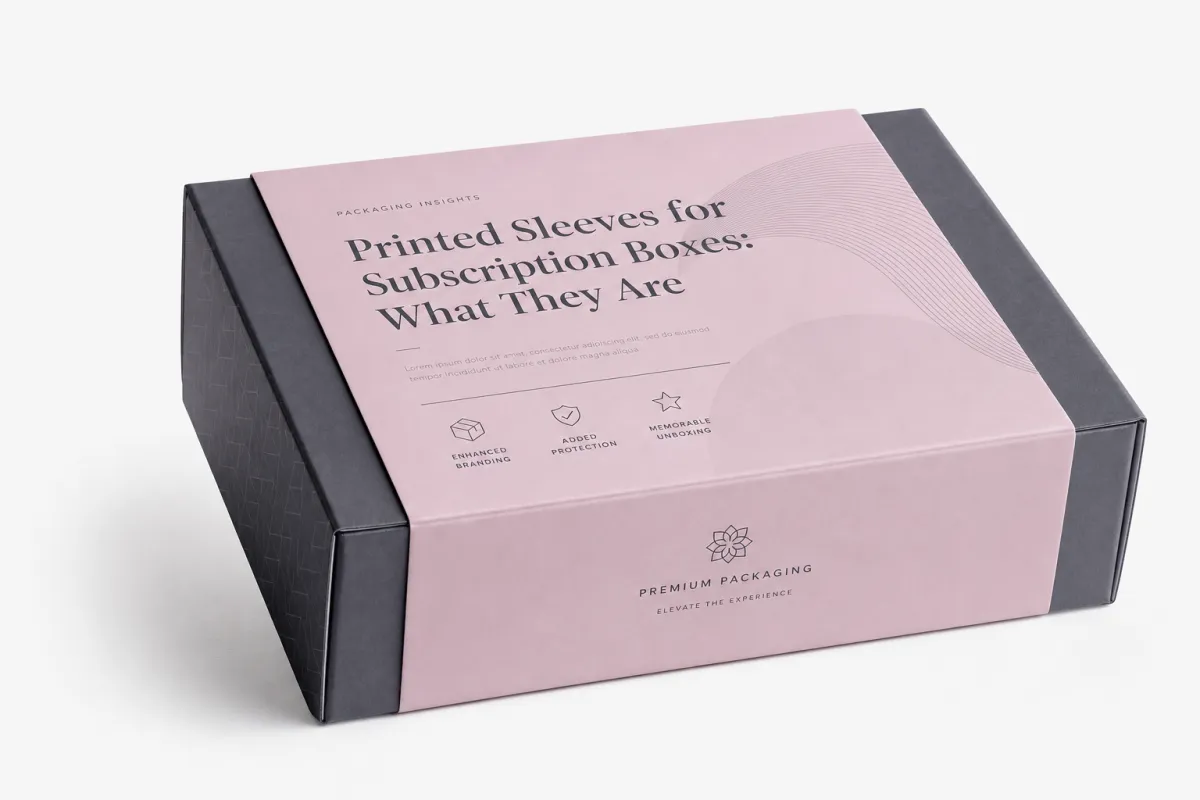
Printed sleeves for subscription boxes are wraparound printed pieces that sit over an existing carton, tray, or mailer. They are not the container itself. Think of them as a branded shell that brings in color, messaging, and shelf presence while the base box handles the structure. Depending on the design, a sleeve can cover the top panel, front face, sides, or the full visible perimeter of the pack.
This format works well for subscription programs because it keeps the structural box stable while leaving the graphics flexible. A skincare brand can keep the same underlying carton and change artwork each quarter. A snack company can roll out a holiday sleeve, then move to a spring campaign without retooling the whole box. That kind of flexibility is useful when the business changes more often than the packaging line would like, and honestly, it usually does.
Printed sleeves for subscription boxes can also support a cleaner materials story when the package is planned carefully. A paper-based sleeve over a recyclable base carton often uses less board than a fully custom printed setup. That does not make a package sustainable by default, and I would never pretend it does, but it can reduce material use and make the system easier to sort if the rest of the components are chosen well. The best version of this format is straightforward about what it does: it reduces complexity, keeps branding strong, and avoids overbuilding a box just to get a printed surface.
Beauty is one of the strongest use cases because the sleeve can create a premium first look without pushing the pack into rigid-box territory. Snacks and wellness products fit naturally as well, especially when the artwork changes from month to month. Apparel and gift kits can use printed sleeves for subscription boxes too, though those formats need careful testing around tissue, inserts, and product height, since those details affect the fit more than many teams expect.
The sleeve format shines when the base carton is already right and the brand wants to sharpen the presentation. If the box is weak, crushed, or awkward to pack, a sleeve will not fix the problem. It will only highlight it with better graphics.
How Printed Sleeves for Subscription Boxes Work
The process starts with the actual packed dimensions, not the nominal carton size that sits in a spreadsheet or on an old drawing. You need the full footprint with product, inserts, tissue, tape, and any closure features included. That packed size determines the sleeve opening, the wrap length, and the clearance needed so the piece slides on cleanly without scraping the corners or fighting the folds.
Printed sleeves for subscription boxes can be built in a few different ways. Some are simple wraps with a glued seam. Others are scored bands that fold around the pack. Some use die-cut tabs, tuck-in ends, or locking features to hold the piece in place. The structure depends on the box shape, the handling method, and how often the package will be opened before it reaches the customer. Once the layout is set, the artwork has to follow the dieline exactly. Panel breaks, seams, and folds are not decorative choices. They are the places where text gets interrupted and logos get bent if the design is not planned with care.
The production flow usually runs through dieline setup, artwork placement, proofing, print, cutting, scoring, finishing, and packing. Some sleeves ship flat for hand assembly. Others arrive partially finished so they can be applied faster on the line. Smaller runs often rely on manual application, while larger programs may use simple guides or line tools to keep placement consistent and reduce waste from crooked wraps.
Material selection shapes both the look and the behavior of the sleeve. Kraft stock gives a natural, understated finish that suits cleaner brand systems. Coated paper and SBS board handle stronger color, finer detail, and sharper typography. Recycled board can strike a useful middle ground when the brand wants a more responsible material choice without giving up too much print quality. Textured stocks add tactile interest, though they also change fold behavior, so a sample is worth requesting before a full order of printed sleeves for subscription boxes is approved.
The rest of the packaging system matters just as much. A shipping label that hides part of the sleeve, an insert that pushes the panel outward, or an opening style that fights the artwork can all make a well-printed sleeve feel wrong. In packaging reviews I have seen, plenty of printed sleeves for subscription boxes fail because the fit was never tested in the real pack, not because the printing itself was poor.
Cost and Pricing for Printed Sleeves for Subscription Boxes
Printed sleeves for subscription boxes usually cost less than a full custom carton because they use less board and simpler tooling. The savings can be meaningful, though the final price still depends heavily on run size, coverage, material grade, and finishing. A clean, uncomplicated sleeve can stay fairly affordable. Add complex die work, specialty coatings, foil, or a soft-touch finish, and the quote climbs quickly.
A realistic pricing pattern for printed sleeves for subscription boxes, assuming standard paperboard, four-color process printing, and no specialty decoration, often looks something like this: small runs around 1,000 pieces may land between $0.42 and $0.90 per unit, especially if the artwork or finishing requires more handling. At 5,000 pieces, the range may move closer to $0.18 to $0.35. For 10,000 to 25,000 pieces, the price often falls into roughly $0.08 to $0.24, depending on coverage, production efficiency, and how much labor the job needs. Those numbers are not promises. They are a practical buying range, and the difference between quotes usually comes from the details that look minor until they show up on the invoice.
| Run Size | Typical Unit Price | What Drives It | Best Fit |
|---|---|---|---|
| 1,000 units | $0.42-$0.90 | Setup spread across fewer pieces, proofing, and basic die cutting | Launches, tests, limited seasonal drops |
| 5,000 units | $0.18-$0.35 | Better setup efficiency, more stable print scheduling | Monthly subscription programs, repeatable campaigns |
| 10,000-25,000 units | $0.08-$0.24 | Material optimization, faster throughput, lower per-piece labor | High-volume subscription boxes and multi-SKU programs |
The main cost drivers are easy to name and easy to underestimate. Material grade affects the quote because kraft, recycled board, coated paper, and specialty stock are priced differently. Print method matters because digital printing makes sense for smaller quantities, while offset usually becomes more efficient as volume rises. Color count and coverage matter because rich, ink-heavy art takes more press time and more setup. Finishes raise the price because matte lamination, spot UV, foil, embossing, and similar effects each add steps. Die complexity matters too, since a straight wrap is cheaper than a sleeve with windows, locking tabs, or unusual folds.
Compared with a fully custom box, printed sleeves for subscription boxes often save money because the base carton stays standard. That said, a sleeve is not automatically the cheaper route if the brand wants high-end embellishment or if the base box needs custom sizing anyway. A structure that must change for protection, stacking, or shelf display may justify a custom carton. If the box already performs well and the branding needs a stronger finish, a sleeve usually makes better budget sense.
Hidden costs deserve attention. Setup fees, dieline revisions, physical proofs, freight, storage, and assembly labor can move the total project cost more than the unit price alone. One quote may look lower because shipping is excluded or because the supplier assumes the buyer will handle assembly on-site. Another quote may appear higher because it includes pre-gluing or tighter quality control. Ask for multiple quantities so you can see the pricing curve instead of guessing where the break-even point lives for printed sleeves for subscription boxes.
If the base carton already protects the product, the sleeve should carry the story and the shelf impact. Asking the sleeve to do structural work is how you end up with flimsy, overcomplicated packaging and a higher invoice.
If you are comparing formats, ask for side-by-side pricing on printed sleeves for subscription boxes and the matching custom box option. Our custom box and sleeve packaging options page is a useful place to start if you want to check the numbers before you request quotes.
Process and Timeline for Printed Sleeves for Subscription Boxes
The workflow starts with dimensions, not artwork. Before anything else, the supplier needs the exact packed size: length, width, height, insert thickness, and any space needed for tissue, product protrusions, or closure tabs. After that comes the dieline review, which is where many delays begin because the box changed size after the design work was already underway. Designers want momentum. Production wants stable measurements. Both sides have a point, and the box still does not care. Physics wins every time.
Once the dieline is approved, the artwork is placed on the template and a proof is generated. That is the stage where bleeds, safe zones, panel breaks, and fold lines need real attention. A rushed proof can send a sleeve into production with text too close to a seam or a logo straddling a fold in a way that looks awkward in hand. For printed sleeves for subscription boxes, careful proofing usually saves more time than it costs.
Lead times vary by print method and finish. Digital printing can move quickly on short runs, with some jobs shipping in about 7 to 10 business days after proof approval if the stock is available and the finish is straightforward. Offset printing usually fits larger runs better and may take 12 to 18 business days, sometimes longer if special finishing is part of the job. Add another 3 to 5 business days for complex lamination, foil, embossing, or unusual cutting patterns. Rush work can happen, but rush work usually comes with less flexibility and a higher price. That is not a surprise so much as the cost of compressing a process that still has to be done carefully.
Sampling matters a great deal for Subscription Brands That cannot afford a fit mistake across a full drop. A physical sample shows how the sleeve slides on, whether the corners scuff, and whether the print holds up under handling. Pilot runs are even more useful when a program changes monthly or quarterly, because they let the team verify the packing speed and customer-facing appearance before committing to volume. Printed sleeves for subscription boxes work best when the fit is tested before the order becomes large enough to be painful.
Recurring programs also create their own timing pressure. When artwork changes on a schedule, the production calendar has to work backward from the ship date, not forward from the approval date. One late sign-off can ripple through the entire drop. Build in a buffer. Subscription packaging has a habit of punishing optimism more than caution.
Key Factors That Affect Fit, Sustainability, and Shelf Appeal
Fit comes first with printed sleeves for subscription boxes because the sleeve only looks polished when it sits cleanly on the carton. That means using the real packed dimensions, not a rough estimate from an old drawing and not the empty box size that looked good on the purchase order. Inserts change the numbers. Tissue changes the numbers. A product that rises a few millimeters above the rim changes the numbers. A sleeve that is too tight slows the line and crushes corners. A sleeve that is too loose wanders during transit and starts to look cheap before the customer even opens it.
Sustainability choices shape both the appearance and the function of the package. Recycled content, FSC-certified paper, and water-based inks are a strong starting point if you want printed sleeves for subscription boxes to fit a more responsible packaging story. Right-sized artwork and efficient dielines also help because they reduce waste without relying on a flashy finish to do the talking. For transit performance and package durability, the ISTA standards community is a useful reference point, especially when the box is shipping by parcel instead of sitting only on a shelf. For responsible fiber sourcing, the FSC label remains one of the clearest signals many buyers recognize.
Visual impact matters in a very practical way. A sleeve has a short job: catch attention and communicate value before the box is opened. Contrast, hierarchy, and finish need to work at arm's length, not just on a screen. Dark type on a dark background may look elegant in design software and disappear in warehouse lighting. A busy pattern can bury the logo. Gloss can reflect light in ways that make fine text hard to read. Printed sleeves for subscription boxes should be checked on the actual board stock, in the light where the customer will see them.
Brand constraints often show up late, which is common and frustrating in equal measure. You may need space for seasonal artwork swaps, barcode placement, SKU variation, or a shipping label that has to cover a fixed area. You may also need the sleeve to work with the packing rhythm already in place. If the team fills boxes quickly, adds inserts, and closes them under time pressure, the sleeve should not slow the process down so much that it becomes a bottleneck. Durability matters as well. Light stock can work for a shelf presentation, but in a rough fulfillment environment it can start to look tired very quickly.
Practical rule: test the sleeve in the worst-case packed condition, not the prettiest one. The worst-case size reveals the assumptions that matter. Printed sleeves for subscription boxes either survive the real workflow or they do not. There is no prize for almost fitting.
Common Mistakes With Printed Sleeves for Subscription Boxes
The first mistake is measuring the wrong box. It sounds too obvious to happen, which is exactly why it happens so often. Teams approve printed sleeves for subscription boxes using an empty carton sample, then the actual packing line adds inserts, tissue, and a product with a taller profile. The sleeve starts cracking at the corners or slipping because it was built around the wrong packed size.
The second mistake is treating the artwork like a flat screen mockup instead of a folded object. Copy placed too close to a fold line gets distorted. A logo that looks centered in software can land off-center once the sleeve wraps around the carton. Weak contrast causes trouble too. If the design looks beautiful on a backlit monitor and falls apart in print, the customer sees the error immediately. Printed sleeves for subscription boxes need to be designed for paper and folding, not for a render.
Over-finishing is another common trap. Heavy coatings, foil stamping, thick laminates, and layered specialty effects can raise the cost quickly. They can also make recycling more difficult. That does not mean those finishes should never be used. It means they should serve a clear purpose instead of being added because somebody in a meeting wanted the package to "pop." Yes, it will pop. So will the invoice.
Process mistakes are just as expensive. Skipping a physical proof, approving the design before the final box spec is locked, or changing the insert after the sleeve has been finalized all lead to rework that could have been avoided. Printed sleeves for subscription boxes are precise wrappers. They do not forgive last-minute size changes the way a soft mailer might. Assembly errors create their own pain too. A sleeve that is too tight slows the line. A sleeve that is too loose looks untidy once the package is stacked or shipped. Neither outcome feels small once the order volume rises.
Another misstep is using a sleeve to cover for a box that never should have been standard. If the product rattles, the structure collapses, or the carton is underbuilt for the load, the base packaging needs attention first. Printed sleeves for subscription boxes are a branding tool, not a structural repair kit.
Expert Tips and Next Steps for Printed Sleeves for Subscription Boxes
Begin with the box you already ship. Measure the real packed product, not the spec line in the purchasing file, and include every insert, tissue layer, label, and closure that changes the footprint. That one step clears up a surprising number of fit problems for printed sleeves for subscription boxes. If the sleeve is built around the wrong build, the rest of the process becomes expensive guesswork.
Ask for two or three material samples so you can compare feel, fold quality, print sharpness, and the way each stock supports your sustainability goals. Recycled board can feel sturdier than expected. Kraft stock can look more premium than a glossy sheet when the brand leans natural, minimal, or wellness-focused. Printed sleeves for subscription boxes should always be evaluated with the actual product inside the carton, since an empty sample rarely tells the full story.
For recurring subscription programs, a pilot run is a smart move. A small batch gives you a way to test assembly speed, corner durability, scuff resistance, and the final customer presentation before you commit to a full order. That step becomes even more valuable when the brand changes artwork often or ships many SKUs. The pilot does not need to be large. It only needs to be honest about how the sleeve performs in real use.
Build a vendor checklist before you request quotes. Ask about MOQ, lead time, proofing method, assembly support, freight terms, and whether the quoted price includes storage or pre-gluing. Ask whether the supplier can quote several quantities so you can see the pricing curve rather than one number that hides the real break point. If you are also reviewing printed packaging options, compare the sleeve quote with a standard custom box and a hybrid structure. Sometimes the best answer is obvious. Sometimes it is just the least risky one.
Here is the rollout sequence I would use for printed sleeves for subscription boxes: finalize the dieline, approve the proof, run a packing-speed test, inspect the first physical samples, then lock the repeat order. That order keeps surprises low and makes the budget easier to trust. People say they want flexibility, but what they really want is a packaging program that stops changing under their feet. Fair enough.
Printed sleeves for subscription boxes work best when the base carton already performs well and the sleeve is there to sharpen the story, control cost, and keep the program flexible. Get the fit right, Choose the Right board, review the proof with care, and the sleeve becomes a practical part of the system rather than another packaging problem. The clearest next step is simple: measure the packed product, check the carton structure, and build the sleeve around the real workflow, not the idealized one.
FAQs
How do printed sleeves for subscription boxes compare with custom boxes?
Printed sleeves for subscription boxes usually cost less than fully custom boxes because they use less material and often simpler tooling. They work well when you already have a strong base carton and only need branding, seasonal updates, or a stronger shelf presence. Custom boxes make more sense when the structure itself needs to change for protection, presentation, or shipping performance.
What material is best for sustainable printed sleeves for subscription boxes?
Recycled paperboard or kraft stock is a common starting point for printed sleeves for subscription boxes because it balances print quality with recyclability. FSC-certified paper and water-based inks help support a cleaner sustainability story. Heavy plastic laminates are best reserved for cases where moisture resistance or abrasion protection is truly needed.
How much do printed sleeves for subscription boxes usually cost?
Price depends on quantity, material, print coverage, and finishing. Smaller runs have a higher per-unit cost, while larger runs usually drop sharply once setup is spread across more pieces. Ask for quotes at several quantities so you can see the real break-even point instead of guessing from one sample number.
How long does it take to produce printed sleeves for subscription boxes?
A typical timeline includes dieline review, proofing, production, and shipping, so the approval stage matters a lot. Simple digital jobs can move faster than offset or specialty-finishing orders. If you need a sample or pilot run first, build extra time into the schedule before your subscription drop.
Can printed sleeves for subscription boxes fit multiple box sizes?
Yes, but only if the size range is narrow enough that the sleeve still fits snugly and lines up correctly. Brands with many box sizes often need separate dielines or a more flexible sleeve strategy. Test the worst-case packed size, not the ideal one, because inserts can change the fit quickly.
Printed sleeves for subscription boxes are worth the effort when you want stronger branding without abandoning a carton system that already works. Measure carefully, price by volume, and test the real pack before you lock the order. That is how printed sleeves for subscription boxes stay useful instead of becoming a very decorated mistake.

