Buyer Fit Snapshot
| Best fit | Printed Subscription Boxes Wholesale for Reliable Shipping projects where brand print, material claims, artwork control, MOQ, and repeat-order consistency need to be specified before quoting. |
|---|---|
| Quote inputs | Share finished size, material target, print colors, finish, packing count, annual reorder estimate, ship-to region, and any compliance wording. |
| Proofing check | Approve dieline scale, logo placement, barcode or warning zones, color tolerance, closure strength, and carton packing before bulk production. |
| Main risk | Vague material claims, crowded artwork, missing packing details, or unclear freight terms can make a low unit price expensive after revisions. |
Fast answer: Printed Subscription Boxes Wholesale for Reliable Shipping should be specified like a repeatable production item. The safest quote records material, print method, finish, artwork proof, packing count, and reorder notes in one written spec.
Production checks before approval
Compare the actual filled-product size with the drawing, then confirm tolerance on folds, seals, hang holes, label areas, and retail display edges. Reserve space for logos, QR codes, warning copy, and material claims before decorative graphics fill the panel.
Quote comparison points
Review material grade, print process, finish, sampling route, tooling charges, carton quantity, and freight assumptions side by side. A quote is only useful when the supplier can repeat the same color, closure quality, and packing count on the next order.
Printed Subscription Boxes Wholesale for Reliable Shipping
Printed subscription boxes wholesale buyers are not just buying a decorated carton. They are buying a shipping unit, a brand surface, and a damage-control tool in one line item. That matters more than many teams expect. A subscription box can be handled at packout, staged on a pallet, sorted in transit, scanned at a hub, dropped at the door, and only then opened by the customer. Every one of those moments tests the structure, the print, and the fit. If any part is weak, the cost shows up later as dents, refunds, replacements, and churn. That is the part people forget while staring at a pretty mockup on a screen.
I have sat in packaging reviews where everyone was obsessed with foil and nobody asked how the carton would ride through a sort facility. That is how brands end up with boxes that photograph well and ship badly. Pretty is fine. Pretty and practical is better. The box has to survive the route first, then earn its keep on the customer's table.
From a packaging buyer's point of view, the smartest programs treat printed subscription boxes wholesale as a logistics decision first and a branding decision second. The reason is simple: better structure can reduce the need for extra labels, outer overwrap, and loose filler. That can lower labor time at fulfillment, cut material spend, and create a cleaner unboxing sequence. In practice, the outer carton should do more than carry a logo. It should protect the contents, hold shape during shipping, and make repeat ordering easy when the subscription volume climbs. Cheap boxes are cute until the returns start rolling in.
Why Printed Subscription Boxes Wholesale Change Shipping Economics
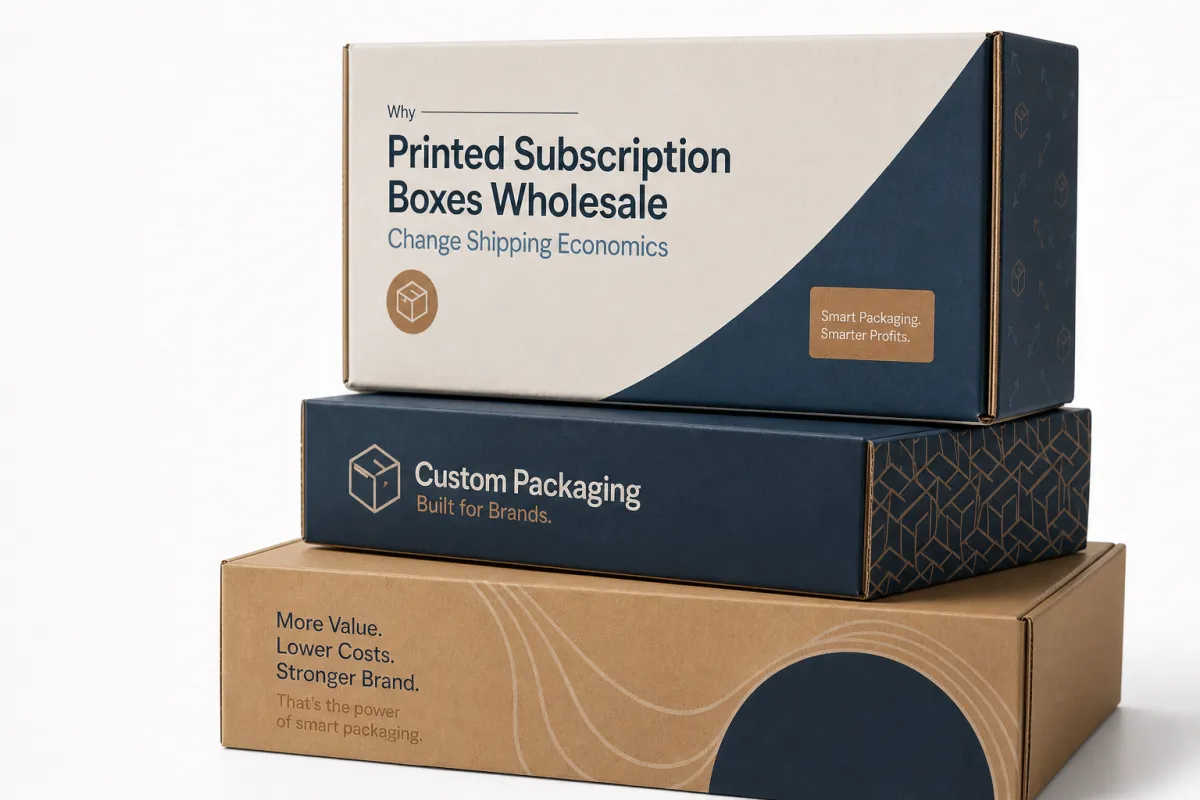
The economics start with one uncomfortable truth: weak packaging is expensive in ways that do not show up on the first quote. A box with crushed corners can trigger a replacement shipment. A box that opens too easily can create product loss. A box that looks generic can weaken the perceived value of the subscription before the customer even sees the contents. That is why printed subscription boxes wholesale often pay for themselves by reducing the hidden costs that ride along with damage and rework.
Here is the packaging reality most brands learn the hard way. A subscription kit is rarely handled only once. It is packed, moved, stacked, sorted, loaded, delivered, and opened. That repeated handling turns print quality into a logistics issue. If the exterior scuffs badly, the box can look old before it reaches the customer. If the closure is sloppy, items shift during transit. If the board is under-specified, the corners collapse under stacking pressure. A better printed subscription boxes wholesale spec gives the shipment a stronger chance of arriving intact and looking intentional.
There is also a labor angle that gets overlooked. If the carton is designed correctly, the fulfillment team may not need separate labels, extra branding wraps, or complicated inserts to keep products in place. That can reduce packing steps, which matters more as order volume grows. For a subscription business, shaving even 20 to 30 seconds per order can become meaningful over thousands of units. A box that combines structure and graphics well is not a luxury. It is a time-saving asset.
Most damage claims start with fit, not print. If the item moves inside the carton, the best artwork in the world will not fix the customer experience.
Printed subscription boxes wholesale also influence repeat purchase behavior. Subscribers do not evaluate a box the same way they evaluate a shipping label. They notice the corners, the print consistency, and the way the lid or flap behaves. A clean box signals control. A crushed one signals sloppiness. That perception is hard to recover from, especially in categories where presentation matters, such as beauty, apparel, wellness, and curated gifts.
For brands that ship on a fixed monthly cycle, the financial case becomes clearer still. A box that costs a bit more but cuts damage claims by even a small percentage can outperform a cheaper alternative. That is why the right comparison is not just unit price. It is unit price plus freight, plus labor, plus claims, plus the cost of losing trust. Printed subscription boxes wholesale should be measured on landed value, not on the first line of a quote.
One practical rule helps here: choose the lowest spec that still protects the product, then spend on the details customers actually see. That might mean a stronger closure, better board, or cleaner print registration instead of a fancy finish that adds cost but not protection. Good packaging buyers think that way because the box is doing two jobs at once. No need to make it fussy just for the sake of it.
Printed Subscription Boxes Wholesale Product Options and Uses
Not every subscription program needs the same box style. Printed subscription boxes wholesale can be built as mailer boxes, Corrugated Shipping Boxes, rigid presentation boxes, or hybrid structures that combine presentation with strength. The right choice depends on product weight, fragility, and how much of the unboxing experience the brand wants to control. Nobody wants to ship a premium beauty kit in a carton that gives "warehouse leftovers."
Mailer boxes are common for lightweight to medium-weight kits because they balance cost, print area, and shipping durability. Corrugated Shipping Boxes are better for heavier contents or when stacking strength matters more than presentation. Rigid presentation boxes suit premium kits, limited editions, and gift subscriptions where the customer experience is meant to feel elevated. Hybrid structures sit in the middle, using reinforced walls or internal partitions to hold mixed items in place.
Product category matters too. A beauty subscription may need a compact carton with a high-end exterior and a custom insert for fragile bottles. Apparel often benefits from a cleaner rectangular format with enough depth for folded goods and tissue. Food and beverage kits need careful attention to weight, leakage risk, and temperature exposure. Wellness boxes may include bottles, jars, and pouches that need separation so they do not collide in transit. Curated gift subscriptions often need stronger visual branding because the recipient is buying the experience as much as the items inside.
| Box style | Best use | Typical finish options | Relative cost per unit |
|---|---|---|---|
| Mailer box | Lightweight to medium subscription kits | Full-color exterior, matte, gloss, soft-touch | $0.55-$1.20 at 5,000 units |
| Corrugated shipping box | Heavier products, stacking, long routes | Exterior print, simple branding, liner options | $0.48-$0.95 at 5,000 units |
| Rigid presentation box | Premium kits, gifting, high perceived value | Wrap print, foil, emboss, soft-touch wrap | $1.80-$4.50 at 5,000 units |
| Hybrid reinforced box | Mixed kits, fragile items, better transit protection | Printed exterior, partitions, custom inserts | $0.90-$2.10 at 5,000 units |
Finish choices can change how customers read the box before they touch it. A matte surface usually feels restrained and modern. Gloss can brighten color and make bold graphics pop, though it may show scuffs differently. Soft-touch adds a tactile premium feel, but it should be used with care because it can raise cost without improving shipping performance. Spot treatments, such as spot UV or foil, work best when they reinforce a clear brand idea rather than exist for decoration alone.
Internal fit matters just as much as exterior style. Die-cut locks reduce the need for tape on some mailer formats. Partitions help when several small products would otherwise shift into each other. Product-specific cushioning can protect glass, pumps, or electronics. If the contents are mixed, a smart insert often saves more money than it costs because it reduces returns and preserves the presentation. Printed subscription boxes wholesale should be judged by how well the box holds the kit together, not just by how it looks in a mockup.
There is also a practical supply chain benefit to standardizing on a few box styles. If the dimensions stay consistent, repeat orders are easier to forecast, warehousing is simpler, and reorder risk drops. Many brands start with one pretty carton and later discover they need a second size for seasonal bundles or promotional inserts. Planning for that from the beginning can save weeks of rework later.
Printed Subscription Boxes Wholesale Specifications That Matter
Before requesting a quote, buyers should lock in the details that actually drive production. Finished dimensions matter because even small changes can affect board usage, insert layout, and freight efficiency. Board grade matters because a recycled kraft liner behaves differently from a premium white board. Flute type matters for corrugated structures because it affects compression strength, print surface, and shipping weight. Closure style matters because a tuck flap, lid, or auto-lock bottom changes both assembly speed and protection level. Printed subscription boxes wholesale become much easier to compare once these specs are fixed.
Tolerances deserve more attention than they usually get. A box that measures slightly loose on paper can become a problem once products are packed by a fulfillment team using different operators or different shift patterns. If the fit is too generous, items slide. If the fit is too tight, the carton can bow or crush when closed. Consistent tolerances support repeatability across reorders, which is exactly what a subscription program needs. The goal is not just to make one sample work. The goal is to make the hundredth carton behave like the first.
Material choice is a tradeoff, not a moral statement. Recycled board can be a strong choice for sustainability targets and can still print well if the coating and press setup are matched correctly. Premium white board often gives sharper image contrast, but it may cost more and does not automatically improve shipping strength. In many cases, a recycled or FSC-certified board is the better business decision because it balances cost, appearance, and sourcing documentation. If that documentation matters to your team, the FSC site is a useful reference for chain-of-custody and certified sourcing basics.
Print expectations should be set early. Buyers should ask for the dieline, bleed, safe area, and any barcode or regulatory mark placement before artwork gets finalized. A barcode too close to a fold line can become unreadable. Rich black backgrounds can show scratches faster than lighter designs. Small reverse type may print poorly on corrugated surfaces if the line weight is too thin. These are not design opinions. They are production realities.
For shipping validation, many teams use test methods aligned with industry standards. A common reference point is ISTA, which publishes transport test procedures used to simulate handling, drop risk, vibration, and compression. That does not mean every subscription box needs the same test protocol, but it does mean the packaging conversation should include transport conditions, not just graphics approval. ASTM D4169 is another standard buyers often discuss with suppliers, especially if the contents are fragile or high-value.
- Finished size: confirm inside dimensions, not just outside dimensions.
- Board grade: specify paper weight, liner type, and flute if corrugated.
- Print coverage: full exterior, partial print, or inside print.
- Finish: matte, gloss, soft-touch, foil, or spot UV.
- Insert type: partition, die-cut insert, cushion, or no insert.
- Closure: tuck, lock, magnetic, telescoping, or taped seal.
- Artwork file: dieline format, resolution, bleed, and color profile.
A good spec sheet makes printed subscription boxes wholesale easier to buy, easier to reorder, and easier to audit. That matters for finance teams as much as it matters for fulfillment. When the spec is vague, every reorder becomes a new conversation. When the spec is tight, the box behaves like a managed part, not an improvised project.
Printed Subscription Boxes Wholesale Pricing and MOQ
Pricing for printed subscription boxes wholesale is driven by a handful of variables that buyers can actually control. Box size is the first one. Bigger cartons use more board and often need stronger structures. Print complexity is next. A one-color logo on kraft costs less than a full-bleed design with interior print, foil, and soft-touch lamination. Finish level changes labor and setup. Inserts add die-cutting and assembly. Order volume matters too, because higher runs spread setup costs across more units.
MOQ, or minimum order quantity, is usually tied to press setup, board sourcing, and conversion efficiency. Mailer-style runs are often more flexible than rigid boxes because the tooling and assembly are simpler. A buyer testing a new subscription program should ask whether the minimum applies to one size only or can be spread across size variants. That single question can change inventory planning significantly. If the MOQ is 5,000 units per size, holding two SKUs can feel very different from holding one.
For fair quote comparison, separate the numbers into categories. Unit price is only part of the story. Setup fees, plates or tooling, sample charges, freight, and split-shipping fees can move the real landed cost more than expected. Storage or phased delivery can matter if your launch date is later than production completion. A quote that looks cheap on the page can become expensive once the cartons land in your warehouse. Packaging budgets have a bad habit of hiding the real number until the invoice shows up.
Here is the buying rule I recommend to most subscription brands: pick the lowest spec that still protects the product, then invest in the details customers actually notice. That usually means keeping board and structure strong, then spending selectively on print and finish. A premium feel is valuable, but damage prevention is valuable first. If the carton fails in transit, no amount of foil can recover that expense.
| Cost driver | What changes it | Typical impact |
|---|---|---|
| Box size | Inside dimensions, depth, and board usage | Often the biggest driver of unit price |
| Print coverage | One-color logo vs full-color exterior and interior | Can add setup time and ink cost |
| Finish | Matte, gloss, soft-touch, foil, spot UV | Raises cost most on premium runs |
| Insert complexity | Partition count, die-cut layout, hand assembly | Can add labor and conversion charges |
| Order volume | Total units per run | Lowers per-unit cost as volume rises |
As a rough planning range, many printed subscription boxes wholesale buyers see mailer-style quotes around $0.55 to $1.20 per unit at 5,000 pieces, depending on board and print coverage. Stronger corrugated cartons often land in a similar or slightly lower range if the print is simple, while rigid presentation styles can move well above $1.80 per unit. Those numbers are not universal. They change with country of origin, freight mode, seasonal board pricing, and how much finishing you ask for. Still, they give buyers a useful frame for budgeting.
One more point on MOQ: a minimum is not only about the supplier protecting its production efficiency. It is also about keeping your price from rising sharply on small runs. A buyer can absolutely launch with a lower quantity, but the tradeoff is usually a higher per-unit cost. That can be worth it for a pilot program or a seasonal test. It is not always the right move for a mature subscription brand that already knows its reorder cadence.
Printed Subscription Boxes Wholesale Process and Timeline
The process is more predictable than many buyers expect, as long as the spec is clean. It usually starts with a quote request that includes dimensions, product weight, artwork goals, and target quantity. From there, the supplier confirms a dieline or provides one, then the customer uploads artwork. After that comes proofing, sample approval, production, inspection, and shipping. Printed subscription boxes wholesale work best when each step is treated as a checkpoint, not a casual email thread.
Timing depends on how quickly approvals move. Artwork setup may take one to three business days if files are ready. Proofing can take another one to two days, more if the buyer needs internal sign-off from marketing, operations, or compliance. Sample or structural proof approval can add several days if the team wants to test fit with actual products. Production often runs in the 12-15 business day range after proof approval, though this depends on order complexity and factory load. Freight adds its own clock, especially if the order crosses regions or needs consolidation.
Delay points tend to be predictable. Late artwork is one of the most common. So is changing dimensions after the proof stage. A revised insert can force a new dieline. Unclear delivery instructions can delay shipment even after production is complete. If a brand needs split deliveries to different fulfillment centers, that should be stated early. The more precise the order, the less likely the timeline will drift.
Rush orders are possible in some cases, but they are much easier when the spec is already locked. A first-time order with incomplete artwork is a bad candidate for speed. A repeat reorder with a stable spec sheet is a much better fit. That is one reason experienced buyers keep a controlled packaging library: approved dielines, artwork archives, print standards, and reorder notes in one place. It shortens future lead times and reduces mistakes.
For brands shipping on a monthly cadence, production planning should be tied to sell-through rate and reorder threshold. If your box lead time is three weeks and your monthly volume is 20,000 units, do not wait until inventory is almost gone. Build a buffer that reflects both transit time and likely variability in demand. That buffer can be the difference between steady operations and a scramble.
Printed subscription boxes wholesale also benefit from clear inspection criteria. Ask what is being checked: print registration, color consistency, glue strength, dimensional accuracy, and carton integrity. If the box is being used for a subscription program with fragile items, ask for drop test or compression documentation. The more visible the standards, the fewer surprises after delivery.
At the logistics stage, pallet efficiency matters more than many teams realize. A slightly smarter carton size can improve cube utilization and lower freight cost. The same is true for carton count per master case and how the product stacks during storage. Printed subscription boxes wholesale should be built with warehouse handling in mind, because a box that ships beautifully but packs inefficiently can still create avoidable cost.
Why Choose Our Printed Subscription Boxes Wholesale Program
For buyers at Custom Logo Things, the value of a printed subscription boxes wholesale program should show up in measurable ways: consistent color, dependable structure, cleaner reorder handling, and fewer surprises during transit. A supplier does not earn trust by promising perfection. It earns trust by making repeat runs behave like the first approved sample, with the same fit, the same print logic, and the same ordering path.
Quality control is where that promise becomes real. If the box is not holding shape, the customer notices. If the print shifts, the brand notices. If the insert does not align, fulfillment notices immediately. A strong program reduces the risk of reprints and damaged inventory because those problems are caught before a full run ships. That is especially useful for subscription brands, where a bad batch can touch a whole month of customers at once.
Logistics support matters as much as print quality. Brands that ship on fixed cycles need predictable carton counts, pallet planning, and a supplier that can forecast with them instead of forcing a redesign every time volume changes. Printed subscription boxes wholesale should support scale without punishing the buyer for success. If the order doubles, the structure should still be practical. If the order grows into multiple sizes, the supplier should be able to help manage that transition without starting over.
This is also where broader packaging capability helps. If your subscription strategy expands beyond one carton type, it helps to work with a partner that can support Wholesale Programs and a wider range of Custom Packaging Products. That keeps the packaging language consistent across campaigns, gift sets, and seasonal launches. In practical terms, consistency lowers training time, simplifies reorder reviews, and keeps the brand from drifting into mismatched packaging styles.
There is a financial side to supplier consistency too. A well-managed run can reduce the likelihood of reproofs, color disputes, and extra shipping charges caused by last-minute changes. That does not mean every order will go perfectly. It means the process is designed to catch problems early. From a buyer's point of view, that is what a dependable printed subscription boxes wholesale program should do.
Another advantage is production continuity. Many packaging suppliers can handle a first order but struggle when the order becomes a repeat series with tighter delivery windows. A better partner can support both launch quantities and ongoing replenishment without forcing the brand to redesign just because volume changes. That continuity matters. Subscription boxes are recurring by nature. The packaging operation should be recurring too.
Next Steps for Printed Subscription Boxes Wholesale Orders
If you are ready to move forward, gather the details that make a quote useful. Start with product dimensions, target ship weight, monthly volume, artwork files, and any insert requirements. Add the closure style you want, whether the contents are fragile, and whether you need inside print or just exterior branding. Printed subscription boxes wholesale quotes become more accurate when the supplier sees the real use case, not only a rough sketch of the idea.
Requesting a sample or structural proof is a smart next step, especially if the kit includes glass, electronics, or mixed-size components. A sample tells you whether the fit is right, whether the closure behaves correctly, and whether the box feels sturdy enough for the route it will actually travel. That is cheaper than discovering the issue after production. And yes, discovering it after production is the expensive version nobody enjoys talking about.
Set a reorder threshold before you need it. A good rule is to base that threshold on sell-through rate plus production lead time plus a buffer for freight or inspection. If your replenishment plan is thin, any delay can force a rush order. If the threshold is realistic, the subscription program stays steady and the team spends less time in emergency mode.
Finally, treat the first quote as the start of a packaging decision, not the end of one. Ask what the landed cost includes, what the MOQ really applies to, and how repeat runs will be handled. The best printed subscription boxes wholesale outcomes come from clear specs, straightforward approvals, and a supplier that thinks about shipping as seriously as it thinks about print.
For brands that want reliable shipping and a box that does more than hold product, printed subscription boxes wholesale are a practical investment. They protect margin, reduce damage, and shape the customer's first impression in the same move. The most useful next step is simple: lock the inside dimensions, choose the lightest structure that still protects the contents, and test one sample against the real shipment route before you place the full run.
What is the typical MOQ for printed subscription boxes wholesale?
MOQ depends on box style, print coverage, and material, but mailer-style runs are usually more flexible than heavily finished rigid boxes. Ask whether the minimum is tied to one SKU or can be spread across size variants, since that can change how much inventory you need to hold. If you are testing a new subscription program, request the lowest viable run that still gives you accurate pricing and production quality.
How much do printed subscription boxes wholesale cost per unit?
Per-unit cost is driven mainly by size, board grade, color coverage, and finish level, with freight and setup charges often adding to the real landed cost. Higher volume usually lowers unit price, but only if the spec stays stable, so compare quotes using the same dimensions and print requirements. The cheapest quote is not always the best value if it raises damage rates or forces you to add extra packaging later.
Which box style works best for monthly subscription shipping?
Mailer boxes are often the best fit for lightweight to medium-weight subscription kits because they balance brand presentation and shipping durability. Heavier or fragile kits may need stronger corrugated structures or custom inserts to keep items from shifting in transit. Choose the style based on product weight, unpacking experience, and how much stacking or carrier handling the box will face.
How long does a printed subscription boxes wholesale order take?
Timing usually includes artwork setup, proof approval, production, inspection, and shipping, so the total lead time depends on how quickly each step is approved. First orders take longer than repeat orders because the dieline and color standards still need to be confirmed. Rush production is possible in some cases, but it usually requires locked specs, clean artwork, and immediate proof approval.
Can printed subscription boxes wholesale use recycled board and still look premium?
Yes, recycled board can still support strong print quality if the coating, ink coverage, and press setup are matched to the material. Premium results come from managing contrast, color calibration, and finish selection rather than from using a more expensive board alone. If sustainability is a priority, ask for board options that balance recycled content, structural strength, and print clarity.


