Getting a Printed Woven Labels Quote for fitness is usually more involved than comparing one price to another. For activewear, gymwear, and athleisure, the label touches comfort, wash durability, and overall garment finish, so the quote should reflect how the label will actually perform once it is sewn into a waistband, neck seam, side seam, or hem.
That is why experienced buyers ask for pricing early, before sampling begins. They want to compare label construction, size, finish, fold style, and attachment method while there is still room to adjust the spec, because the wrong choice can lead to scratchy edges, poor legibility, or avoidable rework after approval.
Why fitness brands request woven label quotes before sampling
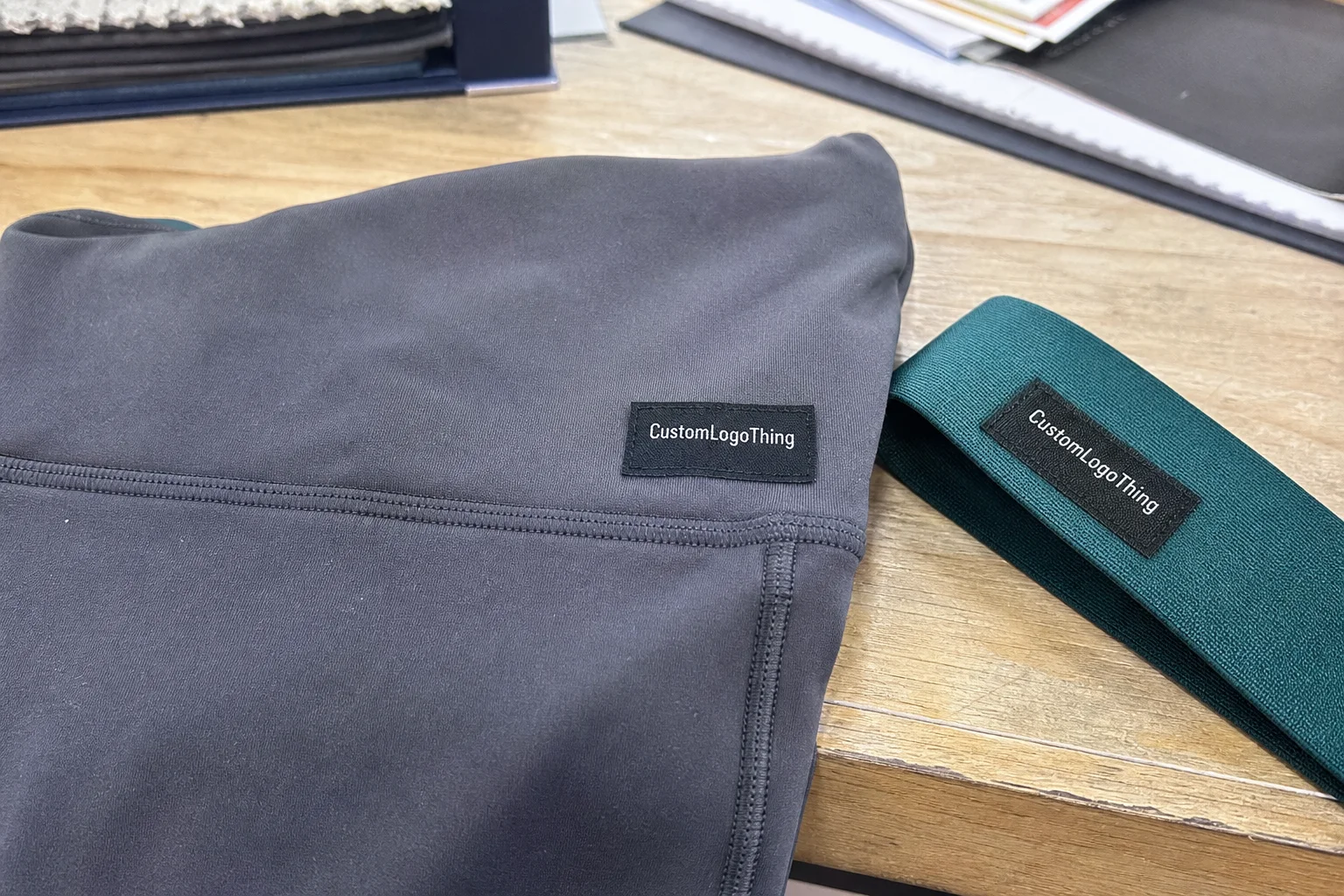
Fitness apparel is exposed to repeated stretching, sweat, abrasion, and frequent laundering. A neck label on a compression tee, a care label on leggings, or a brand tab on a hoodie has to survive all of that while staying soft enough that the wearer does not notice it during movement. If the label curls, feels stiff, or frays after washing, complaints follow quickly.
For that reason, label buyers usually treat the quote as part of product development rather than a last-minute procurement detail. The label is part of the garment spec. On performance wear, where the fabric itself is often engineered to recover, wick moisture, and move with the body, the label should not become the weak point that interrupts comfort or creates a cheap feel.
Quotes also help buyers separate suppliers more clearly than a basic catalog comparison. Two vendors may both offer woven labels, but one may be quoting a fine damask-style construction with sharper detail, while another is quoting a heavier satin-like base with less definition but a softer hand. Those differences matter when the label has small type, a tight logo mark, or needs to sit directly against skin.
“A low label price can be misleading if the label fails wash testing or creates abrasion at the neckline. The real cost shows up later.”
That is the part many first-time buyers underestimate. The label is not just decoration. It is a small component that has to repeat accurately across thousands of garments, with the same shape, finish, and placement each time. If the quote is built on the wrong assumptions, the entire production run can inherit that mistake.
Printed woven label options for activewear, gymwear, and athleisure
Printed woven labels sit between fully woven labels and fully printed trims in a practical way. They use a woven textile base, then printed details help preserve logos, small text, and fine elements that can be difficult to render cleanly at small sizes. For fitness branding, that can be useful when the logo must stay sharp but the label still needs a textile look and feel.
These labels are common on neck seams, hem tabs, size markers, care labels, and exterior branding applications. They appear on leggings, sports bras, tanks, shorts, joggers, hoodies, and lightweight layers. In many of those applications, low bulk matters as much as softness, because the label needs to sit flat under tension rather than create a ridge that the wearer can feel during exercise.
Construction choices change both appearance and comfort. A finer woven base can improve detail, while a smoother surface may reduce friction. If the artwork contains thin letters, tight line work, or a small logo lockup, printed detail on a woven base can help preserve clarity without forcing the design to be oversized.
Fold style is another decision that affects the final result more than many buyers expect. The standard options are simple, but each one serves a different sewing method.
- End fold for brand tabs or side-seam placement where the label is secured at both ends.
- Center fold for neck labels and care labels inserted into a seam.
- Loop fold when the label needs to wrap around a seam allowance or hang from a loop point.
- Straight cut for labels that will be sewn into a seam or handled in bulk.
- Cut-and-fold for production lines that need consistent insertion with minimal bulk.
For high-stretch garments, the best label is usually the one that stays flat, stays soft, and avoids rough edges after repeated movement. That may mean reducing the width, lowering the thickness, or moving the label away from high-friction skin contact points such as the back neck.
If you are comparing Custom Woven Labels for athleisure, ask how the label behaves after stretching and laundering, not only how it looks on a flat proof. That question quickly separates practical production advice from generic sales language.
Label specifications that affect print quality and wash performance
The fastest way to get an accurate Printed Woven Labels Quote for fitness is to define the label specification clearly. Size is the first detail most buyers mention, but it is only one piece of the cost and performance picture. A supplier also needs to know the number of colors, the target finish, the fold style, the edge treatment, and how the label will be attached.
Small typography deserves extra care. A logo that looks crisp on a screen can become weak or crowded if the lines are too fine for the chosen construction. Tiny registration text, thin outlines, and dense artwork are common problem areas. Vector artwork is the safest starting point because it scales cleanly and gives the proofing team a more reliable basis for adjustment.
Wash performance matters just as much as appearance. Fitness apparel sees perspiration, repeated laundering, stretching, and contact abrasion from movement and equipment. A label that looks correct on the first sample but fades, curls, or frays after washing is not an acceptable result. Many buyers align internal checks with common textile quality practices, including wash-fastness expectations and basic wear testing on finished garments.
What to confirm before asking for a quote
- Finished size in millimeters or inches
- Color count and Pantone references, if brand matching matters
- Fold style and whether the label will be supplied as cut pieces or in rolls
- Attachment method such as sew-in, heat-sensitive backing, or another application method
- Edge finish and acceptable cut tolerance for batch consistency
- Placement on the garment, especially for skin-contact zones
For brand consistency, specific color targets are far better than vague descriptions. “Deep blue” may be enough for an internal discussion, but a Pantone reference or an approved brand standard gives production a much clearer target and reduces the chance of color drift between styles.
For companies building out a broader trim program, it can also help to review Custom Labels & Tags as a reference point for the constructions available across apparel labeling.
Where packaging or insert cards are part of the same order, buyers sometimes cross-check outside standards as well. Resources such as ISTA can be useful for distribution testing, while FSC matters if paper-based inserts or packaging are included in the broader trim package.
Printed woven label quote: cost factors, MOQ, and unit pricing
Pricing for a Printed Woven Labels Quote for fitness usually comes down to a handful of controllable variables: size, quantity, number of colors, fold style, finish, backing, and packing format. Once those details are set, the quote becomes much easier to compare across suppliers.
MOQ is where many new buyers get caught off guard. Small runs almost always carry a higher per-piece cost because setup, artwork preparation, proofing, and finishing are spread over fewer labels. That does not make a small order wrong. For a new sportswear line, a lower MOQ can be the sensible choice if you are still checking fit, sell-through, and customer feedback.
Actual pricing varies by spec, but the pattern is fairly consistent. A small, single-color label will usually be the most economical. Add size, extra colors, tighter detail, or a specialty finish, and the unit price rises. Packaging into cut pieces instead of rolls, or including special backing, can also affect the quote.
| Spec choice | Typical effect on cost | Buyer impact |
|---|---|---|
| Small label size, single logo color | Lower unit cost | Good for minimal branding and simple neck labels |
| Larger size, multiple colors | Moderate increase | Better for visible branding and clearer detail |
| Center fold or cut-and-fold | Usually slightly higher than straight cut | Improves sewing efficiency and finished appearance |
| Heat-sensitive backing or specialty finish | Raises unit price | Can reduce handling steps in some production lines |
| Low quantity order | Highest per-piece cost | Useful for testing, prototyping, or limited launches |
For most fitness brands, the best savings come from standardization. If several SKUs can share the same size label, or if care information can be combined where garment regulations allow it, the trim program becomes easier to manage and less expensive to repeat. That kind of planning often saves more than chasing the lowest price on one individual line item.
Quotes should also be checked for what is included. Sampling, freight, design help, cut-and-pack service, and optional finishing can all change the final landed cost. A quote that looks low on paper may rise once those items are added, so it is better to compare complete quotes than isolated unit prices.
If you are checking market position against other packaging and textile suppliers, resources from the Packaging Association resources can offer useful context where consumer presentation and finishing quality overlap.
For a new order, ask for a Printed Woven Labels Quote for fitness that separates setup, unit price, sampling, shipping, and any optional finishing charges. That gives you a cleaner procurement view and makes supplier comparison much more honest.
Production steps, lead time, and sample approval flow
Most label orders follow a familiar sequence: artwork review, spec confirmation, digital proof, sample production, approval, bulk run, and final packing. The process is straightforward, but the early checks matter a great deal. A good proof catches proportion issues, missing text, fold mistakes, and color mismatches before production starts.
Lead time depends on more than quantity alone. Artwork revisions add days. Sample approval can slow down if the buyer is reviewing multiple trims at once. Specialty materials or backing choices may need extra sourcing time. During busy production periods, a well-prepared order may still need a little schedule buffer.
For fitness apparel, test fitting and basic wash checks are worth building into the timeline. A label that looks fine on a proof can feel different once sewn into a waistband, back neck, or side seam where the fabric moves constantly. Even a small change in stiffness or edge finish can become noticeable after wear.
What good production control looks like
- Color placement is checked before the bulk run
- Fold direction matches the garment sewing method
- Cut consistency stays within tolerance across the batch
- Text remains legible at the finished size
- Packing format matches the sewing line or warehouse workflow
Practical control measures reduce expensive surprises. A clear proof catches spelling errors, logo proportion issues, and incorrect color references before the order moves forward. That matters even more when multiple SKUs are in production at the same time, because one bad label specification can spread across several styles.
The best brief is the one that leaves little room for guesswork. Send the artwork, dimensions, quantity, and intended label placement together, and include any comfort concerns for skin-contact areas. If the order has a launch deadline or retail drop attached to it, say so early; schedule pressure changes how the quote and production plan should be framed.
Why Custom Logo Things is a practical label supplier for fitness brands
Custom Logo Things fits buyers who want a quote-based ordering process with clear specifications, repeatable production, and straightforward communication. That approach is useful in fitness apparel, where label issues can affect comfort, fit perception, and brand presentation all at once.
For brand owners, private label apparel companies, and smaller production teams, the most useful supplier is usually the one that reduces spec errors before production begins. That means confirming fold style, attachment method, construction details, and finish rather than sending back a number with no context. It also means being willing to talk through whether a woven base, printed detail layer, or different finishing choice makes more sense for the garment in question.
Reliability matters just as much as price. Buyers care about proof accuracy, stable quality control, and bulk production that matches the approved sample. Those are not flashy selling points, but they are the ones that protect the garment once it leaves the trim table and enters real use.
For brands that need a dependable source for printed woven labels quote for fitness, the supplier should function like a production partner rather than a quote-only vendor. Clear pricing, workable MOQs, practical guidance, and consistent output are what keep the trim program under control.
Next steps to request an accurate quote and place the order
If you want the quote to be accurate on the first pass, gather the key details before sending the request. A complete brief reduces back-and-forth and helps the supplier price the order correctly.
- Label size in finished dimensions.
- Quantity per style and total order volume.
- Artwork file, preferably vector.
- Fold style or whether you need cut pieces or rolls.
- Garment type such as leggings, tanks, sports bras, shorts, or hoodies.
- Placement and comfort concerns, especially for skin-contact zones.
- Color references and any must-match brand standards.
It also helps to ask for a written quote that separates setup, unit price, sampling, shipping, and optional finishing charges. That makes supplier comparison more reliable and keeps the final landed cost from drifting after approval.
Before signing off, review the proof carefully. Check spelling, logo proportions, fold direction, pack count, and color references. A few minutes spent on proof review can prevent a lot of waste later, especially if the labels are tied to a launch calendar or a seasonal drop.
If you are ready to move from planning to production, Contact Us with your specs and request a printed woven labels quote for fitness. Once the important details are on the table, the ordering process becomes easier to manage and the finished label is much more likely to match the garment you had in mind.
FAQ
What details do I need for a printed woven labels quote for fitness apparel?
Provide label size, quantity, artwork file, fold style, and where the label will be sewn or attached. Include garment type and any comfort or wash-performance requirements so the quote reflects real production needs.
Are printed woven labels better than satin labels for gym clothing?
Printed woven labels are often preferred when you need finer branding detail and a textile base with a softer apparel feel. Satin can work well for some garments, but the right choice depends on softness, durability, and the amount of detail in the artwork.
What affects the unit cost of woven labels for activewear?
Quantity, label size, fold style, number of colors, backing, and packaging format all influence unit cost. Lower order volumes usually cost more per piece because setup is spread across fewer labels.
How long does production usually take after I approve the proof?
Lead time depends on order size, artwork revisions, sample approval, and current production workload. Once the proof is approved, the bulk run starts, but buyers should still allow time for packing and freight.
Can I order a small MOQ for a new fitness brand launch?
Yes, small runs are often possible, though MOQ and pricing will depend on the construction and total quantity requested. If you are testing a new line, ask for the lowest practical quantity and compare how it affects the unit price.


