Private Label Clear Garment Bags Supplier: Buyer Checklist
A private label Clear Garment Bags supplier should deliver more than a transparent sleeve with a logo. The bag has to protect the garment, stay clear after handling, hang neatly, and survive packing and transit without turning cloudy or brittle. That sounds simple until a sample looks good on a desk and fails once it is folded, shipped, and rehung.
Buyers usually start with visibility, then discover that drape, seal quality, hang-hole reinforcement, and film memory matter just as much. If the bag wrinkles heavily, splits at the shoulder, or looks hazy under store lighting, the garment loses value before a customer touches it. In retail, that visual drop-off is expensive.
A clear garment bag is part of the merchandising system. Small defects in the film or seal can make the whole presentation feel off.
Why clear garment bags fail on the sales floor
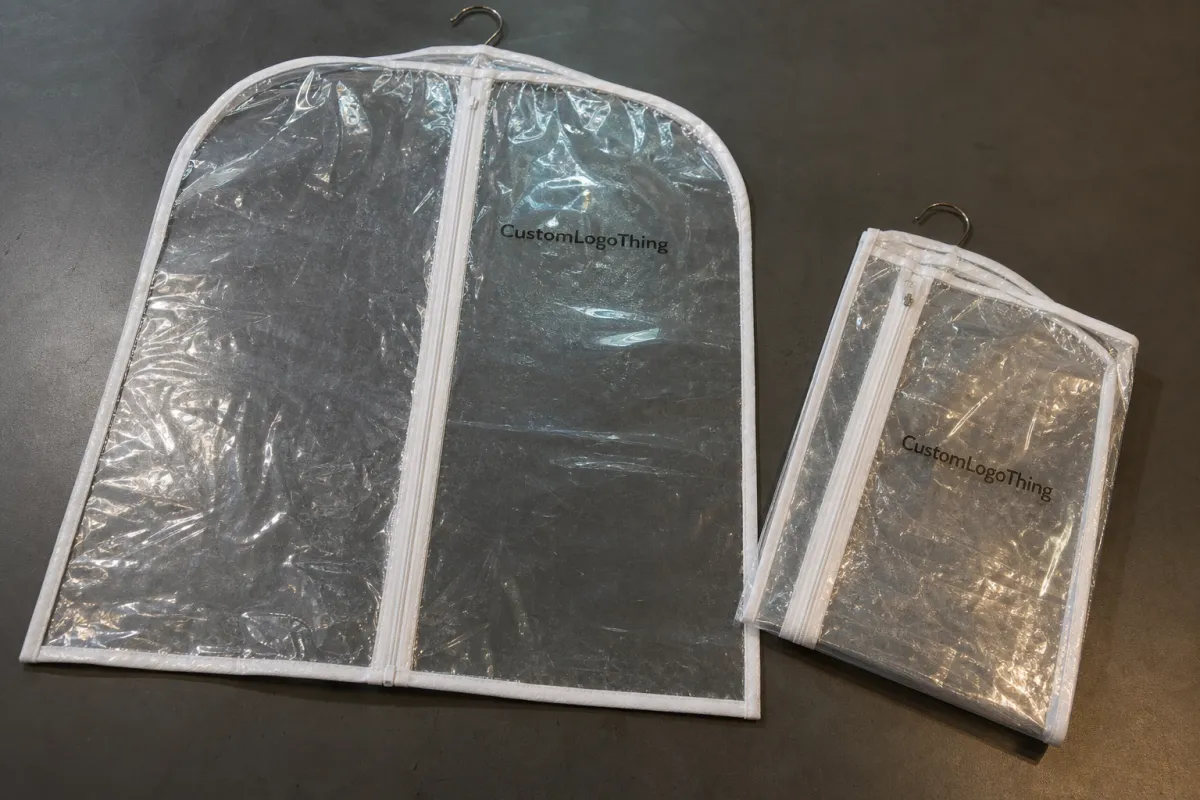
Most failures start after approval. A bag can look excellent on a flat sample sheet, then haze over once it is handled, packed around bulky seams, or exposed to cooler storage. Thin film also creases sharply around the hanger opening and gusset, which breaks the visual line and makes the display look tired.
Clarity is only one variable. The film must hang cleanly, but it cannot be so stiff that it fights the garment underneath. The seal needs enough strength to hold under shipping pressure. The opening needs to resist tearing where staff pull the bag on and off racks. If the bag traps too much air around a coat or stacked item, the presentation puffs out and loses shape.
From a packaging standpoint, the bag should support merchandising, not compete with it. It needs to protect against dust, handling, and light moisture while preserving the brand’s visual standard across stores and fulfillment channels. If the program includes branded inserts or apparel identifiers, coordinating the bag with Custom Labels & Tags helps the presentation feel deliberate instead of assembled piece by piece.
How film becomes a branded garment bag
The production sequence starts with resin selection, and that choice shapes the whole job. LDPE usually gives softer drape and better recovery around folded apparel. CPP and blended films can feel crisper and hold shape better, especially for retail packing where the bag must stay upright in cartons and on racks. After extrusion, the film is cooled, wound, printed if needed, then slit, sealed, and cut into finished bags.
Each stage can introduce variation. Gauge drift changes the feel. Inconsistent sealing temperatures cause weak seams. Sloppy cutting leaves uneven tops that hang crooked. Buyers do not need to manage the machine settings, but they should know which ones matter enough to ask about. A supplier that tracks gauge, seal temperature, and cut consistency is usually more predictable than one that only talks about color and print.
Surface finish matters too. A smoother film generally gives better clarity, while treated surfaces may improve print adhesion or anti-static performance. That tradeoff is real. A bag designed for branded retail display does not always need the same finish as one designed for warehouse protection or dry-cleaning reuse. Matching the film to the channel prevents overbuilding.
Size should be translated into production language, not vague merchandising language. Width and length need to match the garment. Gusset depth should reflect shoulder bulk, hem volume, or folded sleeves. Venting can help when bags cover boxed goods. Open-top and zipper styles serve different workflows, so the closure should follow how the item moves through storage, packing, and display. Carton pack counts matter too; a buyer who needs 200 units per case should not receive 175 and be told to make it work.
Material and construction specs that affect clarity and strength
Film thickness is the first specification worth checking. For light retail apparel, 1.5 to 2.5 mil can be enough if the garment has no sharp edges and the bags are not being reused heavily. For coats, suits, or higher-touch warehouse handling, 3 mil and above is safer. Thicker film costs more, but it usually reduces punctures, seam stress, and the small tears that spread during transit.
Clarity should be measured, not guessed from a sales sheet. Haze level, surface finish, and basic test data tell you more than a generic “high clarity” claim. ASTM D882 tensile data and dart impact testing help show whether the film has enough physical strength for the job. Cold-crack performance matters too if the bags will sit in cooler storage or ship through winter lanes.
Construction details carry real weight. Reinforced seams hold better around corners and hanger stress points. A centered hang hole keeps the bag straight on the rack. Zipper tracks need to close evenly without snagging. Folded-edge consistency helps the bag hang flat instead of twisting. If header cards are included, ask for the board weight and whether the paper is FSC-certified; weak inserts curl fast and make the whole package look careless.
The right spec depends on the garment. A dress bag can be lighter and more fluid. A suit bag needs better shoulder clearance and a steadier top opening. A dry-cleaning cover has a different use pattern again, especially if it is removed and reused. Overbuilt packaging raises cost for no gain. Underbuilt packaging raises returns, repack labor, and complaints. Neither one is efficient.
Private label clear garment bags supplier: cost, MOQ, and quotes
Cost starts with resin grade and thickness, then moves through size, closure style, print method, packaging format, and whether the order is stock-converted or made to a custom specification. A plain stock-converted clear bag is usually the lowest-cost option. A printed private-label version with custom dimensions, reinforced hang holes, and branded carton markings moves higher, but often not dramatically if the order is planned well.
As a rough working range, mid-size orders often land around $0.11-$0.16 per unit for stock-converted unprinted bags, $0.14-$0.22 for simple custom unprinted bags, and $0.18-$0.35 for printed private-label runs. Those numbers move with resin pricing, bag size, print coverage, and setup charges. If a quote comes in far below those ranges, ask what was removed from the build.
| Option | Typical unit price | MOQ | Best for | Tradeoff |
|---|---|---|---|---|
| Stock-converted clear bag | $0.11-$0.16 | 1,000-3,000 pcs | Fast replenishment, simple programs | Limited branding and sizing flexibility |
| Custom unprinted bag | $0.14-$0.22 | 2,000-5,000 pcs | Better fit, cleaner presentation | Less visual brand impact |
| Printed private-label bag | $0.18-$0.35 | 5,000+ pcs | Consistent branding across channels | Higher setup cost and longer approval cycle |
MOQ shifts with factory setup, print complexity, and number of colors. In some cases, a slightly higher MOQ lowers unit cost enough to improve margin. A useful quote should always include unit price, tooling or plate charges, sample cost, freight assumptions, carton pack, and any testing or compliance fees. If those pieces are missing, the price is not really finished.
The supplier should also be clear about what is included in the finish. If the carton needs branded markings, or the bag has to fit with a larger packaging set, those details belong in the first quote, not the third revision. Small omissions are one of the easiest ways to turn a decent sourcing project into a margin problem.
Process, lead times, and approval checkpoints
A clean process usually runs in this order: inquiry, spec confirmation, artwork review, sample approval, production scheduling, in-line checks, packing, and shipment booking. If a supplier skips a step, the order usually pays for it later in rework or delay. Standard production can move in 12-15 business days after final approval, but the full timeline is longer once sampling, freight booking, and artwork changes are included.
Delays often start with vague dimensions. “Fits a medium dress” is not a specification. Better details include garment length, shoulder width, fold pattern, hanger type, and hem or sleeve bulk. Artwork changes are another common slowdown. If the logo keeps moving after the sample is made, the print plate, proof, and carton label all become moving targets.
A reliable supplier should show where the checkpoints sit. A pre-production sample is the first useful gate. For larger runs, a proof of print placement and a first-off inspection are worth requesting. That sequence protects launch dates and avoids the common mistake of approving the idea while never approving the actual bag.
Freight planning belongs in the same discussion. If bags need to land before a retail reset or seasonal ship date, the calendar should allow for customs, inland transit, and receiving. Even a good production run can become stressful if the landing date is too tight. Work backward from the store floor, not forward from the purchase order date.
Common mistakes that cause tearing, haze, and delays
The first mistake is buying on price alone. Cheap film can cloud, stretch unevenly, or fail at the seal after modest handling. That failure is especially painful because it spreads across the order instead of showing up as a few isolated defects. By the time the issue appears, the product is already in the channel.
Specification mistakes are just as costly. Buyers often underestimate garment bulk, then order a bag that looks fine in flat measurements but pinches at the shoulders or wrinkles hard at the hem. Others skip venting for boxed goods, which traps air and makes the presentation puff out in an awkward way. A finish that looks good on a proof can also clash with the garment if it is too glossy or too matte.
Operational mistakes are easier to prevent once they are visible. Do not approve artwork before the final dimensions are locked. Do not skip sample testing. Do not assume one bag works for every apparel category. A satin dress, an insulated coat, and a work shirt behave differently inside the same sleeve.
If a supplier says everything is “standard,” ask which standard they mean. Retail handling, warehouse packing, and repeat use are not the same stress test. A bag can pass one and fail another. The best suppliers understand the distinction and build around it instead of pretending it does not matter.
Sourcing tips for QC, compliance, and packaging fit
For QC, ask for pre-production samples and confirm film gauge before the press or sealing line runs. Then inspect seal consistency under normal handling, not just with a light finger test. It also helps to pack one sample with the actual garment type. A bag that looks perfect on a flat board can hang differently once a real shoulder line or folded sleeve is inside it.
Compliance should be documented, even when the requirements are simple. If recycled-content claims matter, ask for the exact percentage and the proof behind it. If paper components are included, request FSC documentation for headers or inserts. For freight durability, suppliers that understand packaging testing and route simulation usually think more carefully about carton strength and pack integrity. Resources from ISTA are useful here, and the FSC standard matters if the program includes paper-based branded elements.
Fit should be judged on a real hanger, not just by a ruler. Measure the garment as it is stored and sold, then check how the bag behaves after folding and recovery. Look at the shoulder line, bottom hem, and the way the clear film frames the product on a shelf. The best bag disappears enough to show the garment while still feeling like part of the brand package.
If the program also uses sewn-in or adhesive identifiers, aligning the bag with Custom Labels & Tags can keep the branding consistent from garment to cover.
Next steps to compare suppliers and place a clean first order
Before requesting quotes, gather garment dimensions, target quantity, artwork files, packaging preferences, and the shipment destination. The more complete the brief, the cleaner the quote. For a fair comparison, send the same spec sheet to two or three suppliers and ask each one to quote the same film thickness, closure style, print method, and carton pack. Broad estimates are hard to compare; matched specs are not.
Then test the sample against a real garment. Check hang, clarity, seal, film feel, and the way the bag sits after handling. A supplier that answers questions clearly, sends usable samples, and keeps the story consistent from quote to shipment is usually the one worth trusting. If the answer changes every time the question changes, that is a warning sign.
For a first order, keep the scope narrow enough to manage but complete enough to prove the program. One garment category, one bag spec, one branding direction, one QC standard. If the supplier can hit the spec, cost, and timeline without hand-waving, the program has a solid base.
The cleanest orders return to the basics: clear film that stays clear, construction that holds up, pricing that makes sense, and lead times that fit the launch calendar. That combination saves time, protects presentation, and avoids unpleasant surprises once the bags reach the floor.
What should a private label clear garment bags supplier include in the first quote?
A useful quote should list unit price, MOQ, sample cost, any tooling or plate charges, and the assumed freight method. It should also confirm bag size, film thickness, closure style, print method, and carton pack so the spec does not change later.
What MOQ is normal for custom clear garment bags?
MOQ depends on the factory setup, print complexity, and whether the bag is stock-converted or fully custom. Buyers should ask whether a slightly higher MOQ lowers the unit cost enough to justify the bigger first order.
How long does the process usually take after artwork approval?
Lead time usually includes final sample approval, scheduling, production, packing, and freight booking, so the clock starts before the press runs. Late changes to size, artwork, or carton labeling can add time quickly.
Which film thickness and closure style work best for retail garments?
Heavier garments usually need thicker film and stronger seams, while lighter apparel can use a more flexible bag with better drape. Open-top, zipper, and hanging styles each serve different merchandising needs, so the closure should match how the garment will be stored and displayed.
How can I tell if a private label clear garment bags supplier is reliable?
A reliable supplier gives clear specs, sends usable samples, and answers questions about film, seals, and timelines without changing the story from quote to shipment. They should also be willing to test the bag against a real garment and document the QC checkpoints before production starts.


