Clear Garment Bags Lead Time and MOQ: Buyer Ordering Guide
For a buyer trying to keep a launch, replenishment, or seasonal shipment on track, clear garment Bags Lead Time and MOQ are the first numbers that matter. They tell you whether the order is a stock run, a simple custom job, or a production slot that needs setup, proofing, or tooling. A bag that looks standard in a photo can become a different project the moment the width changes, the hanger slot moves, or the film gets thicker.
The most useful quote is the one that sounds plain: a realistic lead time, a realistic minimum, and a spec sheet that does not hide the hard parts. Buyers do not need polished language. They need to know what will be made, how many pieces are required, and which decisions must be fixed before production starts.
What Changes the Clock
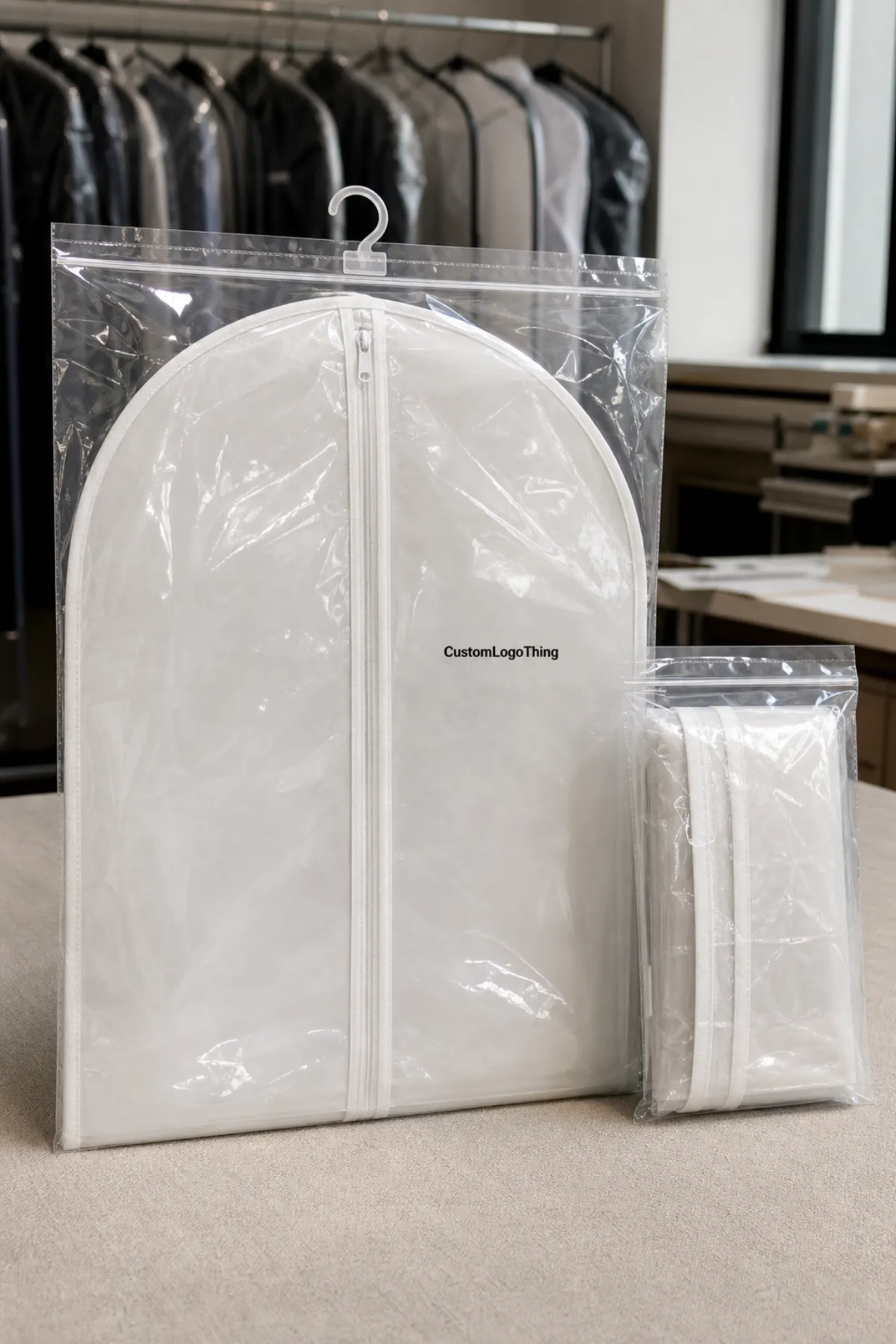
Lead time is not just a factory calendar. It is a chain of decisions that either stays simple or gets heavy quickly. Stock-size, unprinted bags made from standard clear LDPE film can move fast because the tooling already exists and the material is usually easy to source. Add a custom width, a gusset, a zipper, a hanger hole, or print, and the schedule starts depending on proof approval and setup, not only machine time.
The fastest orders are usually the ones with the fewest unknowns. A supplier can quote with more confidence when the finished dimensions, gauge, closure type, and carton count are already fixed. Leave one of those open, and the quote gets padded. Leave three open, and the timeline starts to drift.
For a basic unprinted run, 5 to 10 business days after approval is a common window if film is in stock and the order is not unusually large. Once the order adds print, heavier film, or a custom hanger-hole pattern, 12 to 20 business days is more realistic. If resin supply is tight or tooling has to be adjusted, the schedule stretches again.
The fastest order is the one that does not need to be rediscovered after the quote.
MOQ and lead time usually move together. If the build is more complex, the minimum often rises because the supplier has to cover setup, labor, and sometimes tooling. A low minimum sounds attractive until it is tied to a special construction that needs a longer run to make economic sense.
Where Clear Bags Earn Their Place
Clear Garment Bags win when visibility matters. Retail teams use them because a style, size, or colorway can be checked without opening the package. Distribution teams use them because receivers can confirm contents faster. In storage, they reduce handling, which matters when garments need to stay folded, pressed, or dust-free.
That visibility has a second effect that gets missed: it lowers touch count. Every extra opening, re-bagging step, or manual check adds labor. Across a bulk order, a small reduction per unit can turn into a measurable operational gain.
Opaque covers still have a role. They are better for privacy, premium presentation, and samples that should not be seen before approval. But if the workflow depends on quick identification and low-friction handling, clear covers usually make more sense.
- Suits and jackets: Easy style verification without opening the bag.
- Uniform programs: Faster sorting in warehouse and back-of-house workflows.
- Sales samples: Quick inspection before shipment or presentation.
- Retail replenishment: Less handling during receiving and shelf prep.
That said, clear packaging is not automatically the best choice. If the garment needs privacy, if branding matters more than visibility, or if the pack-out looks unfinished through a transparent cover, an opaque option can be the better decision.
Specs to Lock Before Quoting
Accurate pricing starts with exact specifications. For Clear Garment Bags, the minimum set is straightforward: finished width, finished length, film thickness, seal type, hanger-hole style, and whether the bag is flat or gusseted. Leave out one of those details and the quote may still be usable, but it will not be tight.
Thickness matters more than many buyers expect. A lighter film reduces cost per piece, but it can feel too soft for long transit or repeated handling. A heavier gauge improves stiffness and tear resistance, yet it raises material cost and may slow production if the tolerance needs to be tighter. For many clear garment bags, buyers look in the 1.5 to 3 mil range, but the right choice depends on garment weight and how the pack moves through the supply chain.
Hanger-hole style is another frequent source of revision. A simple punched hole or slot is easier to run than a custom cut that must be aligned across the batch. If the bag will hang on a retail rail, the opening should match the hanger hardware. If it is going into warehouse use, measure the actual hanger width rather than guessing from a catalog.
Carton pack-out matters too. A dense carton can lower freight cost, but it may also raise damage risk if the bags are compressed too tightly or if the stack is unstable. A quote that ignores pack count is incomplete. The bag is one item; the carton and pallet are part of the product.
A short checklist helps prevent the usual back-and-forth:
- Finished dimensions in inches or millimeters.
- Film gauge or thickness target.
- Flat or gusseted construction.
- Closure style, if any.
- Hanger-hole diameter or slot detail.
- Carton pack count and shipping destination.
If printing is involved, add artwork format, color count, and print placement. Those details can change setup time as much as the film spec itself.
Pricing, MOQ, and Unit Cost
Clear garment bag pricing usually follows a simple formula. Quantity tier, film weight, custom dimensions, print setup, and packing format all move the number. Comparing two quotes without comparing those variables is not a real comparison.
MOQ should be treated as a production threshold, not a sales trick. A supplier sets a minimum because setup, labor, and sometimes tooling need to be spread across the run. If the order is small and highly customized, those fixed costs land on fewer bags. The unit price rises with them.
| Option | Typical MOQ | Typical Lead Time | Approx. Cost Per Piece | Best Fit |
|---|---|---|---|---|
| Stock clear bag, unprinted | 500 to 1,000 | 5 to 10 business days | $0.12 to $0.22 | Simple replenishment and fast ship needs |
| Custom size, unprinted | 2,000 to 3,000 | 10 to 15 business days | $0.18 to $0.30 | Programs that need a specific fit |
| Custom size with print | 3,000 to 5,000 | 12 to 20 business days | $0.24 to $0.45 | Retail, branded programs, sample presentation |
| Heavy gauge or special construction | 5,000+ | 15 to 25 business days | $0.30 to $0.55 | Long transit lanes and higher abuse resistance |
Those ranges are directional, not universal. A lower MOQ can still cost more if the supplier has to create fresh tooling or reserve a film that is not in stock. A higher order can lower unit cost quickly because setup charges are diluted across more pieces. Printing follows the same pattern. More colors, more coverage, and more quality checks all increase the delivered cost.
The smartest buying approach is to compare unit price, freight, and rework risk together. A quote that looks cheap on paper can become expensive if it misses the ship window or triggers a second production run.
Timeline From Brief to Shipment
The order flow should be simple enough to fit on one page: inquiry, spec review, quote, proof approval, production, inspection, shipment. If a supplier cannot describe that sequence clearly, the lead time estimate is already weak.
Most delays happen before the line starts. The usual cause is incomplete information. A buyer sends the bag size but not the closure style. Or the width is known, but the hanger-hole diameter is not. Or the art is still changing, so the proof cannot be approved. Each missing detail adds another round, and every round adds time.
In practice, the cleanest orders are the ones where buyer and supplier agree on three things early: the final spec, the approved artwork, and the delivery destination. Once those are fixed, a factory can schedule the run with much more confidence. That matters because production slots are usually planned around resin availability, machine time, and carton packing capacity.
A realistic timeline often looks like this:
- Day 1 to 2: inquiry and spec confirmation.
- Day 2 to 4: formal quote and any revisions.
- Day 4 to 6: proof review and buyer approval.
- Day 6 onward: production, inspection, and packing.
- Final step: shipment booking and dispatch.
That is a typical shape, not a promise. A rush order, a tooling change, or a delayed proof can move any of those dates. If the packing has to survive longer transit, ask whether the carton build has been checked against common distribution standards such as ISTA handling and transport standards. If the brief includes paper cartons or inserts with sustainability requirements, FSC-certified material guidance may also matter.
Approval discipline shortens turnaround more than optimistic promises do.
Quality Control and Packing
Quality control is where repeat business gets protected. Buyers should care about gauge consistency, seal strength, clarity, hole placement, and dimensional accuracy across the run. If those drift, the bag may still look fine in a sample photo and fail in real handling.
One weak seal can create more downtime than a slightly higher unit price ever would. A bag that tears near the hanger hole can slow receiving, damage the garment, or force rework in the warehouse. If dimensions are off by even a small amount, folding and carton loading become inconsistent.
Compliance is not just about the film itself. It also includes how the order is packed and shipped. Ask how many bags go into each carton, whether the cartons are banded or lined, and how the pallet is built. A short domestic move does not demand the same protection as a cross-country freight run.
A basic inspection plan is enough for many orders. Even a simple AQL-style check on dimensions, sealing, and visual defects gives more confidence than a vague “we checked it” statement. The goal is not red tape. The goal is to catch problems before the order lands on your dock.
For regular replenishment, keep a short record of what failed last time. Was the film too soft? Was the hanger opening too narrow? Did the cartons crush in transit? That note helps the next order start from facts instead of memory.
Practical checks buyers usually ask for include:
- Seal integrity: No weak edges or open seams.
- Hole placement: Centered and aligned with the hanger spec.
- Clarity: No haze, streaking, or heavy scuffing.
- Dimensions: Length and width within agreed tolerance.
- Pack-out: Cartons loaded consistently and protected for transit.
What a Reliable Supplier Looks Like
The best suppliers behave like process partners, not quote mills. They confirm the spec quickly, explain where the MOQ really sits, and warn you early if a chosen build will trigger tooling fees or a longer production window. They also keep prior specs on file, which saves time when the same order needs to be repeated.
Communication matters most when the schedule shifts. A reliable supplier says what changed, why it changed, and what the new plan is. Buyers can handle bad news. They cannot plan around silence.
There is a long-term cost question too. A cheaper quote can look attractive until the order needs a correction, a rush freight upgrade, or a reprint. Then the savings vanish. A more responsive supplier may cost a little more on paper, but the total cost can be lower because the run is cleaner, the rework risk is smaller, and the reorder path is faster.
Consistency is a form of savings. Every time a supplier reproduces the same clear garment bag without drama, the buyer avoids another round of measurement checks, artwork edits, and freight surprises.
A good repeat supplier does not just remember your size. They remember your risk tolerance.
For procurement teams, that is the practical answer to clear garment bags Lead Time and MOQ: lock the spec early, compare like for like, and choose the run that fits the actual workflow instead of the prettiest quote.
FAQ
What affects clear garment bag lead time the most?
Finished size, film thickness, and custom printing usually have the biggest impact. Lead time also stretches when artwork, measurements, or proof approval are delayed. Stock sizes with simple specs typically move faster than custom runs.
What is a typical MOQ for clear garment bags?
MOQ depends on whether the bag is stock or custom, and whether printing or special dimensions are included. Custom sizes and heavier gauges usually require a higher minimum than standard unprinted bags. Ask for MOQ by exact spec, not by product name, because the threshold changes with the build.
Can I order samples before placing a bulk order?
Yes. A sample or pre-production proof helps confirm clarity, fit, and hanger-hole placement before the full run starts. For printed bags, review the artwork and layout on the proof rather than waiting until production is finished.
How does pricing change between stock and custom bags?
Custom dimensions, print setup, and thicker film raise unit cost. Stock sizes usually have lower setup cost and better price at smaller quantities. Higher volume lowers unit price by spreading setup across more bags.
What do you need to quote clear garment bags accurately?
Send finished dimensions, gauge target, closure style, hanger-hole details, quantity, and destination. If printing is included, provide artwork files and any color or placement requirements. The more complete the spec sheet, the faster the quote and lead time estimate.


