Buyer Fit Snapshot
| Best fit | Protective Foam Inserts Supplier projects where brand print, material claims, artwork control, MOQ, and repeat-order consistency need to be specified before quoting. |
|---|---|
| Quote inputs | Share finished size, material target, print colors, finish, packing count, annual reorder estimate, ship-to region, and any compliance wording. |
| Proofing check | Approve dieline scale, logo placement, barcode or warning zones, color tolerance, closure strength, and carton packing before bulk production. |
| Main risk | Vague material claims, crowded artwork, missing packing details, or unclear freight terms can make a low unit price expensive after revisions. |
Fast answer: Protective Foam Inserts Supplier: Material, Print, Proofing, and Reorder Risk should be specified like a repeatable production item. The safest quote records material, print method, finish, artwork proof, packing count, and reorder notes in one written spec.
Production checks before approval
Compare the actual filled-product size with the drawing, then confirm tolerance on folds, seals, hang holes, label areas, and retail display edges. Reserve space for logos, QR codes, warning copy, and material claims before decorative graphics fill the panel.
Quote comparison points
Review material grade, print process, finish, sampling route, tooling charges, carton quantity, and freight assumptions side by side. A quote is only useful when the supplier can repeat the same color, closure quality, and packing count on the next order.
Protective Foam Inserts Supplier: What to Look For
A warning label on a carton does not stop impact. A protective foam inserts supplier does, because the insert controls movement, absorbs force, and keeps corners from taking the first hit before the box structure even has a chance to help.
That sounds obvious once you say it out loud, but buyers still miss it. They start with the outer carton, then treat the insert as a filler item, almost like packing fluff. The shipment tells a different story. A loose product inside a strong box can still arrive damaged. In practice, the insert geometry is often the difference between a clean arrival and a claim, especially for electronics, cosmetics, medical devices, glass parts, and premium consumer goods.
I once reviewed a return batch of instrument housings that had passed a basic carton drop test and still failed in transit. The problem was not the box. The parts were drifting 6 to 8 mm inside the pack, just enough to scuff a surface finish and chip two corners. That is the kind of failure a good protective foam inserts supplier is supposed to prevent. Not dramatic, not glamorous, just expensive.
Choosing the Right supplier is not a narrow sourcing task. It changes the packaging system, the labor on the packing line, the rate of returns, and the first impression a customer gets when the box opens. A capable partner should turn product dimensions, fragility, and pack-out goals into a design that protects without making the package bulky or awkward to handle. If the design is too loose, the part moves. If it is too tight, the product starts fighting the foam. Neither outcome is worth celebrating.
What a Protective Foam Inserts Supplier Actually Does
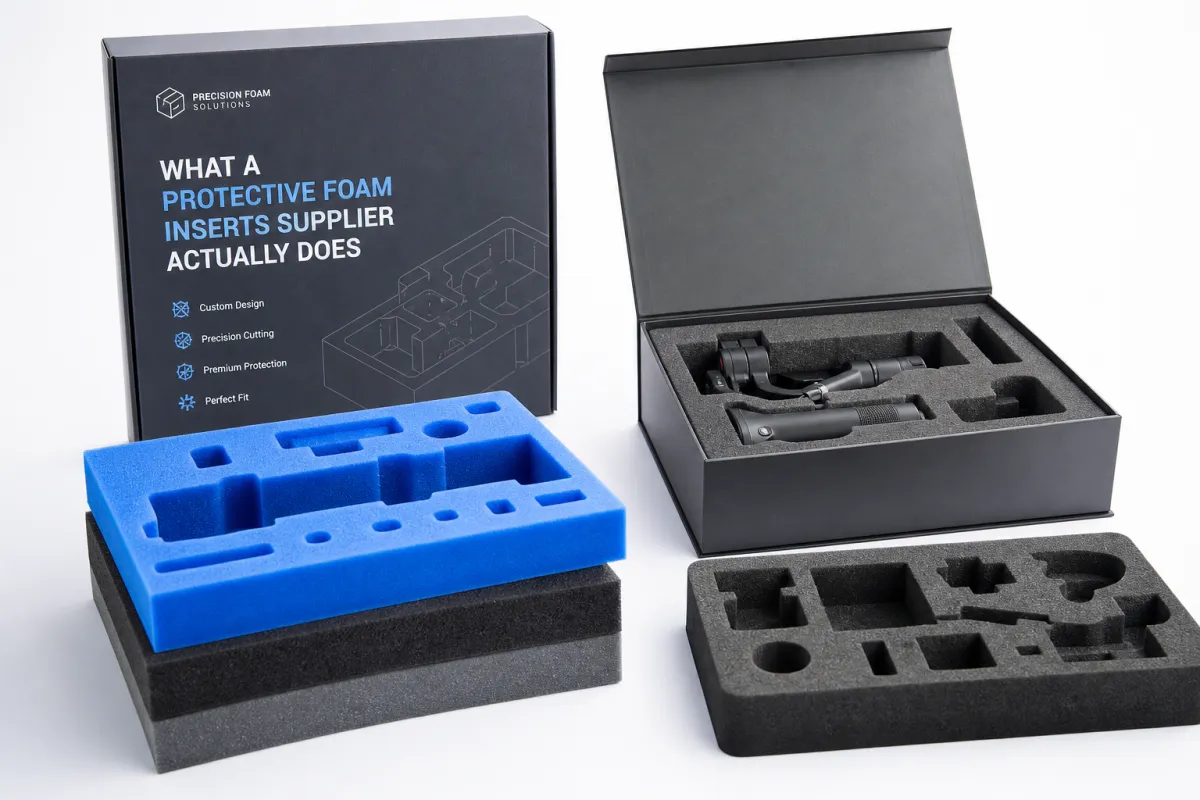
A printed caution label cannot stop vibration, edge crush, or a drop onto a conveyor corner. A protective foam inserts supplier handles those problems by shaping the empty space inside the carton so the product does not drift, tilt, or rattle in transit. The insert becomes the package's internal structure, which is a fancy way of saying it does the real work.
That matters even more for repeat shipments. Stock dunnage can work for low-value kits or temporary programs, but custom foam is built around the actual object rather than a generic outline. A good supplier studies the product footprint, wall thickness, center of gravity, and vulnerable surfaces, then turns those details into a cavity, cradle, or layered support system. The difference between those approaches sounds subtle. It usually is not.
The commercial side matters too. A tighter insert can shrink the carton, reduce void fill, and simplify pack-out. Less air in the box often means lower dimensional weight charges and fewer mistakes at the warehouse table. Shipping costs do not rise because the product is fragile; they rise because the package wastes space. A strong protective foam inserts supplier usually asks about carton size, drop risk, and the shipping network before recommending a material. That question alone tells you whether the supplier understands the job or just sells foam by the sheet.
Warning signs show up early. Scuffs on glossy surfaces, crushed corners, rattling when the box is shaken, and inconsistent placement from one unit to the next all point in the same direction: the insert is not controlling the product tightly enough. If the pack-out changes box to box, the supplier likely missed either the tolerances or the production discipline. And yes, the difference between "mostly fits" and "actually fits" is usually where the damage claims live.
There is a common misunderstanding that the foam should grip as tightly as possible. That is not always true. A packaging partner has to balance restraint with recovery. Too much squeeze can stress delicate housings, deform lids, or leave pressure marks on coated surfaces. Too little support and the product becomes a moving target. The goal is not to make the carton feel stuffed. The goal is to make movement irrelevant, which is a lot harder than it sounds.
Experienced teams treat a protective foam inserts supplier as part engineer, part packaging designer, and part manufacturing partner. The supplier is not only cutting foam. It is building a protection system that has to survive drops, conveyor vibration, stacking loads, and the rough handling that happens between the dock and the customer. That is why the good ones keep asking about the real shipping lane, not the ideal one.
How Protective Foam Inserts Work in the Real World
A foam insert protects in four ways: it absorbs shock, spreads compression, immobilizes the product, and removes extra void. A good protective foam inserts supplier designs for all four, because no single mechanism solves every shipment problem.
Shock absorption matters during drops and jolts. Softer cushioning foams damp impact energy, while denser foams provide structure and better shape retention. Compression matters when cartons are stacked in a trailer or when another box lands on top during transport. Immobilization matters whenever a product has sharp corners, a slippery finish, or a fragile internal assembly. Void control matters because movement inside the carton often causes more damage than the impact itself. That last point catches people off guard, but it shows up in a lot of failure reports.
Different foam families behave differently. Polyethylene foam is often chosen for cleaner support and better recovery. Polyurethane foam can work well for cushioning and irregular surface contact. Cross-linked polyethylene tends to offer a finer cell structure and a more polished cut edge. Anti-static options are common for electronics or assemblies that should not carry a charge. A capable protective foam inserts supplier matches the material to the product instead of defaulting to the lowest-cost stock. Cheap foam is rarely cheap if it creates returns.
Shape matters as much as chemistry. A product with protruding knobs, sharp corners, or a high center of gravity may need cutouts, relief pockets, or layered walls so the insert stabilizes it without concentrating pressure in one point. A glass bottle, a machined part, and a matte-finish consumer device can all need different foam behavior even when their outer dimensions look similar. That is one reason a strong supplier asks for photos and physical samples, not only CAD files. Drawings lie less than people do, but they still leave out the awkward details.
Fabrication methods shape the result too. Die-cutting is often efficient for repeatable production and simpler profiles. Waterjet cutting can help with cleaner edges and more detailed contours in certain materials. CNC routing works well for thicker or more complex builds. Laminated constructions let a supplier combine layers with different densities, which helps when one area needs structure and another needs soft contact. In some projects, the insert is a single piece. In others, it is a nested system of top, bottom, and side components that all have to work together.
The system effect is easy to underestimate. A well-built insert can shrink the carton, reduce exterior wrap, and eliminate extra void fill. That can lower freight dimensional weight, cut packing labor, and reduce the storage space needed for nested components. Put differently, a better insert is not only protection. It is often a cleaner package economics decision. When teams compare suppliers, this is where the conversation gets real fast.
Packaging testing does not rely on guesswork. ISTA procedures are widely used to simulate distribution hazards, and the organization is a useful reference point for buyers who want a more disciplined test plan: ISTA. A serious protective foam inserts supplier should be comfortable discussing drop heights, compression concerns, and how the insert behaves across a realistic shipping cycle. If that conversation stays vague, the design probably will too.
Key Factors When Choosing a Protective Foam Inserts Supplier
The first filter is material fit. Density, recovery, resilience, and chemical compatibility matter more than marketing language. If a product has a painted finish, the foam should not leave residue or imprinting. If the item is heavy, the material must resist bottoming out. If the shipment is likely to face long storage or hot freight lanes, the foam should keep its shape instead of sagging or taking a permanent set. A reliable protective foam inserts supplier should be able to explain those tradeoffs in plain language.
Product geometry comes next. Tolerances may sound like a production detail, yet they are a protection detail too. A housing with a 0.5 mm protrusion, a threaded fitting that sticks out, or a thin bezel edge can change the insert design completely. Buyers often send a nominal dimension sheet and wonder why the sample misses the mark. The answer is usually that the supplier designed to the outline, not the true risk points. A thorough partner asks where the stress is, where the finish is most sensitive, and where the product can tolerate contact.
Operational fit matters just as much. A design that looks perfect on a workbench can become a headache if it slows pack-out or does not fit the warehouse's existing carton sizes. The supplier should know whether the project is for 500 units a month or 50,000, because those are different manufacturing problems. Repeatability, nesting efficiency, and carton compatibility all shape the long-term success of the insert. A good supplier will speak to all of them, not just the foam itself.
Sustainability questions belong in the brief, not on the sidelines. Some buyers want recycled content; others want less scrap or a lighter shipping profile. Foam does not always fit tidy recycling narratives, so the packaging team should verify what local systems can actually handle rather than assume. The EPA's general recycling guidance is a useful baseline for separating wishful thinking from accepted practice: EPA recycling guidance. A thoughtful protective foam inserts supplier should be able to discuss waste reduction honestly, including where a design can save material without weakening protection.
Quality proof should come from samples, drop tests, compression tests, and documentation. Verbal reassurance is not enough. Ask for measured sample dimensions, photo approval, test notes, and revision control. If a supplier cannot explain what changed from version A to version B, or why a foam density was selected, the project is probably being handled by guesswork. A dependable protective foam inserts supplier makes the decision trail visible. That trail matters the first time a reorder goes sideways.
A buyer's best test is simple: shake the packed carton. If the product moves, the insert is still unfinished.
The most expensive mistake is not always the highest quote. The wrong supplier can increase returns, raise labor time, and create hidden rework across every shipment. That is why a protective foam inserts supplier should be judged on fit, proof, and consistency before price gets to play the starring role.
Protective Foam Inserts Supplier Pricing: What Changes the Quote
Pricing usually moves for five reasons: foam type, thickness, cut complexity, tooling or setup, and volume. A protective foam inserts supplier is not pulling numbers from nowhere; the quote is shaped by how hard the material is to source and how many production steps are needed to make it repeatable.
Very rough production ranges, assuming a simple insert set at around 5,000 units and no heavy branding, can look like this:
| Foam option | Best use | Typical unit cost impact | Notes |
|---|---|---|---|
| Polyethylene foam | Rigid support, edge protection, repeat shipments | $0.22-$0.65 | Often chosen for shape retention and cleaner pack-out |
| Polyurethane foam | Cushioning and irregular surface contact | $0.18-$0.45 | Good for softer protection, but can compress more over time |
| Cross-linked polyethylene | Premium appearance, tighter cut detail | $0.45-$0.95 | Usually higher cost, often better finish |
| Anti-static foam | Electronics and sensitive assemblies | $0.60-$1.50 | Specialty material adds cost, but may be required |
Those numbers are directional, not universal. A supplier may quote lower or higher depending on nesting efficiency, thickness, scrap rate, and whether the insert needs multiple layers or a laminated build. A thin two-piece set is a very different job from a deep cradle with relief pockets and branding.
MOQ matters too. Larger runs usually reduce unit cost because setup time gets spread across more pieces. Reorders often cost less than first runs because the supplier already has the design, the tooling, and the approval history. If the item changes every few months, the economics shift. The right partner may recommend a design that is easier to modify even if the first quote looks a little higher, because it lowers revision pain later.
Prototype pricing should be separated from production pricing. The first sample often includes CAD work, mockup material, a small setup charge, and extra inspection time. That is normal. Buyers sometimes compare a prototype invoice to a production quote and assume someone is padding margins. In reality, the early run often carries the development cost that production will later absorb. A transparent supplier will explain which costs are one-time and which repeat.
Hidden costs are where bad decisions usually hide. Rework can erase a small unit-price savings very quickly. Freight can climb if the insert is bulky. Storage costs rise if the design nests poorly. Damage claims can swamp everything else if the package looks cheap but fails in transit. From a buying perspective, the correct comparison is total landed cost, not only the invoice line for foam. A smart protective foam inserts supplier helps quantify that, even if the answer is not the cheapest quote in the inbox.
It also helps to know what changes the price from a manufacturing point of view. A simple die-cut shape with generous tolerances is faster than a tight, multi-step profile with deep cutouts. A single-density block is cheaper than a laminated insert with different compression zones. Printed branding, color matching, and specialty coatings can all add cost. The more the insert is doing, the more the quote should reflect it. That is not price inflation; that is the cost of functional design.
Step-by-Step Process for Working With a Protective Foam Inserts Supplier
The best projects start with a complete brief. Before asking for a quote, gather product dimensions, weight, photos from multiple angles, any fragile areas, the target carton size, the expected annual volume, and the shipping conditions. If there is an actual sample on hand, send it. A supplier can work from drawings, but the process usually gets faster and more accurate once the team can see the real object.
From there, the design usually moves into CAD or a mockup stage. Some suppliers begin with a digital layout, while others cut a quick physical concept to check fit. That first proof is where many hidden assumptions surface. Maybe the product is heavier than expected. Maybe a cable protrudes farther than the drawing suggested. Maybe a lid flexes in transit and needs extra side support. A careful protective foam inserts supplier uses that stage to correct the design before the project becomes expensive.
The next step is a prototype. This is where the insert meets the actual product inside the actual carton. Buyers should test the real pack-out, not a simplified demo. Shake the box. Tilt it. Stack it. Run a basic drop sequence that reflects the shipment path rather than a perfect lab scenario. If the project is for a fragile, high-value item, document the test conditions in writing. A disciplined supplier should welcome that discipline, because it reduces confusion later.
Revision is normal. In fact, it is often the most useful part of the process. Tolerances may need tightening. Cutouts may need widening. Density may need a change. The key is fast, specific feedback. Saying "too loose" is less useful than saying "the product shifts 4-6 mm when the carton is rotated." A capable protective foam inserts supplier can work with that kind of note because it translates directly into geometry.
Realistic timing depends on complexity. A straightforward insert can move from brief to prototype in 3-7 business days, then from approved sample to production in roughly 10-15 business days if material is available. More complex laminated builds, specialty foams, or projects that need multiple revision cycles can take 2-4 weeks or more before full production begins. A supplier should say that plainly instead of promising a date that only works if nothing changes.
Rush production is possible in some cases, but not always wise. If the product is highly fragile, if tooling must be created, or if the foam specification is new, compressing the schedule can weaken the approval stage. That is a false economy. Missing one shipping window is annoying; sending out a damaged product line is worse. A realistic protective foam inserts supplier will explain where speed is safe and where it starts to compromise quality.
The final step is handoff. The supplier should provide the approved spec, material description, and any pack-out notes so the warehouse team can reproduce the same result every time. If the insert is easy to misorient, label it. If the carton has a specific loading order, document it. Strong packaging systems are built on repetition, not memory. A good design that cannot be packed consistently is only half a solution.
Common Mistakes Buyers Make With Foam Inserts
The most common mistake is spec'ing foam by feel. "Softer" or "firmer" is not enough information for a sourcing decision. A supplier needs performance details: compression behavior, resilience, density, and whether the product needs cushioning or rigid support. Feel is subjective; shipping performance is measurable. There is a big difference, and the freight bill tends to expose it.
Another error is ignoring the rest of the package. Carton strength, stack height, pallet pattern, and outer pack format all influence whether the insert will work. A foam design that performs well in a bench test can fail if the outer carton buckles or if pallet stacking loads compress the headspace. A good protective foam inserts supplier thinks about the system, not just the foam block.
Tolerance mistakes are common too. Too tight, and the insert can stress a painted surface or crack a brittle corner. Too loose, and the product moves enough to create scuffs or impact damage. Buyers often under-specify clearance because they want the box to look neat. Neat is not the same as secure. A seasoned supplier will usually push back if the product needs a little more room to breathe.
Price-only sourcing causes trouble as well. A low quote can hide weak material quality, poor repeatability, or a design that uses more labor on the packing line. If damage rates rise, the unit savings disappear fast. Returns, customer service calls, freight replacements, and rework all cost more than the apparent discount. That is why a protective foam inserts supplier should be compared on damage control and process stability, not price alone.
Special requirements are another place where teams miss the mark. Electronics may need anti-static materials. Moisture-sensitive goods may need better environmental control. Clean-room or low-lint applications need careful material selection. Products stored in hot warehouses may need foam that resists deformation. A thoughtful supplier will ask about the real use case instead of assuming every package follows the same path.
There is also a documentation mistake that shows up later. If the approved sample is not captured with enough detail, the next reorder can drift. The foam may be "close," but close is not the same as approved. Keep version numbers, photos, dimensions, and material calls in one place. A reliable supplier should make that traceability easy, not awkward. Nobody enjoys arguing over a sample that no one can quite identify six months later.
Some buyers forget that packaging performance should be tested against the product's actual failure mode. If corners are chipping, corner support matters more than center cushioning. If a connector is snapping, immobilization at the connector is critical. If a glossy panel is scuffing, surface contact needs to be rethought. The right partner does not just cut foam to size; it designs against the way the product actually fails.
How Do You Choose a Protective Foam Inserts Supplier?
Start by asking for a sample kit and a written recommendation. A good protective foam inserts supplier should be able to explain why one foam is better than another for the specific product, not only why one quote is lower. If the explanation is thin, the engineering probably is too. Cheap answers tend to create expensive boxes.
Ask how revisions are handled. That question tells you a lot. Suppliers with a clear process will describe version control, approval steps, and what happens if a carton size changes after sampling. Suppliers without a process tend to treat each adjustment like a fresh problem. A responsive partner should make revision management feel orderly. If every change turns into a scramble, pack-out will feel like that too.
Look for evidence, not hype. Request photos of previous builds, test notes, and a description of how the insert was validated. Ask whether the sample was tested in a lab, on a bench, or only by hand. Those distinctions matter. A strong supplier is usually comfortable discussing the limits of a test, which is often a better sign of credibility than a broad promise of perfection. Perfect is not a process. It is a slogan.
Build a comparison sheet before you decide. Score each supplier on cost, lead time, sample quality, communication speed, engineering support, and reorder ease. Add a column for damage-risk reduction if your team can estimate it. That makes the decision more concrete. A protective foam inserts supplier that costs slightly more but cuts damage claims by half can still be the better business choice.
Pay attention to the warehouse experience too. If the insert takes too long to load, the pack-out line will feel it every day. If parts are confusing, errors will creep in. If the foam sheds dust or creates static concerns, those problems will become operational friction. The right partner should solve for the whole journey: production, packing, transit, and unboxing.
Use standards as a sanity check. ASTM methods for flexible foams can help frame compression and recovery expectations, while ISTA procedures help build a shipping test plan. No standard replaces a real product test, but standards make supplier conversations less vague. The best buyers ask suppliers to explain how the insert aligns with the test route the product actually faces, not just the route on paper.
If you want a practical way to move forward, shortlist two suppliers, send the same brief to both, request samples, and compare the responses line by line. Do not let each company redesign the brief for its own convenience. Ask the same questions of each protective foam inserts supplier, then judge the clarity of the answers. That is where the real difference usually appears.
One last point: the supplier should help protect margin, not only product. That means asking about freight, labor, storage, and reorder consistency. It also means being honest when a small design change can save money over thousands of units. A dependable protective foam inserts supplier thinks in total package cost, which is where the smartest packaging decisions usually live.
Brands that want a cleaner, more durable pack-out need a partner that can show its work, test its assumptions, and keep production stable over repeat orders. A protective foam inserts supplier should reduce damage, simplify operations, and make the package feel deliberate from the first shipment to the hundredth.
The most useful next step is not another round of generic sourcing. It is a side-by-side sample review built from the same product, the same carton, and the same test conditions. Once those three variables are fixed, the differences between suppliers stop hiding in the noise. That is the point where the right choice becomes obvious, or at least a lot less fuzzy.
How do I compare protective foam inserts suppliers?
Send the same product brief to each supplier so the quotes are comparable. Then score each protective foam inserts supplier on sample quality, engineering support, lead time, and how clearly they explain tradeoffs. Ask for test evidence and a revision process, not only a price.
What information does a supplier need for an accurate quote?
Provide product dimensions, weight, fragile areas, carton size, annual volume, and any special handling requirements. If possible, include photos or an actual sample so the supplier can judge tolerances, clearance, and pack-out needs before quoting.
How much do protective foam inserts usually cost?
Pricing depends on foam type, thickness, cut complexity, and the order quantity. The first prototype or tooling run usually costs more than repeat production, so the best comparison is total landed cost, not only the invoice from the protective foam inserts supplier.
How long does it take to develop custom foam inserts?
A simple project can move from brief to prototype in about 3-7 business days, while more complex builds may need 2-4 weeks or more. Sampling, approval, and tooling are the steps most likely to affect the schedule, and a good protective foam inserts supplier will be upfront about that.
Which foam type is best for fragile products?
Rigid, high-support foams are often better for products that must not shift in transit, while softer cushioning foams can work well when shock absorption is the main goal. Anti-static or specialty materials may be necessary for electronics, medical parts, or moisture-sensitive items. The right supplier should match the foam to the failure mode, not the other way around.
If you are comparing options now, focus on fit, repeatability, and total cost. A reliable protective foam inserts supplier should make the package easier to ship, easier to pack, and harder to damage.