A retail Foam Trucker Hats factory quote only matters if it reflects the whole product, not just the cap body. A foam-front trucker can look inexpensive at first glance, then pick up cost through decoration, labels, packaging, and freight. That gap is where most buying mistakes start.
Foam truckers sell because they are visually loud and structurally simple. The front panel gives a wide graphic area, the mesh back keeps the cap light, and the overall shape reads quickly from a rack, peg, or display table. That visibility is valuable in souvenir stores, concert merch programs, convenience retail, and seasonal promotions, where a customer often makes a decision in seconds.
The hard part is pricing the hat as a retail item instead of a blank. A factory can quote a plain foam trucker cheaply, but a shelf-ready version needs cleaner finishing and tighter packing discipline. Those details are easy to overlook until the sample comes back and the numbers no longer match the original plan.
There is also a practical production reality behind the numbers. Foam fronts are forgiving in some ways and stubborn in others. They handle bold graphics well, but heavy stitch density, weak artwork files, or vague packaging instructions can make the order slower and more expensive than expected. Buyers who understand that difference usually get better quotes and fewer revisions.
For transport and carton handling, the basics still matter. ISTA publishes testing standards that help buyers think about drop risk, stacked cartons, and retail-ready packing. You do not need lab-grade testing for every run, but you do need enough protection that caps arrive without crushed fronts, bent bills, or damaged labels.
Why Foam Trucker Hats Are a Fast Retail Win
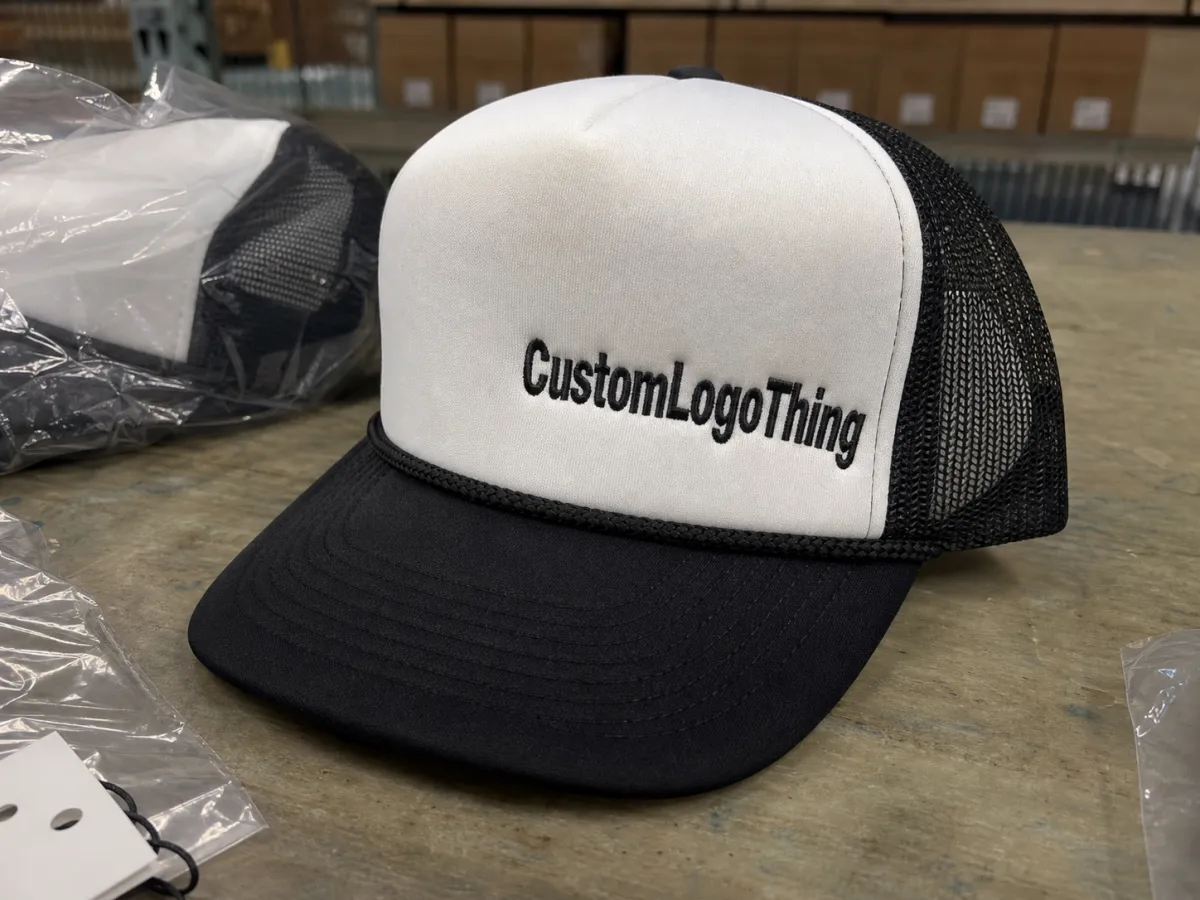
Foam-front truckers have one obvious advantage: they are easy to notice. The front panel sits tall, the shape is bold, and the cap has enough visual space to carry a logo without feeling crowded. That makes the style useful for brand merch and tourist retail, where the hat has to do its job quickly, before the buyer starts comparing finer details.
They also sit in a useful cost band. A foam trucker is usually cheaper to build than a fully structured cap with heavier fabric panels, but the price advantage only survives if the order stays simple. Add dense embroidery, multiple decoration locations, custom inserts, or overly elaborate packaging, and the unit cost climbs fast.
For most buyers, the budget tends to move on a few practical choices:
- Decoration method - screen print, woven patch, heat transfer, PVC patch, or light embroidery
- Front panel material - EVA or similar foam, thickness, and surface finish
- Packaging level - bulk packed, individual polybag, hangtag, barcode, or display carton
- Color handling - stock colors are faster; custom Pantone matching adds time and sometimes waste
- Trim details - sweatband, inner tape, label style, and snapback closure quality
That is why foam truckers work well for retail programs that need strong shelf presence without a heavy construction bill. They are also useful for test programs. A buyer can trial a colorway, graphic, or seasonal drop without committing to a more expensive silhouette. The flip side is that the cap has to be finished well enough to hold up in a store, because the low-cost look can turn into a cheap-looking product very quickly.
The difference between a good and bad run is often subtle. A slightly flatter front panel, a cleaner bill curve, or a better patch placement can change how the cap reads from five feet away. On a crowded shelf, five feet is enough.
What Makes the Cap Look Retail-Ready on Shelf
Buyers usually judge the cap before they touch it. That means the visual stack has to work: crown height, front panel firmness, mesh quality, visor shape, and closure finish all need to line up. If one element feels off, the cap reads as lower grade even if the materials are acceptable.
The front panel carries most of the retail burden. Foam that is too soft tends to wrinkle around the logo or bend during packing. Foam that is too stiff can make the cap feel bulky and awkward. Most factories settle somewhere in the middle, usually with a front panel that holds shape while still tolerating the heat and pressure of decoration.
Material choice matters more than buyers sometimes expect. Foam fronts are commonly made with EVA or a similar lightweight foam sheet, while the mesh back is usually polyester. Sweatbands may be cotton, poly-cotton, or a simple tricot tape, depending on price point. None of those details sounds dramatic on a quote sheet, but each one changes hand feel, recovery, and how the cap survives shipping.
Retail details are the ones that basic quotes often skip. A finished cap may need a woven label, barcode sticker, hangtag, polybag, carton mark, size sticker, and batch identification. If the order is going to a store chain or distributor, those pieces are not decoration; they are part of the product. Missing one can create receiving problems even if the hat itself is fine.
Clean finishing is another quiet value driver. Tighter seam alignment, a more consistent bill curve, and even color blocking all help the cap look deliberate. Buyers notice when a batch arrives with one bill stiffer than the next, or when the front panel sits slightly crooked. Those inconsistencies do not always show up in a photo. They show up on a shelf.
A retail cap does not need to be expensive. It needs to look controlled. Sloppy finishing is usually what makes a solid quote feel overpriced.
The packaging level also changes how the product is perceived. A cap tossed into a carton with no order is cheaper to ship, but it can arrive with flattened fronts and bent bills. A simple polybag and orderly stacking add a small amount of cost and a large amount of presentation value. That tradeoff is usually worth making for retail stock.
Specs That Change Fit, Feel, and Decoration Results
Accurate quoting starts with exact specs. A factory needs more than a logo and a quantity. It needs front foam thickness, panel structure, mesh type, closure style, bill shape, decoration method, and packaging requirements before it can give a quote that means anything. Loose instructions produce loose pricing.
Decoration choice is a major variable. Screen print usually gives the cleanest low-cost result on foam when the artwork is bold and the surface is flat. Patches add texture and can feel more premium, especially for retail. Heat transfer works well for sharper gradients or smaller graphics, though the foam surface and the intended wash or wear life need to be considered. Dense embroidery can work on some foam truckers, but it can also compress the front and distort the shape.
Artwork quality matters just as much as method. Clean vector files, Pantone references, and exact placement dimensions reduce the number of proof rounds. When the logo size is too large for the available panel, it can wrap awkwardly around seams. When the color target is vague, the factory will usually produce something close rather than something exact. That sounds minor until a whole run arrives in the wrong shade.
Fit is another detail buyers underestimate. Foam truckers are usually adjustable, but the base fit still depends on crown depth, inner sweatband feel, and the stiffness of the back mesh. A cap can technically fit a head and still feel wrong in hand. For retail use, that hand feel matters because customers pick caps up, try them on, and compare them against adjacent products.
Here is a practical sample review checklist:
- Check fit on more than one head size.
- Inspect the front panel from arm’s length and shelf distance.
- Confirm the logo sits flat and centered without distortion.
- Look at the brim curve, stitch finish, and edge consistency.
- Verify the closure, label, and packing method match the quote.
The sample should also reveal whether the cap survives normal handling. If the front dents too easily, the foam is probably too soft for retail packing. If the print sits well but the bill arrives warped, the issue may be in pressing or carton stacking rather than decoration. A good sample answers those questions before the bulk order starts.
Small quality controls make a large difference on foam truckers. Stitch density should be even. Panels should line up. The closure should hold without snagging. Boxes should not crush the front panel. None of those checks is glamorous, but they are the reason one run feels retail-ready and another feels like a warehouse closeout.
Retail Foam Trucker Hats Factory Quote: What Changes the Price
This is where the quote stops being theoretical. A retail Foam Trucker Hats factory quote usually shifts on five inputs: quantity, decoration complexity, color count, packaging level, and shipping destination. Everything else matters less than buyers think. Once those five are clear, the pricing starts to make sense.
Quantity is the biggest driver. Lower runs can be done, but they carry a higher unit cost because setup and labor are spread across fewer pieces. For straightforward foam truckers, a practical MOQ is often 100 to 300 pieces. Once the order needs retail packaging, custom labels, or more involved artwork, the minimum may move upward. That is not a trick. It is just how line setup works.
Decoration complexity is the next lever. A single-color front print on a stock black cap is much easier to quote than a multicolor patch with custom backing and placement instructions. More colors, more steps, and more correction time all add cost. Dense decoration also raises rejection risk, which factories price into the run whether they say so or not.
Packaging has a real unit cost. A blank cap in a carton is one thing; an individually bagged cap with a hangtag, barcode, size sticker, and retail carton mark is another. The more the product needs to be retail-ready on arrival, the more handling it needs before shipment. That extra handling often costs more than the printing itself on simpler runs.
Color matching can also move the number. Stock black, white, and standard mesh colors are faster to source and easier to schedule. Custom body colors or foam shades may require extra material coordination, color approvals, and sometimes a minimum dye or sheet purchase. A buyer who wants precise brand matching should expect the quote to reflect that.
Here is a practical ballpark for comparing factory pricing:
| Order Tier | Typical Unit Price | Sample / Setup Cost | Packaging Level | Best For |
|---|---|---|---|---|
| 100-300 pcs | $2.80-$4.50 | $40-$120 sample, possible setup charge | Bulk packed or basic polybag | Pilot retail tests, event merch, small regional programs |
| 500-1,000 pcs | $1.90-$3.10 | $35-$100 sample, lower setup pressure | Polybag, hangtag, barcode, carton marks | Seasonal retail, souvenir programs, brand drops |
| 2,000+ pcs | $1.35-$2.40 | Sample fee often easier to credit back | Retail-ready packing, batch labels, custom inserts | Repeat programs, wider distribution, multi-store rollout |
Those numbers are only a working range. They move with material quality, print area, how much handwork the cap requires, and whether the order includes packing that takes extra labor. A price that looks too low can also hide shortcuts: thinner foam, loose stitching, low-grade mesh, or packaging that falls apart during transit. Cheap is only cheap if the finished goods still sell.
Ask for a line-item quote whenever possible. Sample fee, setup charge, unit price, packing, and freight should each be visible. If a factory sends a single number with no breakdown, it becomes hard to judge whether the quote is efficient or padded. Tiered pricing at three quantities is even better, because it shows how the cost changes if you decide to scale the run.
Freight matters more than many buyers expect. A small hat is light, but boxes add up, and air freight can erase the advantage of a low unit cost. Sea freight is slower but often makes more sense for repeat retail stock. The right choice depends on launch timing and the margin left after inbound shipping. A cap that misses its release window is not a bargain.
Production Steps, Proofing, and Turnaround Timing
Good production should feel plain. Inquiry, spec review, artwork proof, sample approval, bulk production, inspection, packing, and shipment booking are the normal steps. If a supplier cannot describe that sequence clearly, the rest of the job often becomes harder than it needs to be.
Proofing usually takes longer than buyers expect because the first pass is where most errors surface. If the artwork is clean, sample confirmation may take a few business days. If the logo needs rebuilding, colors need adjustment, or packaging needs to be added after the fact, the schedule stretches. That is the part that most often pushes a “quick” order out by a week or more.
For a standard custom run, bulk production often lands around 15 to 30 business days after sample approval. Small orders can move faster if the material is in stock and the decoration is simple. Larger orders, custom colors, and more involved packing usually take longer. The timing also depends on whether the factory is balancing other production lines at the same moment.
These are the usual delay points:
- Artwork files that need to be rebuilt before proofing can start
- Color revisions after the first sample or digital mockup
- Packaging changes after production has already been scheduled
- Late barcode, hangtag, or carton mark edits
- Freight bookings that were never reserved early enough
Inspection should not be treated as an afterthought. A retail order benefits from a straightforward QC checklist: logo placement, stitch consistency, foam surface quality, bill curve, closure function, label accuracy, and packing count. If the order includes multiple colorways, random carton checks matter even more because batch variation can hide until the end of the run.
There is also a materials issue that affects timing. Foam, mesh, and trim are not always pulled from the same shelf. If a custom color or special closure is required, the factory may need to source or schedule those components before production can start. That is one reason why a quote that looks fast on paper can move slowly once the details are locked.
Shipping should be treated as a separate timeline, not a footnote. Sea freight, air freight, and courier shipping each change the arrival date and the landed cost. If a buyer is supplying stores with a seasonal drop, the production window needs enough margin for delays at packing, export booking, or customs review. The product might be ready on time and still arrive late.
What a Reliable Cap Factory Does Better Than a Trading Company
Direct factory control usually means fewer handoffs and fewer chances for the spec to drift. That matters on a retail order, where a small shift in label placement or packing method can create a receiving issue later. Every extra handoff adds another point where details can get softened, translated poorly, or simply missed.
The practical benefit is consistency. A factory that controls the line, the sample, and the packing process can usually keep carton counts, label placement, and color matching tighter across a run. That matters if the same style will be reordered, sold in multiple locations, or compared side by side with other inventory. Retail buyers notice batch variation faster than most suppliers expect.
Trading companies can still be useful. They may offer broader sourcing, faster category mixing, or easier communication for buyers who need several product types at once. The tradeoff is that technical correction can take longer if the order needs precise material or decoration adjustments. For a foam trucker run, where decoration and packing are already enough variables, a thinner chain of communication is usually safer.
That said, direct factory buying is not automatically better. A small order with unclear art, a missing spec sheet, or unrealistic timing will still be difficult no matter who is managing it. The supplier can only quote against the information provided. Weak briefs create weak quotes, and that is true in every market.
Useful proof from a supplier is concrete, not promotional. Ask for sample images, packing photos, inspection notes, or a comparison against a similar cap build. If a source cannot show how it handles retail packing or repeat consistency, the buyer is taking a gamble on the final finish.
A reliable factory should also be able to explain its quality checks in plain language. Look for measurements on crown depth, bill shape, label accuracy, and carton counts. If the answer stays vague, the risk usually shows up later in the shipment.
How to Send Specs So the Quote Comes Back Clean
Send one complete request package. Quantity, logo file, decoration method, target colors, packaging needs, and delivery deadline should all be in the first message. If the factory has to chase each detail separately, the quote gets slower and less precise.
Retail requirements should be named up front. If the cap needs a barcode, hangtag, polybag, carton label, or special pack-out method, include that before the quote is issued. A factory can only price the packing it knows about. Leaving those details out usually makes the first quote look cheaper than the finished order will be.
A clear brief also makes it easier to compare options. Ask for quantities at multiple tiers, sample cost, turnaround time, and packaging upgrades in one view. That lets you see where the pricing softens and where it rises sharply. If a supplier refuses to quote tiered pricing, the cost picture may not be complete.
Here is a sample request format that gets a practical answer:
- 500 foam trucker hats
- White foam front, black mesh back
- Two-color front screen print
- Polybag, hangtag, and barcode label
- Landed timing for store delivery
That is enough detail for a real retail quote. It is not elaborate, but it is specific. If the goal is to keep the retail foam trucker hats factory quote clean, the spec sheet has to do the heavy lifting. Vague requests create vague answers, and vague answers are where budgets get damaged.
One more practical point: keep the decoration area realistic. Foam fronts work best when the artwork respects the panel size and the cap shape. A logo that is too tall, too wide, or too close to the seam will either distort or force a redesign. Good suppliers will flag that early. Better buyers expect it.
What should be included in a retail foam trucker hats factory quote request?
Include quantity, logo file, decoration method, color references, packaging requirements, and the delivery destination. If the order needs barcode labels, hangtags, or retail carton marks, say that before the quote is issued. Ask for pricing at multiple quantity tiers so you can see how the unit cost changes.
What MOQ is normal for foam trucker hats from a factory?
A practical MOQ is often 100 to 300 pieces for a simple run, though the number can move with decoration and packing. Retail packaging, custom labels, and color matching usually raise the minimum. Lower MOQs are possible, but the per-piece price usually climbs because setup costs are spread across fewer hats.
How much does a sample usually cost?
Sample cost usually covers setup, materials, and one proof run, so it is often higher than the unit cost in bulk. Complex graphics, custom packaging, or multiple revisions can raise that fee. Some factories will credit part of the sample charge back if the bulk order proceeds.
How long does production take after sample approval?
For a standard custom order, bulk production often takes about 15 to 30 business days after approval. Simpler jobs can move faster, while custom colors, special packaging, or heavy revision cycles can add time. Freight is separate, so shipping time should be planned alongside production time.
What decoration gives the cleanest retail finish on foam front caps?
Flat screen print and well-made patches usually give the cleanest retail look on foam fronts. Dense embroidery can work, but it may compress the panel or distort the logo. The right method depends on logo size, shelf distance, and the level of durability the product needs.
What quality checks matter most before shipment?
Check logo placement, panel symmetry, bill curve, closure function, packing count, and label accuracy. Also inspect whether the foam front dents too easily or the mesh feels too soft for retail display. A short pre-shipment check catches most of the problems that turn into receiving complaints later.

