Buyer Fit Snapshot
| Best fit | Recyclable Packaging Custom Printed projects where brand print, material claims, artwork control, MOQ, and repeat-order consistency need to be specified before quoting. |
|---|---|
| Quote inputs | Share finished size, material target, print colors, finish, packing count, annual reorder estimate, ship-to region, and any compliance wording. |
| Proofing check | Approve dieline scale, logo placement, barcode or warning zones, color tolerance, closure strength, and carton packing before bulk production. |
| Main risk | Vague material claims, crowded artwork, missing packing details, or unclear freight terms can make a low unit price expensive after revisions. |
Fast answer: Recyclable Packaging Custom Printed: Quote Scope should be specified like a repeatable production item. The safest quote records material, print method, finish, artwork proof, packing count, and reorder notes in one written spec.
Production checks before approval
Compare the actual filled-product size with the drawing, then confirm tolerance on folds, seals, hang holes, label areas, and retail display edges. Reserve space for logos, QR codes, warning copy, and material claims before decorative graphics fill the panel.
Quote comparison points
Review material grade, print process, finish, sampling route, tooling charges, carton quantity, and freight assumptions side by side. A quote is only useful when the supplier can repeat the same color, closure quality, and packing count on the next order.
Recyclable Packaging Custom Printed: What to Know First
If you are sourcing recyclable packaging custom printed for a launch, start with the least glamorous part: the material. Pretty artwork does not make a package recyclable. Neither does a green leaf icon slapped on a box like it solved anything. I have seen a lot of projects get stuck because the team fell in love with the mockup before anyone checked the substrate. A carton can look clean on shelf, carry a sharp logo, and still fail once a coating, adhesive, liner, or window film gets in the way of recovery.
For any brand buying recyclable packaging custom printed, the real question is not whether the graphics will print. The real question is whether the package still belongs in the recycling stream after printing, converting, shipping, and consumer use. That distinction matters because packaging decisions are never isolated. They affect cost, line speed, damage rates, shelf presence, and whether your sustainability claim survives contact with reality. Fancy claims are easy. Keeping them true is the part that takes work.
What recyclable packaging custom printed actually means
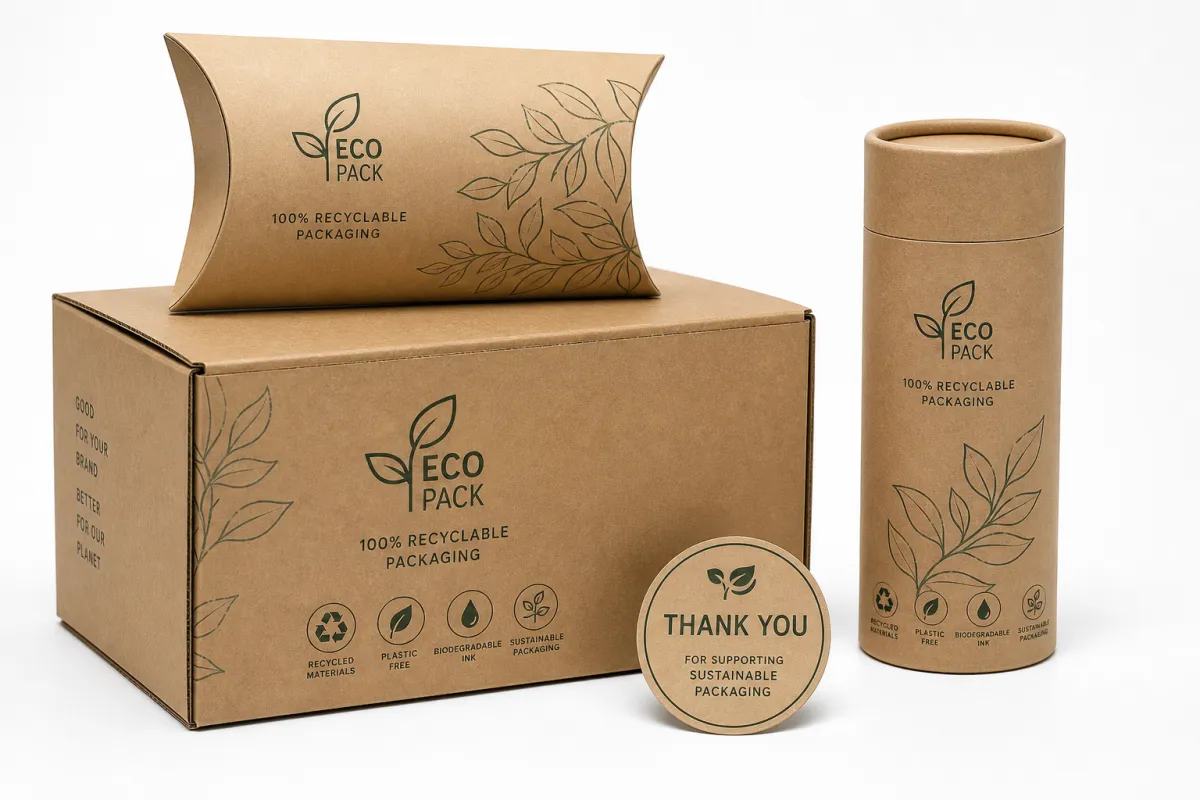
Recyclable packaging custom printed means the package is designed to enter an existing recycling stream and still carry brand graphics, product information, legal copy, and compliance marks. That sounds simple until you start checking how recycling actually works. It is not a visual category. It is a system result. A package may be accepted in one region and rejected in another because collection rules, sorters, bale standards, and recovery equipment vary.
That difference matters to buyers. A plain kraft mailer may feel cleaner than a laminated carton, yet both can fail if the adhesives or coatings interfere with fiber recovery. A well-executed recyclable packaging custom printed format can still be practical, but only if the design stays close to one substrate, one recovery path, and one finishing strategy. The spec sheet tells the truth. The front panel usually does not.
There is also a constant tug-of-war between packaging design freedom and recovery rules. Brand teams want rich color, tactile finishes, metallic accents, inserts, and visual drama. Operations wants a pack that runs without drama and arrives intact. Recycling teams want a structure that does not confuse material recovery facilities or contaminate a fiber or plastic stream. Good recyclable packaging custom printed work respects all three sides of that triangle instead of pretending the trade-offs disappear.
The phrase covers a wide spread of formats: paperboard cartons, corrugated mailers, molded fiber trays, mono-material pouches, and some rigid plastic structures. The common thread is the base format is chosen with recovery in mind while the print still supports branded packaging and shelf communication goals. That is why a supplier who understands both print production and end-of-life behavior usually delivers more value than a shop that only knows how to make artwork look good.
Recyclable packaging custom printed also depends on documentation. You need substrate details, ink and coating notes, supplier data, and a clear statement of where the pack can be recycled. The U.S. EPA's recycling guidance is a solid reference for why local collection systems differ: EPA recycling resources. The claim should match the real material path, not a hopeful line in a deck. If the recycling route is unclear, the claim is probably too.
"A package that looks sustainable but fails on press, in transit, or in the recycling bin costs money in all three places."
How recyclable packaging custom printed works in production
The production path for recyclable packaging custom printed usually follows the same order: choose the material, build the artwork, select the print method, convert the structure, apply finishing, then check recyclability before sign-off. Each step affects the next. Change the board caliper and the fold score shifts. Change the print process and ink laydown changes. Add a coating and the recycling path may change. Packaging is rarely just a graphics problem, no matter how often someone in a meeting tries to treat it that way.
Material selection comes first. Paperboard, corrugated board, molded fiber, and mono-material plastics all behave differently. Paper-based formats are popular for Custom Printed Boxes because they offer strong shelf presence, good print quality, and relatively clear recycling routes in many markets. Corrugated works well when shipping strength matters. Molded fiber is useful for protective inserts. Mono-material films can work too, but once you start layering materials, the recovery story gets more complicated and more fragile. The more mixed the structure, the more cautious you need to be.
Print method choice matters just as much. Flexographic printing is common for corrugated and labels because it handles long runs efficiently and keeps unit pricing manageable after setup. Digital printing fits short runs, versioned graphics, and faster approval cycles. Offset or lithographic printing delivers crisp detail and strong color control on paperboard, which is why it shows up so often in premium retail packaging. Each method has its own waste profile, setup burden, and lead-time impact, so the right choice depends on volume and visual goals.
Finishing is where a lot of projects quietly drift off course. A recyclable substrate paired with a non-recyclable window film or heavy lamination is still a problem. Decorative treatments can also force extra sorting steps or weaken fiber recovery. Strong recyclable packaging custom printed programs choose finishes with the end-of-life path in mind before artwork gets locked. Not after. After is how teams end up paying twice. And yes, that is as annoying as it sounds.
Proofing is where the file meets the real material. A layout that looks balanced on a screen can print too dark on uncoated recycled board or too dull on a fiber-heavy stock. Pantone expectations, tiny legal type, reverse type, and dense solids all need to be checked on the actual substrate. A test print often saves a production run from color drift or unreadable copy. That matters a lot for product packaging that carries ingredients, warnings, or compliance marks.
If you need a place to compare structures before artwork gets expensive, Custom Packaging Products can help narrow the board, flute, or fiber options first. Choosing the right structure early beats forcing a design onto the wrong one later. That approach saves time, money, and several useless revision rounds.
Transit testing belongs in the same conversation. The International Safe Transit Association publishes packaging test standards many brands use for ship-ready performance; see ISTA testing standards. A package that shows up damaged is not sustainable, no matter how technically recyclable the substrate is. If it breaks before the customer touches it, you are just making more waste.
Key factors that affect recyclability, performance, and appearance
The first rule of recyclable packaging custom printed is simple: pick the substrate to match the recycling stream before you start chasing special effects. That sounds obvious until you see how many projects do the reverse. A design team chooses a finish, procurement hunts for a stock that can tolerate it, and only later does someone ask whether the final build is still recyclable. That order creates expensive compromises. Predictable, avoidable, expensive compromises.
Inks and coatings come next. Water-based inks, low-migration formulas, and recycling-friendly coatings are often preferred because they reduce contamination risk and are easier to specify in paper-based systems. That does not mean every water-based option is better than every solvent-based one. Substrate, drying behavior, and end use still matter. Still, if you are buying recyclable packaging custom printed, ink chemistry is not a side note. It is part of the spec.
Finishes deserve hard scrutiny. Soft-touch coatings feel premium, sure, but they can complicate fiber recovery. Metallic foils make a strong shelf statement, but they often weaken the recovery path. Heavy laminates, glitter effects, and thick UV coats can look polished and still undermine the very recyclability claim the package is supposed to support. I have watched teams spend extra to make a carton look more expensive, only to backtrack when the recovery side of the spec got ugly. That part never feels as elegant as the render.
Strength matters too. A package that fails in distribution creates more waste than it prevents. If a paperboard carton crushes under stack pressure or a mailer tears on the carton line, the waste footprint rises immediately. For that reason, recyclable packaging custom printed should be checked for compression resistance, seal integrity, edge crush, scuff resistance, and moisture tolerance. A board grade that behaves nicely in the lab and falls apart in humidity is kinda not a win.
Print fidelity has cost and performance consequences. Small type, dense solids, and tight color matching can increase setup complexity, especially on recycled or uncoated stocks. A simple one- or two-color system often stays more consistent across runs. That is one reason some brands get better results by simplifying the graphic system instead of trying to cram the same visual language onto every SKU. Package branding gets stronger when the print is clear, not merely busy.
Compliance language needs discipline. If the package is recyclable only under specific conditions, say that clearly. Vague symbols and loose claims create legal risk and brand distrust. Many teams use internal review checklists so marketing, legal, and procurement sign off on the same wording. That habit is especially useful for recyclable packaging custom printed because the claim is tied to actual material behavior, not wishful thinking.
Here is the quick version:
- Material: Does it fit the intended recycling stream?
- Print: Will the inks and coverage behave on that stock?
- Finish: Does the coating protect the pack without blocking recovery?
- Performance: Will it survive shipping, stacking, and handling?
- Claims: Can the sustainability language be documented and defended?
That list looks basic because it is. Basic is good. Basic keeps a project from turning into a glossy mess with no recovery story. A supplier can make almost anything look "green" in a sample image. The harder part is proving that recyclable packaging custom printed still works like packaging after the extra features are added.
Cost and pricing factors for recyclable packaging custom printed
Cost is usually the first thing buyers ask about, and that is fair. Recyclable packaging custom printed can land close to standard packaging pricing, or sit well above it, depending on structure and volume. The main drivers are material choice, print complexity, quantity, tooling, finishing, artwork revisions, and lead time. Change one of those and the quote moves. Sometimes by a little. Sometimes in a way that makes finance suddenly interested in your project.
Digital runs often make sense for smaller quantities, seasonal launches, test SKUs, and designs with several version changes. Flexographic and offset runs usually become more attractive as volume rises because setup costs spread across more units. On a 1,000-unit run, digital may be the safer choice. On a 20,000-unit run, plate-based printing can produce better unit economics. That is not a universal rule, but it shows up often in recyclable packaging custom printed programs.
Material pricing is not always intuitive. Recycled-content board, FSC-certified stock, molded fiber, and mono-material structures can be competitively priced, but availability matters. A board that is easy to source this quarter may tighten next quarter, especially if basis weight, caliper, or conversion style is uncommon. Sometimes the most recyclable choice is also the least expensive one. Sometimes it is not. Procurement does not get to ignore the market just because a spreadsheet would be nicer that way.
Here is a practical comparison many brand teams use:
| Print method | Best fit | Setup profile | Typical pricing behavior | Recycling fit |
|---|---|---|---|---|
| Digital | Short runs, versioning, fast turn | Low setup, fewer prepress steps | Higher unit cost at scale, lower upfront cost | Strong on paperboard and select labels |
| Flexographic | Corrugated, labels, longer runs | Plate and setup costs upfront | Better unit economics as volume rises | Very common for fiber-based packaging |
| Offset / litho | Premium cartons, high-detail graphics | More prepress control and make-ready | Strong quality, good economics on medium to high runs | Excellent on paperboard when specified well |
Hidden costs matter as much as visible ones. Artwork changes after proof approval can trigger new plates or another setup cycle. Unusual structures may need prototype runs. Freight can jump if the pack is bulky or ships assembled. If color matching needs multiple passes, scrap creeps up fast. Those are the details that separate a realistic quote from a fantasy number with a logo on top.
A useful buying habit is to ask every supplier to separate material, printing, finishing, tooling, and logistics. That makes comparison much easier. It also shows where a recyclable choice is genuinely more expensive and where the gap is buried in markup. On a lot of recyclable packaging custom printed jobs, that transparency is what turns a guess into a decision.
As a rough market guide, simple single-color mailers or cartons often sit in a lower price band, while multi-panel retail boxes with custom inserts, specialty coatings, or tight color matching climb quickly. A clean design on standard board can be cost-competitive even at moderate volume. A heavily decorated structure with window patches and mixed finishes usually will not be. That is not a value judgment. It is just production math doing its thing.
Step-by-step process and timeline from brief to delivery
The best recyclable packaging custom printed projects start with a tight brief. Before design begins, define product dimensions, fill weight, shelf environment, shipping stress, target retail channel, recycling goal, and budget ceiling. If the pack has to protect a glass jar, survive humidity, and fit a display tray, say so early. Every one of those details changes the structure choice and the final quote.
Artwork and spec development comes next. Dielines, bleed, safe zones, barcode placement, legal copy, and material notes all need to be locked in. A good supplier will usually want to review the substrate first so the team can adjust ink coverage, fold lines, and fold direction before proofing starts. For recyclable packaging custom printed, that early review also catches incompatible coatings or decorative pieces before they turn into sunk costs.
Sampling is where the project stops pretending. Structural samples check fit and closure. Print proofs check color, legibility, and registration. If the package ships, you may also need compression or drop testing. Some categories need extra compliance review depending on product type, channel, or regulatory claims. The point is not to slow the launch. The point is to avoid a first production batch that immediately teaches everyone an expensive lesson.
A typical timeline often looks like this:
- Brief and scoping: 2-5 business days if the product data is ready.
- Artwork and dieline setup: 3-7 business days, depending on revisions.
- Proofing and sample approval: 5-10 business days for standard programs.
- Production: often 7-15 business days after approval, longer for complex builds.
- Shipping and receiving: 2-7 business days, depending on distance and freight mode.
Those ranges are not fixed. Standard structures with existing tooling move faster. Custom inserts, special die cuts, or unusual coatings add time. The shortest route for recyclable packaging custom printed is usually a standard substrate, a clean graphic system, and a first proof approved without major changes. The slowest route is a late redesign after everyone has already promised the launch date to sales.
Delays usually show up in a few predictable places. Artwork revisions are a big one. Stock shortages are another. Sample loops drag when the team keeps changing the finish or the board grade. Sustainability claims slow release when compliance asks for better substantiation. None of that is unusual. It is just packaging production moving at the speed of multiple departments all touching the same file.
If you want tighter control, give the project one internal owner and keep every approved spec in a single sheet. Include substrate, print method, coating, adhesive, dimensions, tolerances, and the approved recycling claim. Once that document exists, recyclable packaging custom printed becomes a repeatable system instead of a string of handoffs that drift apart.
Common mistakes that undermine recyclable packaging custom printed
The biggest mistake is assuming the base material decides everything. It does not. A carton made from recyclable board can still be compromised by an incompatible layer, a hard-to-remove window, or a finish that blocks fiber recovery. That is why recyclable packaging custom printed needs a full spec review, not a material label and a prayer.
Over-finishing causes trouble too. Heavy laminates, thick UV coats, glitter effects, and decorative metallic treatments may look impressive in a mockup, but they can create recovery problems and cost problems at the same time. They also add setup complexity. Brands often find this out when the samples look gorgeous and the production run looks like a compromise nobody wanted but everyone signed anyway.
Poor supplier communication creates avoidable issues. Marketing approves a visual without confirming whether the board can handle the ink load. Procurement chooses the lower quote without checking whether the adhesive is recovery-friendly. Operations notices too late that the closure style needs a second pass. In a mature recyclable packaging custom printed program, those decisions are connected from the start, not patched together after someone spots a problem in receiving.
Misleading claims are just as damaging as weak construction. If a package is recyclable only in specific regions or through certain drop-off systems, say that clearly. Broad claims invite scrutiny. They also create internal confusion when sales, customer service, and compliance describe the pack three different ways. The safer route is precise language backed by supplier documentation and a clear recycling reference.
Performance failures get underestimated all the time. Weak seals, poor scuff resistance, and collapsed mailers can increase returns, replacements, and complaints. That is not just a logistics problem. It is a sustainability problem too. A box that needs to be replaced because it did not survive the trip wastes more material than a slightly heavier structure that actually makes it to the customer. With recyclable packaging custom printed, durability and recovery need to work together.
Some teams also rush to launch without testing line behavior. A design may look excellent in a PDF and still jam on a folder-gluer, warp under heat, or misregister in a long run. If the package cannot run cleanly, costs rise fast. In my view, a short pilot beats a large corrective reprint almost every time. One pilot is cheaper than pretending the line will magically forgive bad assumptions.
A better benchmark is simple: compare the planned package against transit requirements and the real recycling route. A structure that passes shipping tests but fails recovery is not ideal. A structure that recycles easily but cannot protect the product is not ideal either. The sweet spot is the one that does both with the least possible material complexity. That usually means fewer layers, clearer print specs, and no vanity features pretending to be strategy.
Expert tips and next steps for smarter recyclable packaging custom printed
The smartest way to approach recyclable packaging custom printed is to start with the recycling stream first and let the graphics follow the material. That one choice avoids a lot of friction later. If you know you need paperboard, corrugated, molded fiber, or a mono-material format, the design team can build a visual system that fits the substrate instead of wrestling it into submission. It also keeps the project from ballooning into a mess of special finishes nobody can defend later.
I also recommend a supplier scorecard. Keep it plain: material options, print methods, turnaround time, quote transparency, testing support, and documentation quality. A supplier that can explain why a specific board grade works better for your SKU is usually more useful than one that only promises a lower number. For recyclable packaging custom printed, clarity is worth real money. It saves revisions, and it saves those awkward meetings where everyone realizes the cheap option was only cheap on paper.
Ask for a sample pack, not just a PDF. Texture, fold quality, print clarity, and edge crush only show up in your hand. A printed mockup also helps marketing and operations agree on what "good" looks like. If you are comparing custom printed boxes or retail cartons, physical samples cut debate down faster than another round of comment threads.
For new SKUs, seasonal packaging, or a channel launch, run a pilot before scaling. A pilot reveals real unit cost, line behavior, and customer reaction. It also gives you a chance to check whether the recycling claim is clear enough on the front panel and the product page. That is especially useful if your brand sells through both ecommerce and retail, because those channels ask the package to do different jobs. A box that survives a warehouse and still looks good on a shelf is doing real work.
One more habit saves a lot of confusion: document the approved spec in a single internal sheet and make it the source of truth. Include the substrate, print method, coating, adhesive, dimensions, tolerances, test notes, and approved sustainability language. Share it with procurement, marketing, and operations. That sounds basic because it is, and basic systems keep recyclable packaging custom printed from mutating into three different versions across three departments.
For packaging teams that are ready to move, the next steps are straightforward:
- Audit current packaging for mixed materials, coatings, and unclear claims.
- Shortlist two or three recyclable substrates that match the product and shipping needs.
- Request detailed quotes that separate material, print, finishing, and freight.
- Test one small production run before committing to a larger order.
That process is not flashy. It works anyway. A package that protects the product, supports the brand, and still fits the recycling stream is far more useful than a beautiful concept that collapses in production. That is why recyclable packaging custom printed works best as a system decision, not a last-minute design flourish. Start with the substrate, document the claim, test the build, and then scale only after the package has proven it can do the job. That is the cleanest path, and honestly, the least annoying one.
What makes recyclable packaging custom printed actually recyclable?
The base material has to fit a real collection and recovery stream, not just a marketing label. Inks, coatings, adhesives, closures, and windows also need to work with the recycling process. Local rules matter too, so the same pack may be accepted in one region and rejected in another.
Is recyclable packaging custom printed more expensive than standard packaging?
Not always. Cost depends on material, print method, quantity, and finishing choices. Simple designs on standard substrates can be cost-competitive, especially at higher volumes. Premium effects, custom tooling, and short runs usually raise the unit price.
Which materials work best for recyclable packaging custom printed?
Paperboard, corrugated board, molded fiber, and some mono-material plastics are common choices. The best option depends on product weight, moisture exposure, and the target recycling system. A good supplier should recommend the material that balances protection, print quality, and recovery.
How long does recyclable packaging custom printed take to produce?
Timeline depends on artwork readiness, sample approval, and whether tooling already exists. Standard runs may move faster, while custom structures and extra finishing steps add time. A simple material choice, an approved dieline, and limited revisions usually get the fastest result.
How do I avoid greenwashing with recyclable packaging custom printed?
Use specific, verifiable language about the material and recycling conditions. Avoid blanket claims if the package only works in certain facilities or regions. Keep supplier documentation on file so marketing, compliance, and procurement stay aligned before the package goes live.

