Buyer Fit Snapshot
| Best fit | Recycled Apparel Packaging Boxes Manufacturer projects where brand print, material claims, artwork control, MOQ, and repeat-order consistency need to be specified before quoting. |
|---|---|
| Quote inputs | Share finished size, material target, print colors, finish, packing count, annual reorder estimate, ship-to region, and any compliance wording. |
| Proofing check | Approve dieline scale, logo placement, barcode or warning zones, color tolerance, closure strength, and carton packing before bulk production. |
| Main risk | Vague material claims, crowded artwork, missing packing details, or unclear freight terms can make a low unit price expensive after revisions. |
Fast answer: Recycled Apparel Packaging Boxes Manufacturer: Board, Finish, Dieline, and Unit Cost should be specified like a repeatable production item. The safest quote records material, print method, finish, artwork proof, packing count, and reorder notes in one written spec.
Production checks before approval
Compare the actual filled-product size with the drawing, then confirm tolerance on folds, seals, hang holes, label areas, and retail display edges. Reserve space for logos, QR codes, warning copy, and material claims before decorative graphics fill the panel.
Quote comparison points
Review material grade, print process, finish, sampling route, tooling charges, carton quantity, and freight assumptions side by side. A quote is only useful when the supplier can repeat the same color, closure quality, and packing count on the next order.
Recycled Apparel Packaging Boxes Manufacturer: Smart Guide
For apparel brands, the box is often the first physical proof that the checkout promise was real. A strong recycled apparel packaging boxes manufacturer can turn recovered fiber into packaging that protects the garment, carries the brand story, and still feels premium in hand. That balance matters because customers read the box before they ever touch the fabric, and the package quietly sets the tone for everything that follows.
From a packaging buyer's point of view, the challenge is not just finding a box made from recycled content. It is finding a recycled apparel packaging boxes manufacturer that can explain the fiber source, how the board behaves in transit, and what the finish will do to recyclability. If you want more context on the broader packaging mix, our Custom Packaging Products page is a useful place to compare formats, and About Custom Logo Things gives a clearer sense of how the team approaches branded packaging decisions.
What a Recycled Apparel Packaging Boxes Manufacturer Does
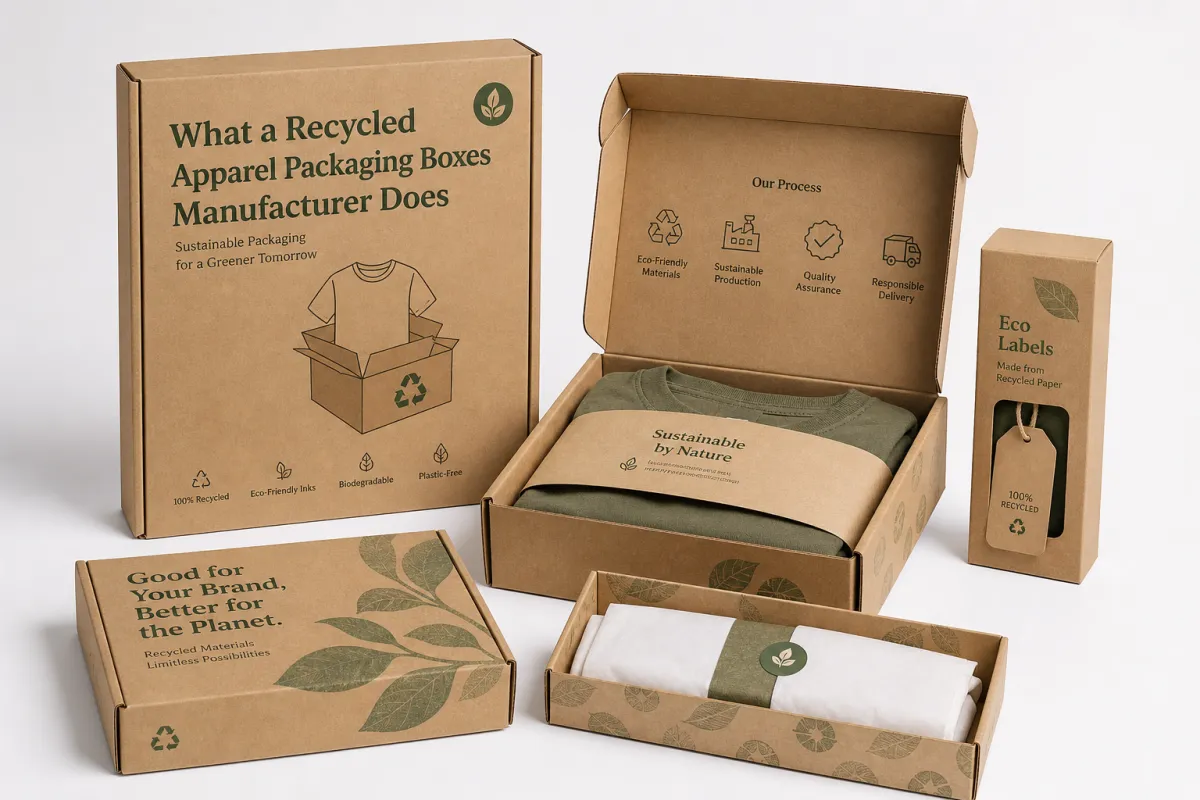
A recycled apparel packaging boxes manufacturer does more than print logos on brown board. The real work starts with recovered fiber, then moves through board formation, converting, and finishing until the carton is ready for shipping and shelf presentation. That can mean a folded shirt in a mailer box, a premium jacket in a rigid presentation box, or a subscription order that needs both protection and a polished reveal.
“Recycled” is not one simple material story. It may mean post-consumer fiber collected after use, post-industrial fiber captured during manufacturing, or recovered paperboard blended into a new sheet. The mix matters. A board with high recycled content can still perform very well, but the fiber length, stiffness, and surface smoothness will change depending on how it was made. Coatings and inks matter too. Water-based coatings, soy-based inks, and light aqueous finishes usually make for easier recycling conversations than plastic lamination or heavy foil coverage.
Apparel brands choose boxes for a few practical reasons. Premium drops need a better reveal than a poly mailer can provide. Gift sets need structure. Direct-to-consumer orders often need packaging that feels worth keeping. Subscription brands want repeatable product packaging that looks consistent across every shipment. A recycled apparel packaging boxes manufacturer sits at the center of that decision, because the box has to look good, protect the product, and still support the environmental message the brand wants to send.
The hardest part is usually the trade-off. More recycled content sounds good, but not every board grade behaves the same in every format. A recycled apparel packaging boxes manufacturer has to balance sustainability claims, product protection, shelf appeal, shipping efficiency, and a clean brand presentation. If one of those pieces is ignored, the package starts to feel compromised.
A box can be recycled and still be the wrong box if it crushes in transit, wastes carton space, or forces the brand to over-print a weak surface.
That is why buyers should think in systems, not slogans. The best branded packaging usually comes from the simplest structure that still performs, with enough visual discipline to feel intentional. A recycled board, careful typography, and a well-proportioned closure often do more for brand perception than a pile of extra embellishments ever will.
How a Recycled Apparel Packaging Boxes Manufacturer Works
A good recycled apparel packaging boxes manufacturer follows a chain that starts with fiber sourcing and ends with converted cartons ready to ship. The sequence is straightforward on paper, yet each step creates its own quality decisions. Recovered paper is sorted, repulped, cleaned, and formed into board. That board is then dried, calendered, cut, printed, converted, and finished. If the source material is uneven, the end result can show it in the form of rougher surfaces, weaker folds, or a duller print response.
In production, common apparel formats include mailer boxes, tuck-top cartons, rigid presentation boxes, sleeves, inserts, and display-ready retail packs. Each format has a different relationship with recycled content. A simple mailer box can tolerate more board variation because the geometry is forgiving. A rigid box for luxury apparel needs tighter tolerances and better wrap adhesion. A recycled apparel packaging boxes manufacturer will usually recommend the format based on product weight, ship method, and the opening experience the brand wants customers to remember.
Testing matters here, and not as a box-ticking exercise. A manufacturer should be able to talk about crush resistance, print adhesion, moisture handling, stacking strength, and simulated transit abuse. For transit expectations, the protocols discussed by ISTA are a good reference point. A box can look elegant on a proof and still fail if the closure pops open or the side panel bows under stacking loads. Structural prototypes are worth the time before anyone commits to a full run.
There is room to tune recycled content without wrecking performance. A recycled apparel packaging boxes manufacturer can sometimes raise recycled fiber percentage in the outer liner, adjust the flute profile in corrugated formats, or modify the board caliper so the box still holds its shape. The key is to protect the mechanical behavior first. If a board is too soft, the brand pays for it later in returns, dents, and customer complaints. If it is too rigid for the intended use, the buyer may end up paying for structure they did not need.
Surface finish is another place where buyers get surprised. Heavy coatings can make a recycled package feel less honest, and they can complicate recycling streams. A light matte aqueous finish, by contrast, often supports the visual design without hiding the fiber story. That is one reason experienced brands ask a recycled apparel packaging boxes manufacturer to show samples under real lighting, not just in a render.
Most buyers only see the finished carton, yet the production chain determines whether the box feels crisp or flimsy. If the converting team has to fight board curl, inconsistent density, or poor surface strength, print quality will suffer. If the artwork is rich but the substrate is weak, the whole package loses confidence. A capable recycled apparel packaging boxes manufacturer understands that recycled content is not a badge to slap on the carton; it is a material property that has to survive manufacturing, handling, and shipping.
Cost, Pricing, and MOQ Trade-offs
Pricing is where the conversation gets real. A recycled apparel packaging boxes manufacturer is usually quoting against board grade, recycled content percentage, size, print coverage, coating, embossing, die-cut complexity, and finishing steps. The box itself may look simple, yet each additional operation adds setup time, machine time, or waste. Buyers often assume recycled board should always be cheaper. Sometimes it is. Sometimes it is not, especially when the order needs tighter print control or specialty finishes.
MOQ means minimum order quantity, and it matters more than many teams expect. Small runs cost more per unit because setup, tooling, and press time are spread over fewer boxes. That is true whether the supplier is a startup-friendly recycled apparel packaging boxes manufacturer or a large operation focused on retail volumes. If you order 1,000 boxes, a die and setup fee can make each unit look expensive. At 10,000 boxes, the same fixed costs get diluted.
Here is a practical comparison that buyers can use as a rough planning tool. Actual numbers move based on region, freight, board availability, and artwork complexity, but the ranges below are realistic enough to guide early budgeting.
| Scenario | Typical MOQ | Approx. Unit Cost | Best Fit | Main Trade-off |
|---|---|---|---|---|
| Startup apparel drop | 500-2,000 units | $0.55-$1.20 | Mailer box or tuck-top carton | Higher per-unit pricing because setup is spread across fewer boxes |
| Growing DTC brand | 2,000-5,000 units | $0.28-$0.65 | Printed mailer, sleeve, or insert system | Good balance of cost and brand presentation, but storage needs increase |
| Retail or seasonal volume | 5,000-20,000+ units | $0.18-$0.45 | Custom printed boxes with standard finishes | Lower cost per box, yet more capital tied up in inventory |
| Luxury apparel packaging | 1,000-5,000 units | $1.10-$3.00 | Rigid presentation box | Elevated unboxing, but higher material and labor costs |
The hidden costs are where budgets often slip. Sample rounds, plates or dies, freight, storage, and waste from incorrect sizing can add a meaningful amount to the final bill. A thoughtful recycled apparel packaging boxes manufacturer will flag those items early rather than bury them in the last quote. If the supplier does not mention freight or tooling until the end, that is usually a sign to slow down and ask a few more questions.
Comparing buyer scenarios helps. A startup launching a limited apparel drop may value presentation and speed more than the absolute lowest unit price. An established brand ordering for retail or peak season demand may care more about line efficiency and consistent lead times. The same recycled apparel packaging boxes manufacturer can serve both, but the box spec should not be identical. A premium-feel box for a launch can justify a higher cost per unit. A high-volume replenishment run should usually be simplified to protect margin.
One useful rule: ask for the quote at three tiers. For example, 2,500, 5,000, and 10,000 units. That shows where the unit cost drops, where freight becomes more efficient, and whether the larger run really earns its place. The point is not to buy the biggest quantity. The point is to buy the quantity that keeps cash flow, storage, and customer experience in alignment with the brand.
Step-by-Step Process and Timeline
The cleanest projects start with a packaging audit. Before a recycled apparel packaging boxes manufacturer can recommend a structure, the brand needs to define product dimensions, garment weight, ship method, damage risk, and the unboxing experience it wants to create. A folded T-shirt in a subscription order does not need the same box as a structured jacket sent through parcel networks. The more precise the brief, the fewer revision loops later.
Then comes the dieline and sampling stage. A dieline is the structural map of the box, and it is where fit problems usually show up early. Structural prototypes help confirm closure strength, insert fit, panel proportions, and shelf presence before production starts. If a sleeve slides too loosely or a tuck flap pops open, that is cheaper to discover in sample form than after 8,000 units are printed. A careful recycled apparel packaging boxes manufacturer will usually recommend at least one physical sample, sometimes two if the closure or insert system is unusual.
Artwork prep and prepress checks matter just as much. File setup, bleed, color accuracy, barcode placement, and recycled-content messaging all need to be reviewed before the plates or digital files are released. On recycled board, color can appear slightly warmer or more muted than on a bright white substrate. That is not a defect. It is a material characteristic. If the design depends on a stark, high-gloss color effect, the team should say that upfront and decide whether the recycled board still fits the brand story.
At this stage, a manufacturer should also verify which claims the packaging can support. Can the box honestly say "recycled content"? If so, can that be backed by documentation? Can the supplier show FSC chain-of-custody or FSC Recycled documentation where applicable? A credible recycled apparel packaging boxes manufacturer will not guess. It will confirm. If a marketing claim cannot be verified in writing, it should stay out of the artwork.
Here is a realistic timeline for a custom run:
- Brief and spec review: 1-3 business days.
- Dieline and structural sample: 3-7 business days.
- Artwork revision and proof approval: 2-5 business days.
- Production after approval: 10-20 business days for many custom runs.
- Freight and delivery: 3-7 business days domestic, longer for cross-border or ocean freight.
That schedule can stretch. Revisions, paper shortages, color correction, and freight delays all happen. A reliable recycled apparel packaging boxes manufacturer will tell you where the bottlenecks are likely to occur instead of promising a fantasy timeline. If the boxes are tied to a launch date, add a buffer. I would rather see a brand receive its cartons a week early than watch a launch slip because the approval cycle was too optimistic.
From a practical standpoint, the best timeline conversations include a trigger date, not just a delivery date. Ask when artwork must be final, when the sample must be approved, and when inventory must leave the facility. That way, the box program becomes a managed project instead of a loose promise. For branded packaging, that difference matters.
Common Mistakes Brands Make
The first mistake is treating all recycled board as equal. It is not. A recycled apparel packaging boxes manufacturer may offer several board grades with very different fiber blends, stiffness levels, and print surfaces. Two boxes can both claim recycled content and still behave differently in shipping or feel very different in hand. If the buyer does not ask for the actual grade or material specification, the result can be inconsistent.
The second mistake is overdesigning the package. Foil, soft-touch lamination, heavy spot UV, and multiple coatings can make a box look luxurious, but they also make the sustainability story harder to defend. They can complicate recycling, increase cost, and add lead time. A smarter recycled apparel packaging boxes manufacturer will usually suggest restraint where it helps the package perform better and communicate more clearly.
The third mistake is oversizing the box. It sounds small, but waste space adds up quickly. A box that is 15 to 20 percent larger than the garment needs more board, more shipping air, and often more void fill. That is money leaving the system for no real customer benefit. Right-sizing is not only a sustainability tactic. It is a cost-control decision. In many cases, the smallest effective box is also the most elegant one.
The fourth mistake is skipping sample testing or assuming the first quote is final. A quote can change once artwork coverage, freight, inserts, or material substitutions are finalized. A box that looks affordable on paper can become less attractive once all the actual variables are included. The better recycled apparel packaging boxes manufacturer is the one that helps the buyer see the full cost picture before the order is placed.
"A recycled box is only sustainable if it fits the product, survives the journey, and supports claims the brand can actually stand behind."
There is also a brand risk hiding underneath these mistakes. If customers see a box that feels flimsy, over-embellished, or oddly proportioned, they may not separate the box from the garment. The packaging becomes part of the product story. That means the package has to earn trust fast. A recycled board with a clean, disciplined package branding system often feels more credible than a flashy box that is trying too hard.
Expert Tips for Better Sustainable Packaging
Start with right-sizing. If a garment can ship safely in a compact carton, use the compact carton. A smaller box usually reduces board use, lowers shipping volume, and improves the unboxing experience because the product does not swim in empty space. A competent recycled apparel packaging boxes manufacturer should be able to adjust the dieline so the garment sits securely without adding filler that exists only to make the box feel full.
Ask for recycled content, certifications, and acceptable coating limits in the brief. That sounds basic, but many projects fail because the buyer and supplier are not quoting the same standard. If you want 100% recycled board with no plastic lamination, say so plainly. If FSC Recycled or another documentation trail matters to your marketing team, ask for that in writing. A good recycled apparel packaging boxes manufacturer will appreciate the clarity.
Design choices matter more than flashy finishing. Strong typography, measured white space, and well-placed graphics can make a recycled box feel premium without disguising its material character. The strongest custom printed boxes I see tend to be the ones that look deliberate rather than decorated. That is especially true in apparel, where the box often lives in the customer's home for a while before being discarded or reused.
For proof of sustainability, ask for chain-of-custody documentation and any third-party certifications the supplier can provide. The FSC framework is useful because it gives the buyer a clearer way to separate verified claims from vague green language. If inks or coatings are involved, ask how those materials affect end-of-life handling. Water-based alternatives are not always the answer, but they are often easier to defend than heavy plastic finishes.
Use the box as a communication tool, not just a vessel. A small note on reuse or disposal can help the customer understand what to do next. That note should be simple. One line is enough. The goal is not to lecture the customer. The goal is to make the sustainable choice visible at the moment of unboxing, when attention is highest.
Another practical tip: think about the whole packaging system, not just the box. Tape, inserts, labels, and outer cartons all influence the final environmental footprint. A recycled apparel packaging boxes manufacturer can only optimize the carton it builds, so the brand should keep the rest of the system aligned. That is where many sustainability programs break down. The box is recycled, but the rest of the kit is not.
Actionable Next Steps for Choosing a Manufacturer
The easiest way to compare suppliers is with a short scorecard. Ask each recycled apparel packaging boxes manufacturer about recycled content, lead time, MOQ, sample quality, communication speed, and willingness to explain trade-offs. If one supplier gives vague answers and another explains the board grade, finishing limits, and freight implications in plain language, the second one is usually the safer partner.
Request the same quote format from at least three suppliers. Make sure each quote includes unit price, tooling, sample charges, freight, and any finishing add-ons. That lets you compare apples to apples instead of comparing incomplete numbers. I have seen too many teams choose the lowest quoted unit price, only to find out later that plates, inserts, or delivery costs were excluded. A strong recycled apparel packaging boxes manufacturer will not hide those details.
Then order one sample, run one transit test, and review one branding pass before committing to volume. If the sample closes too loosely, if the artwork looks muddy, or if the transit test damages the corners, fix that now. One sample can save thousands of units from disappointment. In apparel, where branding and perception influence repeat purchase behavior, that is not a small issue.
For teams building a broader packaging lineup, compare the box with other options in our Custom Packaging Products catalog. Some brands need a mailer for fulfillment, a sleeve for retail, and an insert system for presentation. Others need only one clean box format. The right answer depends on product mix, order volume, and how much the packaging contributes to retail packaging and unboxing value.
It also helps to keep the decision tied to business outcomes. A better carton can reduce damage, protect margins, support brand trust, and lower confusion at the warehouse. Those are concrete benefits, not abstract sustainability wins. A thoughtful recycled apparel packaging boxes manufacturer gives the brand more control over all four.
My practical advice is simple: choose the supplier that can explain the why behind the spec, not just the price. A supplier who understands board behavior, print compatibility, and transit risk is far more valuable than one who only promises a cheap unit cost. If you want a sense of how the team thinks about that balance, About Custom Logo Things is a useful reference point. The right partner should make the packaging decision feel clearer, not more confusing. That is what a capable recycled apparel packaging boxes manufacturer should do for a serious brand.
Frequently Asked Questions
What should I ask a recycled apparel packaging boxes manufacturer before ordering?
Ask what recycled content they can verify in writing and whether that content comes from post-consumer fiber, post-industrial fiber, or a mixed source. Confirm sample turnaround, minimum order quantity, and exactly what is included in the quote so you can compare suppliers fairly. Also ask about print limits, coating choices, and the test methods they use to confirm the box will work in shipping and retail settings. A trustworthy recycled apparel packaging boxes manufacturer should answer those questions without dodging the details.
How much do recycled apparel packaging boxes usually cost?
Pricing depends on size, board grade, recycled content, print complexity, coatings, and order quantity. Smaller runs usually cost more per box because setup and tooling are spread across fewer units. For planning, many Custom Apparel Boxes land somewhere between about $0.18 and $1.20 per unit depending on structure, with rigid presentation styles running higher. Ask for pricing at multiple quantity tiers so you can see where the unit cost drops and whether a larger run makes sense for your brand. A good recycled apparel packaging boxes manufacturer will give you those tiers up front.
How long does production take with a recycled apparel packaging boxes manufacturer?
Sampling and dieline approval can take about one to two weeks, depending on revisions and proof cycles. Production often takes two to five weeks after approval, but custom finishes, special materials, or larger volumes can extend that window. Add shipping time and a buffer for last-minute artwork changes if the boxes must arrive before a launch or seasonal drop. The best recycled apparel packaging boxes manufacturer will help you build that buffer into the schedule instead of pretending it is unnecessary.
Can recycled apparel packaging boxes still look premium?
Yes, premium usually comes from structure, proportion, typography, and print discipline rather than heavy embellishment. A recycled board with a clean matte finish, crisp graphics, and smart opening mechanics can look more elevated than an overfinished box. The best designs make sustainability feel intentional, not like a compromise, and that is exactly where a skilled recycled apparel packaging boxes manufacturer earns its keep.
What proof of sustainability should I request from a manufacturer?
Request recycled content declarations, chain-of-custody documentation, and any third-party certifications they can provide. If the box uses specialty inks or coatings, ask how those affect recyclability and whether there are water-based or lower-impact alternatives. Keep the proof in your records so your marketing claims stay accurate and defensible. That documentation matters because the right recycled apparel packaging boxes manufacturer should help you support your claims, not just decorate the carton.
The clearest path forward is simple: define the garment, define the shipment, and then choose the box that protects both the product and the claim. If the carton passes fit, transit, print, and documentation checks, you are not just buying packaging, you are building a reliable part of the brand experience. That is the real test for any recycled apparel packaging boxes manufacturer.


