Buyer Fit Snapshot
| Best fit | Recycled Apparel Packaging Boxes Supplier projects where brand print, material claims, artwork control, MOQ, and repeat-order consistency need to be specified before quoting. |
|---|---|
| Quote inputs | Share finished size, material target, print colors, finish, packing count, annual reorder estimate, ship-to region, and any compliance wording. |
| Proofing check | Approve dieline scale, logo placement, barcode or warning zones, color tolerance, closure strength, and carton packing before bulk production. |
| Main risk | Vague material claims, crowded artwork, missing packing details, or unclear freight terms can make a low unit price expensive after revisions. |
Fast answer: Recycled Apparel Packaging Boxes Supplier: Board, Finish, Dieline, and Unit Cost should be specified like a repeatable production item. The safest quote records material, print method, finish, artwork proof, packing count, and reorder notes in one written spec.
Production checks before approval
Compare the actual filled-product size with the drawing, then confirm tolerance on folds, seals, hang holes, label areas, and retail display edges. Reserve space for logos, QR codes, warning copy, and material claims before decorative graphics fill the panel.
Quote comparison points
Review material grade, print process, finish, sampling route, tooling charges, carton quantity, and freight assumptions side by side. A quote is only useful when the supplier can repeat the same color, closure quality, and packing count on the next order.
A recycled Apparel Packaging Boxes supplier is not just somebody selling brown boxes with a green sticker slapped on top. If the board is flimsy, the print flakes, or the structure wastes freight, the “eco” story falls apart fast. Buyers want packaging that looks premium, protects folded garments, and still passes the sustainability sniff test without turning into a margin leak.
That balancing act is exactly where a good Recycled Apparel Packaging Boxes supplier earns its keep. The job is part material sourcing, part packaging design, part production control, and part damage prevention. If you are comparing options for branded packaging, product packaging, or retail packaging, the details matter more than the sales pitch. I have watched brands get dazzled by a nice mockup, then regret it the first time a hoodie arrives with crushed corners. Pretty box, ugly outcome.
For brands that need help choosing formats, Custom Packaging Products is a useful place to compare structures before you start asking for quotes. You do not need to guess your way through the process. You do need to ask the right questions early.
What a recycled apparel packaging boxes supplier actually does
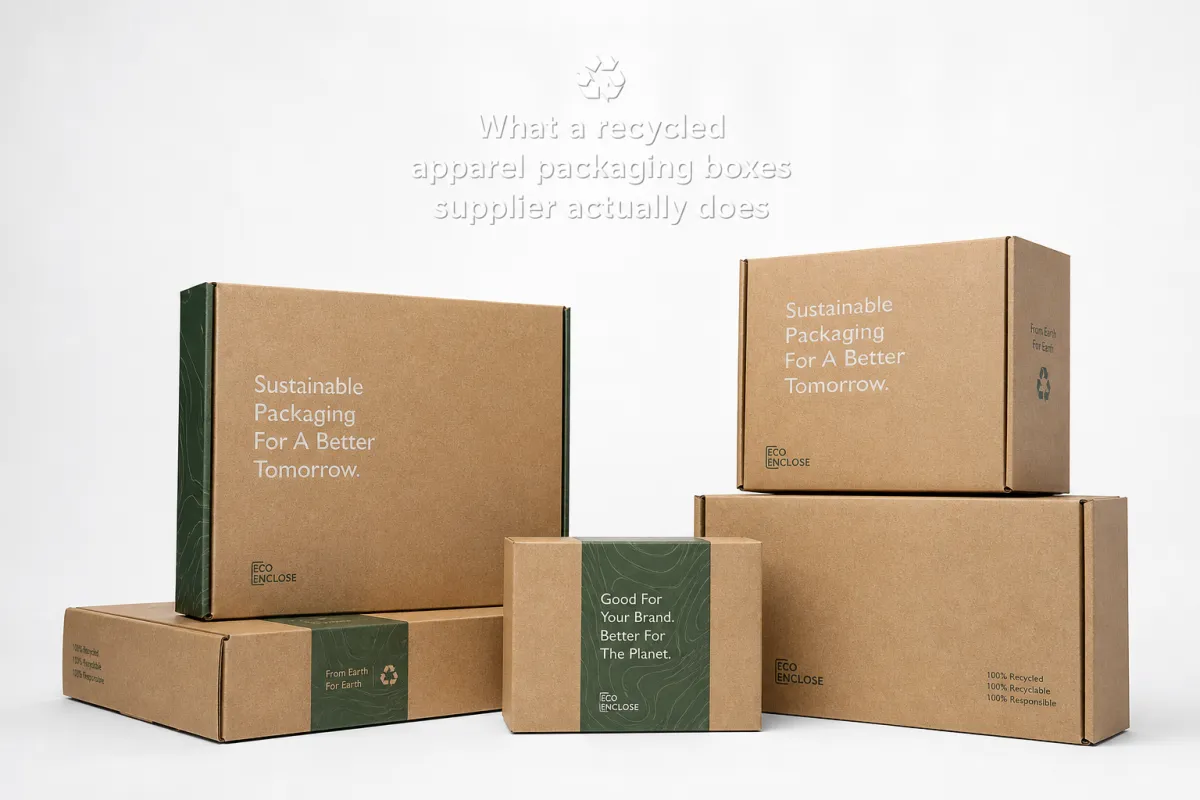
A recycled apparel packaging boxes supplier handles the full path from recycled fiber to finished carton, mailer, or rigid box. That usually includes sourcing recycled paperboard or corrugate, converting it into a usable board grade, printing the artwork, cutting the dieline, folding or gluing the pieces, and packing the final shipment for your warehouse or 3PL. A decent supplier also flags whether the box is meant to be retail packaging, shipping packaging, or presentation packaging, because those are not the same animal.
The first trap is assuming “recycled” means “good enough.” It does not. Fiber content is only one piece of the puzzle. Coating choice, ink system, adhesive, board caliper, compression strength, and closure style all affect whether the box survives transit and still looks clean when the customer opens it. A recycled apparel packaging boxes supplier should be able to explain whether the board is post-consumer, post-industrial, or a blend, and what that means in practice.
Here is the simple version. If a clothing brand is moving from plastic mailers to custom printed boxes, the box has to do more work. It needs to hold folded tees without crushing them, protect knitwear from scuffing, and still keep the landed cost in a range that does not make finance wince. The right recycled apparel packaging boxes supplier will help you decide whether a mailer box, folding carton, or rigid setup box makes sense for the product.
Practical rule: a box that looks sustainable but ships badly is not sustainable. It is just expensive disappointment in recycled fiber.
Before you approve anything, ask for the basics: board grade, recycled content percentage, print method, minimum order quantity, sample options, and whether the box can be flattened for freight efficiency. A recycled apparel packaging boxes supplier worth using should answer those questions without dodging. If the answers sound vague, that is usually a sign the quote will get messy later.
For brands that want a more premium finish, the same supplier may also advise on package branding choices like blind embossing, one-color kraft printing, or a restrained logo placement. Honestly, that is usually better than overcomplicated artwork. Recycled substrate and heavy ink coverage often fight each other, especially if you want a natural paper look instead of a glossy sales brochure pretending to be a box.
How a recycled apparel packaging boxes supplier turns specs into boxes
The production chain is straightforward on paper and slightly annoying in real life. A recycled apparel packaging boxes supplier starts with recycled fibers, turns them into board, slits and scores the sheets, then die-cuts the shape, prints the graphics, folds or glues the structure, and packs it for delivery. That sounds simple until you factor in tolerances. A 2 mm error on a box for folded shirts is not catastrophic, but it is enough to slow down packing and create ugly bulging corners.
There are three common order types. Stock boxes are existing sizes with limited branding. Semi-custom runs use an existing structure with custom print or size tweaks. Fully custom packaging starts with your dimensions and your exact insert or closure needs. A recycled apparel packaging boxes supplier will usually price those tiers very differently, because the tooling, setup, and approval work increase as the box becomes more custom.
Apparel use case matters more than many buyers expect. A box for folded tees can be lighter and simpler. A sweater box often needs a stronger board because the garment has more loft and the stack height is higher. Accessories like scarves, socks, and belts may fit into slim cartons or sleeve-style packs. Subscription kits and gift-ready retail packaging often need inserts or partitioning so the presentation stays neat when the box is opened.
Sustainability details should not be an afterthought. Water-based inks are usually a cleaner choice than heavy solvent systems. Aqueous coatings can protect the print without adding much plastic content. Recyclable adhesives matter too, because mixed-material construction can ruin the disposal story. A recycled apparel packaging boxes supplier should tell you whether the box design stays recyclable in typical municipal paper streams, rather than forcing you to decode the claim yourself. The EPA recycling guidance is a useful reference point for general disposal expectations: EPA recycling basics.
After production, the supplier still has a few choices to make. Boxes may ship flat, which saves freight and warehouse space. Or they may be pre-glued and nested, which speeds up packing but increases cube. A recycled apparel packaging boxes supplier should explain that tradeoff clearly. In some warehouses, flat shipping reduces total cost by 10% to 25%. In others, the labor cost of assembly wipes out that savings. There is no magic answer, just math.
It also helps to know where the box will be tested. If the product is sold direct-to-consumer and travels through rough courier networks, transit testing matters. ISTA standards are a sensible benchmark for that conversation: ISTA test methods. A recycled apparel packaging boxes supplier that understands shipping abuse will talk about compression, drop risk, and edge crush strength instead of only showing pretty renders.
Cost and pricing factors from a recycled apparel packaging boxes supplier
Pricing is where buyers get surprised, then irritated, then suspicious. A recycled apparel packaging boxes supplier is usually balancing board cost, print setup, die tooling, finishing, labor, packing, and freight. The unit price is not just the box. It is the box plus all the stuff that makes the box real. That is why one quote can look cheap until you notice the missing extras.
The biggest drivers are board thickness, recycled content, box structure, print coverage, finishing, and order volume. A simple kraft mailer with one-color print can be very different from a rigid presentation box with wrap, insert, and foil detail. If the supplier offers recycled apparel packaging boxes supplier pricing for 500 units and 10,000 units, the gap may be dramatic. Small runs carry more setup cost per piece, and there is no polite way around that.
In practice, the lowest quote is often not the lowest cost. Some suppliers quote a low box price, then load up the estimate with plate charges, sample fees, extra cartons, or high freight. A recycled apparel packaging boxes supplier should give you a full landed-cost view if you ask for it. If not, request it. Otherwise you are comparing fiction.
| Box type | Typical recycled board / build | Usual unit price at 5,000 pcs | Best use | Main tradeoff |
|---|---|---|---|---|
| Folding carton | 18-24 pt recycled paperboard, water-based ink | $0.18-$0.42 | Tees, socks, small accessories | Limited structure protection |
| Mailer box | E-flute recycled corrugate, printed exterior | $0.38-$0.85 | DTC apparel, bundled garments | More cube than a carton |
| Rigid presentation box | Greyboard or chipboard with recycled wrap | $1.10-$3.25 | Premium retail packaging, gifting | Higher freight and labor |
| Subscription kit | Mailer + insert + branded sleeve | $0.65-$1.60 | Monthly apparel boxes, multi-item sets | More setup and assembly |
Those ranges are not fantasy, but they are not one-size-fits-all either. Print coverage, special finishes, and the exact recycled content target can move prices quickly. A recycled apparel packaging boxes supplier may also quote a higher price for tighter color control, especially if you want Pantone matching on recycled kraft. That paper surface can absorb ink differently from a bright white stock, which means more care, more waste, and sometimes more cost.
Sizing inefficiency is another silent budget killer. If the box is 20 mm wider than it needs to be, you do not just waste board. You often increase shipping weight, warehouse footprint, and pallet count too. A recycled apparel packaging boxes supplier that understands product packaging should help you fit the garment closely without making the pack-out process annoying. That is where packaging design becomes a cost tool, not a creative indulgence.
Buying rule: ask every recycled apparel packaging boxes supplier for quotes with the same size, same board grade, same print method, same finish, and same delivery terms. Otherwise you are comparing apples, oranges, and a very optimistic spreadsheet.
If you want to see broader format options before you lock a spec, browse custom packaging products and compare the structures side by side. That is usually faster than trying to reverse-engineer pricing from vague email replies.
Step-by-step process and timeline with a recycled apparel packaging boxes supplier
The order process is usually more predictable than people think. A recycled apparel packaging boxes supplier normally moves through inquiry, quote, dieline review, sample approval, production, quality check, and delivery. The weak point is rarely the factory line. It is usually the approval chain. Someone changes artwork late, somebody else wants a different size, and suddenly the “simple reorder” turns into a three-week cleanup project.
For a realistic timeline, simple stock-based or lightly customized work can move in about 7 to 12 business days after approval. Fully custom packaging often needs 12 to 20 business days for production alone, plus sampling and transit. If the order goes by sea freight or needs cross-border shipping, build in much more time. A recycled apparel packaging boxes supplier should tell you the difference between production lead time and door-to-door lead time. Those are not the same thing, and pretending they are is how launches slip.
The fastest quotes come from complete information. Send garment dimensions, folded pack size, box style preference, artwork files, quantity, target ship date, and whether the box must arrive flat or assembled. A recycled apparel packaging boxes supplier can usually quote much faster if the spec is clear. The more guessing they do, the more padding they add to the estimate.
The sample stage is worth protecting. You want to check fit, print clarity, fold behavior, glue quality, and how the board feels in the hand. A box that looks fine in a mockup can still fail in the packing room if the closing flap catches or the insert shifts. A recycled apparel packaging boxes supplier that offers a proper prototype can save you from a full production run of slightly wrong boxes, which is a painfully expensive lesson. For brands with custom printed boxes, this is where the project either gets better or gets expensive.
Delays usually come from a few predictable places: vague specs, late artwork edits, board swaps, or unclear sign-off. If the supplier is waiting on approval, nothing else moves. If the supplier is waiting on material confirmation, the schedule slips again. If you have multiple stakeholders, assign one person to approve package branding and dieline changes. Otherwise the box becomes a committee project, which is a great way to lose a week and gain three opinions.
One more practical detail: ask how the boxes are packed for shipment. Carton counts, pallet height, and compression stacking matter. A recycled apparel packaging boxes supplier should describe whether the finished boxes are bundled in master cartons or palletized loose, because that affects damage risk and unloading speed. For high-volume apparel programs, that can change labor planning on your side as much as it changes freight cost.
If your supplier offers multiple production routes, ask which one suits your timing and volume. Sometimes a slightly simpler structure or a less complex finish saves days, not just dollars. A recycled apparel packaging boxes supplier that understands retail packaging should be able to tell you where the bottleneck is before you hit it.
Common mistakes when choosing a recycled apparel packaging boxes supplier
The biggest mistake is treating recycled content as a full sustainability verdict. It is not. A recycled apparel packaging boxes supplier can use high recycled content and still produce a box that is hard to recycle because of mixed materials, heavy lamination, or a plastic window. If the end-of-life path is unclear, the claim is weaker than the sales deck wants to admit. This is where recycled apparel packaging boxes supplier due diligence pays off.
Another classic error is writing a spec sheet that is basically a wish list. “Need a medium box, eco-friendly, nice print, not too expensive” is not a brief. It is a cry for help. A recycled apparel packaging boxes supplier needs actual dimensions, board grade, print coverage, finish details, and quantity breaks. Without that, the quote is guesswork and the sample is likely to miss the mark.
Cheapest-quote syndrome also causes pain. A low number can hide thin board, poor print registration, or unreliable lead times. That is not theory. It happens constantly. A recycled apparel packaging boxes supplier should be judged on sample quality, compression strength, communication, and realistic delivery dates, not just on who offered the prettiest unit price.
Brands also waste money by mismatching structure to product. Oversized boxes are common with small garments, and underbuilt boxes are common with heavier items like sweaters or multi-piece sets. Both are avoidable. A recycled apparel packaging boxes supplier with decent packaging design instincts will tell you if a slimmer carton or a mailer box makes more sense. That is where the supplier becomes more than a vendor; they become part of the product packaging decision.
Skipping proofing is another expensive habit. Color shifts on recycled stock are normal enough, but they still need review. Logo placement, barcodes, and typography all need checking before production. If Pantone matching matters, say so early. If not, expect variation. A recycled apparel packaging boxes supplier can hit a cleaner result when the approval chain is tight and the files are correct. Nobody enjoys printing 10,000 boxes and discovering the logo sits 6 mm too low.
From the buyer side, it helps to remember that packaging is not a place for vague optimism. It is a spec-based purchase. Recycled apparel packaging boxes supplier conversations should sound like a production meeting, not a mood board. That is how you protect both the budget and the brand.
Expert tips for working with a recycled apparel packaging boxes supplier
Design around the product first. That sounds obvious, but a lot of brands do the reverse. They choose a box style they like, then force every garment into it. A recycled apparel packaging boxes supplier can usually help more if you share the actual folded size, the packing method, and whether the item is meant for direct mail, retail packaging, or gifting. That makes the box work for the operation instead of against it.
Keep the print simple if the goal is a cleaner recycled look and lower cost. One-color or two-color printing often looks better on kraft and recycled stock than a fully flooded design. The texture stays visible, the recycled story feels more authentic, and the unit price usually behaves better. If you want premium, restraint is often smarter than decoration. That is especially true for branded packaging where the logo carries the weight.
Ask for material samples, not just finished samples. You want to feel the stiffness, check the board surface, and see how the recycled stock takes ink. A recycled apparel packaging boxes supplier can send a sample pack with different calipers and finishes, which is far more useful than staring at a render on a monitor. The box has to work in the hand, not only in a sales presentation.
Test with real garments and real packers. Put the actual folded tees, hoodies, or accessories inside the box and let the warehouse team assemble a small batch. That will show you whether the closure is annoying, whether the insert helps, and whether the box size is really efficient. A recycled apparel packaging boxes supplier that knows the business will not be offended by that test. They will usually appreciate it.
Negotiate for volume tiers and re-order terms. If your brand expects repeat runs, there is no reason to rebuild the spec from scratch every time. Ask the recycled apparel packaging boxes supplier how pricing changes at 3,000, 5,000, and 10,000 units. Ask what happens if you need a quick reprint, and whether a backup material is acceptable if the original board goes short. Those details save time later.
One more practical move: compare your supplier’s recommendation with a second route from custom packaging options for apparel brands. Not because every quote is wrong, but because the second look often exposes where the original estimate is padded or underspecified. Good purchasing is usually a comparison exercise, not a blind trust exercise.
Here is the short version. A recycled apparel packaging boxes supplier should help you reduce waste, tighten fit, and keep the brand presentation clean. If the supplier only talks about “eco materials” and avoids the actual spec, keep looking. That kind of talk sounds good in a pitch deck and falls apart in production. Seen it too many times.
What to do next with a recycled apparel packaging boxes supplier
Start with a one-page brief. List the product type, box dimensions, recycled content target, print needs, quantity, target ship date, and whether the box needs to be retail-ready or just transit-safe. A recycled apparel packaging boxes supplier can do far more with one clear page than with six scattered emails. That one step alone usually cuts back-and-forth in half.
Then request three quote versions. Ask for a simple recycled version, a mid-tier version with better print or structure, and a premium version if the brand presentation matters. A recycled apparel packaging boxes supplier should be able to show you how the cost moves with board grade, finish, and structure. That makes the buying decision visible instead of mystical.
Before production, ask for a physical sample or prototype. Test it with the actual folded apparel and the real packing workflow. A recycled apparel packaging boxes supplier that gives you a prototype is saving you from guesswork, which is a rare and underrated service in custom printed boxes. If the sample feels off, fix it before the order is locked.
Confirm the hidden details before approval. Freight terms, payment timing, reprint policy, defect tolerance, and delivery windows all matter. A recycled apparel packaging boxes supplier should be able to explain how claims are handled if a batch arrives with a print issue or a structural defect. That is not paranoia. It is normal procurement.
After the first order, use the run as a benchmark. Track damage rate, packing speed, warehouse feedback, and customer response. Then tighten the spec. A recycled apparel packaging boxes supplier becomes more valuable over time when you treat the first order as a learning run, not a once-and-done event. Better specs produce better boxes, and better boxes keep the brand story believable.
If you are narrowing choices right now, compare a recycled apparel packaging boxes supplier on fit, print control, lead time, and landed cost, not on recycled buzzwords. The supplier that can show you those numbers clearly is usually the one worth keeping. The one that cannot is selling vibes, not packaging.
Here is the practical takeaway: send a tight brief, demand apples-to-apples samples, and judge the recycled apparel packaging boxes supplier on how the box performs in real packing, real shipping, and real customer hands. Do that, and the packaging stops being a cost center with a nice logo. It becomes part of the product.
FAQ
How do I compare recycled apparel packaging boxes supplier quotes?
Match every quote by the same box size, board grade, recycled content, print coverage, and finish. Check whether tooling, samples, freight, and taxes are included so the low quote is not fake cheap. Ask for a unit price at multiple quantities to see where the real breakpoints are.
What recycled materials should a recycled apparel packaging boxes supplier use?
Look for recycled paperboard, kraft board, or recycled corrugate depending on the box style and protection needed. Avoid mixed-material builds when recyclability matters, because plastic windows, heavy laminations, and odd coatings can complicate disposal. Ask whether the recycled content is post-consumer, post-industrial, or a blend.
How long does a custom order usually take with a recycled apparel packaging boxes supplier?
Simple stock-based or lightly customized jobs can move quickly, while fully custom structures need more time for dielines, samples, and approvals. Artwork changes and sample revisions are the usual schedule killers, not the factory line itself. Build in extra time for shipping, especially if you need boxes before a product launch.
Can a recycled apparel packaging boxes supplier make premium-looking boxes?
Yes, if the structure is clean and the print is controlled; recycled does not have to look cheap. Minimal branding, good typography, and the right surface finish often look more premium than heavy decoration. Ask for samples that show edge quality, fold accuracy, and print registration.
What should I ask before I choose a recycled apparel packaging boxes supplier?
Ask about recycled content, board strength, print method, minimum order, sample policy, and lead time. Ask how the supplier handles defects, reprints, and rush orders so there are no surprises later. Ask for the most apples-to-apples quote possible, then compare like with like.


