Buyer Fit Snapshot
| Best fit | Recycled Boutique Bags with Logo projects where brand print, material claims, artwork control, MOQ, and repeat-order consistency need to be specified before quoting. |
|---|---|
| Quote inputs | Share finished size, material target, print colors, finish, packing count, annual reorder estimate, ship-to region, and any compliance wording. |
| Proofing check | Approve dieline scale, logo placement, barcode or warning zones, color tolerance, closure strength, and carton packing before bulk production. |
| Main risk | Vague material claims, crowded artwork, missing packing details, or unclear freight terms can make a low unit price expensive after revisions. |
Fast answer: Recycled Boutique Bags with Logo: Film, Print, MOQ, and Carton Packing should be specified like a repeatable production item. The safest quote records material, print method, finish, artwork proof, packing count, and reorder notes in one written spec.
Production checks before approval
Compare the actual filled-product size with the drawing, then confirm tolerance on folds, seals, hang holes, label areas, and retail display edges. Reserve space for logos, QR codes, warning copy, and material claims before decorative graphics fill the panel.
Quote comparison points
Review material grade, print process, finish, sampling route, tooling charges, carton quantity, and freight assumptions side by side. A quote is only useful when the supplier can repeat the same color, closure quality, and packing count on the next order.
Recycled Boutique Bags with Logo look simple until you actually have to buy them. Then the little details show up and ruin the fantasy. Paper weight. Handle strength. Print quality. Recycled content. Shipping. Suddenly it is not "just a bag." It is packaging that has to carry a product, carry a brand, and survive more than five minutes. Not glamorous. Very real.
I have seen teams obsess over the logo file and completely forget the bag itself. Bad move. The customer does not separate the two. If the bag tears, wrinkles badly, or looks half-baked, the brand takes the hit. Recycled boutique Bags with Logo are supposed to help the sale feel finished, not make the checkout counter look improvised.
That is why the spec matters. A real spec, not a rushed order from whoever promised the fastest quote. A good bag gets seen at the counter, on the street, in the car, on the office desk, and again when the customer reuses it. One purchase. Multiple impressions. Pretty efficient for something most people still treat like disposable filler.
There is a big difference between recycled stock and packaging that only looks green. Kraft color does not automatically mean recycled fiber. A natural texture does not prove anything either. Real recycled paper should list actual recycled content, often 30%, 50%, or 100%, and the supplier should be able to show the claim without wobbling around it. If the answer is vague, the claim probably is too.
That matters because recycled boutique bags with logo show up where presentation matters and waste gets noticed: apparel boutiques, cosmetics counters, gift shops, event kits, holiday sets, trade shows, and premium retail. The bag has to feel polished enough for the brand and sensible enough for the planet. Those two goals are not in conflict. They just need a little discipline.
The bag is not the star. It is the thing customers keep seeing after they leave.
From a buyer's angle, recycled boutique bags with logo are doing three jobs at once: carrying the product, signaling the brand, and making the sustainability story feel real instead of slapped on. Miss one of those jobs and the bag turns into expensive decoration. Nice to look at. Useless in practice. A classic retail mistake.
Recycled Boutique Bags with Logo: What Buyers Miss First
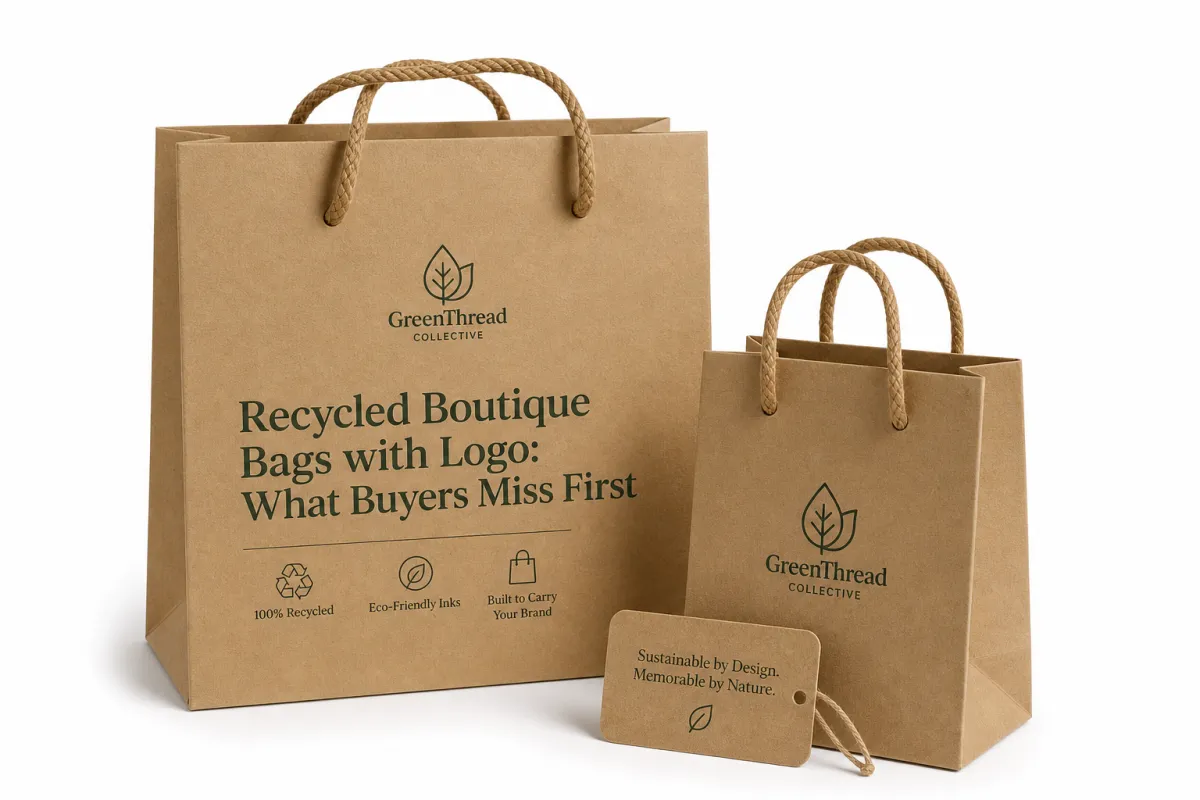
The first thing buyers miss is life span. Recycled boutique bags with logo often outlive the purchase inside them. Customers reuse them for returns, carry them to work, stash them in the trunk, or hand them to someone else. That turns the bag into a moving brand impression with a surprisingly long shelf life for a piece of paper.
The second miss is assuming "eco" means recycled. It does not. A bag can be recycled, recyclable, compostable, unbleached, FSC-certified, or just brown. Those are not the same thing. Ask for the actual fiber content, not the marketing adjective. If the supplier talks more about the story than the spec sheet, keep pushing.
The third miss is size and load. A bag can look expensive in a mockup and still fail the second a customer puts a box of candles or a pair of shoes in it. Light apparel might be fine with 150-180 gsm recycled kraft. Heavier items need stronger stock, a better bottom, stronger handles, or all three. The sidewalk is a terrible place to discover that the seam was decorative.
Recycled boutique bags with logo make the most sense in categories where the handoff is visible and the bag sticks around after checkout. Common uses include:
- Apparel boutiques: folded shirts, accessories, and small garments.
- Gift and lifestyle shops: candles, journals, decor, and curated sets.
- Beauty and cosmetics: boxed products, sets, and clean premium presentations.
- Events and activations: welcome kits, press kits, and VIP handouts.
- Premium retail: stores where the bag itself adds brand value.
If the product is tiny and light, the bag should not feel like overkill. If the product is heavy or fragile, the bag should not feel flimsy. That sounds obvious. People still get it wrong all the time because they fall in love with artwork before they check weight and structure. Packaging does not care about mood boards.
There is also the brand perception problem. A bag that feels cheap makes the whole purchase feel cheaper. A bag that feels overbuilt can look wasteful or disconnected from the store. The sweet spot is usually a clean silhouette, solid paper weight, and a logo treatment that looks intentional instead of crowded. That is where recycled boutique bags with logo start earning repeat use instead of immediate disposal.
How Recycled Boutique Bags with Logo Are Made
Most recycled boutique bags with logo follow a standard production path, but the details are where the outcome changes. First comes the fiber. Recycled pulp is sourced, sorted, cleaned, and blended. That feedstock may include post-consumer waste, post-industrial scraps, or both. The quality of that mix affects sheet strength, surface texture, print behavior, and how much abuse the bag can take before it gives up.
Then the paper sheet is formed, cut, folded, glued, and assembled. Handles are added after that, unless the bag style builds them into the structure. Paper handles are usually attached and reinforced at the top. Rope handles, ribbon handles, and reinforced toppers raise the assembly count and the price, which is why they show up more often on premium runs. For recycled boutique bags with logo, structure usually matters more than ornament. A bag that stands up and carries well beats a prettier one that slouches.
The material changes the feel in obvious ways:
- Recycled kraft paper: common, cost-friendly, matte, and easy to position as natural.
- Post-consumer recycled paper: a stronger sustainability story when the claim is documented correctly.
- Coated recycled board: better for richer color and sharper detail, less rustic in feel.
- Mixed recycled fiber blends: useful when the budget needs to balance price, strength, and print quality.
Printing is where expectations get messy. Recycled surfaces absorb ink differently than bright virgin white stock. Colors can soften. Edges can look less crisp. That is not a defect. That is the material. Simple logos, dark neutrals, and strong line art usually print well. Foil, embossing, and spot UV can work too, but they need careful setup and a supplier that knows how to handle recycled stock without flattening the texture. If you want a premium finish on recycled boutique bags with logo, ask for sample photos before you approve the fancy version from a flat mockup.
Artwork prep matters just as much as the print method. Suppliers usually want vector files in AI, EPS, or PDF format. Thin strokes and tiny type are risky on textured paper. A logo that looks clean on a screen can turn muddy on recycled stock if the contrast is weak or the details are too fine. Bigger shapes, stronger spacing, fewer fussy bits. That is usually the move.
For packaging that will be handled, stacked, or shipped, it helps to think like a logistics person for once. Testing standards such as ISTA are useful because they keep everyone honest about real-world handling, vibration, and transit abuse. A bag that survives a table display but fails in shipping is not a win. It is a very expensive way to learn about physics.
Timeline wise, recycled boutique bags with logo usually need a little patience. A simple run can move fast, but proofing, drying, scheduling, and packing still take time. Specialty finishes, unusual handles, and custom dimensions add more time. Recycled does not mean slow. It also does not mean instant, no matter how aggressively someone circles a date on a calendar.
One step buyers skip too often: ask for a dieline early. The dieline shows printable area, fold lines, handle placement, and bleed. Without it, artwork gets revised, then revised again, then someone says, "Wait, can the logo move left?" and suddenly three days are gone. With it, recycled boutique bags with logo can be designed to fit the bag instead of floating around on guesswork.
Cost, Pricing, and Material Choices for Recycled Boutique Bags with Logo
Pricing for recycled boutique bags with logo comes down to a handful of variables: size, recycled content, paper weight, handle type, print coverage, quantity, and finishing. If you want more from the bag, you pay for more from the bag. That is not a philosophy. It is how paper conversion and printing actually work.
Small runs cost more per unit because setup gets spread across fewer bags. Larger runs usually get cheaper fast once the supplier can optimize paper yield and machine time. A few hundred bags and a few thousand bags do not belong in the same price conversation. People compare them anyway, then act offended when physics refuses to negotiate.
| Option | Typical build | Best use | Indicative unit price |
|---|---|---|---|
| Entry-level recycled kraft | 120-150 gsm, paper handles, 1-color logo | Events, light apparel, giveaways | $0.18-$0.30 at 5,000+ units |
| Mid-range retail bag | 150-180 gsm, twisted paper or rope handles, 1-2 color print | Boutiques, cosmetics, gift shops | $0.26-$0.48 at 5,000+ units |
| Premium recycled finish | 180-250 gsm, reinforced top, matte finish, detailed print | Luxury retail, PR kits, high-value items | $0.45-$0.90 at 5,000+ units |
| Small custom run | Any of the above at low quantity | Launches, seasonal tests, limited editions | $0.85-$1.80 at 250-500 units |
Those numbers are directional, not a promise. Still, they give a realistic budget frame for recycled boutique bags with logo. If a quote comes in far below those ranges, check the paper weight, print coverage, handle quality, and whether freight is included. Cheap paper can get very expensive after one broken handle and a second order to replace it.
Handle choice can move the price more than people expect. Twisted paper handles are usually the most economical retail-friendly option. Cotton rope and ribbon handles look better in a premium setting, but they increase cost and may change the positioning of the bag entirely. Reinforced tops, board inserts, and extra gusset support also add expense. For heavier products, that extra spend usually saves money later because the bag actually works.
Print coverage changes the budget in a sneaky way. A small one-color logo on the front panel is efficient. Full bleed coverage, foil, or a second print location is not. Minimal designs often give stronger brand presence for less money because the bag stays clean and production stays simple. That is why some of the best recycled boutique bags with logo are not the most decorated ones.
Watch the hidden costs:
- Custom inserts: protect fragile products but add tooling and assembly time.
- Rush fees: shorten lead time and narrow material choices.
- Extra proofs: useful for complex artwork, not free.
- Freight: bulky paper goods can get expensive fast if shipping is ignored.
- Color matching: Pantone matching on recycled stock may need extra adjustment.
Smart budgeting starts with deciding what the bag actually needs to do. If the bag is part of a premium retail moment, spend on structure, handle feel, and print clarity first. If it is for a trade event, spend on quantity and readability, not fancy finishes nobody will notice. The cheapest recycled boutique bags with logo are not always the cheapest once replacements, delays, and complaints show up.
Step-by-Step Ordering Process and Timeline
The ordering process for recycled boutique bags with logo runs smoother when you treat it like a production job, not a shopping cart. Start with the basics: bag size, product weight, handle style, recycled content goal, print method, and quantity. If those six things are blurry, the quote will be blurry too, and the proof will take longer than it should.
A practical workflow looks like this:
- Define the use case. What goes in the bag, how heavy is it, and how polished should it feel?
- Choose the size. The bag should fit the product with enough room for an easy handoff.
- Select the material. Decide between recycled kraft, coated recycled stock, or a reinforced build.
- Pick the print method. One-color, two-color, foil, emboss, or a simple logo lockup.
- Request the dieline. Use it before finalizing artwork, not after the mistake is made.
- Approve the proof. Check placement, spelling, color notes, and handle positions.
- Schedule production and shipping. Build in transit time so the bags arrive before the launch, not after it.
Timelines vary, but a realistic schedule usually includes quoting, proofing, production, finishing, packing, and transit. For a straightforward run of recycled boutique bags with logo, quoting may take 1-3 business days, proofing 2-5 business days, and manufacturing 7-15 business days after approval. Specialty finishes, low quantities, or artwork changes can stretch that. If you need the bags for a store opening, count backward from the launch date and order earlier than your gut says. Your gut is probably being optimistic.
Where do delays happen most often? Artwork. More specifically: artwork that is not vector-ready, artwork with unclear Pantone references, and artwork that changes after proof approval. Another common delay is size confusion. A buyer says "small boutique bag," but the supplier needs exact dimensions, gusset width, and handle drop. Those numbers matter. So does the product itself, because recycled boutique bags with logo for folded apparel do not need the same structure as bags carrying boxed gifts.
There is also the supply chain reality. Certain recycled grades may have longer lead times if mill allocation is tight, and paper stock availability can change. That is not drama. That is the job. If your date is fixed, order earlier than feels necessary. If your date is flexible, you usually get more options on material and finish.
A simple planning rule helps a lot: for seasonal launches, start the conversation at least 4-6 weeks before use. For larger custom runs, 6-8 weeks is safer. That gives room for revisions without turning recycled boutique bags with logo into a panic purchase. Nothing improves decision-making like a deadline that is already breathing down your neck. Or so everyone claims right before they pay rush fees.
Common Mistakes With Recycled Boutique Bags with Logo
The first mistake is choosing a bag that looks sustainable but cannot hold the product. Thin stock bows. Bottom panels fail. Handles pull out. Then the brand gets blamed for a packaging choice that was never built to do the job. Recycled boutique bags with logo still have to function as bags before they can act like branding.
The second mistake is designing a logo that is too small, too detailed, or too low contrast. Recycled stock usually has more visible fiber and texture than coated white paper, so thin lines and pale colors can disappear. Light gray on kraft is a gamble. Pastel on kraft is a worse one. If the logo needs to be seen from a few feet away, it should not require a microscope.
The third mistake is skipping sample checks. A digital mockup is not the same as the actual bag. Recycled paper can shift tone from sheet to sheet, and a natural surface can make a color look softer than expected. Ask for sample photos, a physical sample if the schedule allows it, or at least a printed proof that shows how the ink behaves on the chosen stock. That small step saves a lot of regret later.
The fourth mistake is treating sustainability claims like decoration. If the bag is described as "eco," "green," or "recyclable," the buyer should know exactly what the claim means. Recyclable is not the same as recycled content. Compostable is not the same as recyclable. A vague claim with no documentation is a problem waiting for a customer to ask a simple question. And customers do ask. Usually at the exact moment you wish they would not.
If the packaging moves through a warehouse or fulfillment flow, think about transit durability like a grown-up. Standards and test methods matter. The goal is not to make a paper bag indestructible. The goal is to make sure it survives stacking, handling, and shipping without embarrassing the brand. That is the sort of thinking that belongs behind recycled boutique bags with logo.
Here are the mistakes most people repeat:
- Overselling the eco story: claiming recycled content without a spec sheet or certification basis.
- Underbuilding the bag: picking a thin stock for a heavy product.
- Overcomplicating the print: too many colors, gradients, or tiny details.
- Ignoring handle strength: nice-looking handles that fail in real use.
- Skipping lead time: acting as if production and shipping will magically happen overnight.
There is a good reason to keep the design honest. Recycled boutique bags with logo work best when they feel like well-made carriers, not a marketing apology in paper form. People notice the difference. So does the trash can. Usually right away.
Expert Tips to Make Recycled Boutique Bags with Logo Feel Premium
If you want recycled boutique bags with logo to feel premium, start with restraint. Clean layouts usually look more expensive than crowded ones. A centered logo with generous negative space can feel richer than a loud full-panel print, especially on recycled paper where the texture already does some visual work. Let the material breathe instead of fighting it.
Choose colors that respect the paper tone. Natural recycled kraft warms everything up and can mute bright whites, cool blues, and some neon shades. Deep navy, black, forest green, warm burgundy, and earthy neutrals usually behave better. If the brand needs a brighter color, test it first. A color that looks lively on screen can look flat on the real bag. That is not bad printing. That is a bad match between ink and substrate.
Upgrades help when they have a reason. Rope handles feel more boutique than twisted paper handles. Reinforced tops improve structure. Matte finishes reduce glare and can make recycled boutique bags with logo feel calmer and more refined. Blind embossing or debossing adds texture without shouting. Foil can work, but too much foil on recycled stock can look confused. One strong finish beats four half-committed ones.
Proportion matters more than people admit. A bag that is too small makes the product feel squeezed. A bag that is too large makes the purchase feel loose and less special. The best fit gives the item breathing room while still looking deliberate. For premium retail, that fit can matter as much as the logo itself. A bag that matches the product size makes recycled boutique bags with logo look custom in the right way, not accidental in the cheap way.
Premium does not mean flashy. It means the bag looks considered from the paper weight down to the handle drop.
Ask for evidence, not promises. Supplier photos, dielines, sample shots, and a clear spec sheet tell you far more than a polished sales pitch. If the supplier cannot show how the bag has been built before, you are buying a concept, not packaging. That is a rough place to be when your logo is printed on the front.
Use simple quality checks before approving the order:
- Check the logo at actual size: print legibility matters more than screen zoom.
- Confirm the handle drop: it should carry comfortably, not scrape the floor.
- Review the recycled claim: make sure the wording matches the actual material.
- Inspect the fold lines and gussets: clean construction usually signals better assembly.
- Ask about stacking and storage: flat storage can affect how the bag holds shape at launch.
There is nothing glamorous about a badly made bag. There is also nothing subtle about a customer noticing it. When recycled boutique bags with logo feel quiet, sturdy, and deliberate, people notice that too. The bag carries the product. It also carries the judgment of the brand. That part is less fun, but very real.
What to Do Next Before You Order
Before you request quotes for recycled boutique bags with logo, lock down the basics. You need the product dimensions, expected weight, target quantity, desired recycled content level, print area, artwork file type, budget range, and delivery deadline. If those are fuzzy, the quote will be fuzzy too. Suppliers can only price what they can actually understand.
Then compare at least three spec sheets or samples side by side. Do not stop at price. Compare paper weight, handle style, print quality, lead time, and how honest the supplier is about limitations. The cheapest bag is not the best deal if it creases badly, looks thin, or fails on first use. For recycled boutique bags with logo, structure and print clarity usually matter more than shaving a few cents.
Ask for the production timeline in writing. Ask for the approval step in writing. Ask what happens if the artwork needs a revision. Get the answer before money changes hands. That sounds tedious because it is tedious. It also prevents the classic "we thought it was included" mess that turns a simple order into a fight nobody wanted.
One more thing: approve the artwork before payment if the supplier allows that workflow, or at least before production starts. A clean proof means fewer surprises, and fewer surprises mean fewer delays. If you need the bags for a store opening, launch, or gifting window, your schedule should have breathing room. Recycled boutique bags with logo are much easier to manage when the order starts from a clear brief instead of a hope and a deadline.
If you want the fastest path from idea to order, keep the plan tight: choose one bag style, one print method, and one backup option. That is usually enough to move recycled boutique bags with logo forward without getting buried in endless variations. Packaging already has enough moving parts. No need to invent extra chaos just to end up with the same bag.
Bottom line: recycled boutique bags with logo can be a strong branding asset if you treat them like functional packaging first and marketing second. Get the material right, size the bag to the product, keep the artwork clean, and order early enough to avoid rush fees. Do that, and recycled boutique bags with logo stop being "just a bag" and start doing real work for the brand.
How much do recycled boutique bags with logo usually cost?
Pricing usually depends on size, recycled content, print colors, and quantity. Small runs cost more per bag; bulk orders usually drop the unit price fast. Add freight, proofing, and any rush fee before comparing quotes, because those extras can change the real total by a lot. I have seen a quote look perfect until shipping showed up and blew the budget to pieces. Fun stuff.
What materials work best for recycled boutique bags with logo?
Recycled paper with a sturdy kraft or coated finish is the most common choice for retail use. Heavier stock works better for apparel and gifts that need more support. Choose the material based on weight, not just the sustainability label, or you will end up with a pretty bag that fails at the wrong moment. If the product is boxed, oddly shaped, or heavy, ask for a stronger build instead of guessing.
How long does production take for recycled boutique bags with logo?
Typical timelines include quoting, proofing, production, and shipping, so plan ahead. Artwork changes and sample revisions are the main reasons jobs slip. Rush orders are possible, but they usually cost more and narrow your options, which is a lovely trade if you enjoy stress and paying extra for it. For most projects, I would not count on a "fast" turnaround unless the supplier has already confirmed stock and artwork readiness.
Can recycled boutique bags with logo still look premium?
Yes, if the design is clean and the bag size fits the product properly. Simple logos, good paper weight, and better handle choices usually look stronger than overdesigned bags. Premium does not mean flashy; it means intentional, tidy, and built to hold up in real use. In practice, the quiet bags often look more expensive than the noisy ones.
What artwork do I need for recycled boutique bags with logo?
Vector files are best because they stay sharp at print size. You should also provide exact logo placement, color references, and any required copy. Ask the supplier for the dieline before finalizing layout, since that saves a lot of back-and-forth and keeps the finished bag looking the way you expected. If your logo has thin strokes, consider a heavier version for print so it does not disappear into the recycled texture.
Do recycled boutique bags with logo need certification?
Not always, but documentation helps a lot if you are making sustainability claims. A supplier should be able to explain whether the paper is post-consumer recycled, post-industrial recycled, FSC-certified, or simply recyclable. If the claim is fuzzy, ask for proof. Trust is good. Traceability is better.


