Buyer Fit Snapshot
| Best fit | Recycled Cardboard Inserts with Logo projects where brand print, material claims, artwork control, MOQ, and repeat-order consistency need to be specified before quoting. |
|---|---|
| Quote inputs | Share finished size, material target, print colors, finish, packing count, annual reorder estimate, ship-to region, and any compliance wording. |
| Proofing check | Approve dieline scale, logo placement, barcode or warning zones, color tolerance, closure strength, and carton packing before bulk production. |
| Main risk | Vague material claims, crowded artwork, missing packing details, or unclear freight terms can make a low unit price expensive after revisions. |
Fast answer: Recycled Cardboard Inserts with Logo: Material, Print, Proofing, and Reorder Risk should be specified like a repeatable production item. The safest quote records material, print method, finish, artwork proof, packing count, and reorder notes in one written spec.
Production checks before approval
Compare the actual filled-product size with the drawing, then confirm tolerance on folds, seals, hang holes, label areas, and retail display edges. Reserve space for logos, QR codes, warning copy, and material claims before decorative graphics fill the panel.
Quote comparison points
Review material grade, print process, finish, sampling route, tooling charges, carton quantity, and freight assumptions side by side. A quote is only useful when the supplier can repeat the same color, closure quality, and packing count on the next order.
Recycled cardboard inserts with Logo: A Practical guide Recycled cardboard inserts with logo sound simple until a product shifts in transit, dents a corner, and turns a clean unboxing into a mess nobody wants to explain. The outer box gets the glory. The insert does the actual work. Miss that, and you end up paying for broken goods, replacement freight, and a very awkward spreadsheet conversation.
The insert has two jobs, and both matter. It keeps the product still, centered, and protected, and it carries the brand message the second the lid opens. If the structure feels sloppy, the package feels cheap. If the fit is tight and the branding stays restrained, recycled cardboard inserts with logo make the product look considered instead of improvised.
Brands use them for cosmetics, candles, food gifts, electronics accessories, bottles, and small retail kits that need more than loose crinkle fill and hope. The best insert is usually the one nobody talks about because everything sits exactly where it should. Clean structure. Less waste. Fewer damaged returns. Better first impression. Not magic. Just competent packaging, which is rarer than it should be.
I have seen beautiful outer cartons ruined by one sloppy insert. A glass jar rattles for 200 miles, the base scuffs, and suddenly the premium launch looks like it came from a garage. That is why recycled cardboard inserts with logo are not a nice extra. They are the part that decides whether the packaging feels finished or kinda fake.
Recycled Cardboard Inserts With Logo: What They Are and Why They Matter
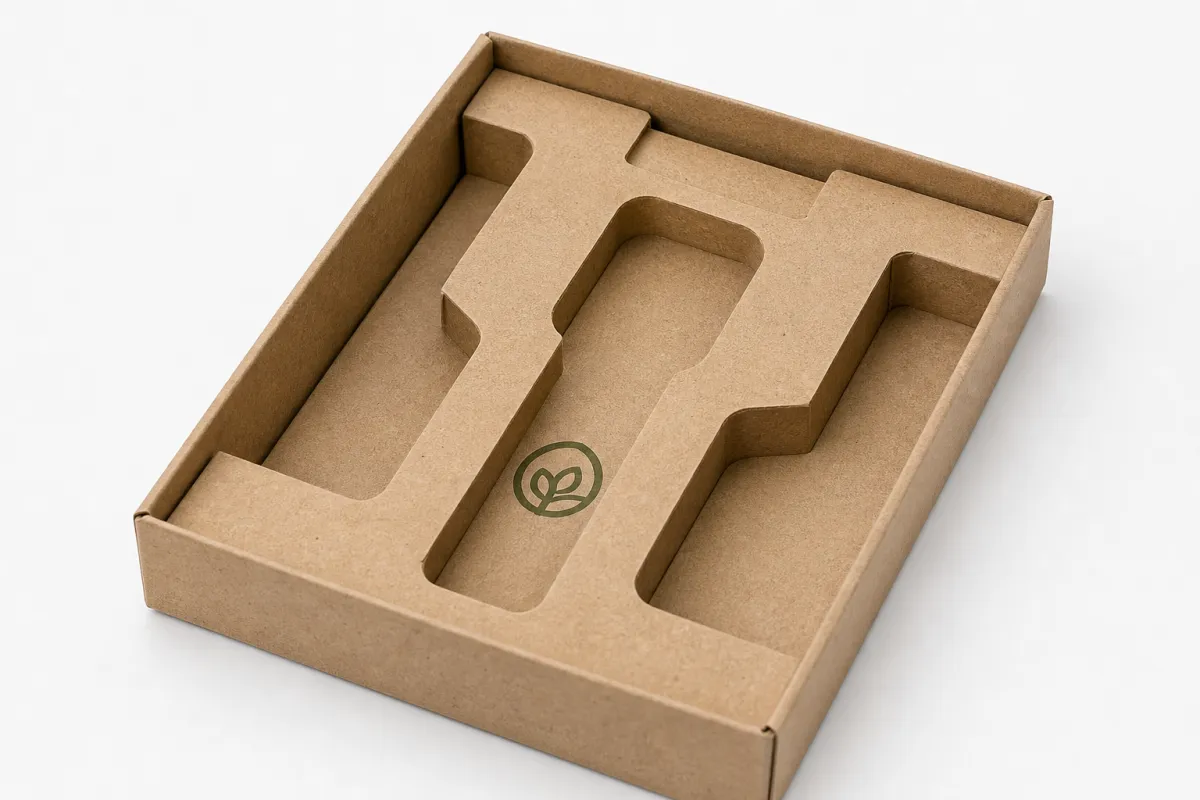
Recycled cardboard inserts with logo are custom-fit internal supports made from recycled board, chipboard, or corrugate, then printed or branded to reinforce the product experience. They can be plain kraft with a small one-color mark or a layered internal tray with more print control. Decoration is not the point. Structure is. The logo just gives the structure a voice.
A good insert does more than stop movement. It tells the customer that the brand noticed the details most people ignore until something arrives broken. A candle in a loose cavity rattles. A serum bottle with too much headroom feels cheap. A headphone accessory that pops out of its cutout feels unfinished. Recycled cardboard inserts with logo remove those little failures before they become support tickets.
These inserts sit right between protection and branding. A shipping carton handles the outside abuse, while the insert manages the inside. If you already use Custom Shipping Boxes, the insert is the part that keeps the product locked in place so the outer box does not carry the whole burden. That usually means fewer dents, less foam, less plastic, and less void fill stuffed in as a lazy fix.
There is also a credibility angle. Recycled cardboard inserts with logo give brands a clean way to show material discipline without yelling about it. A restrained logo, a recycled kraft look, and a snug fit often read as more premium than loud full-panel print. Buyers notice. They just do not hand out applause for it.
From a packaging buyer's point of view, the strongest insert is the one that disappears during shipping and reappears as a nice detail during unboxing. That is the real job. Strong enough for transit. Calm enough for presentation. Cheap enough to keep the margin alive. Packaging has to do all three, because nobody pays extra for good intentions.
How Recycled Cardboard Inserts With Logo Are Designed and Made
The process starts with measurements, not artwork. Good recycled cardboard inserts with logo begin with the actual product dimensions, including closures, caps, labels, and any part that sticks out beyond the main body. A millimeter or two off and the cavity gets loose. Loose cavities lead to scuffs, rattles, and products that look like they had a rough commute. Designers usually build around the object plus a small tolerance window, then test the fit with a physical sample.
After the dimensions are set, the team develops a dieline. That flat layout tells the cutter where to score, cut, fold, and lock. The structure might be a simple slotted tray, a layered cavity, a tab-lock insert, or a wrap-style support that cradles the product from more than one side. Recycled cardboard inserts with logo are not one-size-fits-all; a bottle needs different support from a cable kit, and a candle jar needs different support from a small cosmetic set. That is obvious once you stop pretending every product behaves the same.
Printing usually comes later in the workflow, and it should never fight the structure. Logo placement needs to avoid glue zones, folds, and areas that touch the product. A one-color stamp or a flood print on the inside panel is often enough. Some brands want the recycled character to stay visible, so they keep the ink light and the finish plain. Others want a stronger brand mark because the insert is part of the unboxing moment. Both can work. The wrong choice is the one that makes assembly harder or protection weaker.
One thing I always push for: handle the sample in real light, with real product, not under perfect studio conditions. On screen, everything is gorgeous. In a warehouse, board grain, cut depth, and print registration stop pretending. If the insert looks great but chips the product edge on the first lift, it failed. Pretty failures are still failures.
Structure choices that matter
Simple slotted inserts are usually the fastest and cheapest to make. Layered cavities give more control over fragile items. Locking tabs reduce the need for adhesive, which helps when recyclability matters. Wrap-style supports are useful for odd shapes, though they can slow pack-out if the team has to wrestle with them. Recycled cardboard inserts with logo should follow the product, not bully the product into fitting the design.
Print choices that affect the final feel
A small logo in one location is often enough for brands that want a clean, controlled look. Full-face printing brings more visual punch, but it can raise cost and erase the recycled look people actually want. Inside-panel branding is a good middle path because the customer sees it after opening the box, not before. If the goal is premium without overdesign, that middle path usually behaves better.
Sampling is where the real decisions get made. A flat PDF is not enough. You want a physical sample that shows whether the product sits level, whether the lid closes without pressure, and whether the logo still looks sharp after handling. Recycled cardboard inserts with logo can look perfect on screen and fail in the hand. Print does not fix bad geometry. Geometry does not rescue bad print placement. The sample tells you which problem you actually have.
Material choice changes the whole experience. Recycled chipboard is smoother and lighter, which works well for cosmetics, small retail sets, and lighter accessories. Heavier recycled corrugate gives better crush resistance and suits bottles, heavier jars, and ecommerce shipping. Board thickness changes both protection and feel, so the cheapest option is not automatically the smartest one. Cheap is only cheap if the product survives.
Key Factors That Decide Fit, Strength, and Appearance
The first factor is product weight and fragility. A 30 ml glass serum bottle needs a different structure than a folded garment accessory. A candle jar is heavy enough to crush weak board if the cavity is too loose. A small electronics accessory may not be fragile, but it can still look cheap if it shifts during transit. Recycled cardboard inserts with logo should be chosen based on the real risk, not the guess you make while staring at a spreadsheet.
Dimensional tolerance comes next. A few millimeters of slack can create movement, and movement creates scuffing. Too tight, and the product becomes hard to pack or hard to remove without damage. Good suppliers usually ask for product samples, not just measurements, because rounded corners, caps, and labels all change the fit. That is why recycled cardboard inserts with logo should be treated like a production spec, not a graphics job with a nice label on it.
Board grade, flute type, and thickness drive strength. Lightweight chipboard can work for presentation-heavy kits. E-flute or similar corrugated structures are better for shipping and impact resistance. Thicker board gives better crush performance, but it also adds stiffness that can slow assembly if the design is awkward. More strength is not automatically better if the packer has to fight the insert every single time.
Branding decisions affect perception more than people expect. A logo printed in low-contrast gray on kraft board feels quiet and premium. A dark, bold logo feels more retail-forward. Full coverage can look expensive, or it can look like you tried too hard. Recycled cardboard inserts with logo need to match the brand voice. If the outer box is minimal, the insert should not suddenly start shouting like a drunk intern at a launch event.
Sustainability claims need actual support. Recycled content percentage, recyclable inks, and paper-based structures help, but vague language is a bad idea. If the insert uses mixed materials, heavy coatings, or plastic film, that changes the end-of-life story. For public claims, brands should confirm the material makeup and check local recycling guidance. The EPA recycling guidance is a useful reference point, and FSC certification details are available at FSC if chain-of-custody matters to your sourcing story.
There is also the practical question of whether the insert reduces the need for extra packaging. If a well-built tray eliminates foam, Paper Void Fill, or an extra inner bag, that is real value. Recycled cardboard inserts with logo should lower material clutter, not add another layer of it. More packaging is not better packaging. That mistake gets expensive fast, then somehow becomes everyone's problem.
Another detail people underestimate is assembly tolerance on the line. A design that works in a sample room can slow down packers if it needs twisting, force, or two hands to place. The insert has to protect the product and respect the labor that packs it. If it is annoying to assemble, the warehouse will find a way to hate it. They always do.
What to verify before approving a design
- Product weight, wall thickness, and any fragile features like pumps or glass shoulders.
- Closure clearance, especially if the lid compresses the insert during shipment.
- Logo position relative to folds, cut lines, and glue points.
- Board thickness, recycled content, and any coating or ink restrictions.
- Transit risk, including vibration, drop height, and parcel handling.
Recycled Cardboard Inserts With Logo: Cost, Pricing, and Order Size
Pricing has more moving parts than most buyers expect. You are paying for design or setup, die cutting, print, material, assembly, and freight. Recycled cardboard inserts with logo are usually priced as a bundle of those pieces rather than one tidy number, which is annoying but normal. The cleanest quote separates tooling from per-unit cost so you can see exactly where the money is going. Mystery pricing helps nobody except the seller.
Small runs almost always cost more per unit. A setup fee spread across 250 pieces hurts more than the same fee spread across 5,000 pieces. If the shape is simple and the logo is one-color, the unit price stays saner. Add multiple cavities, deep scoring, or a complex wrap structure, and labor climbs. Recycled cardboard inserts with logo reward simplicity. Fancy geometry sounds clever until it lands in your margin and stays there.
| Insert Style | Typical Order Size | Common Per-Unit Range | Best For | Notes |
|---|---|---|---|---|
| Simple recycled chipboard insert with one-color logo | 500 to 5,000 | $0.18-$0.42 | Light accessories, cosmetics, gift sets | Lowest setup complexity and fast assembly |
| Layered recycled board tray with printed branding | 1,000 to 10,000 | $0.28-$0.65 | Candles, bottles, premium retail kits | Better fit control and stronger presentation |
| Heavier corrugated insert with custom cavities | 1,000 to 20,000 | $0.40-$0.90 | Fragile shipping applications | More protection, more material, more labor |
Those numbers move with size, print coverage, and board grade. A tiny insert for a lip balm is nowhere near the cost of a two-piece support for a glass bottle set. First orders also carry sample and tooling charges that can matter more than the paper itself. Sample costs often sit in the $40-$180 range for straightforward builds and climb for elaborate structures. Die setup can run from roughly $120-$350, while complex tools can go higher depending on the shape and the mood of the production floor.
There is a break point where pricing gets calmer. Once orders move from a few hundred units to 1,000-plus, the unit cost often drops enough to make the design feel sensible instead of irritating. At 5,000 pieces, the economics usually improve again if the design stays stable. Recycled cardboard inserts with logo are one of those items where volume matters a lot, because setup cost does real damage at the low end.
Compare landed cost, not just unit price. A cheap insert that ships in a bulky carton can end up costing more than a slightly better insert that nests efficiently. Assembly time matters too. If the insert saves 4 seconds per pack, that becomes real labor savings over a month of fulfillment. A quote that ignores pack speed is only half a quote. Pretty, but half-baked.
If you are benchmarking packaging as a whole, compare the insert with the outer carton. Our Custom Shipping Boxes page gives a useful picture of how the outer structure and inner support should be priced as one system. Recycled cardboard inserts with logo do not live alone. They sit inside a larger cost stack, and that stack needs to hold together.
One more cost detail that gets ignored too often: freight efficiency. A structure that nests flat and ships compactly can save real money, even if the unit price looks slightly higher. A cheap insert with poor nesting can eat margin in shipping cartons, warehouse space, and pack labor. That is the sort of expense nobody notices until the month closes and the numbers are rude.
Practical price drivers
- Board thickness and recycled content percentage.
- Logo coverage, ink count, and print registration.
- Number of product cavities and folds.
- Assembly time per unit.
- Sample revisions before final approval.
From Brief to Delivery: Process and Timeline for Recycled Cardboard Inserts With Logo
The process should start with a clean brief. Measure the product, note the weight, list any breakable areas, and send photos from several angles. Recycled cardboard inserts with logo move faster when the supplier knows exactly what the insert has to hold and how the final box closes. Guessing is slow. Guessing badly is slower. It also costs more than people want to admit.
- Collect exact product dimensions and identify the fragile areas.
- Choose the level of protection needed for parcel shipping or shelf presentation.
- Select board type, thickness, and print style.
- Review the dieline and confirm logo placement.
- Approve a physical sample and test the fit.
- Run a transit or drop-style check before production.
- Lock the final artwork and release the order.
Simple sample development can often take a few days if the structure is straightforward and the artwork is ready. Final production usually takes a few weeks after approval, with the exact timing depending on quantity, print method, and finishing complexity. Recycled cardboard inserts with logo that need multiple revisions or layered structures can easily take longer. That is not a failure of the process. That is the process telling you the product deserves more than a rushed guess and a hopeful email.
"The insert looked great on screen, but the first sample was loose enough to rattle. We fixed the fit, and the whole package felt more expensive immediately."
Rush orders deserve caution. They can be done, but the tradeoff is usually fewer sample cycles and a higher risk of missing a fit issue. A rushed insert that looks fine but shifts in transit creates more work later. Recycled cardboard inserts with logo should protect the product the first time, not after three emergency revisions and a very unpleasant warehouse conversation. If the packout is not stable, a rush schedule just moves the problem into fulfillment.
Testing should be part of the schedule, not a nice extra if time remains. Many suppliers use parcel handling and vibration testing that mirrors common transport abuse. For a good baseline, ask whether the supplier can align with ISTA test profiles, and review the program details at ISTA. A sample that survives desk handling is not enough. It needs to survive the sloppy reality of shipping cartons, conveyor movement, and warehouse drops.
Shipping and receiving time also belong in the timeline. A production run that leaves the factory in 12 business days may still take several more days to reach your warehouse, depending on freight method. Recycled cardboard inserts with logo should be planned from proof approval to receipt, not just from die creation to dispatch. That sounds boring right up until launch week arrives and there is nothing to pack into.
If you are working with a launch date, build one buffer into the schedule. Just one. Not because suppliers are unreliable, but because samples, freight, and approvals all take longer than people think. The packaging team always says this. Then someone still acts surprised when the truck is late. Fun little ritual.
Where delays usually happen
- Incomplete product measurements.
- Artwork changes after the dieline is approved.
- Unexpected fit issues on the first sample.
- Material substitutions when board stock is unavailable.
- Late decisions on print coverage or branding location.
Common Mistakes Brands Make With Recycled Cardboard Inserts With Logo
The biggest mistake is still the simplest one: guessing dimensions. A product is not a rough idea. It is a measured object with closures, shoulders, corners, and clearances. Recycled cardboard inserts with logo built from guesswork usually end up loose, tight, or awkward to pack. None of those outcomes help. They just create new problems with better lighting.
Another mistake is overdesigning the insert. People add layers, extra folds, or more print because they want the packaging to feel premium. Often, the result feels busy and costs more without adding real protection. A clean insert with the right board grade is better than a complicated insert trying to justify itself. Recycled cardboard inserts with logo should solve a functional problem first and a visual problem second.
Logo placement can go wrong too. Make it too dominant and the insert steals attention from the product. Make it too hidden and the branding feels like an afterthought. The sweet spot is usually deliberate, not loud. A small logo on a side panel or inside flap often gives a better premium read than a giant printed block sitting where the customer's eye goes first. Big does not always mean better. Packaging loves proving that.
Skipping shipping tests is a classic regret. A design that sits beautifully on a studio table can fail once it faces real parcel handling. Vibration, drop angles, and compression all matter. If the insert cannot survive a basic transit check, it is not ready. Recycled cardboard inserts with logo need to be judged in the same environment they will actually live in. Paper optimism is not a test plan.
Weak sustainability claims create another problem. Saying the package is eco-friendly without explaining recycled content, recyclability, or certification is vague enough to annoy buyers and compliance teams. Better to state what the material actually is and avoid the hype. If you cannot back the claim, do not print it on the box. That saves awkward questions later and saves your team from writing a second version of the same apology.
The last common mistake is ignoring assembly time. A beautiful insert that takes twice as long to pack becomes a burden in fulfillment. If one design takes 6 seconds to assemble and another takes 14, the difference matters quickly at scale. Recycled cardboard inserts with logo should fit the production line as well as the product. Pretty packaging that slows shipping is just an expensive hobby with a logo on it.
There is a quieter mistake too: treating the insert like a one-off art project instead of a repeatable spec. Once the launch lands, you want the next reprint to behave the same way as the first. If the artwork, tolerances, and board grade are not documented, every reorder turns into a small rescue mission. Nobody needs that. Especially not during peak season.
Expert Tips for Better Recycled Cardboard Inserts With Logo
Start with one hero SKU before scaling the whole range. That keeps budget under control and gives you a real sample to learn from. Recycled cardboard inserts with logo improve fastest when the design is tested on the product that matters most, not on a theoretical version of the line. One solid prototype tells you more than three opinion-heavy meetings with people who have never packed a box.
Ask for three things every time: a flat dieline, a physical sample, and a transit-test version. The dieline helps your team understand the structure. The physical sample tells you whether the fit is right. The transit-test version shows whether the insert survives handling without wandering around inside the carton. If a supplier can only provide one of those, you are not getting enough information. Nice conversations do not count as technical proof.
Choose branding with restraint. A small, well-placed logo often reads more premium than a large print block. Recycled cardboard inserts with logo tend to look better when the branding supports the product instead of competing with it. If the customer notices the insert before the product, the insert is doing too much. You want quiet confidence, not packaging theater with a standing ovation.
Before comparing quotes, ask for recycled content details, board thickness options, and waste-yield estimates. Waste yield matters because a design that nests well uses less board and usually costs less per unit. If a supplier offers recycled cardboard inserts with logo in multiple board grades, compare protection and labor together. The cheapest board is not always the cheapest result. The cheapest quote can be the most expensive mistake.
Here is the shortest practical checklist I can give you: measure the product, define the protection level, choose two material options, request sample pricing, and test the insert in a real ship-out. That is the part people skip. Then they wonder why the packaging looked fine on paper and failed in the warehouse. Paper is very persuasive right up until gravity shows up.
If you also need the outer pack to work with the insert, compare the internal structure against your carton plan. A good starting point is to review our Custom Shipping Boxes alongside the insert spec so the whole system makes sense together. Recycled cardboard inserts with logo work best as part of a package stack, not as a random add-on that somebody threw into the project late on a Friday.
One more practical point: keep the supply brief clean. Send exact dimensions, product weight, logo file, expected order quantity, and any assembly limits. The clearer the brief, the cleaner the quote. That is not glamorous advice, but it saves real money. Recycled cardboard inserts with logo are much easier to spec well than to fix later. Fixing later usually means paying more for less control.
Done properly, recycled cardboard inserts with logo protect the product, reduce waste, and make the opening experience feel more considered without burning budget on unnecessary extras. That is the sweet spot: a fit that holds, a finish that feels right, and a price that still makes sense after freight and assembly are counted. Packaging should work. Everything else is decoration with a spreadsheet attached.
If you want the cleanest path forward, start with the product dimensions, pick the board grade based on transit risk, and approve a physical sample before you talk yourself into print details. That order matters. Get the structure right first. The logo should support the insert, not rescue it.
Are recycled cardboard inserts with logo strong enough for fragile products?
Yes, if the board grade and insert shape match the product weight and breakage risk. Fragile items usually need tighter cavities, thicker board, or layered support instead of a simple flat cutout. Always test the insert in real shipping conditions, not just by hand.
How much do recycled cardboard inserts with logo usually cost?
Pricing depends on size, material thickness, print coverage, and order volume. Small runs cost more per unit because setup and cutting fees are spread across fewer pieces. A simple design with minimal print is usually the most budget-friendly option.
What is the typical turnaround time for custom recycled inserts with logo?
Simple samples can often be produced in days, while final production usually takes a few weeks after approval. Complex structures, special finishes, or rush schedules can extend the timeline. Having exact product measurements ready is the fastest way to avoid delays.
Can recycled cardboard inserts with logo be fully recyclable?
Often yes, if the board, inks, and adhesives are chosen for recyclability. Heavy coatings, plastic laminations, or mixed materials can reduce recyclability. Suppliers should confirm the material makeup before you make public claims.
What should I send a supplier for a quote on recycled cardboard inserts with logo?
Send exact product dimensions, product weight, photos, and the number of items the insert must hold. Include your logo file, preferred print style, order quantity, and any shipping or assembly constraints. The clearer the brief, the more accurate the quote and sample plan will be for recycled cardboard inserts with logo.


