Buyer Fit Snapshot
| Best fit | Recycled Packaging Boxes for Ecommerce projects where brand print, material claims, artwork control, MOQ, and repeat-order consistency need to be specified before quoting. |
|---|---|
| Quote inputs | Share finished size, material target, print colors, finish, packing count, annual reorder estimate, ship-to region, and any compliance wording. |
| Proofing check | Approve dieline scale, logo placement, barcode or warning zones, color tolerance, closure strength, and carton packing before bulk production. |
| Main risk | Vague material claims, crowded artwork, missing packing details, or unclear freight terms can make a low unit price expensive after revisions. |
Fast answer: Recycled Packaging Boxes for Ecommerce: Board, Finish, Dieline, and Unit Cost should be specified like a repeatable production item. The safest quote records material, print method, finish, artwork proof, packing count, and reorder notes in one written spec.
Production checks before approval
Compare the actual filled-product size with the drawing, then confirm tolerance on folds, seals, hang holes, label areas, and retail display edges. Reserve space for logos, QR codes, warning copy, and material claims before decorative graphics fill the panel.
Quote comparison points
Review material grade, print process, finish, sampling route, tooling charges, carton quantity, and freight assumptions side by side. A quote is only useful when the supplier can repeat the same color, closure quality, and packing count on the next order.
A carton can look perfect at pack-out and still arrive with a split corner, a scuffed sleeve, or a crushed insert. Shipping has a way of humbling everyone. That is why Recycled Packaging Boxes for ecommerce have become a practical choice for brands that want better material stewardship without gambling on transit performance. The best versions do more than signal sustainability. They protect the product, support package branding, and keep the fulfillment line moving at a cost that still makes sense on real invoices.
The useful part of this topic is that the same box has to do three jobs at once. It needs to survive the warehouse, look good when the customer opens it, and fit the packing line without creating extra void fill or annoying freight charges. That is a tall order, frankly. Recycled packaging boxes for ecommerce earn their place because they can reduce virgin fiber use while still fitting product packaging, retail packaging, and custom printed boxes that need to move cleanly from point A to point B.
One mistake shows up over and over: people treat recycled content like the only metric that matters. It is not. Board grade, flute profile, liner weight, print method, adhesive choice, and the way the box nests in a master shipper all affect the outcome. I have seen brands chase a high recycled percentage, then spend the next quarter paying for damage claims. That gets old fast. In practice, recycled packaging boxes for ecommerce work best when they are treated as part of a complete packaging design, not as a stand-alone sustainability badge.
That is the lens for the rest of this piece. The focus stays on actual box construction, realistic order timelines, the cost drivers that show up on a quote, and the mistakes that usually appear after the first damage report lands on somebody’s desk.
Recycled Packaging Boxes for Ecommerce: Why They Stand Out
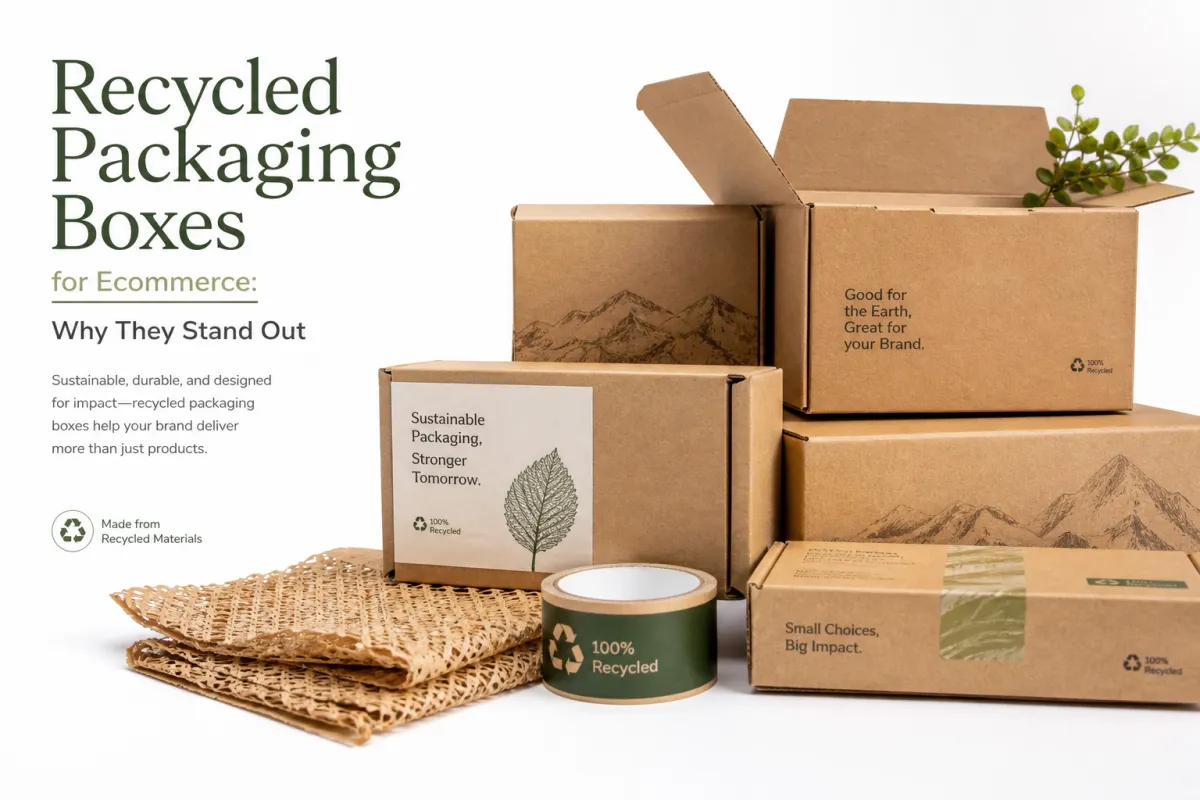
Picture a warehouse on a busy afternoon. Cartons are moving down a conveyor, a picker is building mixed-SKU orders, and the brand wants every box to feel a little more intentional than the last one the customer received. In that setting, recycled packaging boxes for ecommerce stand out because they can lower reliance on virgin fiber without forcing the team to accept flimsy packaging or awkward handling steps. When the carton is engineered properly, recycled content becomes a material choice, not a compromise.
These boxes are made with recovered fiber. Depending on the format, that recycled fiber may show up in the corrugated liners, the fluting medium, or the faces of paperboard cartons. A mailer made from recycled corrugated board is not the same thing as a folding carton with recycled paperboard faces, but both fall under the wider umbrella of recycled packaging boxes for ecommerce. The material story changes with the structure, while the buying logic stays the same: match the board to the product and the route.
That matters because ecommerce packaging is not just shipping packaging anymore. It is also branded packaging, and customers notice the gap between a box that feels intentional and one that feels like plain freight. A clean opening experience can make a modest product feel more considered. Recycled packaging boxes for ecommerce let that experience happen with a lighter footprint when the spec is done well.
Operations teams care for a different reason. Recycled packaging boxes for ecommerce can help reduce exposure to price swings in virgin fiber, and they fit sustainability reporting without forcing a complete redesign of the fulfillment process. Performance still has to win first, though. A box that fails drop testing or crush testing creates returns, reships, and customer frustration, which tends to wipe out any environmental win fast.
That is why I usually treat recycled packaging boxes for ecommerce as one part of a bigger system. The carton, the insert, the seal method, the artwork, and the shipping method all work together. If one piece is off, the whole package suffers. If they line up, the box protects the item, supports the brand, and uses material with a little more discipline.
For companies buying at scale, that balance is where the real value sits. A solid spec may use a slightly heavier recycled board in a few places, a cleaner die-cut, or a tighter fit that cuts down on void fill. The result is often a package that looks sharper and ships more consistently, which is exactly what most ecommerce teams want from recycled packaging boxes for ecommerce.
How Recycled Packaging Boxes for Ecommerce Are Made
The material journey starts long before the box reaches a converter. Recovered paper is collected, sorted by grade, and sent to a mill where it is pulped, cleaned, screened, and formed into sheets. Those sheets become linerboard or paperboard, which are then converted into finished packaging. In recycled packaging boxes for ecommerce, the recycled fiber may be used in the facings, the corrugating medium, or both, depending on the strength and appearance the job needs.
Recycled content does not automatically mean weak content. Strength comes from the way the board is built. A box with a well-matched liner weight, the right flute profile, and a proper closure style can perform very well even when it uses a high percentage of recovered fiber. For ecommerce, common constructions include single-wall corrugated board, E-flute mailers, B-flute shippers, and paperboard cartons for lighter product packaging.
Where people get tripped up is confusing recycled content claims with structural performance. They are related, but they are not the same thing. A board can be 100% recycled and still fail if the caliper, fiber blend, or compression strength is not right for the product. A board with mixed virgin and recovered fiber can be excellent for transit if the structure was engineered correctly. That is why recycled packaging boxes for ecommerce should always be specified by performance requirements, not by recycled content alone.
Finishing details shape the final result too. Water-based inks usually keep the recycling path simpler than heavy laminates or tricky coatings. Adhesives matter as well, especially in glued mailers and inserts. If a design uses foam, magnets, or mixed-material window patches, end-of-life handling gets messier. That does not make those elements forbidden. It just means the buyer should ask whether they are doing any real work for the product and the brand.
I've had more than one sample where the recycled board was fine, but the closure failed because the glue line was sloppy. That part gets overlooked. A box is a system, not a manifesto.
If you need help narrowing the field, start with Custom Packaging Products and compare the board style to the product weight, the drop risk, and the shelf or unboxing presentation you want.
Common material paths
Three material families show up most often in recycled packaging boxes for ecommerce. The first is recycled corrugated board, the workhorse for shipping cartons, mailers, and many subscription boxes. The second is recycled paperboard, usually used for lighter folding cartons or premium outer sleeves. The third is hybrid construction, where one layer or component is recycled while another uses virgin fiber for extra strength or better surface quality.
Hybrid structures can help when a brand wants a clean print face but also needs a stronger inner wall or insert. That approach is not always necessary, and it does add complexity, but it is sometimes the right compromise for fragile products. The decision should be simple: does the structure need to protect first, display first, or do both equally well?
For buyers who want outside guidance, standards help. The EPA has useful recycling basics at https://www.epa.gov/recycle, and the ISTA site at https://www.ista.org/ is a solid reference point for transport testing ideas. Those resources will not pick your board grade for you, but they do keep the conversation tied to actual practices instead of guesses.
Key Factors That Shape Performance and Cost
When a buyer asks why one box costs more than another, the honest answer is usually a mix of board grade, size, print coverage, tooling, and quantity. Recycled packaging boxes for ecommerce are no different. A simple unprinted mailer in a standard size can be efficient to produce, while a heavily printed custom box with inserts and tight tolerances will cost more because it needs more converting steps and tighter quality control.
Board grade is one of the biggest drivers. A light product in a smaller ship zone might do fine in a recycled E-flute mailer, while a heavier item moving through multiple distribution points may need a stronger single-wall corrugated spec with a higher edge crush test, often 32 ECT or 44 ECT depending on the load. The more the carton has to do, the more the board choice matters. That is exactly where recycled packaging boxes for ecommerce should be chosen with transit reality in mind, not just sustainability targets.
Print coverage affects price too. A one-color logo with simple product text is very different from full-bleed graphics on every panel. More ink means more press time, more setup, and sometimes different drying or coating requirements. If the box is supposed to stay highly recyclable, it is usually smarter to keep graphics purposeful instead of chasing a fully covered luxury look that adds little to the customer experience.
Tooling and order quantity are the other big levers. A custom die line, new cutter tooling, and unique insert shapes all add fixed cost, which means a small run carries more setup expense per unit. At larger volumes, the per-unit price usually drops because the setup cost gets spread out. That is why recycled packaging boxes for ecommerce can look expensive in a short-run quote and much more efficient once the order moves into a stable annual volume.
Freight and storage should stay in the conversation too. A carton that is a quarter-inch too large in each direction may seem harmless, but it can raise dimensional weight charges, take up more rack space, and force the fulfillment team to use extra void fill. In many programs, that added shipping cost is larger than the difference between two board grades. So when comparing recycled packaging boxes for ecommerce, the box price alone is not the whole story. Landed cost is the better number.
A recycled box only saves money when it matches the product and the route. If it is oversized, underbuilt, or hard to pack, the hidden costs show up later in damage, freight, and labor.
| Option | Typical Use | Approx. Unit Cost at 5,000 pcs | What It Usually Offers |
|---|---|---|---|
| Recycled E-flute mailer | Light apparel, cosmetics, small gifts | $0.38-$0.72 | Good print surface, compact profile, efficient for lower-weight orders |
| Recycled B-flute shipper | Heavier goods, multi-item kits, mixed distribution | $0.42-$0.88 | Better stacking and crush resistance, usually a stronger transit choice |
| Recycled paperboard folding carton | Retail-ready product packaging, sleeves, inserts | $0.22-$0.56 | Cleaner presentation, lower material weight, often paired with an outer shipper |
| Custom printed recycled mailer with insert | Branded subscription and premium ecommerce | $0.65-$1.25 | Stronger package branding and product presentation, but more setup and design complexity |
Those numbers are planning ranges, not quotes. They shift with board availability, print coverage, size, and freight. Still, they help buyers think about recycled packaging boxes for ecommerce the way a production manager would: not as a single price, but as a structure with a cost profile.
Order Timeline: From Spec to Shipment
The fastest way to lose time is to start with artwork before the structure is settled. A better workflow for recycled packaging boxes for ecommerce starts with measurements, product weight, fragility, fulfillment method, and any shipping restrictions. Once the product profile is clear, the box style can be recommended with far less back-and-forth. That helps a lot when the program needs both branding and protection, because the box should be built around the item instead of forced around a graphic concept.
A typical workflow looks like this: product measurement, structural recommendation, sample approval, print proofing, production, and delivery. Simple stock conversions can move quickly, but custom printed boxes with unique die cuts or inserts need more time. For planning, many teams should expect sample review in about 3-7 business days once the spec is clear, proof approval in 1-2 days if artwork is ready, and production in roughly 10-18 business days after final approval. Freight time sits on top of that, and the calendar gets real pretty quickly.
Delays usually happen in the same few places. A dieline that does not match the product dimensions creates another sample round. Late artwork changes force a new proof. A transit test might show that the carton needs stronger board or a different flute, which is useful but still adds time. That is why recycled packaging boxes for ecommerce should be scheduled like any other production item, not treated as an afterthought to the marketing launch.
Testing deserves a real place in the schedule. For shipping programs, teams often look at compression, drop, and vibration behavior, sometimes using methods aligned with ISTA procedures or internal quality checks that mirror the actual route. Not every package needs a full formal lab program, but the box should be tested in a way that reflects how it will move through the system. A carton that passes on a bench and fails in the carrier network is not a win.
If your launch calendar is tied to product release dates, seasonal promotions, or a subscription renewal cycle, build buffer time into the plan. Safety stock matters too. Even the best recycled packaging boxes for ecommerce can get delayed by a paper shortage, a proof correction, or a spike in order volume. A modest reserve on hand keeps the line from stalling when demand jumps.
From a packaging buyer’s point of view, the smartest schedule is the one that leaves room for one sample revision, one proof pass, and enough cushion for freight. That sounds conservative. It is still cheaper than rushing a box into production and finding out it needs a structural fix after the first hundred units go out the door.
Common Mistakes With Recycled Packaging Boxes for Ecommerce
The biggest mistake is simple: choosing recycled packaging boxes for ecommerce because the claim sounds good, then forgetting to test how the box behaves in transit. Sustainability does not cancel physics. If the item is heavy, fragile, sharp-edged, or top-heavy, the carton still has to resist crush, shock, and repeated handling. Buyers sometimes learn that the hard way after a few returns show the same corner failure or the same insert shift.
Oversizing is another frequent problem. A box that is too large invites product movement, burns more dunnage, and can raise dimensional weight charges. On paper, the program may still look efficient because the carton is made from recycled fiber. In practice, the oversized box creates more waste, more labor, and more risk than a tighter fit would have. Recycled packaging boxes for ecommerce only deliver their full value when the dimensions are right.
There is also a habit of overdecorating. Heavy coatings, thick laminates, and overly complex finishes can make a carton harder to recycle and more expensive to produce. That does not mean every premium finish is wrong, but it does mean the finish should earn its place. A clear logo, useful handling marks, and a thoughtful inside panel often do more for brand perception than a glossy surface that adds cost without adding function. Good package branding is usually restrained, not noisy.
Verification mistakes show up too. Recycled content percentages, FSC claims, and substrate descriptions are not interchangeable. A buyer may see a recycled label and assume it means the same thing across vendors, but the documentation can vary. One program may use FSC Recycled certified board, another may rely on a post-consumer recycled content declaration, and another may combine recycled and virgin fibers in a way that still qualifies for a sustainability target but performs differently. That is why recycled packaging boxes for ecommerce should always be specified with clear documentation.
Another issue is ignoring how the box will be opened, resealed, or returned. If the customer may send it back, the structure should tolerate a second life. If the box is only meant to be opened once, then the pack-out process can be simpler. Either way, the return path matters. Recycled packaging boxes for ecommerce should be thought through in both directions when the product has a high return rate or a fit-sensitive SKU.
The mistake is not choosing recycled content. The mistake is choosing it in isolation. The right decision always accounts for board strength, transit route, branding goals, and the real cost of failure.
Expert Tips for Better Recycled Packaging Boxes for Ecommerce
Start with the product, not the box. That sounds obvious, but it is where many programs go wrong. Measure the item carefully, note the heaviest configuration, and think about the shipping path from warehouse to doorstep. A box moving in a controlled regional route has different needs than one traveling cross-country or through multiple carriers. Recycled packaging boxes for ecommerce perform best when the spec is built around that route, not around a catalog default.
Test more than one board grade if you can. A familiar carton style may feel safe, but a quick comparison between two flute combinations or two liner weights can reveal a better fit. One program might benefit from a lighter E-flute mailer because presentation matters and the item is relatively stable. Another might need a stronger B-flute shipper because the product is dense or the route is rougher. For many brands, the right answer shows up through testing, not assumption.
Keep graphics purposeful. A logo, a concise brand message, and a clean inside print often go further than a box covered in ink. That is especially true if the carton is part of a larger product packaging system and the goal is to keep recycling instructions simple. If the design supports package branding without clutter, customers usually read it as more deliberate and more premium. Custom printed boxes do not need to be loud to be memorable.
Standardize wherever possible. If three carton sizes can cover most of your catalog, that is usually better than maintaining eight slightly different versions. Fewer SKUs reduce inventory complexity and can improve purchasing power. In many operations, the smartest recycled packaging boxes for ecommerce program is not the most elaborate one; it is the one the team can pack consistently on a busy Tuesday with minimal training.
Pay close attention to return shipping. If your category has exchange behavior or seasonal returns, build the structure so it can reopen cleanly and still protect the item. A box that tears in a bad place on the first opening may be fine for outbound shipping, but it becomes a weak point if the item needs to go back. That kind of practical detail is where experienced packaging design earns its keep.
If you are comparing options, use the supplier conversation to separate must-haves from nice-to-haves. A supplier should be able to explain how the recycled content is documented, what board grades are available, and how the carton will perform under real handling conditions. For brands that want a broader set of options, Custom Packaging Products can be a useful starting point for looking at box styles, print approaches, and structural formats together.
Actionable Next Steps for a Smarter Packaging Spec
The cleanest way to move forward is to build a short packaging brief. Include product dimensions, weight, fragility, ship method, expected order volume, branding requirements, and your recycled content target. If you already know the customer experience you want, say that too. The more specific the brief, the easier it is to quote recycled packaging boxes for ecommerce that fit the actual job instead of a fuzzy version of it.
Next, ask for a sample round. A sample is where you learn whether the fit feels tight enough, whether the board has the right hand feel, whether the print is crisp, and whether the structure stacks the way the fulfillment team expects. Samples are also where you catch small issues like awkward tuck flaps, a closure that needs more pressure than expected, or an insert that is technically correct but annoying to use. Those are the details that matter on the line.
After samples, run a small production test if the volume justifies it. Track damage rates, shipping spend, labor time, and customer comments. A few weeks of data can tell you whether the recycled packaging boxes for ecommerce are doing the job or whether the spec needs adjustment. A modest pilot usually pays for itself because it catches real-world issues before they get multiplied across a full run.
If you are working through a redesign, audit what you already use. Measure the boxes that seem too large, note which SKUs have the most damage claims, and look for repeated void fill usage. Those patterns usually point to the best opportunities. Often the biggest win is not a dramatic new structure; it is a better-fit carton, a simpler insert, or a reduced print system that lowers waste while keeping the opening experience polished.
That is the practical route to better recycled packaging Boxes for Ecommerce: gather the facts, sample the structure, test the route, and refine from real data. When those steps line up, the box stops being a guess and starts being a tool. The sustainability story gets easier to defend too. Funny how that works.
FAQ
What makes recycled packaging boxes for ecommerce strong enough for shipping?
Strength comes from the board grade, flute profile, liner weight, and carton design, not recycled content alone. A well-engineered recycled corrugated box can handle transit stress when it is sized correctly, closed properly, and tested against the product load it will actually carry. That is why recycled packaging boxes for ecommerce should be evaluated for structure first and material claim second.
Are recycled packaging boxes for ecommerce more expensive than virgin boxes?
Not always. Pricing depends on board grade, print complexity, quantity, tooling, and freight, so the cheapest raw material is not the whole story. In some programs, recycled packaging boxes for ecommerce lower the total cost because they improve fit, reduce damage, and cut down on oversized shipping charges.
Can recycled packaging boxes for ecommerce be custom printed?
Yes, they can be printed with logos, handling marks, product information, and branded artwork. The key is to balance print coverage with recyclability goals and avoid heavy finishes unless they are truly needed. Many brands find that recycled packaging boxes for ecommerce deliver stronger package branding when the design is clean and purposeful rather than overloaded.
How long does it take to order recycled packaging boxes for ecommerce?
Timeline usually includes specification, sample approval, proofing, production, and shipping, so planning ahead matters. Simple stock conversions can move quickly, while fully custom structures or printed programs need more lead time. For most buyers, recycled packaging boxes for ecommerce are easiest to manage when the launch calendar leaves room for one sample pass and one proof correction.
What recycled content should I ask for in ecommerce packaging?
Ask for a recycled content level that matches your sustainability goals and performance needs, then confirm how the claim is documented. If the box must protect fragile goods, it may be better to prioritize structural performance first and then optimize recycled content where possible. That is the practical way to buy recycled packaging boxes for ecommerce without guessing, overbuying, or compromising the ship experience.


