Buyer Fit Snapshot
| Best fit | Recycled Shipping Cartons Price projects where brand print, material claims, artwork control, MOQ, and repeat-order consistency need to be specified before quoting. |
|---|---|
| Quote inputs | Share finished size, material target, print colors, finish, packing count, annual reorder estimate, ship-to region, and any compliance wording. |
| Proofing check | Approve dieline scale, logo placement, barcode or warning zones, color tolerance, closure strength, and carton packing before bulk production. |
| Main risk | Vague material claims, crowded artwork, missing packing details, or unclear freight terms can make a low unit price expensive after revisions. |
Fast answer: Recycled Shipping Cartons Price: Board, Finish, Dieline, and Unit Cost should be specified like a repeatable production item. The safest quote records material, print method, finish, artwork proof, packing count, and reorder notes in one written spec.
Production checks before approval
Compare the actual filled-product size with the drawing, then confirm tolerance on folds, seals, hang holes, label areas, and retail display edges. Reserve space for logos, QR codes, warning copy, and material claims before decorative graphics fill the panel.
Quote comparison points
Review material grade, print process, finish, sampling route, tooling charges, carton quantity, and freight assumptions side by side. A quote is only useful when the supplier can repeat the same color, closure quality, and packing count on the next order.
Recycled Shipping Cartons Price: What Buyers Should Know
Recycled Shipping Cartons Price looks straightforward until freight, stacking, and damage start messing with the math. A carton that seems cheaper on paper can end up costing more once you factor in product protection, dimensional weight, repacking, and replacement shipments. If you are comparing recycled shipping cartons price across suppliers, the real question is not what the box costs at quote stage. It is what the box costs after it moves through fulfillment, transit, and the return loop.
I have seen teams celebrate a low unit price only to eat the savings in crushed corners and customer complaints a few weeks later. That is not a rare problem. It is the usual one. A carton with the wrong flute, the wrong inside dimension, or the wrong board grade can lead to wasted void fill, higher claim rates, and slower pack stations. Ecommerce shipping exposes those flaws fast. Palletized distribution does it even faster. Either way, recycled shipping cartons price needs to be treated as a landed-cost decision, not a vanity number.
Cheap is great. Damaged product is not.
Why Recycled Shipping Cartons Price Often Beats First Impressions
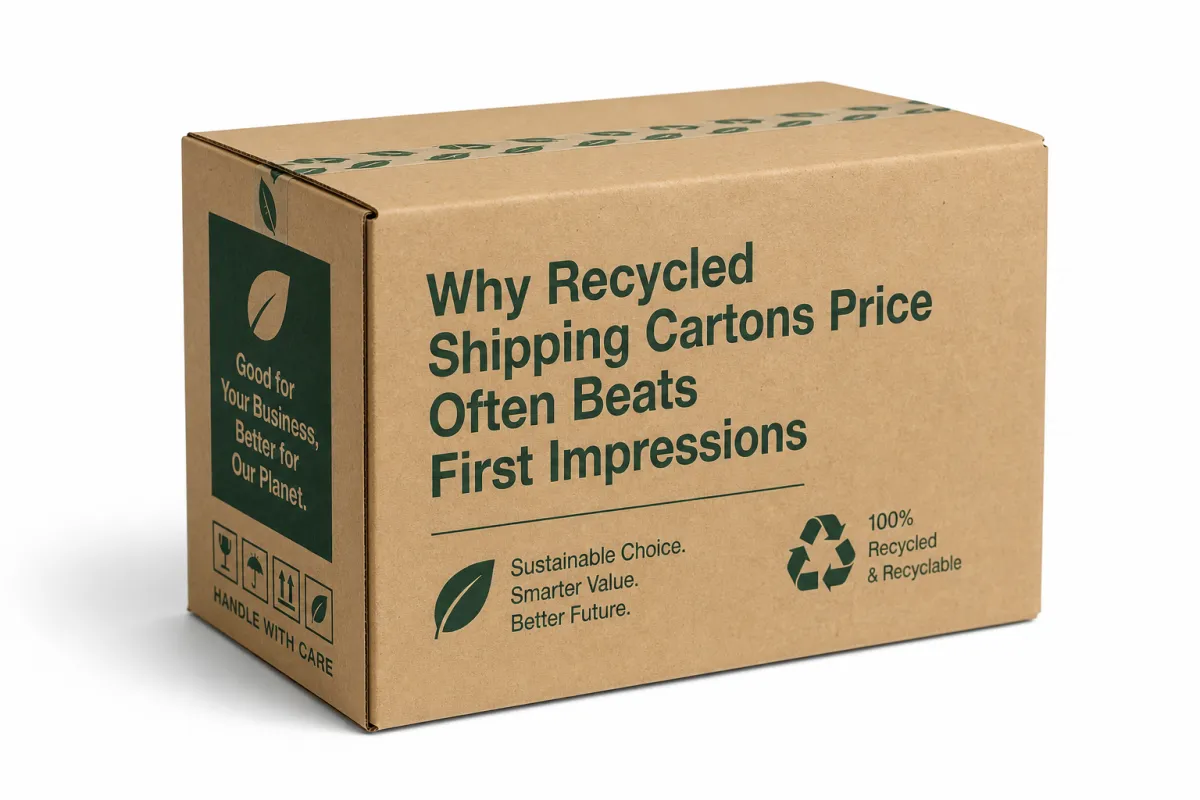
Recycled shipping cartons price can look high next to a generic stock carton if someone is staring only at the number next to the box. That number leaves out the part that actually matters. The better comparison is what the carton does under load, over distance, and during storage before it ships. A carton that fits correctly and survives stacked inventory usually saves more money than a box that is a few cents cheaper but creates damage, repacking, or a second shipment.
Packaging buyers run into the same trap over and over. Oversized cartons waste corrugated material, increase dimensional weight, and burn warehouse space. Undersized cartons squeeze the product, stress seams, and slow packing labor. Weak recycled board can look fine in a sample and then fail once the load is packed, palletized, and rattled across a route. That is why recycled shipping cartons price should be judged alongside product weight, shipping mode, and storage environment before the first order goes out.
A carton is not cheap if it damages product, inflates freight, or forces a repack. The line item only looks good until the failure shows up.
There are four hidden costs buyers should keep in view:
- Damage cost: a crushed carton can turn a sale into a replacement order and a customer service call.
- Freight cost: a larger outer box can push dimensional weight higher and raise parcel charges.
- Labor cost: poorly matched cartons slow packing, add filler, and create more touch points.
- Inventory cost: over-specifying the carton can tie up cash in shipping materials that are heavier or larger than needed.
That is why recycled shipping cartons price often beats first impressions. Buyers who focus only on the carton miss the broader economics of package protection and fulfillment speed. Buyers who compare cartons the same way they compare pallet counts, freight quotes, and damage rates usually get better results. The carton is a tool. The right tool often costs a little more than the wrong one, and far less than the damage it prevents.
Timing matters too. A carton available in the exact size you need can prevent production delays, while a lower-priced substitute may force a packout change, new inserts, or a higher void-fill percentage. Those are real costs. Not theory. Not a spreadsheet trick with a fancy hat on.
So when the quote looks low, ask the better question: what does recycled shipping cartons price include, and what does it leave out? Freight? Tooling? Print? Samples? The answer usually tells you whether you are buying a box or a working packaging system.
Recycled Shipping Cartons Price by Material, Board Grade, and Build
Recycled shipping cartons price shifts first with the material structure. Recycled kraft liners, test liners, and blended recycled-content boards do not behave the same way. Neither do single-wall, double-wall, and specialty die-cut builds. A buyer who understands the differences can match cost to performance instead of paying for strength that never gets used. That is where most of the savings live.
Recycled liners are common because they keep material cost in check while still supporting solid structural performance for many shipping programs. Test liner construction can be a reasonable middle ground for general shipping materials, especially when the product is not highly fragile and the run size is meaningful. For heavier goods, double-wall structures usually increase recycled shipping cartons price, but they also raise compression strength and lower the risk of pallet failure. A carton that survives stacking can be cheaper than one that collapses in warehouse storage. Funny how that works.
Board grade matters, but flute profile matters too. A B-flute carton behaves differently from a C-flute carton, and both differ from E-flute or double-wall configurations. Smaller flutes can improve print appearance and reduce cube, while larger flutes can add cushioning and stiffness. If you ship consumer goods, books, accessories, or small hardware, flute selection affects package protection and dimensional weight. That creates a direct link to recycled shipping cartons price, even before freight enters the equation.
Build style Changes the Quote as well. Standard RSC cartons usually set the baseline. Die-cut mailer-style cartons, full overlap cartons, and custom inserts add complexity, setup, and material use. If the carton needs partitions, locking tabs, or reinforced corners, the price can rise quickly. Surface treatments matter too. A plain natural kraft exterior is usually less expensive than heavy print coverage, spot coating, or a specialty finish. Protection does not always improve with the price. Sometimes you are paying for appearance.
Here is the practical rule: recycled shipping cartons price is usually driven more by the carton structure than by the recycled content label itself. Recycled content supports sustainability goals and can help with purchasing policy, but it does not automatically make the carton cheaper. The cost driver is the amount of board, the complexity of conversion, and the performance target the carton has to hit.
| Carton style | Typical MOQ | How recycled shipping cartons price usually behaves | Best fit |
|---|---|---|---|
| Stock RSC, unprinted | Low to moderate | Lowest unit cost when dimensions already fit the product | Fast replenishment and basic ecommerce shipping |
| Custom RSC, unprinted | Moderate | Usually a step up from stock because size is tailored | Repeat orders where fit and cube matter |
| Custom RSC with print | Moderate to higher | Print setup adds cost, but branding can replace labels or sleeves | Retail-ready shipping and branded order fulfillment |
| Double-wall or specialty build | Higher | Higher material cost, but better protection can cut damage costs | Heavy, fragile, or long-haul transit packaging |
For procurement teams, this is where recycled shipping cartons price becomes a strategic number. If the carton is part of a branded unboxing experience, print coverage and finish may matter. If the carton is purely protective, strength and cube usually matter more. If it is both, you need a spec that balances the two. That is the job. No drama required.
It also helps to view the carton as one piece of a broader system. A buyer comparing recycled shipping cartons price often benefits from reviewing the rest of the packaging stack at the same time, including Custom Packaging Products, Custom Shipping Boxes, and, where mailer formats are part of the mix, Custom Poly Mailers. The point is not to buy more. The point is to avoid a box-only decision when the shipping program needs a coordinated set of shipping materials.
Specifications That Move Recycled Shipping Cartons Price
Specifications drive recycled shipping cartons price more than many buyers expect. Before asking for a quote, the buyer should know the inside dimensions, product weight, pack count per carton, stacking height, and shipping mode. Those details shape the board grade, flute choice, and build style. Without them, quote comparisons get fuzzy fast. Fuzzy pricing helps nobody.
The first spec to lock down is the inside dimension. A carton that is even half an inch too large can increase corrugated usage, raise dimensional weight, and reduce pallet efficiency. A carton that is too tight can bruise product or slow packing labor down to a crawl. In ecommerce shipping, that difference can shift parcel cost in a way you will notice. In pallet shipments, it can reduce the number of units per layer and change the total case count per pallet. That is why recycled shipping cartons price should never be discussed apart from the product size it is meant to hold.
Strength requirements matter just as much. Buyers often hear terms like ECT, burst strength, and compression, but the practical meaning is simple: how much force must the carton survive during stacking, storage, and transport? If the product is light, a standard single-wall box may be enough. If the product is heavy, moisture-sensitive, or likely to sit in warehouse stacks, a stronger build deserves a closer look. ASTM testing references such as compression testing help here, especially when the load will be palletized. The harsher the use case, the more recycled shipping cartons price reflects the performance target.
Right-sizing usually pays back quickly. A carton trimmed by an inch or two in one or more directions can reduce board area, cut filler, improve pallet fit, and lower freight cube. That is not dramatic on a single order. It becomes obvious across a replenishment cycle. Buyers who manage recurring order fulfillment often see the benefit right away in lower void fill use and cleaner pack-out speed. That is one of the few places where recycled shipping cartons price, labor, and freight all move in the same direction.
Consider the other features only when they truly support the application:
- Single-wall versus double-wall: double-wall is not automatically better, but it is the safer choice for heavier loads and higher stacks.
- Inserts and partitions: these increase part count and conversion complexity, yet they can protect fragile items better than oversized void fill.
- Print placement: one-color print in a controlled area is usually simpler than full-panel coverage or multiple print locations.
- Seasonal storage: humid warehousing or long dwell times can justify a stronger board or coating.
That last point gets ignored more than it should. If the cartons will sit for weeks before use, recycled shipping cartons price should reflect not only transit, but also storage conditions. Corrugated performance can soften in humid environments. A buyer who ignores that can save a few cents and lose far more later in crushed product.
Practical buyers also document the route itself. A direct parcel move across one region is different from a multi-stop distribution lane, and both are different from export handling. Product fragility, expected vibration, stacking exposure, and pallet wrap quality all shape the right spec. If those inputs change, recycled shipping cartons price should change too. That is not a pricing flaw; it is the quote getting more accurate.
Once the spec is clear, recycled shipping cartons price becomes easier to defend internally. Procurement can point to measurable variables instead of vague preferences. Operations can pack faster. Sales can explain the packaging choice without improvising. Everyone wins when the carton spec is built around the actual shipping environment instead of a guess.
Recycled Shipping Cartons Price, MOQ, and Volume Breaks
MOQ is where recycled shipping cartons price changes personality. Small runs almost always cost more per carton than larger buys because setup, labor, and logistics are spread across fewer units. That is normal. It is arithmetic, not a punishment. Once the run size increases, recycled shipping cartons price often falls quickly until the next production threshold. Buyers who understand those breaks make much cleaner sourcing decisions.
Stock cartons and custom cartons behave differently. Stock items usually offer lower setup and faster availability, so the unit price can look attractive at smaller quantities. Custom cartons carry more setup cost, but the fit can reduce filler, cut damage, and improve pallet use. For a company shipping enough volume to repeat the same packout week after week, the custom route often becomes the lower total-cost option even if the invoice looks higher at first glance. That is why recycled shipping cartons price should be compared on the same basis across options.
There is a second layer: tooling, proofing, and freight. Some buyers compare carton quotes without including plate charges, dieline work, sample approvals, or the cost to get finished cartons to the dock. That creates false comparisons. A lower unit price with higher freight or setup can end up more expensive than the quote that looked higher at first. If two quotes do not include the same delivery terms, then recycled shipping cartons price is not being compared fairly.
For planning purposes, many buyers find it useful to think in ranges rather than exact figures. A simple unprinted recycled shipping carton in a standard size may land in a lower range at higher volume, while a custom printed, stronger, or more complex carton may move into a higher range very quickly. The exact number depends on board grade, flute profile, dimensions, and destination, but the direction is consistent: more complexity equals more cost. More units usually reduce the unit price. Better fit can reduce total spend elsewhere.
Here is a useful comparison framework for quoted pricing:
- Confirm the exact carton dimensions and whether the quote uses inside or outside measurements.
- Check the board grade and the flute profile, not just the carton style.
- Separate unit price from landed cost so freight and pallet charges are visible.
- Ask where the MOQ breaks are and what the next price tier looks like.
- Compare the damage risk if one carton option is lighter but less protective.
A practical decision rule helps here: if two options are close in recycled shipping cartons price, choose the carton that lowers damage, storage pressure, or packing labor. A few cents saved on paper cost is not worth a higher return rate. That is especially true in ecommerce shipping, where order volumes make small losses show up fast.
Volume planning also helps with cash flow. A buyer with uncertain demand may prefer a lower MOQ even if the unit price is higher, because inventory risk matters. A buyer with stable replenishment may prefer a larger order and use the lower tier. Both choices can be correct. The mistake is assuming the lowest per-box number is automatically the smartest move. It is not.
The most disciplined teams ask for multiple quote bands at once. One quote should show a lower MOQ option. Another should show the next volume break. That side-by-side view makes recycled shipping cartons price easier to interpret, and it often reveals where the real savings sit. Sometimes the jump from 2,500 to 5,000 cartons is surprisingly modest. Sometimes it is not. Either way, the buyer should know before placing the order.
From Quote to Dock Delivery: Process and Timeline
The fastest way to improve recycled shipping cartons price is to give the supplier a clean brief. A vague request creates slow quoting, more back-and-forth, and a higher chance of a spec mistake. A strong brief includes dimensions, product weight, quantity, destination zip code, print requirements, stack expectations, and any compliance or testing needs. If the carton will support ecommerce shipping, say so. If it will be palletized in high stacks, say that too. The supplier needs the use case, not just the box size.
The quote stage should also clarify whether the carton is for package protection only, branded presentation, or both. If the carton carries a logo or messaging, ask whether the artwork is a one-color flexo run, a limited-print panel, or a fully covered design. Print complexity changes recycled shipping cartons price because it affects setup and conversion. It also changes the proofing step, which can affect the timeline. A clean quote is one that leaves few surprises.
After the quote, the proofing step matters. Some jobs need a dieline. Others need a flat sample or a virtual proof. That depends on the carton style and how much confidence the buyer already has in the measurements. If the packout is tight, requesting a sample before production is smart. It can save money by catching an issue before thousands of cartons are made. That is especially true when product inserts, partitions, or internal supports are part of the spec.
Lead time depends on complexity, material availability, and approval speed. Standard production is usually faster than custom formats, and custom formats are usually faster than jobs that require new tooling or detailed print setup. A realistic planning window for many custom cartons is often measured in business days after proof approval, not calendar days after the first call. Buyers who want a rush order should ask early whether the schedule is actually feasible. A promise that cannot be hit is not a useful quote, no matter how good recycled shipping cartons price looks.
For teams validating transport performance, two resources are worth knowing: the ISTA transit testing standards and the EPA recycling guidance. They are not substitutes for a carton spec, but they help frame how package protection and recycled content fit into a formal purchasing process. If your packaging program references ASTM or ISTA testing, include that upfront. It helps align the quote with the performance expectation.
When the cartons arrive, the receiving checklist should be simple and strict:
- Count cartons against the purchase order.
- Inspect for print accuracy, corner crush, and moisture damage.
- Verify the size against the approved spec.
- Store the cartons dry and off the floor.
- Confirm the first production run before release to the line.
That final step matters more than many teams think. A carton that looks fine on a pallet can still fail in production if the dimensions are off by even a small amount. The goal is not just to receive shipping materials. The goal is to receive the exact carton that the quote promised, on time, and ready for use. That is how recycled shipping cartons price turns into a dependable supply program.
Why Buyers Choose Our Recycled Shipping Cartons
For buyers who want fewer surprises, consistency matters more than slogans. The value is in repeatable specs, straightforward communication, and a carton that performs the same way every time it is reordered. That is especially important for programs with recurring volume, multiple SKUs, or seasonal spikes. A good packaging partner should make recycled shipping cartons price easier to plan, not harder.
One reason buyers stick with a stable supplier is quote clarity. If the quote shows dimensions, board grade, print method, quantity, and delivery terms cleanly, then procurement can compare it against other options without digging through a pile of assumptions. That kind of transparency saves time. It also helps teams manage approvals internally when recycled shipping cartons price needs to be justified against the expected reduction in damage or labor.
Another reason is application support. A buyer may know the product weight, but not the ideal flute profile or board strength. That is normal. Packaging specialists spend their time matching carton structure to the shipping environment, and that can prevent costly over-specification. The difference between a good carton and a merely acceptable carton is often found in those small choices: one more inch of cube, one fewer layer of board, one better fit around the product. Those choices shape recycled shipping cartons price in ways that matter at scale.
Quality control and sample support are also practical differentiators. A first run should not feel like a leap of faith. It should feel like a controlled launch. When the carton is consistent, downstream processes become easier: pack stations move faster, pallet patterns stay cleaner, and ecommerce shipping teams spend less time adjusting the packout. That is a real operational benefit, not marketing fluff.
For brands that buy a mix of cartons and mailers, a coordinated supplier relationship can simplify the whole packaging stack. If the same team is sourcing Custom Packaging Products, Custom Shipping Boxes, and Custom Poly Mailers, it becomes easier to standardize artwork, monitor lead times, and align shipping materials across channels. That matters when order fulfillment is moving fast and nobody has time to re-explain every spec.
Buyers also care about responsiveness. A clear answer in hours can matter more than a vague answer in days. Freight bookings, launch dates, and inventory planning all move on schedules. When a supplier answers fast and avoids hidden fees, recycled shipping cartons price becomes easier to trust. Trust is not soft here. It shows up as less rework, less confusion, and fewer missed ship dates.
In practical terms, buyers usually return when three things are true: the carton matches the product, the pricing is stable enough to plan around, and the communication stays clear from quote to delivery. That is the standard worth aiming for. Not flashy. Just dependable.
How to Turn a Price Inquiry Into a Ready-to-Order Plan
The easiest way to get a useful quote is to send the supplier a complete brief. Start with the inside dimensions, product weight, quantity, ship-to zip code, print requirements, and target delivery date. Add whether the carton is for parcel shipping, pallet shipping, or both. If the product is fragile, tall, moisture-sensitive, or unusually heavy, say that explicitly. Those details change recycled shipping cartons price because they change the carton design.
Then ask for two quote versions. One should show the lower-MOQ option. The other should show the next volume break. That gives you a clean picture of the tradeoff between inventory risk and unit cost. A low run may make sense if demand is uncertain. A higher run may make sense if the carton will be used steadily for weeks or months. Without both numbers, recycled shipping cartons price is hard to evaluate honestly.
Requesting a sample or a spec sheet before the first production order is also smart. It helps validate fit, strength, and print placement. A sample can uncover a bad assumption about carton depth, insert size, or closure style before the run is made. That matters because the cheapest correction is the one you make before production starts. After the cartons are on the floor, every mistake costs more.
If you want a quick internal checklist, use this:
- Unit price: what the carton costs before freight and extras.
- Landed cost: what it costs delivered to your dock.
- MOQ: the minimum quantity that keeps the order open.
- Lead time: the schedule after proof approval.
- Performance: whether the carton protects the product and supports the shipping route.
That five-point view keeps recycled shipping cartons price grounded in reality. It is easy to get distracted by a low per-box figure, but that figure tells only part of the story. The real outcome is whether the carton helps the operation run smoothly, protects the product, and fits the budget once freight and labor are included.
So if you are preparing a quote request, build it around the actual use case, not just the SKU number. The more complete the brief, the better the pricing. And the better the pricing, the easier it is to choose the carton that fits both the product and the budget. Recycled shipping cartons price is best treated as a total-cost question, and once you do that, the decision usually gets clearer, faster, and easier to defend.
Actionable takeaway: Before you compare suppliers, send one quote request with exact inside dimensions, board grade, flute type, print needs, freight destination, and two quantity tiers. That gives you a recycled shipping cartons price you can actually compare, instead of a number that only looks useful.
What affects recycled shipping cartons price the most?
Board grade, flute type, and wall construction usually drive the biggest price changes. Box size and custom die-cuts affect material use and setup cost. Quantity, freight distance, and print complexity can change the final landed price more than the carton itself.
How do I compare recycled shipping cartons price quotes fairly?
Compare quotes with the exact same dimensions, board grade, print, and quantity. Make sure freight, setup, and any tooling costs are included in the total. Ask for both unit price and landed cost so you are not comparing partial numbers.
What MOQ should I expect for recycled shipping cartons?
MOQ depends on whether you are buying stock cartons or custom cartons. Larger or printed cartons often need higher minimums because setup costs are spread across fewer units. If your demand is uncertain, ask for tiered pricing so you can see where the next cost break begins.
How long does it take to produce recycled shipping cartons?
Timing depends on proof approval, material availability, and order size. Standard runs are usually faster than custom formats that need tooling or dielines. If you need a rush order, confirm the deadline before approving the quote so the schedule is realistic.
Can recycled shipping cartons reduce total packaging cost?
Yes, if the carton is sized and specified correctly, it can reduce damage and rework. Better fit can improve pallet efficiency and lower freight cube costs. A slightly higher carton price can still lower total cost if it reduces returns or replacement shipments.


