Black paper bags look simple until a restaurant has to live with them. Then every weakness shows up: a softened fold, a handle that digs into the hand, a base that bows under a clamshell, a logo that disappears under warm lighting. The restaurant Black Paper Gift Bags sample checklist exists for that exact reason. A sample does not just show appearance; it reveals whether the bag can survive service without turning into a complaint.
That distinction matters more than many buyers expect. On paper, a bag can look premium, carry the right dimensions, and match the artwork perfectly. In use, it may scuff at the corners, warp after packing, or feel flimsy once it leaves the counter. A restaurant order is a stress test, not a photo prop.
The smartest sampling approach starts with the real use case: what the bag carries, how often it is handled, how it is handed over, and what guests will notice first. Black stock is honest in a useful way. It exposes weak finishing faster than kraft or white paper, which means one good sample can save an expensive mistake later.
Restaurant black paper gift bags sample checklist: what the bag reveals
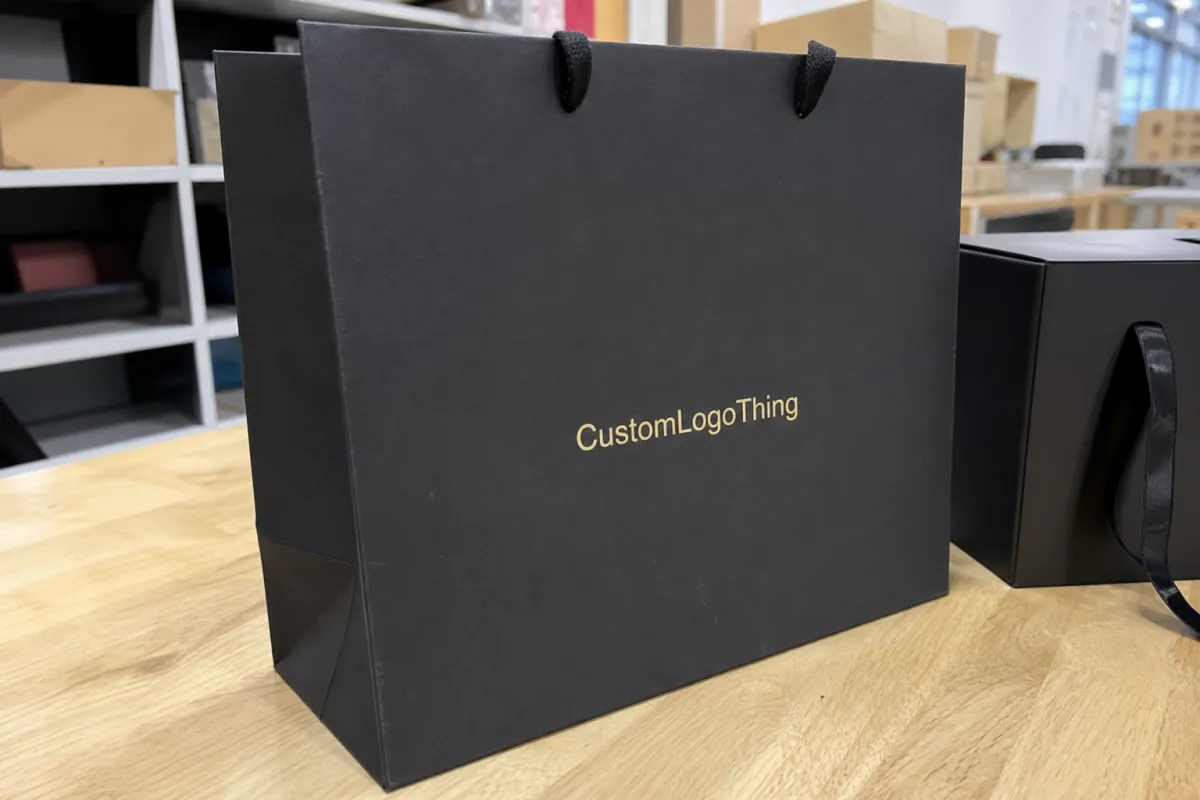
Begin with the sample in natural light if possible, then repeat the check under the restaurant lighting guests actually see. Black paper changes character depending on the lamp. Under warm light, some inks go soft and subdued; under brighter LED lighting, scuffs and fold whitening become obvious. If the bag only looks good in a bright office, that is not enough.
Inspect the bag empty first. The top edge should stay crisp, the gussets should fold evenly, and the corners should not look crushed before anything has been packed inside. Then lift it by the handles and let it hang for a few seconds. If the top panel distorts immediately, the reinforcement is too weak or the glue line is inconsistent.
After that, load it with the exact items the restaurant uses most. A dessert box, a bottle, and a small side order test different pressure points. One item alone rarely tells the full story. A sample that works for a pastry shop may fail for a bistro with heavier takeaway packaging.
- Appearance check: watch for scuffs, white fold lines, uneven black tone, and print blur.
- Load check: pack the heaviest realistic order, then confirm the base stays flat.
- Carry check: lift with one hand; the bag should stay balanced without twisting.
- Photo check: take front, side, and angled photos to see how the logo reads on camera.
- Handling check: rub the surface lightly with a clean cloth to see whether finish marks transfer easily.
That last step catches more than cosmetics. Some black finishes pick up fingerprints quickly. Others resist handling but show scratch lines instead. Both can be acceptable, depending on how the bag will be used. The point is to know the tradeoff before production starts.
A bag also needs to feel intentional. Cheap black stock can look flat and lifeless, while a better material with a clean finish feels dense, structured, and polished without shouting for attention. The difference is subtle in a quote. In hand, it is immediate.
A sample is less about approval and more about exposure. The weak points usually show up first.
What a physical sample proves that a spec sheet cannot
Spec sheets are useful for comparison, but they are not proof. They tell you what was promised: size, weight, finish, handle type, and print method. They do not show how the bag behaves once paper, glue, and artwork meet real handling. A physical sample closes that gap.
One common problem is size tolerance. A difference of 3-5 mm may sound trivial, yet it can matter when the restaurant packs rigid containers or taller boxes. A sample shows whether the interior dimensions are generous enough or whether the side gussets steal more room than expected. If the bag fits only when packed perfectly, it is too tight for daily service.
Another issue is construction quality. The bottom should lie flat without sagging. Glue lines should be neat, not over-squeezed or misaligned. Handle reinforcement should sit evenly so the top edge does not tear during lifting. A bag can survive a single hand test and still fail after repeated carries, which is where restaurants start seeing returns and awkward handoffs.
Ask which sample stage you are actually holding. A blank structural sample proves shape and basic build. A printed prototype proves color, finish, and artwork placement. A pre-production sample should be close to final, but only if the supplier has already locked the materials. If the paper weight or handle stock can still change after approval, the sample is not final in any practical sense.
For sustainability claims, documentation matters as much as the logo on the bag. If the bag is meant to be FSC-certified, request the certificate number and scope early, not after the quote is signed. Public verification is available through FSC. If the order will travel through distribution or storage before delivery, ask whether the carton pack is tested in a way that reflects shipping stress; standards and guidance from ISTA can help frame that conversation.
That is the practical value of a sample. It shows whether the bag exists as a usable object, not just as a line item in a spreadsheet.
Paper weight, finish, and structure: the specs that matter
For restaurant gift bags, the first real decision is paper weight. A black bag around 210-250gsm usually works for lighter takeaway sets, desserts, or branded retail items. For heavier food orders, bottles, or mixed containers, 250-300gsm gives more body and better shape retention. Go too light and the bag slumps. Go too heavy and it may feel rigid unless the build is precise.
Finish changes both appearance and wear. Matte black is the safest option for hiding fingerprints and keeping the bag restrained. Soft-touch film feels upscale, but it can show rub marks if the bag slides across counters or stacks tightly in storage. Lamination improves scuff resistance, though it can make surface imperfections more visible under bright light. Uncoated stock has a natural feel, but it wears faster along the edges. There is no perfect finish; there is only the one that fits the service environment.
Handle choice matters as much as paper. Twisted paper handles are cost-effective and suit lighter loads. Cotton rope handles feel better in the hand and carry more weight, but they raise the unit price. Ribbon handles are mostly decorative and are weak practical choices for daily restaurant use. In a food setting, presentation has to coexist with function. It cannot replace it.
Structure is where the real value lives. A reinforced top edge, tight bottom glue, and even gusset folds do more for durability than extra decoration ever will. Foil stamping, embossing, or a special finish can improve perceived quality, but they do not fix a weak base. If the bag sags when loaded, no one will praise the branding.
A useful sample test is simple: pack the bag with the heaviest realistic order, lift it, set it down, then lift it again. Repeat the cycle several times. Many structural issues only appear after the second or third handling. That is especially true for bags with a narrow top panel or a heavier insert stack.
- Starting range: 210-250gsm for lighter restaurant use.
- Heavier range: 250-300gsm for denser loads and more frequent handling.
- Handle fit: paper handles for economy, rope for stronger carry, ribbon for presentation-led use only.
- Structure first: bottom glue, reinforcement, and fold quality before decorative finishes.
- Surface choice: matte for fewer fingerprints, coated for added scuff resistance, uncoated for a more natural feel.
Black stock also hides some problems and reveals others. Minor glue marks can disappear, but a crooked fold line becomes obvious. A good sample gives a full view of both.
Sample process and timeline: request, revision, approval
A clean sample process starts with a complete brief. The supplier needs the finished size, target paper weight, handle style, artwork files, print coverage, and the exact items the bag must carry. If that information is missing, the first sample will almost always be a guess. Guessing costs time.
The usual path is straightforward: digital mockup, physical sample, revision if needed, then final approval. Simple bags can move quickly. Bags with foil, embossing, dense black coverage, or tight registration need more back-and-forth because those details are sensitive to layout and material changes. One revision is normal. Two is not unusual for a complex build.
Typical timing varies by factory load and printing method, but these ranges are realistic:
- Digital mockup: 1-2 business days.
- Blank sample: 3-7 business days.
- Printed prototype: 5-10 business days.
- Production after approval: often 12-20 business days, with longer lead times for complex finishes or peak-season orders.
Do not blur sampling time with production time. A supplier may send a quick mockup and still need another week to make the physical sample. Likewise, approval should be written, not casual. A message that says “looks okay” is useful for discussion, but it is not a clear release instruction when the order later goes wrong.
Document each revision carefully. Save images, note the changes, and label the files clearly. If the supplier sends a second sample with a slightly different sheen or handle position, you need a record of what was changed and why. That paper trail is rarely exciting. It is very useful when something does not match the approved version.
The sample checklist should also include packaging details. How many bags per carton? Are the cartons double-walled? Is there an inner sleeve or protective wrap? These points sound secondary until a shipment arrives crushed at the edges because the outer pack was too weak for the route.
Cost, MOQ, and quote details to compare
Price comparisons only work when the quote is broken into parts. Sample fee, tooling or plate fee, unit price, freight, and any special handling should appear separately. If the quote is presented as one total with little explanation, there is a good chance the real cost will be revealed later, item by item.
For restaurant black paper bags, sample costs usually fall into broad ranges depending on complexity. A blank structural sample is the least expensive option because it proves shape and build without print setup. A printed prototype costs more because color, artwork, and finish have to be reproduced. A pre-production sample is the closest to final, but it can be expensive and may not be credited back unless that is agreed in writing.
| Sample type | Typical sample cost | What it proves | Main tradeoff |
|---|---|---|---|
| Blank structural sample | $25-$60 | Size, fold quality, bottom strength, handle placement | No print accuracy |
| Printed prototype | $60-$180 | Artwork, finish, color behavior, logo placement | May not show every structural weakness |
| Pre-production sample | $80-$220 | Near-final build and materials | Slower and sometimes non-refundable unless agreed upfront |
MOQ needs context. A lower unit price at 5,000 pieces may look attractive, but if the restaurant only uses a few hundred bags a month, the storage burden can outweigh the savings. Black bags also take up visible space in a back room or stock area, so storage density matters more than buyers usually plan for.
The most expensive features are predictable. Foil stamping, embossing, specialty handles, inserts, and full-coverage print all push the quote upward. Rush sampling, split shipments, artwork cleanup, and extra carton packing charges are the hidden costs that often show up late. A good quote should specify whether the sample fee is deductible from production and whether that credit survives revisions.
Unit pricing for small-to-mid volume restaurant orders often lands somewhere in the range of $0.30-$1.20 per bag depending on size, finish, and print complexity. That range is wide for a reason. A plain black bag with twisted handles sits near the low end; a larger bag with rope handles, foil, and heavier stock moves fast toward the high end.
The cleanest quote is rarely the cheapest. It is the one that makes the tradeoffs visible.
Common sample mistakes that cost restaurants money
The first mistake is approving under the wrong light. A black bag can look rich in an office and dull in a dining room, especially when matte finishes and dark logos are involved. If the customer will see the bag in warm ambient light or under a bright pickup counter, that is the setting that matters.
Another error is testing only one order type. A pastry box may fit cleanly, but add a soup cup, a bottle, or a second container and the geometry changes quickly. Restaurants are not packaging one ideal item; they are moving a mixed set of orders through a busy service line. Samples should reflect that messier reality.
Handle comfort gets missed more often than it should. A handle that is technically strong can still be unpleasant if it cuts into the hand or sits at an awkward angle. Guests may not complain, but they will feel the inconvenience. That kind of friction is small in the moment and memorable later.
Some buyers approve a sample and assume the final run will match automatically. That is risky. Suppliers can change paper stock, glue, handle material, or packing method unless the approved spec is locked in writing. A sample approval only protects you if it names the exact build: size, paper weight, finish, handle type, print method, and carton count.
Color tolerance also needs clear limits. Black is not one shade. It can lean warm, cool, flat, or glossy depending on paper source and finish. If the brand identity depends on a specific black tone, define the acceptable range early. Otherwise the order can pass technically and still look off on the shelf.
Short version: a sample without a comparison standard is not much protection. It is only a starting point.
Expert tips and next steps before you place the order
Take photographs from the front, side, top, bottom, and inside. Then mark the exact changes directly on the image or in the file notes. That keeps the conversation specific. “Make the logo larger” is vague. “Move the logo 5 mm higher and increase the mark by 10 percent” is useful.
Before approval, lock the specification sheet. Include finished size, paper weight, finish, handle style, print method, artwork file name, carton quantity, and packing method. If the order needs FSC-backed material, record the certificate details with the spec file. If the shipment depends on a certain pallet setup or carton count, write that down too. Small details become expensive when they are left to memory.
Ask for a preflight check if the artwork is complex. White ink on black paper, metallic foil, and close registration all deserve extra scrutiny before the production run begins. On dark stock, a minor alignment issue can look larger than it really is. Buyers often notice that problem only after the cartons are opened in a hectic receiving area.
The best approved sample is one the factory can repeat without improvisation. Anything else invites variation.
Confirm three operational points before release: lead time, freight route, and outer carton protection. Bags are light, but they are not immune to crushed corners or warped stacks if the packaging is careless. Restaurants notice when the exterior carton arrives rough, because that is often a sign of what is waiting inside.
Use the restaurant black paper gift Bags Sample Checklist one final time after any revision. The second sample is usually the one worth approving. If it still looks clean under real light, carries the intended load, and stays presentable on camera, the order is probably ready for production.
FAQ
What should a restaurant black paper gift bag sample include?
It should show the finished size, paper weight, handle style, base structure, and the exact print method planned for production. If branding is important, ask for both a blank structural sample and a printed version. Test the bag with the heaviest realistic takeaway load, not a light demo fill.
How do I compare restaurant black paper gift bags sample quality?
Compare the sample under the same lighting, then check for scuffs, fold whitening, edge crush, and print alignment. Look at the bag empty and loaded so you can judge how it behaves under pressure. Side-by-side photos help more than memory, which tends to forgive flaws that matter later.
How long does the sample and approval process usually take?
Digital mockups are usually fast, but physical samples take longer because they may require setup, printing, and shipping. Add extra time for revisions, specialty finishes, or new tooling. Keep sampling time separate from production time so the schedule stays realistic.
What affects restaurant black paper gift bags pricing the most?
Paper grade, finish, handle style, print complexity, and MOQ have the biggest impact on unit cost. Black stock with foil or embossing usually costs more than a plain printed bag. Freight and sample charges can matter a lot on smaller orders, so they should be reviewed carefully.
Can I change the design after approving the sample?
Small changes may still be possible before production release, but they can affect price and timing. Larger changes often require a new sample or a new quote. Lock the spec sheet first if you want the production run to match the approved sample closely.

