If you need a corporate gifting Black Paper Gift Bags quote, start with the spec, not the lowest number. The bag construction, finish, handle style, and intended use determine whether the bag feels premium, holds its shape, and survives handling after it leaves the room. A bag that looks fine in a mockup can fail in transit, storage, or repeated handoffs.
Black paper bags are popular because they hide light scuffs and make simple branding look more deliberate. A restrained logo on black often reads cleaner than a busy print on white stock, especially for executive gifts, onboarding sets, and seasonal packaging. The tradeoff is that black also exposes weak structure faster if the paper is thin or the edges crush easily.
Two quotes can look close and still describe very different products. One may assume thicker board, rope handles, matte lamination, and foil stamping. Another may assume lighter stock, flat handles, and basic ink. If you compare unit price before matching the spec, the cheapest number is usually the least useful.
Corporate gifting black paper gift bags quote: what buyers miss
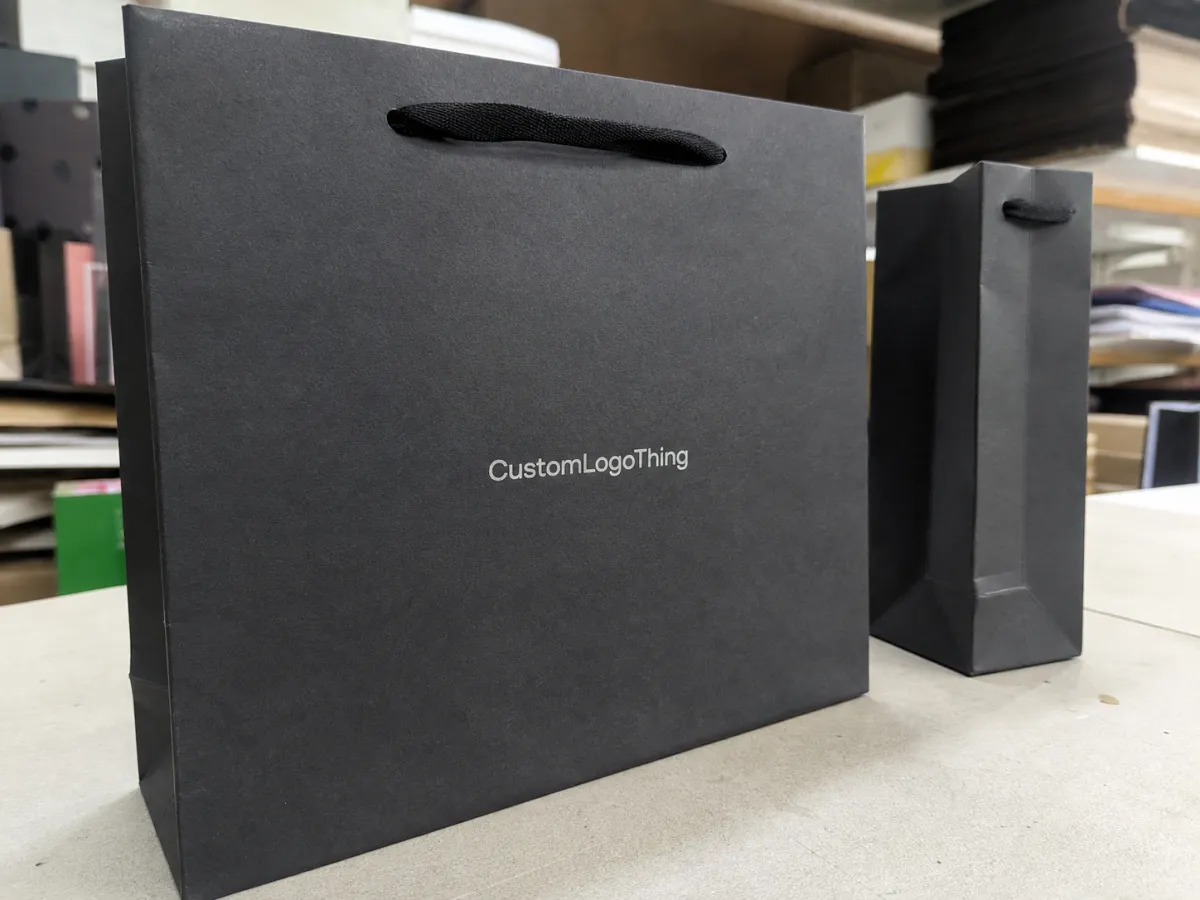
A quote only has meaning when the construction is visible. Buyers often focus on color and logo placement, but the hidden details decide whether the bag feels sturdy and stays presentable after handling. Paper weight, handle reinforcement, and finish all affect the final result more than a headline price suggests.
Black paper also changes how defects show up. Edge crush, fold wear, and scuffs are easier to see on dark stock, especially if the bag is moved through offices, vans, or distribution centers. That is why a good comparison should separate the bag price, print cost, finishing, freight, and setup or sample charges. Combined pricing is faster to read, but it is harder to audit and compare.
Corporate gifting programs also vary by use. A bag handed out at reception may only need to survive one handoff. A bag shipped to remote staff may pass through sorting equipment, a courier, and another carton before it reaches the recipient. Those use cases should not be priced from the same assumptions unless the bag spec is strong enough to cover both.
Bag formats, finishes, and branding options
Finish changes the tone immediately. Matte black feels controlled and modern. Gloss black has more shine, but it shows fingerprints and abrasion more easily. Soft-touch lamination can feel premium and photograph well, though it may mark if packed tightly with sharp items. For most corporate gifting uses, matte or soft-touch is the safer choice.
Handle style matters just as much. Rope handles usually carry weight best and feel the most substantial. Ribbon handles work for higher-touch presentation and seasonal sets. Flat handles are lower cost and can suit short-use events, but they do not communicate the same level of care. If the bag is part of a premium gift, the handle should support that message.
- Foil stamping gives strong contrast on black, especially in silver, gold, or white foil.
- Spot UV creates a subtle contrast, but the base coating must be controlled well or the effect can look uneven.
- Embossing gives a restrained tactile finish, though very fine details can disappear on textured stock.
- Single-color print is the most efficient choice for simpler artwork and larger volumes.
The black stock itself also matters. Some bags use dyed-through paper, while others are surface coated or printed black. Dyed-through paper tends to hide white edge lines better when the bag is cut or folded. Surface-coated stock can look clean at first, but wear shows sooner at the fold and gusset if the coating is thin.
Logo placement needs care on black paper. Thin lines and low-contrast art can disappear if the print method does not match the finish. Ask for a proof that shows the actual foil tone or ink result, not just a flat artwork preview. If the bags will be photographed or used for media coverage, keep the mark clear of seams, handles, and fold lines.
If sustainability is part of the brief, request paper sourcing details and certification paperwork before production starts. FSC is the usual reference point for responsibly sourced paper. If the order will move through distribution centers, ask how cartons are packed and whether they have been tested for stacking and transit stress.
Size, paper weight, and insert specs that affect performance
Bag size should be chosen around the contents, not around a rough guess. A notebook, a boxed charger set, and a folded hoodie behave differently inside the same bag. Small formats work for gift cards, samples, and compact items. Medium formats suit notebooks, apparel, and light merchandise. Large formats are better for boxed kits and heavier multi-item gifts.
Paper weight is one of the clearest indicators of performance. Thin stock bows at the top, wrinkles at the gusset, and makes the bag feel tired before it is even filled. Heavier stock holds the opening square and resists sagging at the base. For standard branded black paper bags, many buyers land around 210gsm to 250gsm. Heavier stock is worth considering if the contents are dense or the bag will be reused.
Reinforcement details often matter more than the budget line suggests. A top board helps the opening stay straight. Bottom inserts prevent sagging. Gusset depth affects how much the bag can carry before the sides flare awkwardly. If the contents can slide around, the bag may still look cheap even with a strong logo. A tissue liner, divider, or insert can solve that for a modest cost increase.
Ask for a dieline or a sample before approving artwork. That is where most avoidable errors show up: a logo too close to a seam, handle anchors cutting into the print area, or a mark that sits too low after the top fold. A flat mockup is useful, but a dieline shows the real construction. Also ask for folded dimensions and carton count if the bags will be stored in an office; oversized cartons create receiving problems fast.
Black paper also shows compression differently from lighter stock. A crease that might pass on kraft can look sharp and white-edged on black. If the order is for a premium event, ask how the bags will be packed and whether inner wrapping is used to reduce abrasion and handle damage.
Pricing, MOQ, and unit cost: how the quote is built
A corporate gifting Black Paper Gift Bags quote is usually built from six variables: size, paper grade, handle style, print colors, finish, and assembly. Add inserts, tissue, or custom dividers, and the price moves again. That is normal. What should not happen is a supplier treating those choices as minor, because they are the product.
MOQ has a direct effect on unit cost. Smaller quantities spread setup across fewer bags, so unit price rises quickly. As quantity increases and the spec stays simple, per-bag cost falls. The real question is not whether a larger order is cheaper on paper, but whether the inventory will be used before it becomes dead stock.
| Order tier | Typical spec | Approx. unit price | What usually changes | Best use |
|---|---|---|---|---|
| 250 units | Simple bag, one-color print, flat or rope handle | $1.15-$2.20 | Higher setup share, fewer options for extras | Small launches, pilot programs, sample kits |
| 500 units | Standard black paper bag, matte finish | $0.85-$1.75 | Better spread on setup and assembly | Onboarding, sales meetings, events |
| 1,000 units | Branding plus stronger paper weight | $0.65-$1.25 | Lower per-unit cost, steadier production | Quarterly gifting, multi-site use |
| 3,000 units | Repeatable spec, streamlined print | $0.48-$0.95 | Best pricing, but less flexibility | Holiday campaigns, large rollouts |
Ask for freight, setup, sample charges, and tax as separate lines. A quote that looks low can rise once shipping or proof revisions are added. If the bags will be used across several teams or events, a slightly higher MOQ can be the better choice because it reduces the risk of a rush reorder. Leftover stock is usually easier to manage than a missed deadline.
It also helps to request tiered pricing at 250, 500, 1,000, and 3,000 units, even if you do not plan to order every tier. Those breakpoints show where the cost curve improves. If the supplier can also show the difference between matte and laminated finish, or rope handles and flat handles, the approval process becomes much cleaner.
Order process and turnaround: from proof to delivery
The most reliable workflow is still the simplest one: spec check, digital proof, sample approval if needed, production, packing, and freight. Delays usually happen between those steps, not inside production. Missing artwork files, unclear dimensions, and slow approvals are the usual causes of a schedule slipping.
For straightforward branded runs, a digital proof may take 1 to 2 business days once artwork is ready. Production often lands around 10 to 15 business days after approval for simple print work. Add foil, embossing, custom inserts, or more complex assembly, and the window can stretch to 15 to 25 business days. Shipping is separate, so a bag can be finished and still not be in your office.
That distinction matters for launches and holiday drops. If the event date is fixed, ask for a written turnaround with buffer days built in. It is better to see a realistic delivery window than a promise that collapses when a proof needs revision or a carton size changes.
If you need a faster corporate gifting Black Paper Gift Bags quote, lead with the event date, the delivery zip code, and the final artwork format. Then ask the supplier to confirm production time and freight separately. The strongest quotes are not the shortest; they are the ones that tell you what can be delivered, by when, without hidden assumptions.
For teams shipping to multiple offices, ask how cartons are packed and labeled. Mixed cartons slow receiving and create confusion. Clear labeling, sensible carton counts, and consistent folding direction make the order easier to manage when it arrives at a warehouse or reception desk.
How to judge a supplier before you reorder
The first sample tells you something. The second order tells you more. Black paper bags make inconsistencies easy to see because edge defects, handle pull, and print alignment stand out against the dark surface. Inspect the finish, fold quality, handle reinforcement, and how the logo sits on the bag.
Ask whether the supplier makes the bags directly or brokers the job. That changes speed, accountability, and how quickly issues can be corrected. A direct producer can usually answer spec questions faster and keep repeat orders closer to the original standard. A broker can still work for simple jobs, but the arrangement should be clear before approval.
Strong suppliers are usually direct about tradeoffs. They will say that lower cost often means simpler print, that faster turnaround can limit finish options, and that high-gloss coatings show handling marks more easily. That kind of honesty matters more than polished sales language because it helps prevent reorders.
If your company orders quarterly or across regions, repeatability becomes the real test. Ask the supplier to store the approved spec against your account and confirm how reprints are matched to previous runs. Color drift, handle variation, and slight board-weight differences are common in repeat packaging orders. The bag does not need to be perfect in a laboratory sense, but it does need to be consistent enough that the next launch does not look like a different product line.
What to send for a faster quote and cleaner approval
If you want a faster corporate gifting black paper gift bags quote, send the essentials in one message: exact bag size, quantity, artwork file, handle preference, finish preference, and delivery zip code. That is the quickest way to reduce back-and-forth and avoid quotes built on assumptions.
Here is the shortest version of what a buyer should provide:
- Bag size and target contents, such as notebook, apparel, or boxed kit.
- Quantity with at least 2 to 3 pricing tiers.
- Artwork format, ideally vector PDF, AI, or EPS.
- Handle style, finish, and any insert or tissue requirement.
- Delivery location and event date, if the order is tied to a launch.
If the deadline is tight, put the event date at the top of the request. Ask for production time and freight as separate lines. If there is a prior version of the bag that needs to be matched, send a sample photo or old spec sheet with the request. Clean approvals usually come from clean inputs, not from faster chasing.
Approve revisions in one round if possible. Piecemeal feedback slows production and raises the chance that a seam, font size, or finish choice gets missed in final sign-off. A quote becomes real only after the bag size, print, finish, timeline, and shipping terms are fixed in the same place.
What should a corporate gifting black paper gift bags quote include?
It should list bag size, paper weight, handle type, print method, finish, and quantity so you can compare quotes fairly. It should also separate unit cost from shipping, setup fees, sample charges, and taxes. A useful quote shows estimated production time and delivery window, not just the price.
How do black paper gift bags affect corporate gifting presentation?
They hide scuffs and fingerprints better than lighter bags, so the handoff looks cleaner. They also make simple gifts feel more deliberate without adding much complexity. That is why they work well for events, client gifts, onboarding kits, and holiday drops.
What MOQ is typical for branded black paper gift bags?
Many custom runs start around 250 to 500 units for simple orders. Lower MOQs are possible, but the per-unit price usually rises quickly. If the bags will be reused across multiple campaigns, a larger MOQ can be the better value.
How long does production usually take after approval?
Simple branded bags often move faster than foil-heavy or heavily customized runs. A proof may take 1 to 2 business days if the artwork is ready. Production and freight should be treated as separate timelines when planning the event date.
Can I speed up a black paper gift bag quote for corporate gifting?
Yes. Send the exact size, quantity, artwork format, and delivery address in the first request. Ask for tiered pricing and confirm whether shipping is included or separate. If the deadline is fixed, tell the supplier the event date up front so they can check capacity immediately.
If you want a quote that is actually useful, do the boring part well: send the spec, ask for tiers, and make sure product cost and freight are listed separately. That is how you get a comparison you can trust, fewer surprises on approval, and a bag that still looks intentional after shipping and handling.