Restaurant Embroidered Baseball Caps Bulk Order planning starts with a practical truth: caps are not polite branded merchandise. They get sweat, steam, sunscreen, oil, and constant handling. They ride through dish pits, patios, dining rooms, and delivery runs. If a cap survives that mix and still looks controlled, it earns its place in the uniform stack.
That is why embroidery usually beats print for restaurant headwear. Stitching sits inside the fabric structure instead of on top of it, so it handles friction and repeated wear better than a screen print or heat transfer. A cap that holds its shape for a full season does more for brand perception than a flashier item that looks new only on the sample table. The difference is not subtle once the order has been worn, washed, and worn again.
For buyers, the question is less about decoration style and more about repeatability. The cap has to look the same on managers, servers, hosts, and off-site catering staff. It also has to be easy to reorder six months later without rebuilding the artwork or renegotiating every detail. That is where planning matters. A quote is only the beginning; the real value sits in fit, fabric, embroidery quality, and the supplier's ability to reproduce the same result without drift.
A restaurant cap that feels cheap on week one becomes a replacement problem by month three. In uniform programs, replacement cost is often the hidden expense that matters most.
Choose the right cap style, fabric, and fit
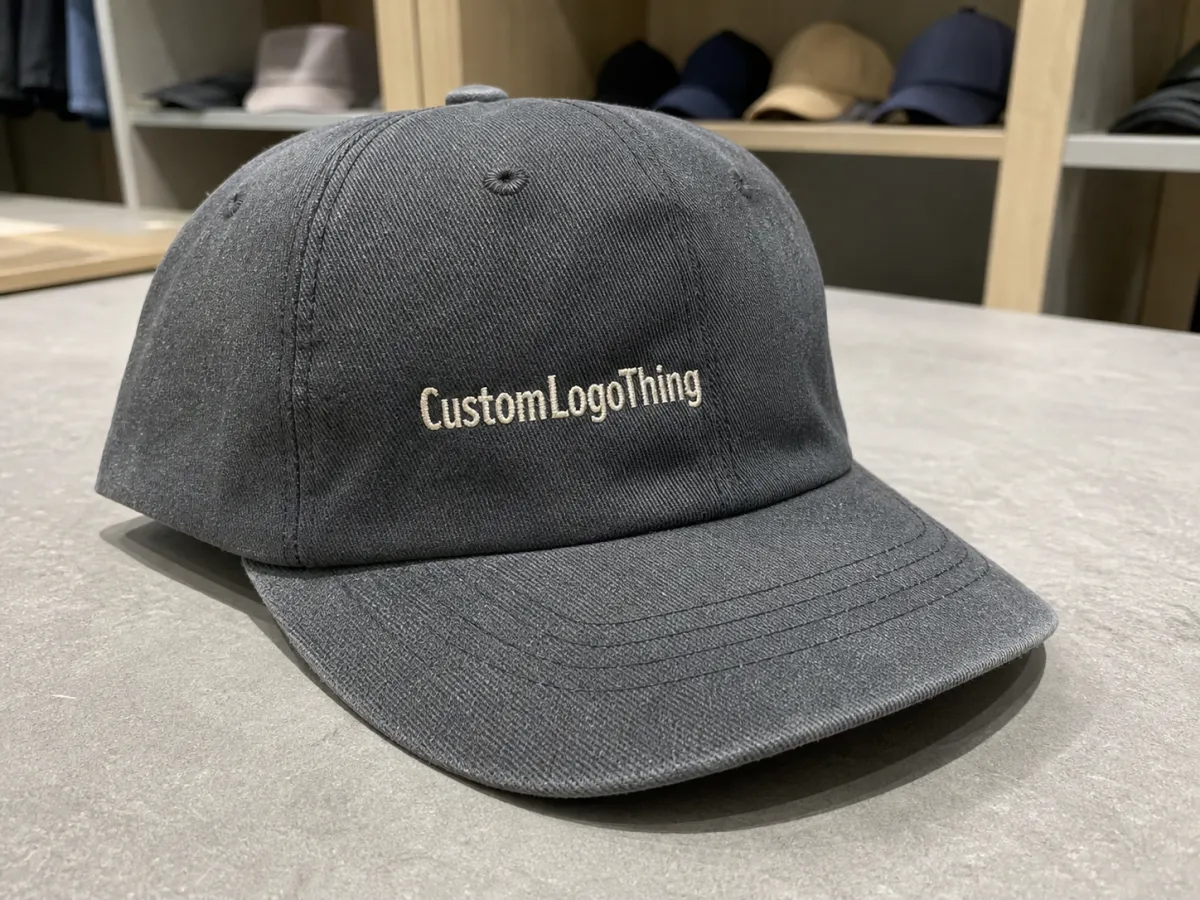
Cap selection should follow the job, not the catalog photo. A structured cap has a reinforced front panel, which gives embroidery a flatter, cleaner surface and creates a more formal look for host teams, supervisors, and dining-room staff. Unstructured caps are softer and read more casual; they can work for coffee counters, delivery teams, or back-of-house staff, but the logo has less support and can appear less precise.
Brim shape changes the tone too. Curved brims are easier for active service because they sit naturally and usually feel less awkward under movement. Flat brims signal a more fashion-led aesthetic, which can clash with a restaurant uniform if the rest of the outfit is traditional. That mismatch matters more than many buyers expect. A cap can be technically good and still feel wrong for the brand if the silhouette fights the rest of the uniform.
Fabric is not just a comfort issue. Cotton twill remains the safest all-around choice because it takes embroidery well and presents a classic, polished face. Poly-cotton blends hold up better under repeated wear and dry faster, which helps when staff move between hot kitchens, patios, and quick-turn laundering. Performance fabrics can be worth the extra cost for humid climates or outdoor dining, because breathability affects adoption. If staff dislike the cap in real service conditions, it will spend its life in a locker.
Fit decides whether the team actually wears it. Adjustable closures are helpful, but they are not all equal. Snapback, strapback, hook-and-loop, and metal buckle closures each solve different problems. A mixed workforce with different head sizes needs a cap that adjusts widely without distorting the crown. Low-profile caps suit smaller heads and more modern brand language. Mid-profile structured caps feel more universal and usually accept embroidery better because the front panel has more usable space.
Comfort issues show up quickly in restaurant settings. A cap that pinches at the temples or sits too high gets adjusted, then removed, then abandoned. That is why a short fit pass with staff is worth the time. The pattern is consistent across teams: if the cap is easy to wear, it gets worn. If it is merely attractive, it becomes a spare.
- Structured crown: cleaner embroidery surface and a more disciplined front-of-house look.
- Unstructured crown: softer appearance, but less support for larger or denser logos.
- Mesh-back: better airflow for patios, delivery, and warm service zones.
- Full fabric: more uniform visual language for indoor dining rooms and management teams.
Artwork setup and embroidery specifications that prevent rework
Embroidery is less forgiving than print, which means the artwork has to be cleaner than most buyers expect. The supplier needs a vector file, preferred thread colors, cap color, logo placement, and any brand rules around spacing or minimum text size. If a brand guide exists, send it. The cleaner the source files, the easier it is for the digitizer to produce a proof that actually reflects the final cap.
Small details that look harmless on a flat mockup can fail on a curved front panel. Thin strokes, tiny text, gradients, and complex outlines do not always survive cap embroidery well. The front of a baseball cap compresses the design, so a logo that looks balanced on screen may end up too small or too dense once stitched. For most restaurant programs, a front logo width of roughly 3 to 4.5 inches is common, but crown shape and seam placement change the usable area. If the logo is crowded, a simplified version often reads better from 10 feet away, which is the distance that matters on a service floor.
Stitch count affects both price and wear. A simple logo may land around 7,000 to 10,000 stitches. More fills, more colors, and more detailed lettering raise that count. That is not only a cost issue. Denser embroidery adds weight and can pull lightly constructed fabric out of shape if the base cap is too thin. On some low-cost caps, heavy embroidery produces puckering around the front panel or a slightly warped seam line. Those defects do not always jump out in a proof. They show up after the cap is worn.
Thread choice matters more than many buyers assume. Standard polyester embroidery thread is common because it resists fading and handles washing reasonably well. Matte thread can soften a bright logo, while glossy thread can make fine details pop but also look louder than the rest of the uniform. Thread color should be confirmed against a supplier chart or Pantone reference, but exact color matching is rarely perfect across materials. A black twill cap, for example, changes how navy or charcoal thread reads under dining room lighting compared with daylight.
Use the proof stage to settle placement, not just the art itself. Ask to see the logo on the actual crown panel, not only on a flat digital file. That difference matters because the curve, seam, and stitch direction all influence how the logo will read in real use. If the embroidery is supposed to align with aprons, shirts, or signage, keep the same logo lockup and color logic across the whole uniform system. Small inconsistencies create a much bigger impression than most buyers expect.
- Send: vector EPS, AI, or PDF files whenever possible.
- Confirm: thread colors by Pantone reference or supplier chart.
- Approve: placement on the actual crown panel, not only a flat mockup.
- Check: minimum text size before approving a fine-detail logo.
Pricing, MOQ, and unit cost for bulk cap orders
Bulk cap pricing becomes clearer once the quote is broken into parts. Look for blank cap cost, embroidery setup, stitch complexity, thread count, packaging, and any special handling. A single lump-sum quote hides the cost drivers and makes future reorders harder to compare. For buyers managing multiple locations, that missing detail becomes a problem quickly because the second order should behave like the first one.
Quantity changes the economics fast. Setup charges are spread across the run, so a 48-piece order can look expensive even if the cap itself is ordinary. That is not a red flag by itself. It is the normal math of decoration production. A 50-unit order and a 500-unit order are different buying events. On most programs, unit prices may land around $8 to $18 depending on style, decoration density, and color count, while digitizing and setup can run roughly $35 to $100. The exact range depends on the supplier, but the structure of the quote should always be visible.
MOQ is often driven by production efficiency rather than pure product cost. A supplier may have a low blank-cap minimum but a higher embroidery minimum, or the reverse. Mixed-color orders can also split into separate minimums if the cap body, panel construction, or thread palette changes. That is easy to miss if the buyer is used to apparel programs where size runs are the only variable. Caps have their own version of complexity, and it is usually tied to the body style more than the size count.
Land cost matters more than the headline number. Freight, sampling, art revisions, and rush fees can materially change the real total. Packaging is another quiet variable. A cap packed loosely in a carton is cheaper to ship than one sorted by location, banded in pairs, or inserted into custom retail-style packaging. None of those choices are wrong, but they should be understood before the order is approved. A cap program that looks inexpensive on paper can become surprisingly costly once fulfillment details are added.
| Cap option | Typical unit price | Best use case | Notes |
|---|---|---|---|
| Structured cotton twill | $10-$16 | Front-of-house teams, managers, polished dining rooms | Strong embroidery support and a classic look |
| Poly-cotton blend | $8-$13 | High-turnover staff programs, repeat reorders | Good balance of cost, wear, and easy care |
| Mesh-back performance cap | $9-$15 | Patio service, delivery, hot kitchens | Better airflow, slightly more casual appearance |
| Low-profile premium cap | $12-$18 | Boutique concepts, branded retail, visible management roles | Higher perceived value, fit can be more specific |
There is also a durability tradeoff that should be treated as part of the budget, not an afterthought. A slightly higher-priced cap can cost less over a season if it keeps its shape better, survives laundering, and avoids early replacement. In restaurant environments, replacement frequency is a real expense. A program that looks cheaper per unit but fails in month two is not actually cheaper.
Production steps, lead time, and approval checkpoints
The production flow is simple enough to describe and easy enough to derail. It usually goes like this: quote request, artwork review, digitizing, proof creation, approval, production, inspection, and shipment. If the order includes size sorting, location labeling, or custom inserts, those steps should be written into the quote. Ambiguity here tends to show up later as delays or unexpected charges.
Lead time depends on proof approval and the production queue. A straightforward order may take 1 to 2 business days to quote, another 1 to 3 business days for proofing, and roughly 10 to 15 business days for production after approval. Shipping adds its own window, especially if the order crosses regions or arrives during a busy season. If a supplier promises a much faster timeline, ask what is being shortened. Speed often comes from limited options, stock-only cap bodies, or fewer proof revisions. That can be fine, but the tradeoff should be visible.
Most delays come from predictable mistakes. Missing vector files are common. So are unclear thread colors, late changes to placement, and approvals that sit for days. A rushed order is usually not rushed by the factory alone; it is rushed by the paperwork. If a restaurant has a hard opening date or a major event, the safest move is to build buffer time and order a few extras for new hires and replacements. The cap count should include normal churn, not only the current headcount.
Inspection is worth asking about. Good vendors check stitch registration, logo alignment, crown symmetry, and packing quality before shipment. That sounds basic because it is basic, but not every supplier does it consistently. A cap can pass a quick visual review and still have a slight logo tilt, thread tail, or crushed front panel that becomes obvious once the box is opened. For restaurant buyers, that kind of issue is more than cosmetic. It weakens the discipline the uniform is supposed to signal.
Shipping protection matters too. Caps are less fragile than glass, but they still arrive damaged if cartons are crushed or packed too loosely. Ask how the supplier protects crown shape during transit and whether cartons are tested for drop handling or comparable shipping stress. For custom packaging, paper certification can matter as well. FSC-certified materials are a useful signal for buyers who want cleaner sourcing claims without turning the order into a sustainability campaign.
- Quote: 1-2 business days if the artwork is ready.
- Proof: 1-3 business days, faster when placement is simple.
- Production: often 10-15 business days after approval.
- Shipping: add 2-5 business days depending on destination and carrier.
How to evaluate suppliers for uniform consistency and service
The supplier matters as much as the cap body because the real product is repeatability. Restaurant embroidered baseball caps Bulk Order Planning only works if the vendor can reproduce the same logo placement, thread colors, and cap style on the next order without improvisation. A low quote is useful only if the finished hats match the proof and stay matchable later.
One useful question is whether the supplier can keep the same cap model and color in stock for reorders. That matters for restaurants with multiple locations, frequent turnover, or seasonal hiring. A supplier who can replicate the order six months later with the same structure and thread palette is often more valuable than one who wins the first order by a dollar. Uniform programs reward consistency more than novelty.
Ask about proof accuracy and file retention. Good vendors save approved specs, digitizing files, and thread notes so the second order does not start from scratch. That saves time and reduces the chance that a reorder comes back with slightly different lettering weight or a shifted logo position. In apparel, those changes are easy to overlook. On caps, even a small shift is visible because the front panel is the focal point.
Service also includes how the supplier handles exceptions. Can they split sizes by location? Can they ship to multiple addresses without re-quoting the whole job? Will they flag a cap body that has changed from the previous run because of a stockout or supplier substitution? Those details are not extras. They are operating costs. For a restaurant group, the cheapest order is not the one with the lowest line item. It is the one that lands correctly, on time, and unchanged enough to reorder cleanly.
Communication speed is another quality signal. Suppliers that respond with plain-language proof notes, clear production windows, and realistic constraints usually run a cleaner operation than those that promise everything immediately. A good vendor does not need to overstate what can be done. They need to explain what cannot be done cleanly, which is often more useful.
- Consistency: same cap body, same thread colors, same logo placement.
- Communication: fast proof turnaround and plain-language updates.
- Repeatability: saved specs for future orders and location rollouts.
- Control: inspection steps that catch misalignment before shipment.
What to confirm before you request samples and place the order
Before requesting samples, lock the basics. Cap style, quantity, color, artwork file, thread colors, placement, target delivery date, and approval contact should all be decided up front. If one of those inputs is still open, the sample can answer the wrong question. A beautiful cap in the wrong color or fit still creates a problem.
Decide whether you need a wear test, a physical sample, or only a proof. Not every order needs all three. A short fit test with hosts, servers, or managers can tell you whether the crown height feels right, whether the brim sits properly, and whether the logo reads at service distance. That feedback is cheap compared with replacing a full run of caps nobody enjoys wearing.
A written quote should separate setup, unit cost, shipping, and rush charges. That makes vendor comparison cleaner and exposes hidden fees before they become a procurement headache. If the restaurant has seasonal hiring or a planned opening, include a small buffer quantity and save the approved spec sheet. The next order should be faster because the first one did the hard work.
There is a reason this kind of planning matters more for caps than for many other branded items. They are visible, touched constantly, and judged from a distance. A restaurant team may forgive a slightly imperfect apron. A cap sits at eye level, which makes inconsistency easier to spot. Good planning reduces that risk. It also keeps the replacement cycle from turning into a recurring budget leak.
The best result is not a cap that looks impressive only in photos. It is a cap that can be reordered, worn hard, washed, and still look like part of the same program six months later. That is the standard worth setting before the first proof ever gets approved.
How many restaurant embroidered baseball caps should I order first?
Start with enough for core staff plus extras for turnover, size swaps, and replacement stock. If you run multiple locations, a small buffer prevents a second order from becoming a rush job because of one new hire or a lost cap.
What cap style works best for restaurant staff uniforms?
Structured cotton twill is a common choice for a polished front-of-house look. Poly-cotton blends and mesh-back styles are practical for hotter service environments because they dry faster and feel easier to wear across long shifts.
How long does a bulk embroidered baseball cap order usually take?
Many orders need a few days for proofing and roughly two weeks for production after approval, then shipping time on top. Faster turnaround is possible, but it usually depends on stock availability, simpler decoration, or fewer revisions.
What affects unit cost on restaurant cap bulk orders?
Quantity, cap style, stitch complexity, setup fees, thread count, and packaging all affect price. Freight and sampling can change the final total, so compare landed cost rather than only the unit quote.
Can I mix cap colors or styles in one bulk order?
Often yes, but minimums may apply by body style or color, and each variation can need separate approval. The more consistent the artwork and placement, the easier it is to keep mixed caps aligned as one uniform system.