Restaurant groups Waterproof Apparel Mailers warning label guide projects tend to begin with something modest: a damp apron bundle, a cracked return bag, a label that smears before it reaches the laundry partner. Then the issue spreads. One unclear package becomes a phone call from receiving. Two damaged mailers become a sorting problem. By the time a regional manager notices, the packaging is no longer a minor supply item. It is part of the operating system.
The package has to keep textiles dry, but that is only half the assignment. It also has to make the contents identifiable, readable, and easy to route through a fast, repetitive environment. Restaurant groups deal with uniforms, aprons, chef coats, hats, branded staff apparel, promo wear, and sometimes laundry returns that have already had a rough day. If the outer mailer cannot handle moisture, friction, cold rooms, and impatient hands, the chain of custody gets messy.
Good apparel mailer specs are rarely flashy. They are built from ordinary choices made carefully: film thickness, seal style, adhesive compatibility, label size, copy hierarchy, pack-out method, and order quantities that match real usage. The aim is not to overbuild every bag. It is to choose a package that survives the actual workflow without making stores, laundry teams, or purchasing staff compensate for weak details.
Why Restaurant Groups Need Waterproof Apparel Mailers
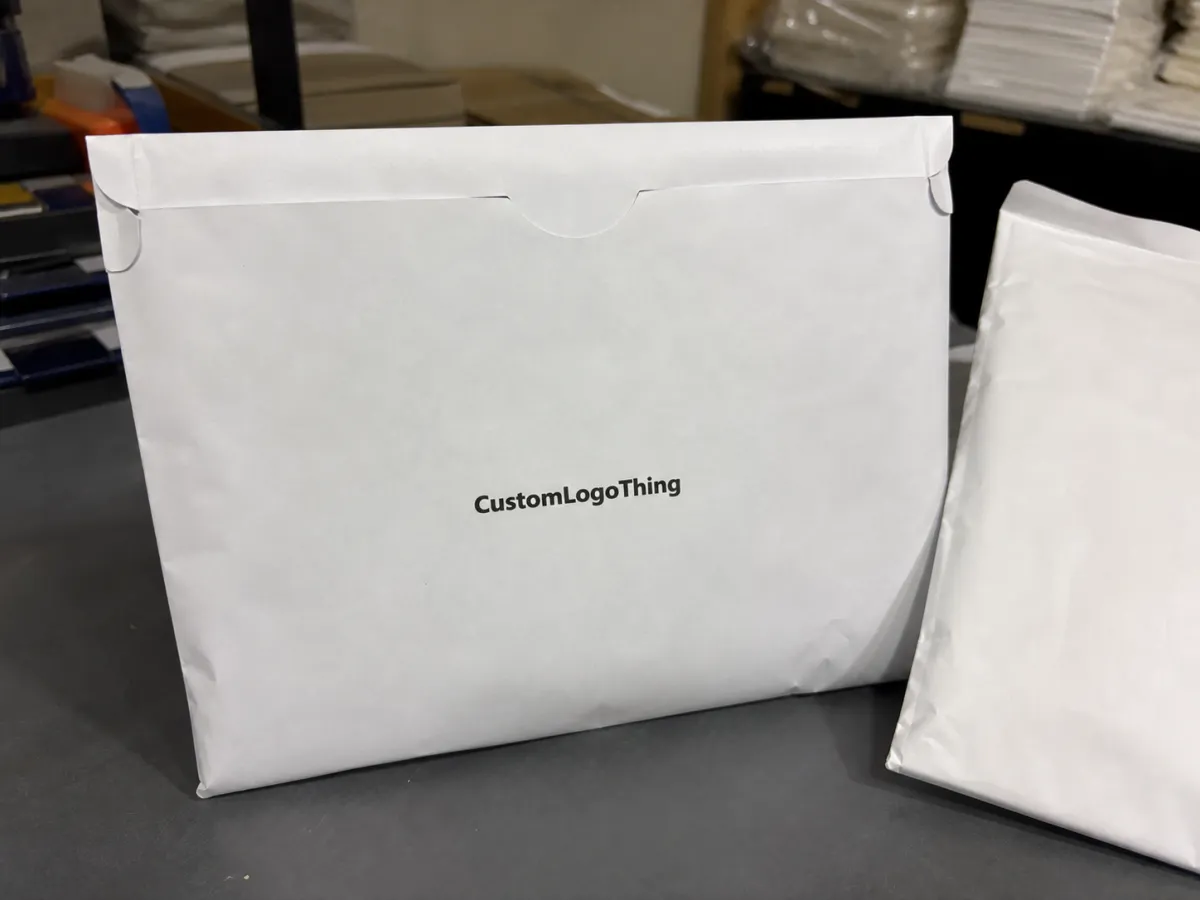
Standard poly mailers can work for dry, lightweight outbound shipments. They are less convincing when apparel comes back damp, when a delivery tote sits near a chilled area, or when laundry moves through a humid dock. Restaurant operations create a particular mix of abuse: moisture, compression, quick sorting, repeated handling, and little patience for packaging that needs special treatment.
A stronger Waterproof Apparel Mailer gives the garment bundle a controlled outer layer. That matters for sanitation perception as much as protection. A clean, sealed, readable package signals that the apparel was sorted and handled with intent. A stained, wrinkled, half-open bag sends the opposite message, even if the garments inside are fine.
Multi-unit groups feel these problems faster than single locations because repetition magnifies small flaws. A label that lifts on one bag is annoying. A label that lifts on hundreds of return packages becomes labor. A mailer that is one inch too small may look acceptable in a sample review, then distort seals across a week of real packing. Packaging errors are quiet until they are no longer quiet.
The most useful mailer setup reduces friction during handoffs. Stores need to see what is inside. Laundry partners need sorting cues. Regional teams need the same visual language across locations. Purchasing needs a repeatable spec that can be reordered without rethinking the whole program every quarter. That is why the conversation belongs with operations as much as procurement.
Some teams pair waterproof mailers with matching Custom Labels & Tags so routing, department, or return instructions stay consistent. Others consolidate the mailer, insert, and labeling requirements through Custom Packaging Products to keep the buying file cleaner. Either path can work as long as the materials match the conditions.
For transit and handling references, ISTA methods can help frame realistic testing, especially when cartons or parcel networks are involved. If paper inserts, hangtags, or outer cartons are part of the apparel program, FSC certification may also be relevant. Those standards do not replace a practical in-store trial, but they give buyers a better vocabulary for asking suppliers the right questions.
Practical rule: if the mailer protects the apparel but the warning label fails in the walk-in, on the dock, or inside the route tote, the packaging system is still unfinished.
How Waterproof Apparel Mailers and Warning Labels Work Together
A waterproof apparel mailer is usually a film-based pouch with sealed edges and a closure, often a peel-and-seal strip or a heat-sealed finish. Common films in this category run roughly 2.5 to 4 mil, with heavier constructions used for bulky garments, repeated handling, or higher puncture risk. Thickness helps, but it does not solve everything. A heavy film with a weak closure can still fail in the exact place the team depends on most.
The warning label is a control point, not decoration. It tells the receiver what the package contains, where it should go, and whether the garment bundle needs special handling. For restaurant groups, that may mean store code, department, uniform type, laundry route, return status, contamination note, or a simple instruction such as “keep sealed until received.” The right copy prevents assumptions without turning the label into a bulletin board.
Material compatibility is the detail buyers often underestimate. Glossy or low-energy films can make adhesion harder. Condensation can slow adhesive cure or cause edge lift. Cold storage can stiffen some label stocks and make corners pop. A label may look clean on a desk sample and still fail after ten minutes in a damp prep area.
Placement matters just as much as material. Keep the warning area away from folds, closure strips, gusset stress, and the highest abrasion points. If a packer naturally grips the same spot every time, that is probably not the best place for small type. A readable label belongs on the flattest, most visible face of the mailer, with enough margin that wrinkles do not bury the message.
Most programs use one of three approaches:
- Printed warning panel: a fixed message printed directly on the mailer, best for stable, high-volume programs with copy that rarely changes.
- Applied label: a separate label added during packing, useful when store codes, routes, departments, or handling notes vary.
- Full direct print: a broader printed design that combines branding, warning language, and handling instructions on the mailer itself.
Each choice has tradeoffs. A printed panel looks clean and tends to hold up well because the message is part of the package. It is less flexible if the routing language changes. Applied labels are more adaptable, but they depend on the correct label stock, adhesive, surface prep, and pack-out discipline. Full direct print gives the most polished exterior, though it usually requires stronger volume commitment, firmer artwork approval, and more careful version control.
Many restaurant groups land in the middle: a durable stock or lightly customized waterproof mailer with an applied warning label that can change by route or location. That approach keeps inventory flexible while still giving the receiving team a consistent reading area. It also avoids reprinting thousands of bags every time a region renames a route or adds a new department code.
Cost, Pricing, and MOQ for Waterproof Apparel Mailers
Pricing starts with material, then moves through size, thickness, print coverage, order quantity, label format, and distribution requirements. A plain waterproof mailer in moderate volume may fall around $0.10-$0.18 per unit. Add a one-color warning panel or simple custom print and the range may move to about $0.18-$0.30. Heavier film, broader coverage, specialty finishes, or multiple versions can push the unit cost toward $0.30-$0.55 or more. Applied labels commonly add $0.03-$0.12 each depending on size, stock, adhesive, and print method.
Those ranges are not promises; they are planning numbers. Resin markets move, freight changes, and suppliers quote differently based on equipment, sourcing, and workload. Still, they are useful for spotting unrealistic expectations. If a buyer wants a thick waterproof mailer, full custom print, several warning versions, split shipments, and a tiny order quantity, the price will not behave like a stock bag.
Minimum order quantity is often the sharper constraint. Stock items may start around a few hundred units, especially if the buyer is applying labels separately. Custom Printed Mailers are commonly quoted at 3,000 to 5,000 units, sometimes higher when special inks, multiple versions, or custom sizing are involved. For a new laundry flow or a small regional opening, a test quantity is worth asking for before committing to a brand-wide run.
Complexity is the quiet budget leak. Three bag sizes, four label versions, and direct-to-store shipping may look manageable on a spreadsheet, but each variable adds proofing, pack-out, inventory, and freight risk. A slightly higher unit price can still be the better buy if it reduces relabeling, damage, or sorting errors. Restaurant groups should compare total program cost, not just the number printed beside the mailer line item.
| Option | Best Use | Typical Unit Cost | MOQ | Lead Time |
|---|---|---|---|---|
| Stock waterproof mailer + applied label | Pilot programs, changing routes, flexible copy | $0.13-$0.28 | 500-1,000 | 5-12 business days |
| One-color printed warning panel | Stable store systems, simple routing language | $0.18-$0.30 | 3,000-5,000 | 10-18 business days |
| Fully custom printed mailer | High-volume, standardized brand-wide rollout | $0.30-$0.55+ | 5,000+ | 15-25 business days |
Useful buying questions are specific. What quantity changes the price tier? How much does a second print version add? Can the same label stock handle condensation and cold storage? Is the quote for one bulk shipment or multiple store drops? Are cartons labeled by region, store, or SKU? These questions sound plain because the expensive mistakes are usually plain too.
Process and Lead Time for Restaurant Group Orders
The order path is simple enough on paper: choose the spec, approve the proof, review a sample if needed, run production, then ship. The trouble usually sits between those steps. Late artwork changes, unclear warning copy, and unresolved store lists cause more schedule strain than the bag manufacturing itself.
Start with the use case before asking for a quote. A supplier needs to know the garment bundle size, approximate weight, moisture exposure, storage temperature, closure preference, print needs, and whether the program uses fixed or variable labels. “Waterproof mailer for uniforms” is too loose. “Mailer for two folded aprons returning damp from store to central laundry, readable after cold storage, with store-code label applied during pack-out” gives the quoting team something real to build around.
A typical workflow looks like this:
- Confirm bag size, film thickness, closure, and usage conditions.
- Finalize warning copy, label hierarchy, and barcode or store-code needs.
- Review digital proof, checking scale and placement against the actual bag size.
- Approve a physical sample when moisture, cold storage, or adhesion risk is meaningful.
- Run production and inspect packed cartons against the purchase order.
- Ship to one warehouse, a laundry partner, or store-level destinations.
Lead time shifts quickly once the order includes custom copy, multiple SKUs, variable labels, or split freight. A stock mailer with a simple applied label can often move quickly. A fully custom printed program with region-specific language and store-level carton labels needs more time because each version has to be checked and packed correctly. The fastest schedule is usually the one with the fewest last-minute decisions.
Proof review deserves more attention than it gets. Check spelling, store code logic, warning hierarchy, barcode quiet zones if used, label size, and placement relative to the seal. Make sure the most urgent language is readable at arm’s length. If someone has to pinch the bag flat and hunt for the instruction, the label is underperforming.
Distribution also belongs in the first conversation, not the last. Central warehouse delivery is simpler than direct-to-store shipping. Region-by-region splits affect carton counts, packing labels, freight class, receiving instructions, and reorder planning. A restaurant group that treats freight as an afterthought may end up with a technically correct mailer program that arrives in the wrong quantities at the wrong locations.
Spec Choices That Affect Durability and Readability
Durability starts with film thickness, but it continues through seal width, closure adhesive, puncture resistance, and how the bag fits the garment bundle. A 4 mil mailer may still disappoint if the closure lifts in humid handling. A thinner mailer may perform acceptably if the bundle is light, the seal is consistent, and the package is not being dragged through rough totes or overloaded cartons.
Size is one of the easiest specs to get wrong. A mailer that is too tight stresses the seal and wrinkles the label. It also slows packing because employees have to fight the garment into the bag. A mailer that is too large creates sliding, sloppy stacking, and more surface area for abrasion. The right size should allow quick insertion, a flat warning area, and a closure that lands without strain.
Readability needs the same discipline. Warning copy should be short, high-contrast, and arranged by priority. Start with what the receiver needs first: garment type, store or department, and handling instruction. Secondary details can sit below that. A busy receiving area is not the place for dense paragraphs, tiny type, or internal abbreviations that only one manager understands.
For labels, buyers should confirm stock, adhesive, finish, print method, and expected temperature range. Synthetic stocks usually tolerate moisture better than basic paper labels, though they cost more. Permanent adhesives may be appropriate for fixed routing, while removable labels can create trouble if they release too easily during transit. If thermal printing is part of the workflow, check whether the print will darken, fade, or smear under the expected conditions.
Quality control does not need to be elaborate, but it does need to be real. Before scaling, check a small group of packed mailers after a damp hold, cold hold, tote transfer, and normal handling. Look for closure lift, pinholes, label edge curl, ink rub, barcode scan issues, and distortion around the seal. A beautiful proof only proves the file was clean. It does not prove the package works.
For broader packaging programs, Custom Poly Mailers may still be the right fit for dry apparel, retail handouts, or branded non-waterproof shipments. The mistake is asking one mailer type to cover every use case. Wet laundry returns, clean uniform distribution, and retail promo apparel may need different levels of protection.
Common Mistakes with Waterproof Apparel Mailers
The first mistake is treating “waterproof” as a complete specification. It is not. Buyers still need to define thickness, closure, dimensions, print method, label stock, adhesive, and handling conditions. A vague waterproof claim does not tell you whether the package can survive cold storage, repeated handoffs, or a damp route tote.
The second mistake is designing the label for the conference room instead of the receiving area. Thin type, low contrast, small labels, and clever internal shorthand may pass an artwork review, then fail during a rushed sort. The label should be readable quickly by someone who did not sit through the packaging meeting.
Under-sizing causes more trouble than many teams expect. Tight bags stretch seals, wrinkle labels, and make apparel bundles look poorly packed. Over-sizing is not harmless either. Loose mailers shift around in cartons, stack badly, and can make store-level receiving less tidy. Measure the folded bundle, not the flat garment.
Another common issue is version creep. A group starts with one warning label, then adds separate copy for every region, concept, department, and route. Some variation is legitimate. Too much variation creates buying complexity and raises the chance of packing the wrong label with the wrong mailer. Use variable labels where they genuinely help, and keep the fixed language stable.
There is also a testing gap. Teams may approve a mailer from a clean sample, then discover that condensation lifts the label or that the closure performs poorly after cold exposure. Testing a small batch under actual operating conditions is not overcautious. It is cheaper than replacing a production run after stores have already built workarounds.
Blunt take: the most expensive mailer is the one that forces employees to relabel, rebag, re-sort, or explain the shipment after it has already entered the system.
Next Steps: Build a Cleaner Ordering Spec
Start with a short internal audit. List which apparel items move through the program, how they are folded, whether they are clean or damp, where they wait before dispatch, who reads the package, and how quickly that person needs to act. This is not glamorous work, but it keeps the spec grounded in reality.
Then turn those answers into a one-page buying spec. Include bag dimensions, film thickness, closure style, color or opacity, warning copy, label size, label material, print method, quantity, delivery destination, and any split-shipment requirements. If the package must remain readable after condensation, cold storage, or repeated handling, say so directly. Supplier guessing creates preventable errors.
A pilot order is the sensible bridge between a good idea and a chainwide rollout. Use one or two stores, one laundry route, or one regional flow. Pack the mailers the way employees will actually pack them. Check seal strength, label readability, pack-out speed, carton behavior, and scan performance if barcodes are involved. Ask the receiving side what they understood immediately and what slowed them down.
Once the spec works, document it tightly. Keep the approved artwork, label copy, material callouts, reorder quantity, carton labeling instructions, and shipping rules together. A clean ordering file protects the program when purchasing staff changes, new stores open, or the supplier asks for approval on a repeat run.
For buyers using this restaurant groups Waterproof Apparel Mailers warning label guide as a planning tool, the practical sequence is clear: define the workflow, choose the material around that workflow, test the warning label under real conditions, and scale only after the package survives the handling it will meet every week.
What should restaurant groups put on waterproof apparel mailers warning labels?
Use copy that helps receiving teams identify and route the package fast. Common fields include garment type, store code, department, laundry route, return status, and a short handling instruction. Keep the label readable at a glance, with strong contrast and enough space around the most urgent message.
Are printed warning labels better than applied labels on waterproof mailers?
Printed warning panels are usually better for stable, high-volume programs because the message is durable and clean. Applied labels work better when store codes, routes, departments, or handling instructions change often. The right choice depends on how often the information changes and how much moisture or abrasion the package sees.
How do MOQ and pricing change for restaurant group mailer orders?
MOQ is usually lower for stock mailers and higher for custom printed programs. Custom sizing, heavier film, multiple print versions, split shipments, and specialty label stocks can all increase cost. Buyers should compare total program cost, including relabeling, damage, and sorting labor, rather than judging the mailer by unit price alone.
What is a realistic lead time for custom waterproof apparel mailers?
Stock mailers with applied labels may move in about 5-12 business days, depending on availability and label production. One-color printed warning panels often take around 10-18 business days after proof approval. Fully Custom Printed Mailers can take 15-25 business days or longer when artwork, materials, or split shipments add complexity.
How can restaurant groups test a new mailer before rolling it out?
Run a small pilot under the same conditions the package will face in regular use. Check the closure after damp handling, cold storage, route-tote movement, and normal receiving. Confirm that labels stay attached, warning copy remains readable, barcodes scan if used, and employees can pack the garments without stressing the seal.