A restaurant takeaway Kraft Paper Bags quote can protect margin or quietly chip away at it month after month. I’ve watched restaurants grow delivery volume while cash flow gets tighter, mostly because packaging specs were copied from an old order, rushed through procurement, or guessed without checking menu weight, moisture exposure, and daily order mix.
Run the math on a busy location: 800 takeaway orders per day, and bag cost increases by just $0.03 because of mismatched paper weight, oversized print coverage, or rushed freight. That works out to about $24 per day, around $720 per month, and more than $8,500 per year tied to a single packaging item. An accurate, technically grounded restaurant takeaway Kraft Paper Bags quote carries much more financial weight than most teams expect.
Why a Restaurant Takeaway Kraft Paper Bags Quote Impacts Margin More Than Most Owners Expect
Picture a familiar situation. Delivery platform sales jump 20%. Revenue looks good on paper. At the same time, complaints about torn handles increase, staff start double-bagging heavier orders, and procurement scrambles to place top-up orders by air because forecast assumptions missed the growth.
I saw this firsthand during a Q4 rush with a regional quick-service brand: their bag line item looked “stable,” but actual packaging spend spiked because emergency freight and bag failures were hidden in different cost buckets. Nobody had done a full landed-cost and failure-rate review, so margin leakage went unnoticed for weeks.
Many teams treat packaging as fixed overhead. Real operations tell a different story. Packaging behaves like a variable cost category, and a solid restaurant takeaway Kraft Paper Bags quote gives visibility before cost drift lands on your P&L. Dimensions, GSM, handle structure, and print method are functional choices, not cosmetic add-ons.
Where hidden packaging loss usually starts
- Size mismatch: Bags run too tall or too wide for actual container sets, wasting paper and increasing carton cube.
- GSM overspec: Teams buy 120gsm where 90gsm with proper fold geometry would do the job, adding avoidable cost.
- Handle under-design: Twisted handles without enough reinforcement patch area fail on multi-container orders.
- Rush logistics: Weak reorder triggers force expedited freight that can double or triple carton freight cost.
- Print complexity inflation: Full-coverage art on both sides even though one-color branding meets store needs.
A useful restaurant takeaway Kraft Paper Bags quote should go well beyond “bag + print + freight.” Expect a material breakdown, construction details, print method, dimensional tolerances, load assumptions, and trade terms. Missing details mean you’re comparing fragments instead of true alternatives.
Buyer reality: The best quote is rarely the lowest piece price. It is the lowest total cost per successful handoff—bag performs, order arrives clean, and reorders stay predictable.
From a buyer’s side, success means each bag survives the full journey: packing line, short carry, bike or car vibration, handoff, then customer carry home. A strong quote matches structure to that real chain of stress. Weak quotes assume every order behaves the same way. They don’t.
Teams running multiple menu categories should ask for scenario-based pricing. Dry bakery packs may run perfectly in lighter flat or SOS formats, while saucy combo meals can demand higher stiffness, stronger bottom folds, or limited barrier treatment. A tailored restaurant takeaway kraft paper bags quote lets you assign the right spec per use case instead of forcing one heavy bag across every order.
Restaurant Takeaway Kraft Paper Bags Quote: Product Options That Actually Fit Foodservice Use
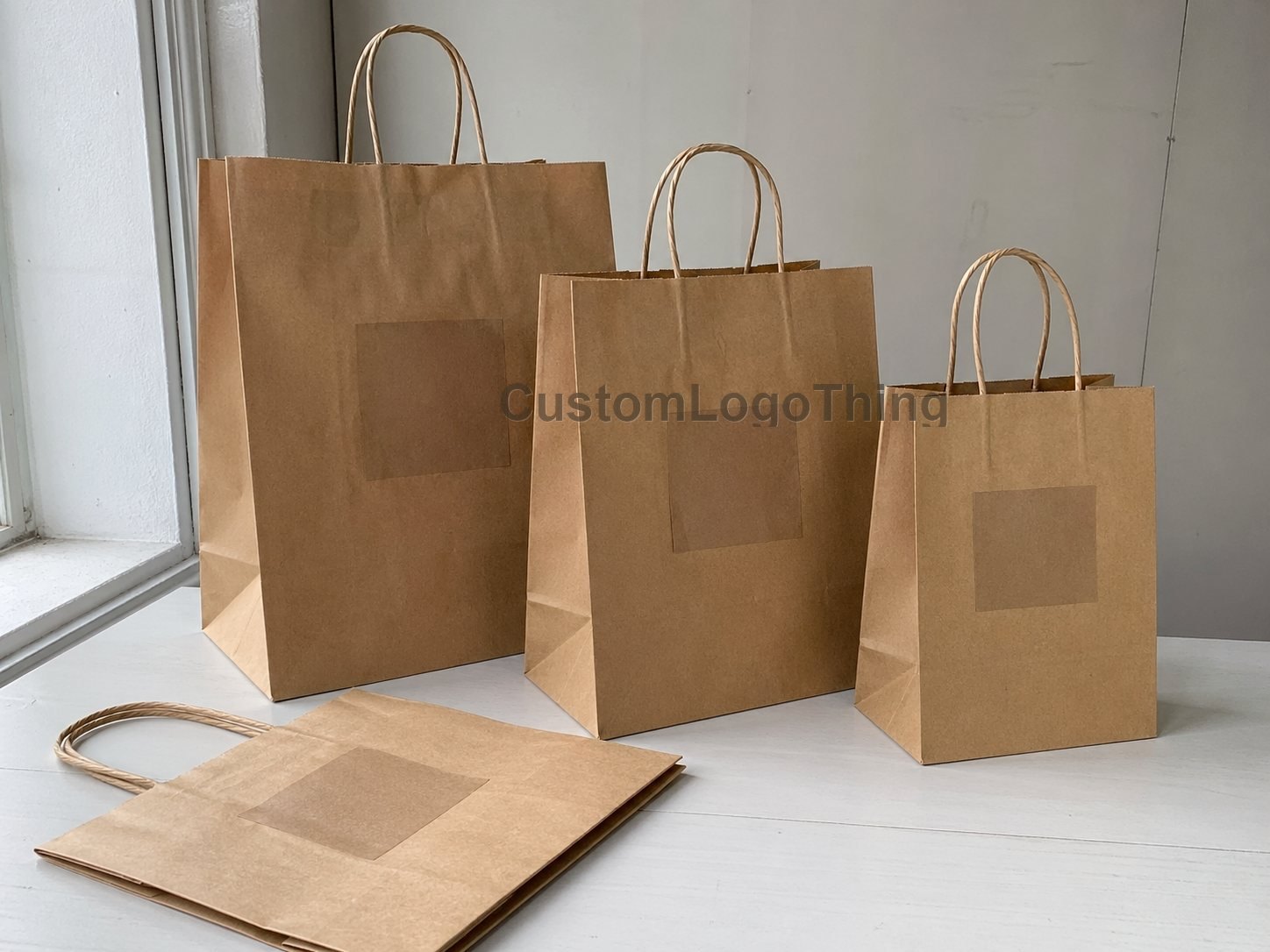
Two kraft bags can share similar dimensions on paper and still perform very differently during service. A detailed restaurant takeaway kraft paper bags quote maps bag format, paper grade, and handle type to your real kitchen and dispatch workflow.
Core bag formats and where each works best
- Flat bags: Best for single baked goods, wraps, and other light dry items. They are cost-efficient, low cube, and quick to pack.
- SOS satchel bags: Self-opening square bottom format that works well in quick-serve lines and medium-weight orders. Easy to stand on the counter.
- Twisted-handle bags: Comfortable for customers and better suited to heavier takeaway bundles or longer carry distances.
- Die-cut handle bags: Cleaner visual style often chosen for lighter premium food packs; comfort can drop under heavier loads unless reinforcement is added.
Kraft paper choices: fiber quality and performance
Kraft paper may be virgin fiber, recycled fiber, or a blend. Virgin fiber usually delivers stronger tear resistance at the same GSM. Recycled grades can still perform very well, though consistency depends on source quality and process control.
If sustainability targets are part of procurement policy, ask for recycled content range and whether it includes post-consumer waste. Also request how that percentage is calculated (mass balance, batch average, or certificate-backed claim), because not every supplier reports it the same way.
Brown kraft gives a natural look and often handles one-color print nicely. White kraft supports brighter graphics and stronger contrast, usually at a price premium depending on basis weight and supply. Foodservice buyers should confirm food-contact suitability and migration compliance declarations for inks and adhesives where relevant; requirements vary by market, so your compliance checklist should match your country or state rules.
Moisture and grease: use protection where needed, not everywhere
Barrier features are often over-specified. Dry menu items usually do not need laminated interiors. Moderate grease exposure may only require treated paper or a light internal coating. High-moisture conditions can justify stronger barrier systems, but that choice changes recyclability and cost.
Practical planning helps here. If 80% of your orders are dry, keep a standard bag for daily volume and reserve higher-barrier SKUs for specific menu lines. Your restaurant takeaway kraft paper bags quote should separate these tiers clearly so cost per order stays in control.
Handle and bottom construction details that decide failure rates
Identical dimensions do not guarantee identical durability. Failure rates often come down to handle patch area, adhesive quality, and bottom fold geometry. Reinforced patches on twisted-handle styles usually improve pull performance for combo meals.
Bottom folds with proper overlap and controlled glue laydown reduce seam opening during transport vibration. In basic terms: more glue is not always better; consistent glue placement is what keeps failure rates down.
Ask suppliers for load-range guidance and internal test methods. Mention of ASTM-style test logic or distribution durability practices aligned with ISTA is a good sign that performance is being engineered instead of guessed.
Print method and brand-cost balance
Flexographic printing is common for kraft takeaway bags and often gives the best economics for straightforward branding. Offset can improve fine detail but usually brings higher setup cost and may be excessive for high-turn foodservice packs.
One-color or two-color artwork, positioned away from heavy folds and seam zones, often delivers the best mix of appearance and repeatability. A practical restaurant takeaway kraft paper bags quote should state print coverage percentage, number of print sides, and whether artwork crosses gussets or fold lines. Those variables affect scrap risk and final price.
Specifications Checklist Before You Request a Quote
Teams that want a quick, accurate restaurant takeaway kraft paper bags quote send structured inputs. Vague requests force assumptions, and assumptions create price swings, misaligned expectations, and slow approvals.
Technical dimensions and load basics
- Bag size in W x G x H (width x gusset x height), in mm.
- Target paper weight (example: 80gsm, 100gsm, 120gsm).
- Expected load per bag (example: 2.5kg, 4kg, 6kg).
- Typical carry distance (counter to vehicle, or 300–800 meters walk).
- Menu profile: dry, warm, greasy, or mixed moisture.
Performance specs that reduce arguments later
Define acceptable performance ranges before production begins. Include handle pull targets, seam integrity expectations, and dimensional tolerance windows. For many foodservice formats, a tolerance around ±2mm to ±4mm is workable depending on bag size and machine capability.
If previous failures exist, include failure mode notes: torn handles, side seam bursts, bottom opening, or print rub-off. A reliable restaurant takeaway kraft paper bags quote is easier to build when root causes are clear upfront.
Artwork and print production inputs
- Vector files (AI/PDF/EPS) with outlined fonts.
- Pantone references for each ink color.
- Print coverage estimate (for example, 15%, 35%, 60%).
- Placement notes near folds, gussets, and seam zones.
- Preferred finish expectations (matte natural, stronger color density, etc.).
Compliance and sustainability criteria
If your brand requires FSC certified paper, call it out at the first quote request and ask for certificate scope confirmation. Forest certification principles are available at fsc.org.
Clarify recycled content targets, whether recycled materials must include post-consumer input, and any local labeling rules tied to environmental claims such as biodegradable packaging. Claim wording needs care: “biodegradable,” “compostable,” and “recyclable” are not interchangeable, and regulators have started scrutinizing sloppy claims more aggressively.
Ordering context suppliers need
- Monthly demand by SKU.
- Peak season uplift (for example +30% in holiday months).
- Storage constraints at your site.
- Preferred pack-out (bags per bundle, bundles per carton).
- Delivery cadence (single large drop vs split shipments).
A complete data pack speeds up your restaurant takeaway kraft paper bags quote and cuts revision loops. Procurement and operations also get a shared decision baseline, which helps prevent internal friction at approval time.
Cost, Pricing, MOQ, and Unit Cost: How to Read a Restaurant Takeaway Kraft Paper Bags Quote
Most buyers go straight to unit price first. That instinct makes sense, but it misses important context. Read any restaurant takeaway kraft paper bags quote line by line, then normalize to delivered cost per usable bag.
Where cost actually comes from
| Cost Component | What Changes It | Typical Impact on Price |
|---|---|---|
| Paper grade & GSM | Virgin vs recycled blend, 80gsm vs 120gsm | High impact; often the biggest material driver |
| Bag dimensions | Wider gusset, taller profile, larger sheet usage | Moderate to high impact |
| Handle type | No handle, die-cut, twisted with patch | Moderate impact; reinforced styles cost more |
| Print colors & coverage | 1-color logo vs multi-color full panel print | Moderate to high impact including setup waste |
| MOQ level | Small run vs production-efficient run | Low MOQ can raise per-unit cost sharply |
| Freight mode | Sea, truck, or emergency air shipment | Can erase material savings if rushed |
As a rough reference, many custom takeaway kraft bag programs at medium volumes (about 5,000 to 50,000 units per SKU) may land anywhere from roughly $0.04 to $0.18 per bag, depending on size, GSM, and print complexity. Heavy-duty or large-format bags can sit higher. Freight and trade terms often shift landed cost more than expected, especially with low-density cargo.
That range is directional, not a guaranteed market price. Pulp cycles, regional energy costs, and seasonality can move numbers fast, sometimes month to month.
MOQ logic in plain language
MOQ is not just a sales rule. It reflects setup economics: machine calibration, plate setup, ink prep, and line changeover time. Requesting very low quantity with custom print spreads those fixed prep costs across fewer units.
That’s why a restaurant takeaway kraft paper bags quote at 2,000 units can look disproportionately high next to 20,000 units. A pilot MOQ for validation, followed by a scheduled scale-up with stepped pricing, is often a smart path. Risk stays controlled while unit economics improve.
Cost levers you can control immediately
- Standardize sizes: Fewer SKUs increase purchasing power and simplify warehouse handling.
- Reduce print coverage: Keep branding visible without flooding the full panel with ink.
- Right-size GSM: Match paper weight to load data instead of defaulting to the heaviest option.
- Simplify handle specs: Use reinforced handles only where menu weight truly requires them.
- Plan reorders earlier: Avoid expensive emergency freight.
Trade terms and landed cost clarity
Your restaurant takeaway kraft paper bags quote should clearly state Incoterm (EXW, FOB, DDP, and so on), currency, validity period, and excluded charges. Two similar-looking quotes can land very differently if one leaves out inland transport or customs-related fees.
Currency swings and fuel movements also affect delivered cost. Longer contracts benefit from clear review intervals or adjustment rules so both sides know how price volatility will be handled.
Compare quotes the right way
Build a side-by-side comparison sheet that includes usable load performance, failure allowance assumptions, landed cost by delivery site, lead-time reliability, reorder flexibility, and documentation quality.
If Bag A is $0.01 cheaper but fails 2% more often or triggers double-bagging on heavier orders, Bag B may deliver better real economics. Every restaurant takeaway kraft paper bags quote should be judged by operational outcome, not isolated piece price.
A quick practical move: test two candidate specs for 7–10 service days each, track failure count per 1,000 bags, then compare total delivered cost per successful order handoff. That one metric cuts through most internal debate.
Production Steps, Lead Time, and Turnaround From Artwork to Delivery
A dependable restaurant takeaway kraft paper bags quote includes process flow and timeline assumptions. Without those details, procurement planning gets shaky and operations risk stock gaps.
Typical production workflow
- Requirement review and quote alignment.
- Artwork preflight (file quality, dieline fit, color references).
- Sample path selection (digital proof, physical sample, or pre-production sample).
- Final approval and production slot confirmation.
- Mass production with in-line checks.
- Final QC, pack-out, carton labeling, and dispatch.
For many programs, production takes around 12 to 20 business days after complete approval, depending on complexity and volume. Transit is separate and varies by route and freight mode.
What pushes lead time up or down
- Multi-color printing with tighter color controls.
- Non-standard paper sourcing or specialty barrier stocks.
- Complex handle assembly requirements.
- High order volume versus available line capacity.
- Peak-season shipping congestion.
Sampling choices and why they matter
Digital mockups are fast for visual checks, but they cannot validate structure. Physical samples confirm fill behavior, stiffness, handle comfort, and stackability. Pre-production samples matter most for first runs, new formats, or high-risk launches where reprint mistakes are expensive.
Sampling may add a few days. In most cases, that time is well spent. One approved sample can prevent thousands of units with wrong gusset depth or weak seam glue patterns.
Quality checkpoints that should be documented
- Print registration and batch color consistency.
- Glue integrity at side seam and bottom folds.
- Handle adhesion and pull consistency.
- Dimensional checks against tolerance limits.
- Carton labels and SKU traceability.
If a restaurant takeaway kraft paper bags quote arrives without QC criteria, ask for them. Defined checks protect both buyer and supplier and reduce dispute cycles. You’re gonna save yourself a lot of back-and-forth later.
Reorder planning to avoid emergency freight
Set reorder points using average daily usage, production lead time, and transit buffer. A common formula is:
Reorder point = daily usage × (production lead time + transit days + safety buffer)
Example: 1,200 bags/day, 18 production days, 12 transit days, and 7 safety days gives a reorder point of 44,400 bags. That discipline helps prevent expensive rush shipments.
If your usage swings by weekday or weather, calculate reorder points on peak-week averages, not annual averages. It’s a small change, but it kinda prevents painful stockouts.
Why Choose a Manufacturer-Focused Partner for Restaurant Takeaway Kraft Paper Bags
Price-only conversations usually stay shallow. Manufacturer-focused conversations start with performance, process capability, and repeatability. For a consistent restaurant takeaway kraft paper bags quote, that distinction is significant.
Technical quoting reduces assumption gaps
Teams that understand converting limits can flag issues early: artwork running across stress folds, weak handle patch design, or unnecessary high GSM. That design-for-manufacturing mindset prevents late changes and shortens approval cycles.
Operational reliability signals to look for
- Documented incoming material controls.
- In-process QC checkpoints with recorded data.
- Production schedule discipline and clear slot commitments.
- Transparent communication on risks and alternatives.
No supply chain runs without surprises, but clear communication builds trust. If material lead time shifts, buyers should hear early and receive options before dispatch dates are affected.
Sustainability execution, not slogans
Many buyers ask for greener alternatives, which is a positive move. The practical discussion should focus on trade-offs: required strength, fiber source, recycled percentage, and end-of-life path. A meaningful restaurant takeaway kraft paper bags quote shows what changes in cost and performance if recycled content increases or certified fiber is specified.
Some formats may need a slight GSM adjustment to hold the same load profile when recycled content changes. That isn’t universal, yet it happens often enough that upfront clarity is worth it.
After-quote support is part of value
Fast revisions, version control, and data continuity matter in repeat procurement. Reorders should not feel like restarting the project each cycle. Strong partners maintain spec history, approved artwork references, and known tolerance ranges so repeat POs move smoothly.
If your current process is scattered across email threads and spreadsheets, consolidate specs into one controlled sheet with revision dates, owner names, and approved tolerances. That single habit usually improves speed more than people expect.
Next Steps: Send the Right Data and Get an Accurate Restaurant Takeaway Kraft Paper Bags Quote Fast
Speed and accuracy can coexist if submission data is complete. The quickest path to a dependable restaurant takeaway kraft paper bags quote is one brief that combines technical, operational, and commercial requirements.
Copy-and-send submission template
- Bag dimensions (W x G x H in mm).
- Target load per bag (kg) and carry distance.
- Menu moisture profile (dry/mixed/greasy).
- Preferred paper type and GSM range.
- Handle style and reinforcement preference.
- Print colors, coverage estimate, and artwork files.
- Monthly volume, peak volume, and SKU count.
- Delivery location and preferred trade terms.
Include failure evidence if you have it
Photos or short videos of current issues—torn handles, bottom opening, print scuffing—can shorten troubleshooting quickly. Clear visuals often reveal whether the root cause is fiber strength, glue pattern, fold design, or overload behavior.
Ask for two quote tiers
Request:
- Baseline functional spec (cost-focused, meets core performance).
- Optimized premium spec (higher comfort, appearance, or performance where needed).
This side-by-side structure gives procurement and operations a practical decision lane instead of abstract debate.
Internal approval checklist before PO release
- Named sample sign-off owner.
- Approved tolerance thresholds.
- Receiving inspection method at warehouse.
- Reorder point and safety stock agreement.
- Escalation contact for quality exceptions.
That internal discipline is what turns one successful order into a stable packaging program.
Actionable takeaway: before requesting your next restaurant takeaway kraft paper bags quote, run a 30-minute internal review with operations, purchasing, and store staff. Lock five items in writing—size set, load target, GSM range, print coverage limit, and reorder point formula—then request two quote tiers and test each on real orders for one week. That process is simple, repeatable, and far more reliable than choosing by piece price alone.
What information do I need for a restaurant takeaway kraft paper bags quote?
Share exact dimensions (W x G x H), paper GSM, handle type, print color count, monthly quantity, and delivery location. Add target load per bag and moisture profile to improve quote accuracy and reduce revision rounds.
How does MOQ affect restaurant takeaway kraft paper bag unit cost?
Higher volume spreads setup and print plate cost across more units, which usually lowers piece price. Low MOQ orders carry higher per-bag cost because preparation time and changeover still apply.
Can I get a sample before confirming a custom takeaway kraft paper bags order?
Yes. Digital proofs confirm artwork placement, while physical samples verify size fit, stiffness, handle comfort, and real load behavior. For new programs, pre-production samples are a practical risk-control step.
What is the typical lead time after approving a takeaway kraft paper bags quote?
Lead time depends on print complexity, order volume, and shipping mode. Most programs move through artwork approval, sample confirmation, production, QC, packing, and dispatch, followed by route-dependent transit.
Which factors increase the price of custom kraft takeaway bags the most?
The main drivers are larger size, heavier GSM, reinforced handles, multi-color or high-coverage printing, low MOQ, and expedited freight. Landed cost can climb quickly when emergency shipping enters the plan.

