Restaurant Takeout Teams and Kraft Paper Shopping Bags: Wholesale Pricing Guide
Wholesale pricing for kraft paper takeout bags should be judged against fit, strength, and consistency, not only the lowest unit number on a quote. A bag that saves a few cents but tears during a rush costs more in labor, replacements, and customer complaints.
Takeout handoffs are demanding. A single order may include entree boxes, sides, sauces, utensils, and drinks, all packed fast and carried through a busy pickup area. If the bag flexes, tips, or fails at the handle, the problem shows up immediately. That is why buyers need to compare size, construction, and freight together instead of treating the bag as a simple commodity.
Kraft Paper Bags sit in a practical middle ground: sturdier than thin carryout plastic, easier to stack than many reusable options, and easier to brand than plain shipping cartons. The right spec is usually not the heaviest one. It is the one that fits the order mix, the packing line, and the storage space at each location.
Why High-Volume Takeout Needs Stronger Bags
Volume changes performance. A sample that looks fine in a showroom can behave differently after hundreds of orders, warm kitchens, and condensation from packed containers. Handles loosen, seams carry more stress, and paper loses some margin when it picks up moisture.
That is why restaurant operators should treat bags as part of the workflow. A bag that opens cleanly, stands upright, and fits common container stacks speeds packing. One that needs extra folding, double-bagging, or careful balancing slows the line and increases labor. In practice, the cheapest bag is often the most expensive once staff time is included.
Consistency matters too. If one store buys a different size or handle style, the packing rhythm changes from site to site and training gets harder. For multi-unit groups, a fixed spec is usually more valuable than a small discount because it reduces mistakes and keeps reorders simple.
“A bag that adds one extra move during the rush is no longer cheap. It is eating labor.”
Dimensions and Strength Specs to Verify Before Ordering
Start with usable interior size, not just the catalog label. Check width, gusset depth, and height against the largest regular order, not the average one. A bag that is too narrow forces containers to tilt; a bag that is too tall wastes paper and storage space.
Core measurements to request
- Width: usually 8 to 16 inches for foodservice carryouts.
- Gusset depth: often 4 to 8 inches so boxes sit flat.
- Height: enough room for the tallest stack plus quick-packing clearance.
- Bottom reinforcement: important for soups, heavy entrees, or multiple containers.
Paper weight is the next filter. Many foodservice bags fall in the 70 to 120 gsm range. Lighter stock can work for sandwiches, pastries, and smaller boxed meals. Heavier paper is better when orders include dense containers, bottle packs, or family-style meals. Side seams, bottom folds, and handle attachment points should match the intended load. If a supplier cannot explain the load range clearly, ask for a sample loaded with real containers.
Record dimensions in both inches and millimeters. That seems minor until a buyer compares a U.S. spec sheet with a packaging drawing from another team. Mixed units create avoidable errors, especially for restaurant groups with multiple locations and one central buyer.
What to verify before you approve an order
- Confirm fit with your widest and tallest regular container stack.
- Check handle style and top-edge reinforcement for heavier carryout.
- Review carton counts and pack-out so storage and rotation stay manageable.
- Approve the bag for the largest routine order, not the smallest one.
A useful rule: order for the worst normal case, not the best one. A 10 x 5 x 13 inch kraft bag often works for lighter meal bundles. A 13 x 7 x 17 inch bag handles taller family packs and stacked dinners more comfortably. Most operators do not need every size; they need the few sizes that remove uncertainty at the packing station.
Keep the approved spec with artwork, carton counts, and reorder notes. That makes the next purchase faster and keeps pricing tied to a known configuration instead of a fresh search each time inventory dips.
Material, Handle, and Print Options That Change Performance
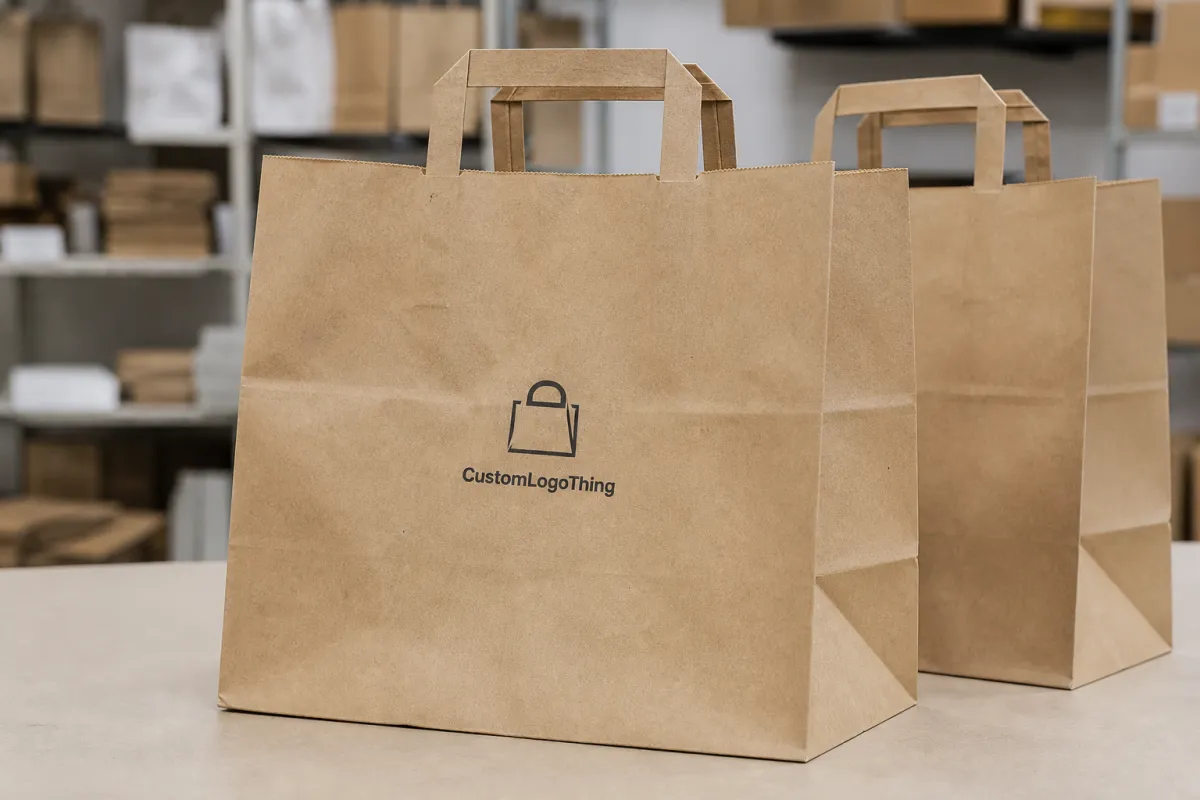
Natural kraft and white kraft solve different needs. Natural kraft is usually the lower-cost workhorse and hides scuffs better. White kraft gives printed logos sharper contrast and can feel cleaner at pickup, though it shows grime sooner in busy or humid environments.
| Option | Typical Use | Cost Impact | Operational Note |
|---|---|---|---|
| Natural kraft | High-volume takeout, casual dining | Lower | Hides marks and handles rougher use better |
| White kraft | Branded pickup, premium presentation | Moderate | Shows print clearly but scuffs more easily |
| Twisted handle | Heavier orders, longer carry distance | Moderate | More comfortable and better for load distribution |
| Flat handle | Budget-focused programs, lighter loads | Lower | Works for simple meals; less comfortable with weight |
Handle style changes how the bag performs in the hand. Twisted handles usually distribute weight better and are easier to grip when the bag is full. Flat handles are acceptable for lighter meals, but they are not the best choice for heavy dinner bundles or orders that move from kitchen to car without pause.
Printing affects both cost and lead time. A one-color logo on natural kraft is often enough for many restaurants. It adds identity without pushing price too far. Multi-color printing, full-bleed coverage, and specialty finishes increase setup, ink usage, and machine time. If artwork is not final, revisions after proofing can delay the order.
Material claims deserve proof. Buyers who want recycled content, FSC-certified stock, or post-consumer fiber should ask for documentation rather than marketing language. The FSC certification framework is a useful benchmark, and the EPA’s guidance on sustainable materials management is a practical reference for source reduction and recovery planning. Both help teams ask better questions.
Eco claims still depend on the full package. Inks, coatings, food residue, and local recycling rules all affect disposal. A greasy bag in the wrong waste stream is not a recycling success story, so buyers should judge environmental claims carefully.
Wholesale Pricing, MOQ, and Total Cost Drivers
Wholesale pricing makes sense only when it is broken into parts. Unit cost matters, but so do size, paper weight, handle style, print coverage, tooling, freight distance, and carton configuration. The landed total is what the operator actually pays.
As a rough market guide, stock kraft bags often land around $0.08 to $0.16 each in larger cartons. Custom-printed versions commonly run closer to $0.14 to $0.32 each, with premium sizes or more complex print setups going higher. Smaller runs can move beyond those ranges because setup is spread across fewer units. Freight can add another 8% to 20% on modest orders, especially when shipping to multiple locations.
MOQ is where many first-time buyers get surprised. Stock bags may start around 500 to 1,000 pieces. Custom-printed bags often need 3,000 to 10,000 units to make the economics work. Special paper, reinforced construction, or unusual dimensions can push the minimum higher.
Ask suppliers to separate the quote into bag price, setup, samples, freight, and any artwork charges. One vendor may show a low unit price but hide fees elsewhere. Another may quote a slightly higher bag price with lower freight or no artwork charge. On smaller orders, those differences can matter more than the unit number itself.
The better buying rule is simple: choose the quote that supports stable service without creating stockouts or excess inventory. A modest price drop is not worth much if the warehouse cannot hold the supply or the team must reorder every other week. Wholesale pricing is only good if the bag also fits the operation on the floor.
For operators with multiple sites or seasonal swings, ask for tiered pricing. The step from 5,000 to 10,000 units can change the decision, but only if cash flow, storage, and reorder timing can absorb the larger run.
Production Workflow, Lead Time, and Delivery Expectations
The usual sequence is quote approval, artwork proof, sample review if needed, production, quality check, and shipment. The fastest orders are the ones that arrive with final measurements, the right art file, and no late changes to handle style or sizing.
Stock bags can ship quickly if inventory is available. Custom orders need more runway. A common production window is 12 to 20 business days after proof approval, then freight time on top. Rush service may exist, but it usually costs more and is better used as backup than as the standard plan.
Small changes can create outsized delays. If a buyer adjusts the bag height after proofing, the carton plan may need to be reworked. If a logo file arrives in the wrong format, production may stop while artwork is corrected. If the bag is approved for one container profile and then used for a different one, the reorder becomes a spec dispute instead of a purchase order.
Repeat orders should be easier than first runs. Suppliers that save dimensions, print settings, carton counts, and approved artwork can usually move faster on reorders. That matters for restaurant groups that do not want each location managing packaging from scratch.
Freight planning deserves equal attention. Shipping one carton to a distribution center is not the same as sending pallets to six stores. Ask for destination-based freight early so the quote reflects reality. A late freight surprise can erase the savings from a good unit price.
How to Compare Suppliers for Repeat Restaurant Demand
The best supplier is not the one with the slickest pitch. It is the one that can deliver the same bag, the same dimensions, and the same print quality again and again. For takeout teams, consistency beats a flashy first order.
Sample evaluation should be practical. Load the bag with actual containers. Check whether it stands upright. Watch the handles under weight. See whether the bottom spreads evenly or bows. A live test tells you more than a polished spec sheet.
Foodservice experience matters because it changes the questions a supplier asks. Teams that understand takeout operations know that greasy containers, hot cartons, and mixed meal kits create different stresses on a bag. They are more likely to ask about the heaviest item, the largest item, and the order mix that shows up most often at peak times.
Inspection and transit standards can help separate serious vendors from casual ones. For packaged shipments, ask whether they test against methods such as ISTA 3A or ASTM D4169 when handling risk is part of the job. That does not replace a live bag test, but it shows the supplier is thinking about transport, not only manufacturing cost.
Service behavior matters too. Do they keep notes on reorders? Can they update artwork without restarting the file process? Do they explain delays plainly? Slow answers before the first order are often warning signs. Packaging problems become stock problems quickly.
Many buyers use two tracks: stock bags for immediate needs and custom printed bags for the stable branded program. That approach keeps operations moving while preserving a backup path if one SKU is delayed.
Quote Request Checklist and Reorder Planning
Before asking for pricing, gather the three items that matter most: exact bag dimensions, target quantity, and whether the order should be stock or custom. Those basics keep the first quote useful and reduce the back-and-forth that usually stretches a simple request into a long email thread.
Ask for a spec sheet, sample set, and tiered pricing. If you are comparing natural kraft to white kraft, twisted handles to flat handles, or plain stock to printed bags, place the options side by side. Decision-making is easier when the cost difference is visible instead of buried in separate messages.
Reorder planning should be based on weekly usage, storage capacity, and the number of service days the current inventory must cover. A location using 1,200 bags a week and holding four weeks of stock has a very different risk profile from a group buying for six sites with a narrow two-week buffer.
Save the final spec in one place. Keep dimensions, paper weight, handle type, print file, carton count, freight destination, and approval notes together. That makes the next purchase easier, especially if a seasonal menu change or new opening requires a fast reorder through Wholesale Programs.
For restaurant takeout teams, kraft paper shopping Bags Wholesale Pricing should be measured as total landed cost, service fit, and repeatability. The right bag protects the pace of the line, keeps loads upright, and avoids unnecessary handling. That is the standard worth using when the lunch rush starts.
What affects restaurant takeout team kraft paper bag wholesale pricing the most?
Bag size, paper weight, handle type, and print coverage usually drive the biggest changes. Freight and setup fees can matter as much as unit price on smaller orders. Higher quantities usually lower per-bag cost, but only if the team can store the stock and reorder before supply gets tight.
How do I choose the right kraft paper shopping bag size for takeout orders?
Measure the widest and tallest container stack, then add space for quick packing. Check gusset depth so boxes sit flat instead of tipping during pickup or delivery. Match the bag to the largest regular order, not only the average ticket, so staff do not need to improvise during rush periods.
What MOQ should restaurant teams expect for custom kraft bags?
Stock bags usually have lower minimums, while custom-printed bags often require larger runs to keep unit pricing practical. Exact MOQ depends on size, print complexity, and reinforcement needs. Ask for both a launch quote and a replenishment quote so you can compare first-order risk against long-term savings.
How long does wholesale production take after artwork approval?
Lead time depends on bag type, print method, and current factory schedule, but approval speed is one of the biggest variables. Final files, exact specs, and quick proof sign-off help keep the order on schedule. Rush options may be available, though they usually cost more and are best reserved for emergency replenishment.
Can kraft paper shopping bags handle greasy or heavy takeout containers?
Yes, when the paper weight, handle strength, and bottom reinforcement match the actual load. For oily or moist items, the bag should be paired with sealed containers so liquid does not weaken the structure. If orders are unusually heavy, ask for a stronger grade or larger footprint instead of forcing a standard size to do extra work.