Buyer Fit Snapshot
| Best fit | Retail Hang Tags Printing Cost projects where brand print, material claims, artwork control, MOQ, and repeat-order consistency need to be specified before quoting. |
|---|---|
| Quote inputs | Share finished size, material target, print colors, finish, packing count, annual reorder estimate, ship-to region, and any compliance wording. |
| Proofing check | Approve dieline scale, logo placement, barcode or warning zones, color tolerance, closure strength, and carton packing before bulk production. |
| Main risk | Vague material claims, crowded artwork, missing packing details, or unclear freight terms can make a low unit price expensive after revisions. |
Fast answer: Retail Hang Tags Printing Cost: Material, Adhesive, Artwork, and MOQ should be specified like a repeatable production item. The safest quote records material, print method, finish, artwork proof, packing count, and reorder notes in one written spec.
Production checks before approval
Compare the actual filled-product size with the drawing, then confirm tolerance on folds, seals, hang holes, label areas, and retail display edges. Reserve space for logos, QR codes, warning copy, and material claims before decorative graphics fill the panel.
Quote comparison points
Review material grade, print process, finish, sampling route, tooling charges, carton quantity, and freight assumptions side by side. A quote is only useful when the supplier can repeat the same color, closure quality, and packing count on the next order.
Retail Hang Tags Printing Cost: Why Small Details Change the Bill
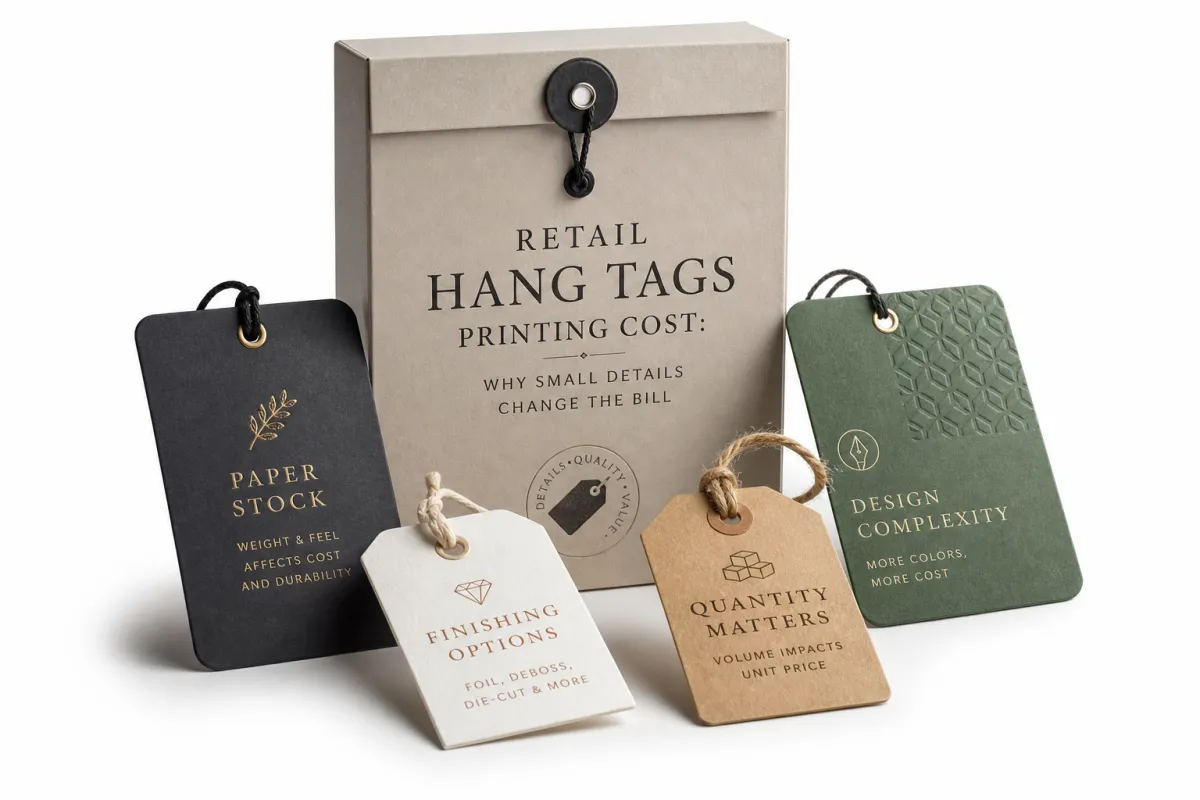
Two hang tag quotes can look almost identical and still land far apart in Retail Hang Tags printing cost. That usually has nothing to do with the artwork on the screen. The real differences live in the boring stuff: stock, finish, cutting, stringing, proofing, packing, and how many times the job gets touched before it leaves the plant.
People get caught off guard because they compare the picture of the tag instead of the production plan behind it. A plain coated card and a tag with foil, lamination, rounded corners, and attached string are not the same job. They just happen to share a shape. Paper is only one line in retail hang tags printing cost. Setup and finishing often matter more than the base board, especially when the order is small.
From a buyer's point of view, the goal is not to chase the cheapest tag on the market. The goal is to buy a tag that supports the product price without draining margin. A $60 blouse with a flimsy tag feels off. A $12 accessory wrapped in gold-plated everything looks like someone lost the plot. Nice paper cannot fix a bad match between product and packaging.
Retail hang tags printing cost should be handled like a design choice, not a random line item in procurement. The right tag helps the product sell. The wrong tag is just a small expensive apology hanging off the garment.
Practical rule: if the tag does not help the product look worth its shelf price, you paid for decoration instead of function.
This matters across apparel, accessories, luggage, home goods, and gift items. In every one of those categories, retail hang tags printing cost jumps fast once you move past a basic rectangle on standard stock. Buyers who understand the tradeoffs make cleaner decisions. They know where to spend, where to stop, and where the sales rep is trying a little too hard.
I have seen brands sink money into a fancy tag while the actual product copy was weak, the barcode was awkward, and the stock was so thin it curled in shipping. That is backwards. The tag should do a job. Not just look fancy for five seconds in a mockup.
The rest comes down to four things: what the tag is made from, how it is printed, how it is finished, and how many pieces you order. That is the line between a controlled quote and a number that starts wandering around with too much confidence and not enough detail.
Retail Hang Tags Printing Cost Drivers: Stock, Finish, and Quantity
The biggest drivers of retail hang tags printing cost are boring on purpose. Boring usually means cheaper, cleaner, and easier to reorder without drama.
Stock choice comes first. Uncoated paper is often the most economical option and gives a natural, honest look. Coated stock sharpens color and detail, which helps when the tag carries bright branding or product photography. Kraft paper leans earthy and handmade. Specialty boards, pearl stocks, cotton papers, and textured sheets all push retail hang tags printing cost higher because they are harder to print, harder to cut, or both.
Thickness matters too. A 250gsm tag can work for lighter products, but many apparel buyers prefer 300gsm to 400gsm because the tag feels more substantial in the hand. Go too heavy and the material cost climbs along with shipping weight. Go too light and the tag curls, bends, or looks cheap after a day on the rack. Packaging loves these neat little tradeoffs. Nobody notices them until the product is already in store.
Print finishing is where budgets start to wobble. Matte or gloss lamination, spot UV, foil stamping, embossing, debossing, soft-touch coating, and rounded corners each add labor, setup, or tooling. On a small order, those upgrades can affect retail hang tags printing cost more than the paper itself. A simple finish stack usually beats a pile of effects that all shout at once.
Quantity changes the math fast. Setup fees do not disappear because the order is larger; they get spread across more pieces. That is why the unit cost drops as you move from a few hundred pieces into the low thousands. A 300-piece run feels expensive because the setup is getting absorbed by a tiny batch. A 5,000-piece run usually brings the per-tag price down sharply, even with the same spec. Plenty of buyers miss that part because they stare at the headline number and stop there.
There are also functional add-ons that quietly raise retail hang tags printing cost:
- Hole punching in one or two positions
- String, loop, elastic, or safety pin attachment
- Variable data, numbering, QR codes, or barcodes
- Custom die cutting or unusual corner shapes
- Collation and packaging by SKU, size, or color
For related projects, the same thinking applies to Custom Labels & Tags. Different format, same logic. Spend on the details that change the product experience. Skip the ones that only sound fancy in a spreadsheet.
Tag Specifications That Change Perceived Value
Size has a strange relationship with retail hang tags printing cost. Smaller tags use less material, sure, but a larger tag can increase shelf presence and make the product feel more premium. A 2 x 3.5 inch tag is efficient and common. A 2.5 x 4.5 inch or 3 x 4 inch tag gives more room for branding, pricing, barcode placement, and a layout that does not look cramped. That extra surface can support a higher retail price if the product needs the visual help.
Shape matters just as much. Standard rectangles are efficient because they waste less material and need less tooling. Rounded corners are usually a modest upgrade. A Custom Die Cut, on the other hand, adds tooling and can increase waste, so retail hang tags printing cost goes up for something that may or may not improve the brand. If your product actually needs a unique silhouette, fine. If the only reason is to look different, that is a very expensive way to feel creative.
Artwork complexity changes the bill too. One-color spot work is often cheaper than full-color CMYK, especially when the design is simple and flat. Photo-heavy layouts need tighter file prep, better color management, and more proof review. The press does not care that the logo looked gorgeous on a laptop screen. It cares whether the file is ready to print without a correction cycle. More corrections mean more time, and more time means higher retail hang tags printing cost.
Durability is easy to ignore until the tags hit real handling. Apparel tags get pulled, folded, scanned, and touched by a dozen people before they reach the customer. Bags and accessories get shoved around in bins and back rooms. If the tag needs to survive that abuse, it may need stronger card, better hole reinforcement, or a finish that resists scuffing. None of that has to be expensive. It just has to be planned instead of guessed.
A few smart choices do more for perception than a stack of upgrades:
- Use one strong stock instead of mixing several flimsy ones
- Keep typography clean and legible
- Choose one premium finish, not three
- Leave enough white space for the design to breathe
- Match the tag size to the product price point
If you need a broader production view, our Manufacturing Capabilities page shows how different processes support different tag builds. That matters because not every job belongs on the same press, and not every retail hang tags printing cost should be inflated by a process the design never needed.
Retail Hang Tags Printing Cost: Pricing, MOQ, and Quote Math
Here is the part buyers need to see clearly. A quote is not just a price; it is a bundle of decisions that shape retail hang tags printing cost. If the supplier does not break out the components, ask for it. Material, print method, finishing, cutting, assembly, proofing, packaging, and freight should all show up somewhere in the numbers.
MOQ matters because setup costs need somewhere to go. On a tiny run, they sit on very few pieces and push the unit cost up. On a larger run, they spread out and become easier to swallow. That is why digital printing is often the sensible choice for short runs and prototypes, while offset printing usually wins on larger orders where consistent color and lower unit cost matter. Flexographic printing is more common in label workflows, but the same logic applies: the more efficient the process for your quantity, the better the retail hang tags printing cost usually looks.
Do not compare quotes unless the specs match exactly. Same size, same stock, same finish, same hole position, same attachment method, same quantity. Otherwise you are comparing a clean quote to a half-truth. That is not buying. That is gambling with better stationery.
| Option | Typical Spec | Illustrative Unit Cost | Best For |
|---|---|---|---|
| Lean digital run | 300-500 pcs, 350gsm coated stock, CMYK, one hole punch | $0.18-$0.42 each | Small launches, samples, fast turns |
| Mid-volume offset run | 1,000-3,000 pcs, 350gsm artboard, CMYK + spot color, matte finish | $0.08-$0.22 each | Standard retail programs, seasonal drops |
| Premium finish run | 1,000-2,000 pcs, heavy board, foil, embossing, custom die cut | $0.22-$0.65 each | Luxury apparel, gift sets, higher-margin items |
| High-volume standard run | 5,000+ pcs, simple shape, offset printing, minimal finishing | $0.05-$0.14 each | Repeating SKUs, chain retail, broad distribution |
Those numbers are illustrative, not gospel. Real retail hang tags printing cost depends on board availability, press setup, finishing complexity, packaging, and delivery location. The pattern is still reliable: more setup and more handwork increase the price, while volume reduces the unit cost.
A useful buying move is to request at least two line-item options. Ask for a lean spec and a premium spec. That gives you a real view of which upgrade is doing the work and which one is just padding the bill. If a finish adds 12% to the quote and barely changes the look, you can probably skip it. If one small finish lift makes a $20 item look like a $40 item, that is where retail hang tags printing cost starts to make sense.
Ask about file handling and proofing too. A supplier that includes a clean digital proof, a preflight check, and a realistic revision window saves money later. If the quote looks cheap but the process is messy, the final spend usually climbs anyway. Hidden fees are just a slower way of saying surprise.
For buyers who care about sustainability, sourcing decisions matter as well. If recycled or certified paper is part of the brief, check the paper chain carefully and verify claims against actual standards instead of marketing fluff. The EPA recycling guidance is a useful reference for packaging and material recovery basics, while ISTA is worth a look if you need to think about distribution durability and transit stress. Those standards do not set retail hang tags printing cost by themselves, but they help you make smarter specs.
Process and Timeline for Retail Hang Tags Printing
The production path is straightforward, but every step has a way of adding to retail hang tags printing cost if it gets messy. A clean job usually moves through request, spec check, artwork review, digital proof, sample if needed, print, finish, pack, and ship. Straight lines are cheaper than chaos. Hard to argue with that.
Delays usually come from the same places. Missing artwork slows prepress. Color corrections add back-and-forth. Custom dies need approval. Foil and embossing often require extra setup time. Last-minute changes are the easiest way to make retail hang tags printing cost climb without improving the tag at all. If you are changing copy after proof approval, the budget is probably not the only thing that is getting irritated.
Simple reorders can move fast when the files are already approved and the spec stays the same. A clean repeat job may finish in roughly 7-12 business days after proof approval, depending on workload and shipping. More custom projects often need 12-15 business days or more, especially if you want specialty finishes, new tooling, or attachment assembly. Rush service is possible on many jobs, but rush service is just another line item wearing a fake mustache.
Here is the kind of information that keeps retail hang tags printing cost under control from the start:
- Final size and shape
- Paper or board thickness
- Print method: digital printing or offset printing
- Color count: CMYK, spot color, or both
- Finish: matte, gloss, soft-touch, foil, embossing, or none
- Hole position and attachment style
- Quantity per SKU
- Delivery deadline and ship-to address
Quality control matters more than people admit. Confirm size, hole position, color, stock, quantity, and attachment method before production starts, not after the boxes arrive. A wrong hole punch or an off-center logo is a tiny mistake on the bench and a very expensive mistake at retail. That is how retail hang tags printing cost gets wasted: not on the press, but on preventable rework nobody planned for.
Why Choose Us for Retail Hang Tags Cost Control
We approach retail hang tags printing cost like a production decision, not a sales trick. That means we look at the tag against the product price point, the order quantity, and the finishing level before suggesting anything expensive. If a standard coated board does the job, there is no reason to push a premium stack just to make the quote look busy.
That kind of honesty saves money. Sometimes the right answer is a lean stock and a cleaner layout. Sometimes it is a standard shape with one finish that does real brand work. Sometimes the best move is to raise quantity so the unit cost drops into a sane range. Retail hang tags printing cost should be predictable. Buyers hate guessing, and they hate surprises more.
We keep the process practical too. Clear line-item quotes matter. Proof approval matters. File feedback matters. If an artwork file is going to cause a problem, it is better to say so before production than to pretend it will print itself into perfection. That is one reason buyers look for partners who understand manufacturing as well as design. Our Manufacturing Capabilities page gives a better sense of how those decisions connect in real production.
What helps the most is not hype. It is a clean match between spec and purpose. We see the same mistakes all the time: a small brand ordering a luxury finish on a low-margin product, or a premium line using a tag that looks too cheap for the shelf price. Both mistakes distort retail hang tags printing cost, just in opposite directions. One wastes margin. The other wastes brand value.
And yes, the reverse is just as annoying. I have watched teams approve a high-end spec for a basic item because the deck looked polished, then wonder why the margin got thin. The tag did not save the product. It just ate the budget with a nice font.
If you are comparing suppliers, ask these questions:
- What is included in the quote and what is separate?
- How does the unit cost change at 500, 1,000, and 5,000 pieces?
- Which finish changes the look the most per dollar spent?
- What lead time applies after proof approval?
- Can the same file support a reorder without rebuilding the job?
That is where the real value sits. Not in the lowest headline number, but in a quote that explains itself and keeps retail hang tags printing cost under control from order to delivery. If you need to expand into other formats later, our Custom Labels & Tags page is a useful place to compare options without rebuilding the whole buying process from scratch.
Next Steps to Quote Retail Hang Tags Without Overpaying
Start with the basics and lock them down before asking for numbers. Size, stock, finish, quantity, attachment method, and delivery deadline should all be set first. That is the fastest way to get a useful quote for retail hang tags printing cost. If those details are fuzzy, every supplier is forced to guess, and guesswork is expensive dressed up as flexibility.
Ask for two or three versions of the same job. One lean. One mid-tier. One premium if needed. That makes the tradeoffs visible. You will see exactly which upgrades raise retail hang tags printing cost and which ones only sound impressive in a sales email. A standard shape with good typography often beats a complicated tag with too many effects. The product should carry the story. The tag should support it, not wrestle it into the floor.
Send one clean file package. Include final artwork, brand color references if you have them, barcode data, variable text if needed, and any notes about hole placement or folding. The less back-and-forth you create, the less chance there is for wasted time and repeated proofing. That is where retail hang tags printing cost quietly grows: not on the first quote, but in the extra rounds nobody budgeted for.
A simple decision rule helps:
- If the tag supports premium pricing, spend on a premium finish.
- If the tag only needs to identify the product, keep the spec lean.
- If the product sells on feel, choose a better stock.
- If the product sells on volume, optimize unit cost and repeatability.
That is the practical way to think about retail hang tags printing cost. Do not buy features because they look expensive. Buy them because they change how the product is perceived, protected, or sold.
If you want the cleanest quote, send the exact spec, ask for line-item pricing, and compare only matching versions. That is the fastest route to a number you can actually trust, and it keeps retail hang tags printing cost from turning into a moving target.
Frequently Asked Questions
What drives retail hang tags printing cost the most?
The biggest drivers are stock choice, finishing, quantity, and whether the tag needs custom cutting or assembly. Setup fees matter more on small runs, while premium finishes like foil and embossing raise retail hang tags printing cost on every unit.
Is digital printing cheaper for small retail hang tag orders?
Usually yes for short runs because it avoids plate costs and keeps setup lean. Once quantity climbs, offset printing can lower the unit cost and make retail hang tags printing cost more efficient for larger replenishment orders.
What MOQ should I expect for custom retail hang tags?
Many suppliers can quote small runs, but the best unit pricing usually starts once you move into the few-hundred to low-thousand range. Custom finishes, special shapes, or assembly work can push MOQ higher because setup has to be spread across more pieces, which directly affects retail hang tags printing cost.
How much do foil, embossing, or spot UV add to the price?
These finishes add separate setup and production steps, so they rarely behave like a small add-on. They make the biggest difference when the design uses them sparingly instead of covering the whole tag, and that is why they can change retail hang tags printing cost fast.
How can I lower retail hang tags printing cost without making the tag look cheap?
Keep the shape standard, reduce unnecessary finish layers, and choose a stock that feels solid without being oversized. Ask for two quotes: one lean spec and one premium spec, then spend only where the tag affects product value. That is the cleanest way to control retail hang tags printing cost without ending up with a tag that looks like it came from a bargain bin.
What should I send first if I want an accurate quote?
Send the final size, stock, quantity, finish, attachment method, and delivery target. If you have barcode data or variable text, include that too. The tighter the spec, the fewer surprises in retail hang tags printing cost, and the faster the quote settles down.

