Buyer Fit Snapshot
| Best fit | Printed Retail Hang Tags with Logo projects where brand print, material claims, artwork control, MOQ, and repeat-order consistency need to be specified before quoting. |
|---|---|
| Quote inputs | Share finished size, material target, print colors, finish, packing count, annual reorder estimate, ship-to region, and any compliance wording. |
| Proofing check | Approve dieline scale, logo placement, barcode or warning zones, color tolerance, closure strength, and carton packing before bulk production. |
| Main risk | Vague material claims, crowded artwork, missing packing details, or unclear freight terms can make a low unit price expensive after revisions. |
Fast answer: Printed Retail Hang Tags with Logo: Design, Cost, Timing should be specified like a repeatable production item. The safest quote records material, print method, finish, artwork proof, packing count, and reorder notes in one written spec.
Production checks before approval
Compare the actual filled-product size with the drawing, then confirm tolerance on folds, seals, hang holes, label areas, and retail display edges. Reserve space for logos, QR codes, warning copy, and material claims before decorative graphics fill the panel.
Quote comparison points
Review material grade, print process, finish, sampling route, tooling charges, carton quantity, and freight assumptions side by side. A quote is only useful when the supplier can repeat the same color, closure quality, and packing count on the next order.
Printed retail Hang Tags with Logo are usually the first branded thing a shopper actually touches. That sounds small. It is not. People make fast judgments off tiny details, and a tag hanging off a product is one of those details. Price, SKU, barcode, care instructions, origin, and a little brand personality all have to live in a piece of stock that gets handled, bent, scanned, and read under bad store lighting. If the tag feels flimsy, the product starts out looking cheaper. If it feels considered, the product gets a better first read.
The job of printed Retail Hang Tags with logo is not decoration with a nicer haircut. They help retail teams move inventory, keep styles organized, and make sure the right item lands in the right place without turning the stockroom into a treasure hunt. They also help the customer understand what they are buying without squinting at a microscopic block of text. Good tags make the whole setup feel controlled. Bad ones feel like somebody shrugged and hoped for the best.
For brands that need more than one piece of packaging, the Custom Labels & Tags category is a practical place to compare formats. Hang tags, stickers, and sewn-in labels usually need to support each other. If they all tell a different story, the product ends up looking confused. And nobody wants confused packaging sitting on a shelf.
What Printed Retail Hang Tags with Logo Actually Do
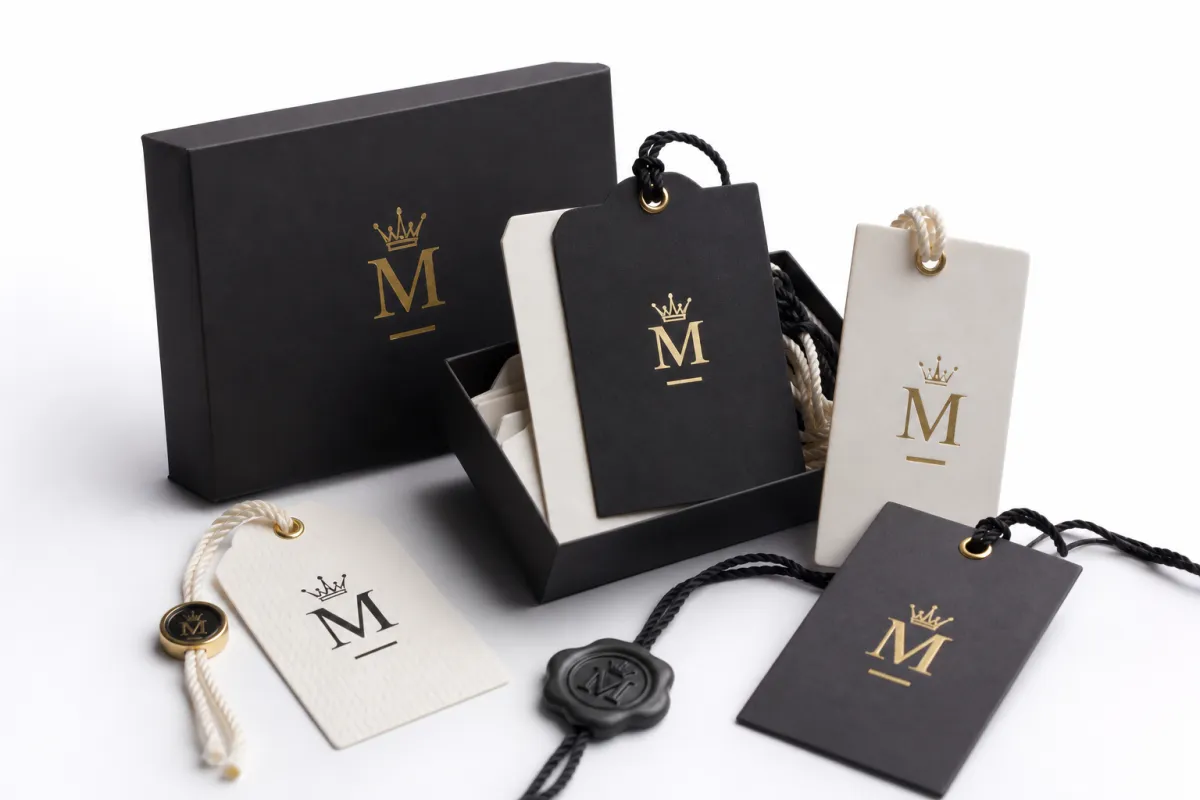
A shopper pulls a garment from the rack, flips it over, and touches the tag before they really look at the fabric. That moment decides a lot. Printed retail hang tags with logo either support the sale or get in the way. Small object, real influence. Retail has a funny habit of making tiny things carry a lot of weight.
These tags do more than carry a price. Printed retail hang tags with logo identify the item, carry operational data, reinforce the brand, and help stores move product faster. In a shop, that means cleaner scanning and fewer questions at the register. In the stockroom, it means less sorting chaos and fewer mistakes during receiving. For the shopper, it means the item feels finished instead of pieced together at the last minute. I have seen products with great construction underperform because the tag looked cheap or cluttered. That is the kind of thing most brands only notice after the bad batch ships.
What separates a tag that helps from a tag that just hangs there? Utility. If the layout is clear, the stock is sturdy, and the information survives handling, the tag earns its keep. If the piece is overcrowded, printed on weak paper, or impossible to scan, it quietly drags the product down. That is why printed retail hang tags with logo should be treated as part of the packaging system, not the leftover task someone assigns on Friday afternoon.
The usual information list looks like this:
- Price or MSRP
- SKU or style number
- Barcode or QR code
- Care instructions or material details
- Country of origin
- Short brand message or product story
Not every tag needs every field. Packing everything onto the front is how brands create little walls of text that nobody wants to read. A better move is deciding what the store team needs, what the customer needs, and what can live on the back. Printed retail hang tags with logo should reduce friction, not turn a simple purchase into a decoding exercise.
Consistency matters too. One product with a clean branded tag and another with a generic sticker makes the range feel uneven. Customers may not stop to explain why it feels off, but they notice. A steady family of printed retail hang tags with logo builds recognition every time the product moves from shelf to cart to bag.
From a buying standpoint, the best tags are not the loudest ones. They are the ones that stay readable, survive handling, and match the item's price point. A $12 accessory does not need a $2 tag. A premium garment can justify more structure and finish. The tag should fit the economics of the product. That should be obvious. Still gets ignored a lot.
How Printed Retail Hang Tags with Logo Are Made
The production path for printed retail hang tags with logo is pretty straightforward, but every step hides choices that affect cost and turnaround. It usually starts with artwork setup, moves through proofing, then printing, finishing, cutting or trimming, and packing. If the order includes stringing, fasteners, or variable data, those get folded in before shipment. Nothing mystical here. Just a chain of decisions that all matter more than the sales pitch would like to admit.
Artwork setup is where delays like to start. The file needs the logo, the right copy, any barcode or QR code, and enough white space to keep the layout readable. For printed retail hang tags with logo, barcode placement matters more than people expect. Put the code too close to the edge or onto a reflective finish, and the store team will end up wrestling with scan failures. That kind of "premium" is not premium. It is just trouble with nicer lighting.
Common production methods usually look like this:
- Digital printing for short runs or flexible quantity changes.
- Offset printing for larger quantities and tighter per-unit economics.
- Specialty printing for texture, foil, embossing, or stronger color control.
- Finishing such as matte coating, soft-touch lamination, UV coating, or varnish.
- Cutting and assembly including die-cut holes, rounded corners, stringing, or bundled packing by SKU.
Digital printing usually wins for low-to-mid volume orders because setup is lighter and revisions are less painful. Offset starts to make sense once the quantity rises and the artwork stops changing every five minutes. Specialty methods look stronger on premium goods, but they also add steps, cost, and lead time. That tradeoff is normal. Printed retail hang tags with logo are not one-size-fits-all, despite what some decks try to imply.
Layout decisions need to happen before anything goes to press. Logo size affects hierarchy. Back-of-tag copy affects whether the design needs one panel or two. Variable data changes how fields are placed. If the tags need to be packed by size, style, or color, that instruction belongs in the order file, not buried in an email thread nobody can find later. For brands managing a lot of SKUs, tying this into Custom Labels & Tags planning can save real time later.
Assembly choices matter more than people think. A round hole, slot hole, or custom punch changes how the tag hangs and how well it resists tearing. Cotton cord, elastic loop, plastic fastener, or stapled attachment each has a different feel and labor cost. If the tags ship pre-threaded, ask how they will be packed. Nobody wants to open a box of tangled tags and pretend that counts as efficiency.
One detail that gets ignored until it turns annoying: carton labeling. If printed retail hang tags with logo are grouped by SKU, size, or style, the receiving team can move fast. If every carton is mixed, somebody ends up sorting in the warehouse under pressure. That is how a small job becomes a messy one. The print gets the attention, but the packing is what decides whether the tags are usable on day one.
Printed Retail Hang Tags with Logo: Cost and Pricing
Pricing for printed retail hang tags with logo comes down to a handful of levers: quantity, stock, print coverage, finishing, shape complexity, variable data, and assembly. There is no magic rate card that behaves the same across every job, which is inconvenient if you wanted one clean answer and a nap. The real answer is a range shaped by the spec.
Small runs cost more per unit because setup gets spread across fewer pieces. Larger runs usually lower the unit price because press time, prep, and finishing are amortized across more tags. That is why a 500-piece order can feel expensive while a 10,000-piece order can look surprisingly efficient. Printed retail hang tags with logo behave like most print products: the first batch carries the setup burden, then the curve starts to flatten.
Here is a practical pricing snapshot for common versions of printed retail hang tags with logo:
| Option | Typical Quantity | Approx. Unit Cost | Best For | Notes |
|---|---|---|---|---|
| Digital print on 14pt-16pt stock | 250-2,000 | $0.18-$0.42 | Short runs, fast changes | Good for clean branding and simple copy |
| Offset print on 16pt-18pt board | 2,500-10,000+ | $0.06-$0.18 | Stable designs, larger rollouts | Better economics once art is locked |
| Premium finish with foil or embossing | 500-5,000 | $0.35-$1.10 | Higher-margin products | Looks richer, adds setup and finish time |
| Recycled or uncoated stock | 500-5,000 | $0.14-$0.30 | Writable tags, natural look | Useful for handmade or eco-positioned goods |
Those numbers are ranges, not promises. The real quote depends on the actual spec. A Custom Die Cut can add $50-$250 in tooling, depending on complexity and supplier setup. Variable data may add $0.01-$0.05 per piece. Extra packaging, like grouping by SKU or inserting into retail-ready cartons, also adds labor. If a quote looks too neat, check what got left out. That little detail is where budgets go to get ambushed.
Stock choice matters more than many buyers expect. A basic 14pt C1S tag can be perfectly fine for a lower-priced item. A heavier 16pt or 18pt board with a matte or soft-touch finish may be worth it for apparel, accessories, or premium home goods. Foil, embossing, and edge painting are attractive, but they only make sense if the margin can carry them. Overbuilding printed retail hang tags with logo on a low-margin product is expensive theater.
Here is the blunt version of the advice: match the tag budget to the product budget. If the item retails for $18, a heavily finished hang tag can be overkill unless the brand story depends on it. If the item retails for $120, a carefully finished tag can support perceived value. The tag should help close the sale, not eat the margin. That sounds blunt because it is.
The cheapest tag is not the one with the lowest quote. It is the one that does its job without causing a reorder, a mismatch, or a launch delay.
For sourcing questions tied to recycled or certified board, the FSC standards are a useful reference point. They do not answer every sustainability question, but they give buyers a credible baseline when material claims need support. If your brand is making environmental claims on printed retail hang tags with logo, do not freestyle it. Support the claim or leave it off.
Printed Retail Hang Tags with Logo: Process and Timeline
The timeline for printed retail hang tags with logo is usually shorter than people fear, but only if approvals stay tight. The normal flow is artwork review, proof approval, production, finishing, packing, and transit. Every step waits on the one before it. A slow approval can create more delay than the press ever will.
For a simple digital order on standard stock, a reasonable range is often 5-8 business days after proof approval, plus shipping. If the order includes a custom shape, special coating, foil, or stringing, 10-15 business days is more realistic. Large offset runs or multi-SKU programs can stretch into 2-4 weeks, especially if there are several proof rounds. That is not a disaster. It is just production with actual steps.
Most delays come from ordinary stuff. Missing logo files. Barcode problems. Unclear color expectations. A client who wants three variants but has not decided on the final assortment. Someone who takes three days to reply to a proof email. None of that is rare. All of it slows printed retail hang tags with logo.
Here is a clean workflow that keeps things moving:
- Send final artwork, logo files, and copy.
- Confirm tag size, stock, finish, and attachment method.
- Review the proof for spelling, barcode size, and color contrast.
- Approve the sample or digital proof quickly.
- Lock carton counts, carton labels, and ship-to details.
- Receive, sort, and check count by SKU or size before launch.
That last step matters more than it sounds. If the receiving team opens cartons without a sorting plan, you can end up with a nice-looking mess on the floor and a launch-time scramble in the back room. Printed retail hang tags with logo are small, which makes them easy to lose track of unless the packing plan is clear from the start.
For goods that travel a long way or get handled heavily, it helps to think about the broader packaging path too. Transit testing standards from ISTA are a practical reference point if tags are packed with finished goods and need to survive pressure, vibration, and rough receiving. That does not mean every tag order needs a lab report stapled to it. It means the whole chain should be treated like a system, not a pile of unrelated parts.
Build a buffer before launch. A few extra days of lead time can absorb proof edits, a machine queue, or a reshipment if carton counts change. If the launch date is fixed and the tags are not, the tags become the bottleneck. That is a strange place for a small paper item to hold up a product rollout, yet it happens all the time with printed retail hang tags with logo.
Key Design Factors That Make the Tags Work
Good design starts with readable size. A hang tag needs enough room for the logo, the price or SKU, and any required product details without turning into a cramped little billboard. For smaller accessories, a compact format may work best. For apparel or premium goods, something closer to 2.5 x 4 inches or 3 x 5 inches gives the layout more breathing room. Printed retail hang tags with logo fail fastest when the designer tries to cram too much into too little space.
Stock and finish should follow use, not vanity. Matte or uncoated stock is easier to write on and often scans more cleanly under store lights. Coated stock can make color pop and give the brand a sharper look. Heavier board feels more substantial in the hand. Soft-touch coating feels premium, but it can cost more and is not always the right answer for tags that get handled constantly. The right choice depends on the product and the store workflow, not the mockup.
Branding details need discipline. Logo size should be large enough to recognize, but not so large that it crowds everything else out. Typography needs contrast and breathing room. Whitespace is not wasted space; it is what keeps the tag readable. A busy design may look exciting on a screen, then fall apart under fluorescent retail lighting. That is one of the basic truths of printed retail hang tags with logo. Pretty on a monitor does not pay the bills in a store.
There are also practical retail details that matter every day:
- Hole placement should support how the tag hangs and how the item is displayed.
- Tear resistance matters if products are handled by customers before purchase.
- Barcode quiet space should be preserved so scanning stays reliable.
- Back-of-tag layout should hold care, origin, or story copy without clutter.
- Attachment method should match the product fabric, weight, or finish.
Compliance is not glamorous, but it is real. If a tag needs care icons, fiber content, origin information, warnings, or pricing zones, the layout has to handle all of it cleanly. A tag can be brand-forward and still practical. It just needs a plan. Printed retail hang tags with logo do not get a pass because they are small.
One thing buyers often miss is how much the finish affects daily use. A glossy tag can look polished, but it may create glare under store lights. A matte tag can feel simpler, but it is easier to mark and scan. Recycled or uncoated stock can support a natural brand story, but only if the color treatment is still strong enough to be readable. You are choosing behavior, not just texture. That distinction saves a lot of regret later.
Common Mistakes with Printed Retail Hang Tags with Logo
The first classic mistake is designing for the mockup instead of the shelf. On a screen, almost anything can look balanced. In a store, bad contrast and tiny type show up fast. If the product is going to hang under bright lights or sit in a dense rack, printed retail hang tags with logo need to be checked in a real reading condition, not just in a presentation deck.
Another common miss is forgetting the operational fields. Barcode too small. SKU buried in the corner. No room for handwritten pricing or store notes. That kind of oversight turns a nice-looking tag into a headache for retail staff. The store team may not say anything directly, but they will work around a bad tag. That is never a compliment.
Some buyers get excited by finishes and then overdo it. Foil, embossing, spot UV, edge painting, custom die cuts. All of those can be attractive. All of them can slow production, raise cost, or create durability issues if the tag gets handled a lot. The point of printed retail hang tags with logo is not to show every finish trick in the book. The point is to support the product and the selling environment.
Too many variations is another trap. A team may want one version for every color, size, or capsule line before the assortment has stabilized. Then the line changes, and half the printed inventory is awkward to use. It is smarter to wait until the lineup is settled before placing the larger order. You can always reorder. You cannot always unprint a bad forecast.
Skipping the proof is probably the most expensive shortcut. A single typo, wrong barcode, or wrong color can turn a clean order into a rush fix. Proofs are not busywork. They are the last honest check before production. If a supplier offers printed retail hang tags with logo without any proofing step at all, that is not efficiency. That is a gamble wearing a tidy shirt.
There is also a quieter mistake: choosing a tag that does not match the product price point. A minimal tag on a premium product can make the item feel underdeveloped. A heavily finished tag on a low-margin item can feel wasteful. Balance matters. Good packaging buying is mostly balance, even if that sounds less exciting than shiny finishes and clever layouts.
What to Do Before You Order Printed Retail Hang Tags with Logo
Before you place the order, build a proper checklist. Final logo file. Exact tag size. Copy. Barcode rules. Quantity by SKU. Finish preference. Attachments. Ship date. Carton labeling instructions. That list is not overkill. It is the difference between a clean production run and a pile of avoidable back-and-forth. Printed retail hang tags with logo go smoother when the decision set is locked early.
Ask for a proof and inspect the boring details first. Spelling. Barcode readability. Color contrast. Hole position. Safe margins. How the tag will attach to the product. The flashy part of the design gets the attention, but the boring part is what keeps the run usable. If the proof is wrong, fix it before production. Nobody enjoys paying to correct a mistake that was already sitting there in plain view.
Plan the receiving side before the shipment lands. Decide who opens the cartons, who counts them, and who sorts them by style or size. If tags are packed in bundles, make sure the team knows the bundle logic. If the packaging is mixed, define the sorting step up front. Printed retail hang tags with logo are only useful if the people handling them can grab the right stack without digging through a pile.
Build a small safety margin. Extra quantity helps with damage, misprints, future reorders, store transfers, and the sample that somehow disappears into a drawer. Most buyers are better off ordering a little more than they think they need, especially if the product line is stable and the tag design is unlikely to change. A slightly larger run often lowers the unit cost enough to justify the extra inventory.
If sustainability matters to the brand story, make sure the claim is supportable. FSC-certified board, recycled content, or uncoated stock can all be part of the spec, but only if the claim is accurate and documented. A nice-looking tag does not make a claim true. It just prints the claim more neatly. That is not the same thing.
Here is the simplest way to avoid delays: confirm the specs, lock the timing, approve the proof, and make sure the tags are packed in the format your team can actually use. Plain advice, but solid. The best printed retail hang tags with logo show up on time, match the product, and work without drama. The flashy part is optional. The useful part is not. That is the whole point, really.
If you are comparing tag formats across a larger launch, the Custom Labels & Tags page is useful for seeing how hang tags fit alongside other branded pieces. And if you want one sentence to guide the buying decision, make it this: choose the printed retail hang tags with logo that your store team can handle fast, your customer can read quickly, and your margin can tolerate without flinching.
How many printed retail hang tags with logo should I order for a small product run?
Order enough for the full run plus a buffer for damage, misprints, samples, and future reorders. If sizes or color variants are still changing, avoid overcommitting until the lineup is stable. A slightly larger quantity often lowers unit cost enough to justify the extra inventory.
What size works best for printed retail hang tags with logo?
Choose the smallest size that still fits the logo, price, barcode, and required product copy clearly. Bigger tags can feel more premium, but they also cost more and can look clunky on small products. Start with the product itself; the tag should fit the item, not overpower it.
Are printed retail hang tags with logo better on coated or uncoated stock?
Coated stock usually gives sharper color and a more polished brand look. Uncoated stock is easier to write on and can feel more natural or handmade. Pick based on how the tag will be used in stores, not just how it looks in a mockup.
How long do printed retail hang tags with logo usually take to produce?
Simple orders can move quickly once artwork is approved and the quantity is locked. Custom finishes, special shapes, or large runs take longer because setup and finishing add steps. The biggest delay is usually approval, not printing, so keep feedback tight and fast.
What should printed retail hang tags with logo include besides the logo?
At minimum, include the price or SKU context the store needs to sell the item cleanly. Add barcode, care details, size, origin, or product story only if it helps the buyer or the store team. Keep the layout readable first; pretty is useless if the tag cannot do its job, and the same rule applies to every set of printed retail hang tags with logo.


